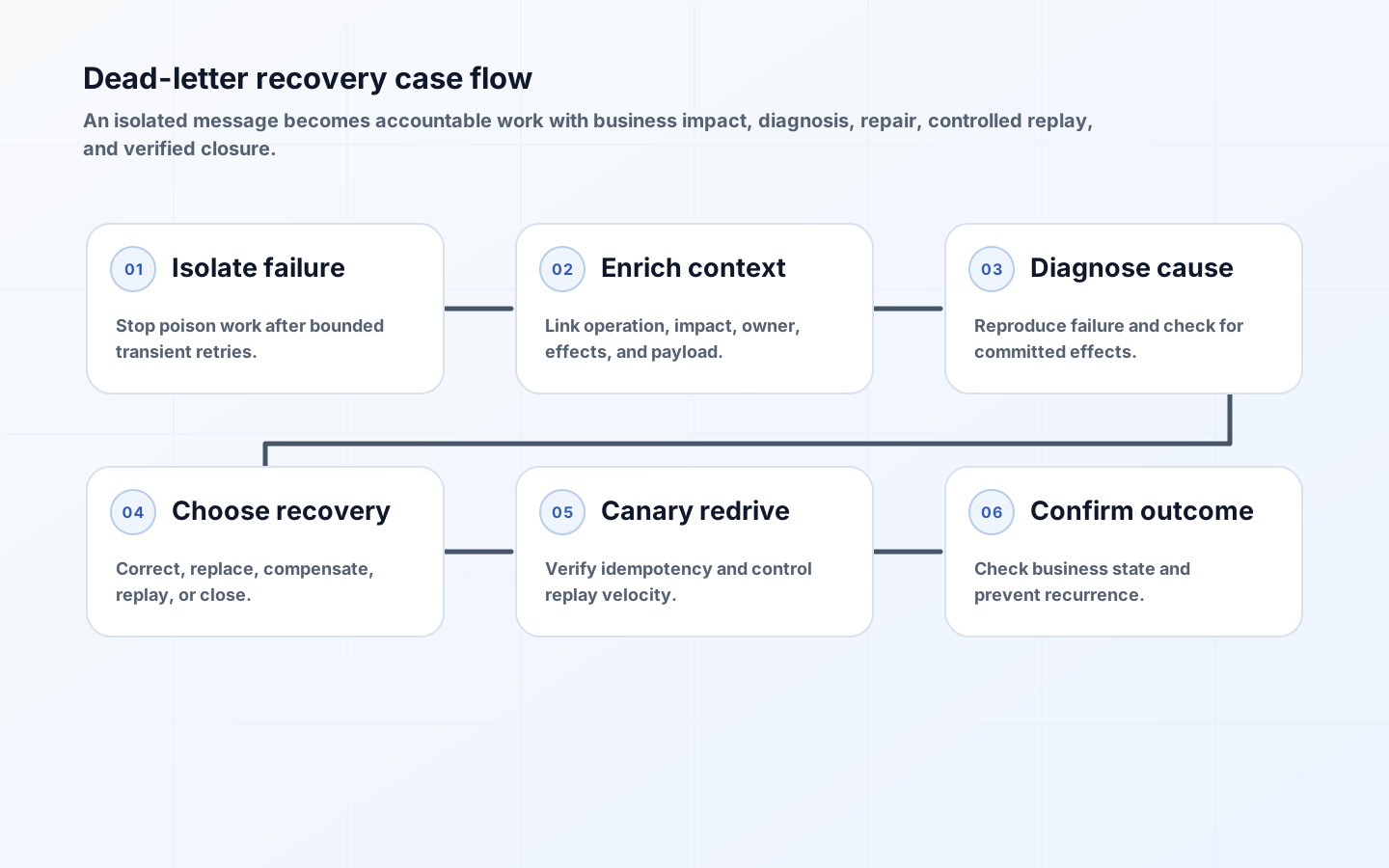
Dead-letter queue automation is the operating system for messages that normal processing could not complete. A broker can isolate undeliverable work, but it cannot determine whether a blocked invoice delays payment, whether a duplicate shipment would harm a customer, or whether a replay is safe after data changed. That judgment requires business identity, impact, ownership, repair, and evidence alongside technical payloads.
Treat every dead-lettered message as a recovery case rather than an anonymous queue entry. The case links the original message and delivery history to the affected business operation, classifies why processing stopped, assigns an accountable owner, and records whether the outcome was replay, replacement, compensation, manual completion, or accepted loss. The queue stores work; the recovery process restores the business obligation.
Separate transient retry from dead-letter triage
Retry transient failures only while there is a reasonable chance that another attempt will succeed without intervention. Use bounded exponential backoff with jitter, a maximum age, and a delivery-attempt limit appropriate to the dependency. Validation failures, incompatible schemas, missing mandatory records, revoked authority, and deterministic code defects will not improve through rapid repetition. Moving them aside protects healthy traffic and gives operators space to diagnose.
Choose the dead-letter threshold from processing time, dependency recovery, customer deadline, and cost, not a copied default. Google Pub/Sub supports retry policy separately from dead-letter forwarding, while Azure Service Bus and Amazon SQS expose their own delivery and redrive controls. Product behavior differs, so record the effective configuration and test it. A DLQ is not successful handling if nobody monitors it or messages expire before investigation.
| Failure class | Retry automatically? | DLQ reason code | Typical recovery |
|---|---|---|---|
| Transient dependency | Yes, bounded by age and attempts | dependency-unavailable-after-retries | Replay after dependency health is proven |
| Invalid or missing data | No repeated hot retry | business-validation-failed | Correct source data or close with accountable disposition |
| Schema or contract mismatch | No until compatible consumer exists | unsupported-schema-version | Deploy adapter or transform into a replacement message |
| Authorization failure | Only after credential or policy repair | downstream-access-denied | Restore least privilege, then controlled replay |
| Consumer defect | No until fixed and tested | unhandled-processing-error | Deploy fix, canary representative cases, then batch replay |
Preserve a business-aware recovery envelope
The original message must remain immutable. Add recovery metadata beside it: stable message and operation IDs, correlation and causation IDs, tenant, entity type and ID, workflow step, schema version, source and destination, enqueue time, first and last failure, delivery count, exception class, dependency, trace link, and payload digest. Include data classification and retention labels so a convenient triage screen does not expose restricted content broadly.
Add business fields that the broker cannot infer: process owner, customer or financial impact category, promised completion time, recoverability, downstream effects already committed, and manual continuity route. Resolve these through a protected lookup when copying them into the envelope would leak data. Keep the raw technical exception, but map it to a stable operational reason code. Reason codes make trends actionable even when library messages change.
Create one recovery case per business obligation
A single operation may generate multiple dead-letter messages, and one bad reference record may poison thousands of operations. Avoid opening an unmanageable ticket for every delivery without correlation. Group only when the same verified root cause and repair applies, while retaining every message link. The case should show the affected population, oldest business deadline, total value or service impact where appropriate, current owner, next action, and closure criteria.
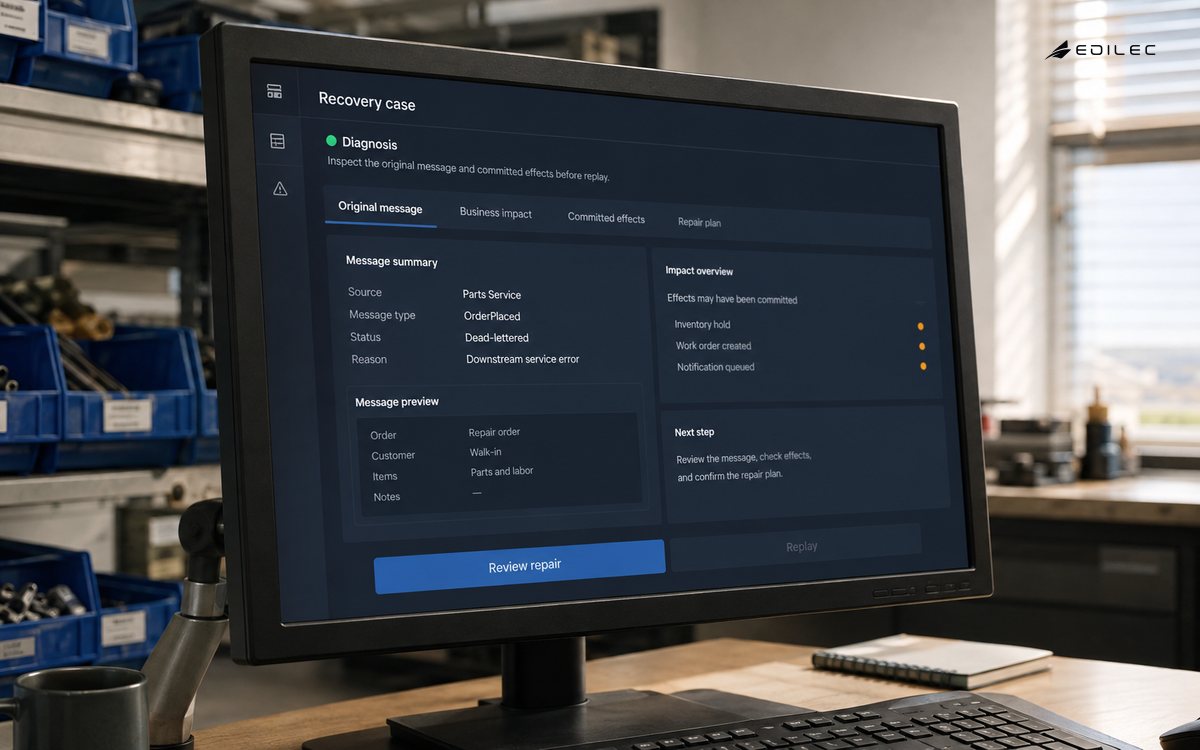
Set service objectives for acknowledgement, diagnosis, repair decision, and business restoration by impact tier. Queue depth alone can hide one critical case among many harmless telemetry messages. Prioritize using consequence and age, then protect against starvation by escalating old lower-priority work. Assign both a technical owner who can correct processing and a business owner who can authorize replay, compensation, or manual completion when effects are material.
| Recovery field | Why it matters | Source | Access caution |
|---|---|---|---|
| Business operation ID | Finds duplicate messages and existing effects | Producer contract or workflow | Not necessarily safe for customer display |
| Committed-effect ledger | Determines whether replay repeats side effects | Consumer and downstream receipts | Financial or personal data may require masking |
| Reason code | Groups root causes across changing exception text | Consumer mapping | Keep raw error restricted for diagnosis |
| Business deadline | Drives priority beyond enqueue age | Source process or SLA service | Use declared timezone and calendar |
| Replay authorization | Proves who accepted residual risk | Recovery workflow | Immutable audit record with scoped role |
Diagnose before modifying or replaying
Reproduce the failure with a sanitized copy in an isolated environment using the original schema, consumer version, and relevant reference-data snapshot. Determine whether the fault is payload-specific, population-wide, environmental, or caused by a consumer release. Check whether later processing already achieved the intended state. A message can appear failed while a downstream request succeeded and its acknowledgement was lost; that is an uncertain outcome, not permission to rerun.
Choose a repair that preserves provenance. Correct the source record when it is authoritative, deploy a backward-compatible consumer, restore a dependency, or create a new replacement message that references the original. Do not edit raw DLQ payloads invisibly. If transformation is required, record tool version, before and after digests, changed fields, reason, reviewer, and resulting message ID. Keep originals until the recovery and audit retention periods permit disposal.
Gate replay with idempotency and a canary
A replay checklist verifies that the root cause is corrected, the destination is healthy, schema is supported, business deadline still permits the action, credentials are valid, and the consumer is idempotent for the stable operation ID. Confirm whether any side effect already happened and whether current reference data changes the intended result. Some cases need a replacement or compensation rather than replay because executing the original command late would be wrong.
Start with representative canary messages and verify technical completion plus business state before increasing velocity. Amazon SQS documents configurable redrive velocity and warns that redriven messages can interweave with new traffic. Control rate to protect dependencies, monitor errors and latency, and pause automatically on regression. For ordered workloads, assess whether extracting a message broke sequence and whether later events make the original stale.
Apply least privilege and explicit retention
Separate permissions to inspect metadata, decrypt payloads, transform, start redrive, and close cases. Automation may replay low-risk cases after objective checks; financial, customer, privilege, or safety effects should require human authorization. Use destination allowlists and prevent an operator from redirecting a sensitive message to an arbitrary queue. Record reads and exports because a DLQ often accumulates payloads from many business contexts in one place.
Set DLQ and case retention from the longest of recovery, source-message, legal, and audit needs, then minimize payload exposure. Azure notes that Service Bus DLQ messages do not automatically disappear through normal time-to-live behavior, making active cleanup essential. Other brokers differ. Alert before expiration where retention can delete work, archive evidence when required, and delete resolved sensitive payloads on schedule while preserving non-sensitive decision metadata.
Measure business restoration, not only queue depth
Monitor arrivals by reason, source, consumer version, schema, dependency, and impact tier. Track oldest age, unowned cases, acknowledgement and diagnosis time, replay success, repeat dead-letter rate, closure outcome, and business restoration time. A successful broker redrive is incomplete until the expected order, ticket, ledger, notification, or device state is verified. Link recovery evidence to incident and problem records when the root cause is systemic.
Use trends to remove recurring causes. A spike after deployment may justify rollback. Chronic validation failures call for producer contract enforcement. Authorization failures may expose credential lifecycle gaps. Repeat timeouts can indicate insufficient backpressure or lock duration. Review closed cases with engineering and operations, assign preventive work, and verify that controls reduce recurrence. The best DLQ program steadily lowers avoidable arrivals without hiding or discarding failures.
Key takeaways
- Stop deterministic poison messages from consuming retry capacity, but configure and test broker-specific forwarding and retention behavior.
- Preserve the original payload and enrich a linked recovery case with business identity, impact, owner, deadline, and committed effects.
- Diagnose uncertain outcomes and retain transformation provenance before choosing replay, replacement, compensation, or manual completion.
- Canary and rate-limit redrive, require stable idempotency, and verify the business state after technical processing succeeds.
- Measure restoration and recurrence by reason, not merely depth or message movement.
Frequently asked questions
Should every failed message enter a DLQ? No. Transient failures deserve bounded retry, invalid work may be rejected immediately, and expired low-value telemetry may be intentionally dropped under policy. The design must still make each outcome observable and accountable.
Can operators edit a message and replay it? Prefer correcting the authoritative source or creating a traceable replacement. If transformation is unavoidable, preserve the original, record exact changes and digests, require appropriate review, and give the replacement a new message ID linked to the same business operation.
When is automatic redrive appropriate? Only when the cause and repair can be verified mechanically, the consumer is idempotent, late execution remains valid, downstream capacity is protected, and business policy permits it. Otherwise create a reviewed recovery decision.
Conclusion
A dead-letter queue becomes useful when it connects technical isolation to accountable business recovery. Immutable originals, enriched cases, reasoned repair, controlled replay, and outcome verification let teams restore obligations without repeating side effects. That operating model turns poison messages from hidden backlog into measurable reliability work.