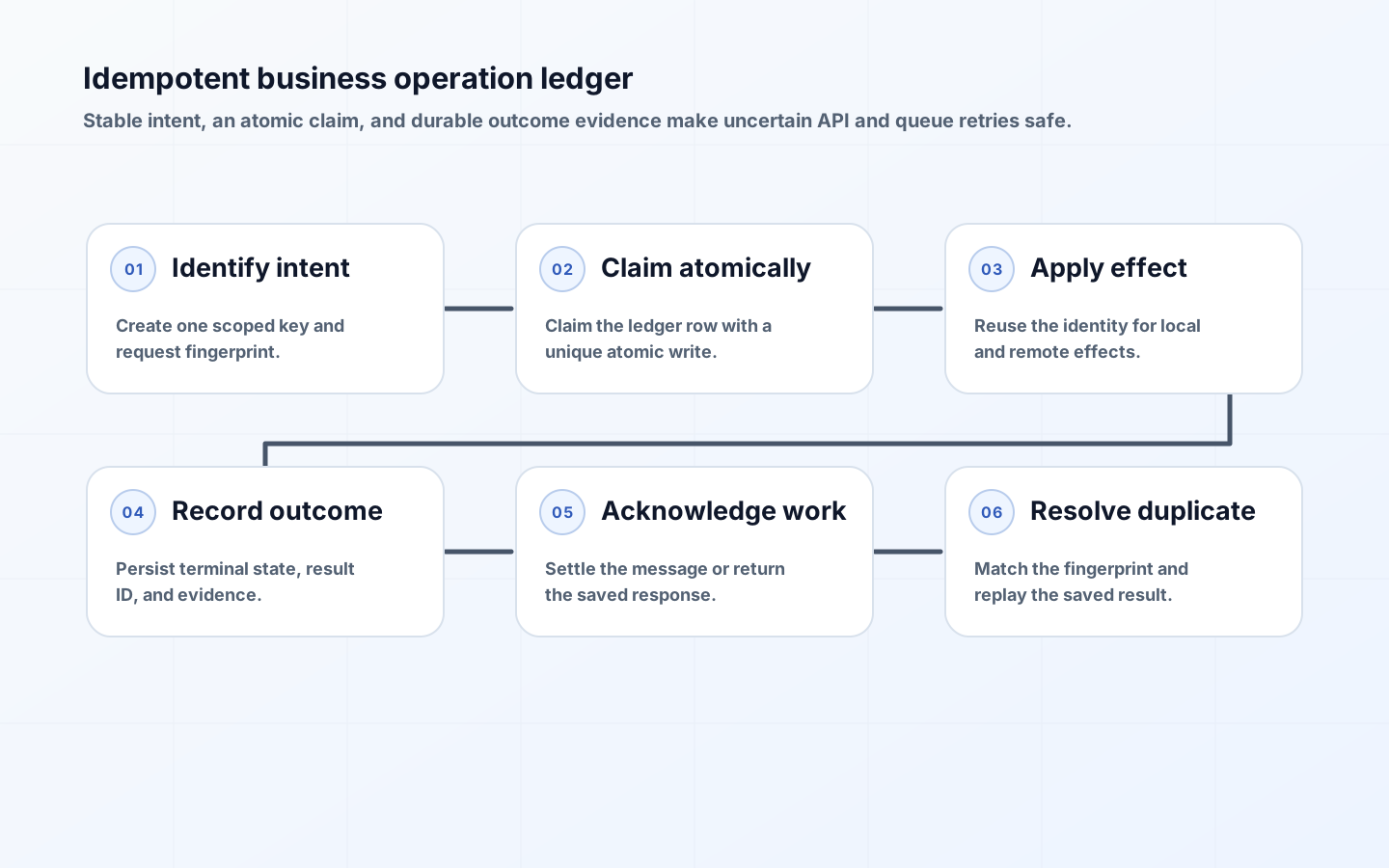
Idempotency in workflow automation means that repeating the same logical business operation does not create an additional effect after the first accepted execution. It is the difference between safely retrying an uncertain payment request and charging twice, between redelivering an event and opening a second case, or between resuming an approval workflow and applying the decision again.
Retries are unavoidable because a timeout cannot tell a caller whether the remote system committed an operation before the response was lost. Queues using at-least-once delivery can redeliver after a consumer crash or lock expiry. Idempotency makes that uncertainty manageable by combining stable operation identity, atomic state transitions, durable result evidence, and side effects that can be reconciled.
Define the business operation before generating a key
An idempotency key identifies one intended operation, not one network attempt. Derive its scope from the business command: create invoice for order 418 revision 2, reserve inventory for fulfillment 771, or apply approval decision 93. A random key generated anew for every retry defeats deduplication. A key reused for unrelated commands incorrectly merges work. Document who creates the key, its tenant and operation scope, and when a genuinely new intent receives a new key.
Store a request fingerprint with the key. On reuse, compare immutable parameters that define intent and reject a conflicting payload instead of returning an unrelated prior result. Stripe's API documentation illustrates this contract: requests with an idempotency key can be replayed, parameters are compared, and the saved result is returned for a matching repeat. Your retention and error semantics may differ, but callers need an equally explicit contract.
| Identity choice | Useful when | Failure mode | Better design |
|---|---|---|---|
| Fresh UUID per attempt | Never for retry identity | Every retry looks new and repeats the effect | Persist one generated UUID with the business command |
| Natural record ID only | One operation exists for the record's lifetime | Different revisions or actions collide | Combine tenant, command type, record, and revision |
| Message broker ID | Producer guarantees stable IDs across retries | Republishing may allocate a new ID | Carry an application operation ID in the envelope |
| Hash of full payload | Payload is canonical and contains no volatile fields | Timestamps or ordering create false differences | Hash a versioned canonical intent projection |
Use an atomic operation ledger
Create a durable record keyed by operation scope and idempotency key. It should include a request fingerprint, state, creation time, lease or owner, result reference, error classification, and expiry policy. The first worker atomically inserts or transitions the record from received to processing. Concurrent workers that lose the claim do not execute the effect; they wait, return an in-progress response, or read the completed result according to the API contract.
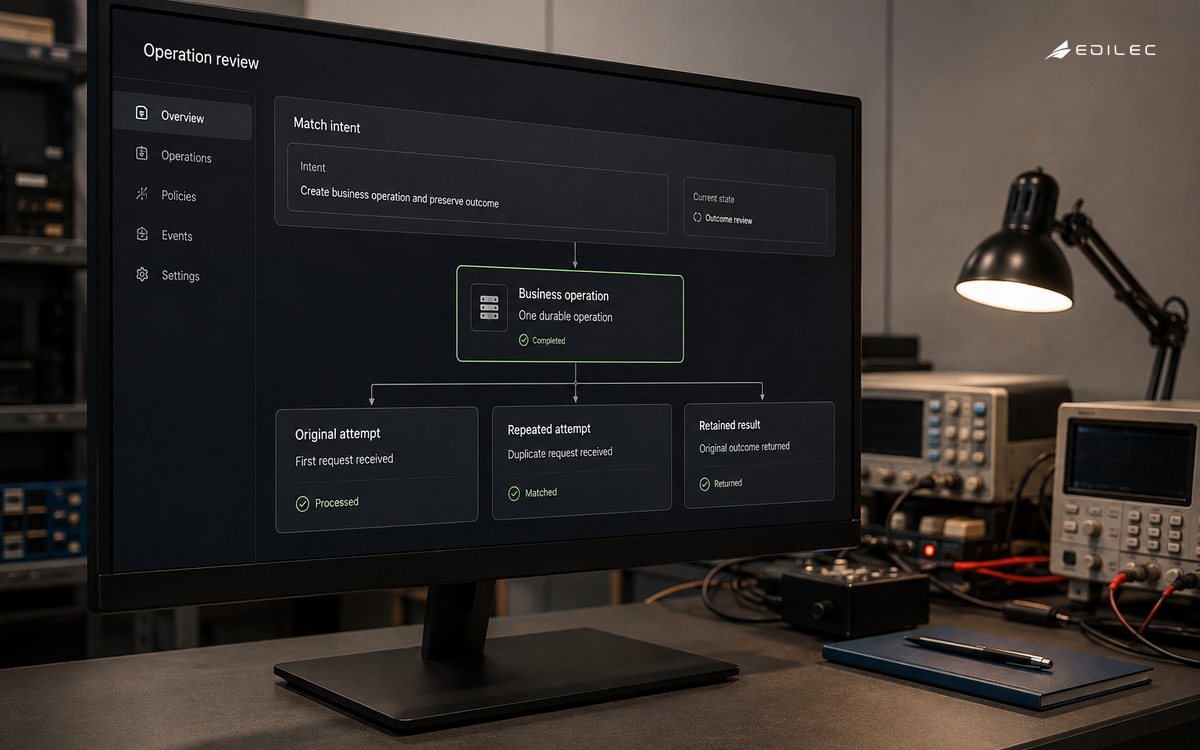
The claim must be atomic at the datastore boundary. A read followed by a separate insert permits two workers to observe absence and both proceed. Use a unique constraint, compare-and-set, conditional write, or transaction. Define recovery for a worker that claims and then dies: a lease may expire, but the next worker must inspect downstream evidence before rerunning an effect whose outcome is uncertain. A timeout is not proof of failure.
Return the original API outcome on replay
For synchronous commands, save enough of the accepted result to reproduce the response: status, stable resource identifier, business outcome, and a safe response body or reference. A duplicate request that matches a completed operation receives that result without executing again. If the first request is still processing, return a documented conflict, accepted status with operation location, or bounded wait. Do not launch a parallel execution simply because the caller became impatient.
Decide which failures are retained. Validation failures that occur before an operation is accepted may be safely corrected and retried using a new or unchanged key according to the contract. A failure after execution begins may need to be replayed exactly, because trying again could duplicate an external effect. Stripe documents that its API v1 saves a result after endpoint execution begins, including certain errors. The important general lesson is to make the boundary observable.
Make queue consumers idempotent after delivery
Broker deduplication is useful but insufficient. Azure Service Bus duplicate detection compares application-controlled message IDs within a configured time window, which protects send-side retries. The same documentation distinguishes this from consumer redelivery: a worker can complete its database change and crash before settling the message, causing another delivery. The consumer therefore needs its own durable record of the processed business operation.
Process under peek-lock or equivalent semantics: validate, atomically claim, apply the local change, record the result, then acknowledge. If local state and the operation ledger share a database, write them in one transaction. If publishing a follow-on event, add it to a transactional outbox in that transaction and let a relay publish it. This avoids the gap where state commits but the event is never emitted, while downstream consumers still deduplicate the outbox message.
| Failure point | What may be true | Retry behavior | Evidence to retain |
|---|---|---|---|
| Before atomic claim | No worker owns the operation | Another worker may claim safely | Request fingerprint and receipt time |
| After claim, before local commit | Lease exists but no durable effect | Recover expired claim after checking dependencies | Lease owner, attempt, checkpoints |
| After local commit, before acknowledgement | Effect exists and message may return | Read completed result and acknowledge | Business record ID and completion state |
| External call timed out | Remote effect may or may not exist | Query by remote idempotency key or reconcile | Remote request ID, key, timestamps, response if any |
| Outbox published, marker not updated | Event may have been delivered | Republish same event ID | Stable event ID and broker acknowledgement |
Design each side effect for repeatable reconciliation
Database upserts can often use a unique business key. Payments and vendor APIs should receive the same downstream idempotency key on every attempt. Email and SMS systems may lack deduplication, so record a send intent before dispatch and capture the provider message ID afterward; on an uncertain result, query the provider or route to manual reconciliation rather than send blindly. File generation can use deterministic paths and content versions. Human tasks should have one stable task ID and terminal decision state.
Idempotent does not mean every command can be repeated literally. Increment balance by ten is not naturally idempotent; apply ledger entry X for ten can be, because entry X has unique identity. Send current customer profile is safer than apply these three relative edits when replay order is uncertain. Reframe side effects as named facts or desired states where possible, and retain evidence sufficient to prove whether the state was reached.
Choose deduplication retention from retry reality
Keep keys longer than the maximum interval in which the same intent can legitimately return: client retries, broker retention and redelivery, offline device buffering, disaster recovery, manual replay, and delayed callbacks all matter. A short cache may protect a burst of HTTP retries yet fail when an operator replays a week-old message. For irreversible financial or entitlement actions, the business ledger may need permanent uniqueness even if response payloads expire earlier.
Separate compact identity evidence from bulky cached responses. Archive or delete response bodies under data-retention rules while preserving a key, fingerprint, terminal state, result identifier, and audit metadata. Never silently treat an expired key as a new operation when the natural business identity still indicates a duplicate. Return an explicit indeterminate or conflict outcome and reconcile. Document whether key scope includes tenant, account, endpoint, and API version to prevent cross-context collisions.
Handle concurrency and ordering as separate concerns
Idempotency suppresses repeated execution of one operation; it does not order different operations or prevent lost updates. Two unique commands can race against the same account. Use optimistic versions, per-entity serialization, message sessions, or domain invariants as appropriate. A stale address update should fail its expected-version check even though its key is unique. Conversely, a duplicate event can arrive after newer events and still needs to be recognized without rolling state backward.
AWS notes that Lambda event sources can process an event at least once and recommends idempotent handlers. Competing consumers improve throughput, but they increase the importance of atomic claims and per-entity coordination. Partition work by the business aggregate when strict order is necessary, and keep unrelated aggregates parallel. Do not turn the entire workflow into one global lock to solve a local sequencing requirement.
Test uncertainty and observe duplicate pressure
Write tests that interrupt execution at every boundary: before claim, after claim, after local commit, during external timeout, after outbox publish, and before acknowledgement. Run concurrent identical requests and conflicting payloads with the same key. Advance time beyond leases and retention. Replay old messages after newer state. The expected result is not merely one successful response; it is one business effect, a consistent terminal record, and explainable responses for all callers.
Measure first executions, duplicate hits, payload conflicts, in-progress collisions, recovered leases, uncertain external outcomes, and key-expiry conflicts by operation type. A rising duplicate rate can indicate client timeout, lock duration, acknowledgement, or network problems even when deduplication prevents harm. Alert on stuck processing records and reconciliation age. Logs should correlate workflow instance, business ID, idempotency key, message ID, downstream request ID, and result without exposing sensitive payloads.
Key takeaways
- Identify the intended business operation, persist one key across all attempts, and reject a changed payload under that key.
- Use an atomic unique claim and durable terminal result; a pre-check followed by a write still races.
- Combine broker duplicate detection with idempotent consumers because send retries and redelivery are different failure paths.
- Treat timeouts as unknown outcomes, preserve downstream evidence, and reconcile before repeating irreversible effects.
- Test crashes at every commit and acknowledgement boundary, then monitor duplicates as a reliability signal.
Frequently asked questions
Is a unique database constraint enough? It is enough only when the constrained row represents the complete business effect and can be written atomically with the result. It does not protect an external payment, email, or follow-on event unless those effects have their own idempotency or reconciliation design.
Can a message ID be the idempotency key? Yes, when producers preserve it across retries and it represents one business command. If republishing creates a new message ID, carry a separate operation ID. Include tenant and command scope when IDs are not globally unique.
How long should keys live? Longer than every automated and manual replay path. For irreversible actions, retain permanent business uniqueness or a durable ledger entry, even when operational caches and full responses have shorter retention.
Conclusion
Reliable retries come from a business protocol, not a retry library. Give intent a stable identity, claim it atomically, preserve the accepted outcome, propagate identity to side effects, and make uncertainty visible. With that design, APIs and queues may deliver an operation more than once while the enterprise still performs it once and can prove what happened.