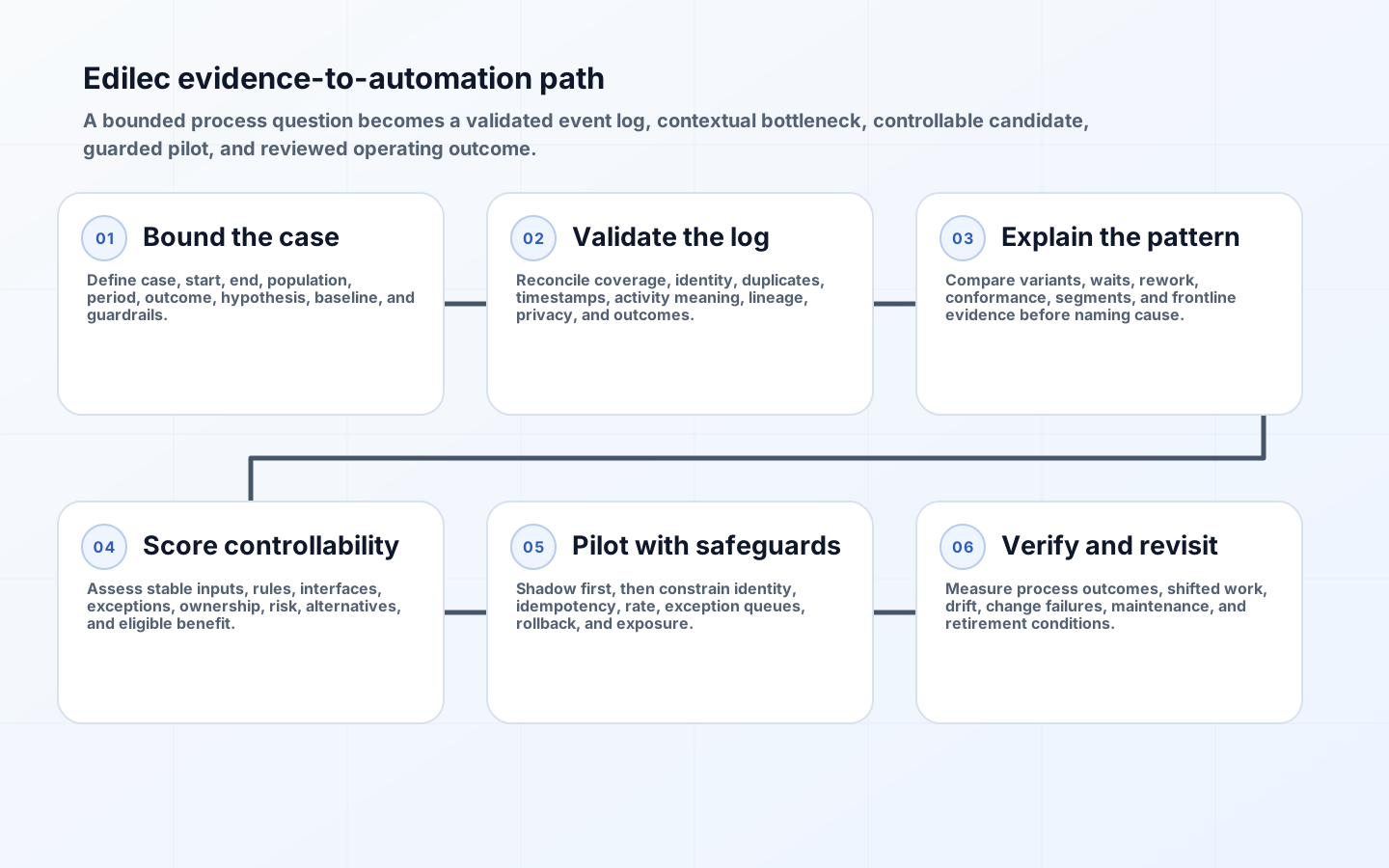
Process mining for automation uses event data from operational systems to reconstruct how cases actually move, quantify variants, identify waiting and rework, and test conformance. It can replace anecdotal candidate lists with evidence. It cannot prove that a bot is the right intervention. A delay may come from policy, missing data, batch schedules, customer response, capacity, or an upstream defect that automation would merely reach faster.
A sound discovery program moves from question to trustworthy log, then from pattern to root cause, controlled candidate, pilot, and verified outcome. Keep business owners, system owners, risk, privacy, and frontline workers involved. The aim is not to maximize automated steps; it is to improve an end-to-end customer or operational result without hiding exceptions or transferring work elsewhere.
Frame a bounded process and automation question
Name the case and its start and end. Examples are one purchase order from request to approval, one invoice from receipt to posting, or one service ticket from opening to resolution. Define the customer outcome, current pain, period, systems, populations, and suspected controllable causes. Avoid scopes such as finance process; they combine unrelated case notions and produce attractive but meaningless maps.
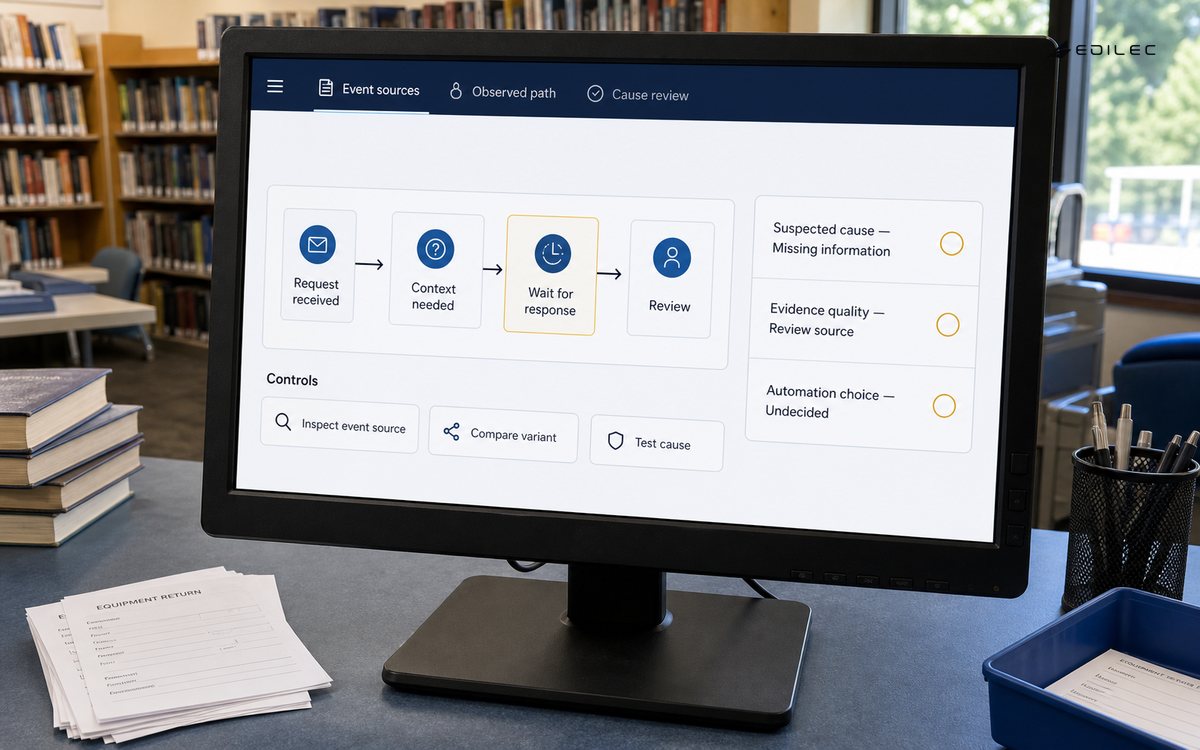
Write hypotheses before exploring: manual re-entry may cause rework, a threshold may create approval delay, a batch interface may add overnight waiting, or missing master data may drive exceptions. Define baseline measures and guardrails: end-to-end elapsed time, active work time, rework, first-pass success, late cases, manual touches, exception rate, quality, control breaches, customer contacts, and work shifted to another team.
| Question | Event evidence | Additional evidence | Decision risk |
|---|---|---|---|
| Where is time spent? | Event order and timestamps by case | Calendars, queues, staffing, service schedules | Timestamp gap is mistaken for active work |
| Which variants dominate? | Trace frequency and outcome by variant | Case mix and policy segment | Rare high-risk work is hidden |
| Where does rework occur? | Repeated activities and loops | Reason codes, defect samples, interviews | Legitimate correction is labeled waste |
| What violates the model? | Conformance deviations | Current policy and approved exceptions | Outdated model is treated as truth |
| Can automation control it? | Stable input and repeated transition | API, UI, rules, ownership, failure modes | Bot accelerates an upstream defect |
Build a trustworthy event log and record its limits
At minimum, each event needs a case identifier, activity, and timestamp with defined timezone and lifecycle semantics. SAP's process data guidance describes an event log as cases containing sequences of events, each tied to a case, activity, and timestamp. Add resource, system, channel, outcome, and selected case attributes only when necessary and lawful.
The XES standard provides an extensible event-log structure with logs, traces, events, classifiers, and extensions; use the XES standard resources when interchange or tool portability matters. Define extraction from immutable audit or transaction records where possible. Normalize activity meaning across systems, preserve source event identity, order equal timestamps deterministically, and document whether time means start, completion, or logging.
Validate log completeness, identity, and selection bias
Reconcile case counts and control totals against source systems for the same filters and period. Sample cases end to end with process workers. Check missing case IDs, orphan events, duplicated source IDs, impossible order, timestamps outside the case, timezone conversion, activity-name drift, and cases cut off at period boundaries. Build separate flags for incomplete traces rather than silently dropping them. Record extraction version and lineage so results can be reproduced.
Logs show recorded system events, not every phone call, spreadsheet, thought, queue, or workaround. Automation candidates often sit exactly in those blind spots. Compare discovered paths with interviews and task observation without treating either as perfect. Access controls and retention should reflect potentially sensitive employee and customer attributes. Pseudonymize where analysis does not need identity and prohibit using individual throughput maps as an automatic performance verdict.
| Gate | Test | Acceptance evidence | Failure action |
|---|---|---|---|
| Case coverage | Compare included cases with source population | Explained inclusion and exclusion by segment | Fix filter or qualify conclusion |
| Event uniqueness | Check source ID and semantic duplicates | Stable deduplication rule | Repair pipeline and rerun |
| Temporal validity | Check order, timezone, lifecycle, period edges | Documented timestamp semantics | Separate uncertain events |
| Activity meaning | Map raw codes to governed vocabulary | Owner-approved mapping with version | Split ambiguous activity |
| Outcome integrity | Reconcile completion and exception totals | Control totals match within explained difference | Do not score candidates |
Analyze variants, waits, rework, and conformance
Start with frequency and outcome, not a fully expanded process graph. Compare the dominant happy path, frequent slower variants, rare high-consequence variants, and segment-specific paths. Decompose elapsed time between queue, calendar, service, and active work where evidence permits. A long edge indicates elapsed gap, not automatically a bottleneck owned by either adjacent activity. Validate causes with queue and worker evidence.
Use conformance checking against a current approved model to identify skipped controls, unexpected order, or repeated work. Treat deviations as questions: the model may be obsolete, the event mapping wrong, the exception legitimate, or execution noncompliant. Microsoft's process mining overview describes extracting system-of-record events to visualize actual processes, compare them, investigate inefficiency, and monitor KPIs. Tool visualizations do not replace causal investigation.
Score candidates for controllability, stability, and benefit
A strong candidate has high enough frequency, stable digital inputs, deterministic or governable rules, a supported interface, bounded exceptions, clear ownership, measurable outcome, and safe rollback. Penalize volatile UI targets, inaccessible source data, judgment-heavy work, many unrecorded exceptions, fragile credentials, high consequence of duplicate effects, and processes already scheduled for replacement. Compare API integration, workflow redesign, rule service, product fix, staffing, policy change, and RPA rather than assuming a bot.
Estimate benefit from eligible cases, not total process volume. For each candidate, calculate current active work and elapsed delay attributable to the target step, expected straight-through share, residual review, exception handling, bot supervision, license and infrastructure, maintenance, change failure, and displaced work. Include control value and error reduction where evidence supports them, but do not convert every qualitative benefit into a fabricated currency amount.
Pilot with process-level outcome and guardrail evidence
Run in shadow mode first where possible: produce the proposed action, compare it with actual results, and classify differences. Then pilot a stable cohort with idempotent effects, rate and concurrency limits, explicit credentials, exception queue, human stop control, and rollback. Keep the original event definitions so pre- and post-change logs remain comparable. Record automation version and intervention exposure on each eligible case.
Compare pilot and control or matched baseline on end-to-end outcome, not only bot execution success. Watch cycle time, active labor, first-pass yield, duplicate actions, exception aging, customer contacts, compliance, queue movement, and downstream rework. A bot can show 99 percent technical success while increasing unresolved exceptions if the remaining cases are harder and under-owned. Decide scale, redesign, or stop against criteria agreed before the pilot.
Operate continuous review after automation
Refresh the log and candidate evidence on a controlled cadence. Monitor activity and variant drift, input completeness, bot exception reasons, source UI or API changes, policy versions, queue depth, credentials, and outcome guardrails. Retire automation when the underlying system gains a native capability, the process is redesigned, or maintenance exceeds benefit. Keep manual contingency documented and tested; an unattended automation is still a production service.
Establish governance for who may access logs, approve mappings, interpret worker-level data, select candidates, accept control changes, and declare benefit. Publish an evidence pack containing scope, extraction lineage, quality tests, maps and filters, causal findings, alternatives considered, risk assessment, pilot design, outcomes, and limitations. That record prevents a visually compelling process map from becoming an unreviewed capital decision.
Model change failure and exception ownership
Automation changes the event log it is meant to improve. A bot may collapse several activities into one technical event, execute at machine speed, retry silently, or create a separate exception queue. Update the event model before launch so automation identity, attempt, outcome, handoff, and human resolution remain visible. Preserve semantic continuity with the baseline or document where measures cannot be compared.
Assign every exception class to an operating team with response time, allowed action, escalation, and feedback path to product or policy owners. Count cases that leave the bot path and their aging, not only successful bot runs. Simulate expired credentials, changed screens, duplicate messages, downstream timeout, partial completion, malformed input, and emergency stop. Recovery must reconcile authoritative business state before retrying; replaying UI steps blindly can duplicate orders, postings, or customer communication.
Key takeaways
- Define one case, outcome, period, and controllable hypothesis before extracting events.
- Reconcile event-log completeness, uniqueness, time semantics, mappings, and outcomes before trusting a map.
- Interpret long waits and deviations with contextual evidence; a recorded sequence does not prove root cause.
- Compare bots with API, workflow, product, policy, and operating-model alternatives.
- Pilot against end-to-end outcomes and guardrails, then monitor drift and retirement conditions continuously.
FAQ
How is process mining different from task mining?
Process mining reconstructs case flows from system event logs across an end-to-end process. Task mining observes detailed desktop interactions for selected work. Task mining can fill manual-step gaps but creates additional privacy, consent, and representativeness obligations.
Does the slowest path identify the best automation target?
No. Elapsed time may be intentional waiting or externally controlled. Investigate active work, queues, policy, arrival patterns, missing inputs, and outcome impact. Automate only when the intervention can control the cause and preserve required checks.
How much event history is needed?
Use enough to capture representative volume, seasonality, policy periods, and rare material exceptions without mixing obsolete process designs. State the window and exclusions, then test conclusions on a later holdout period before investment.
Conclusion
Process mining improves automation discovery when it is treated as an evidence method rather than a bot finder. A bounded case, validated event log, contextual variant analysis, controllability score, alternative comparison, and outcome-based pilot reveal whether automation removes a real constraint or simply mechanizes symptoms. That distinction is where durable value begins.