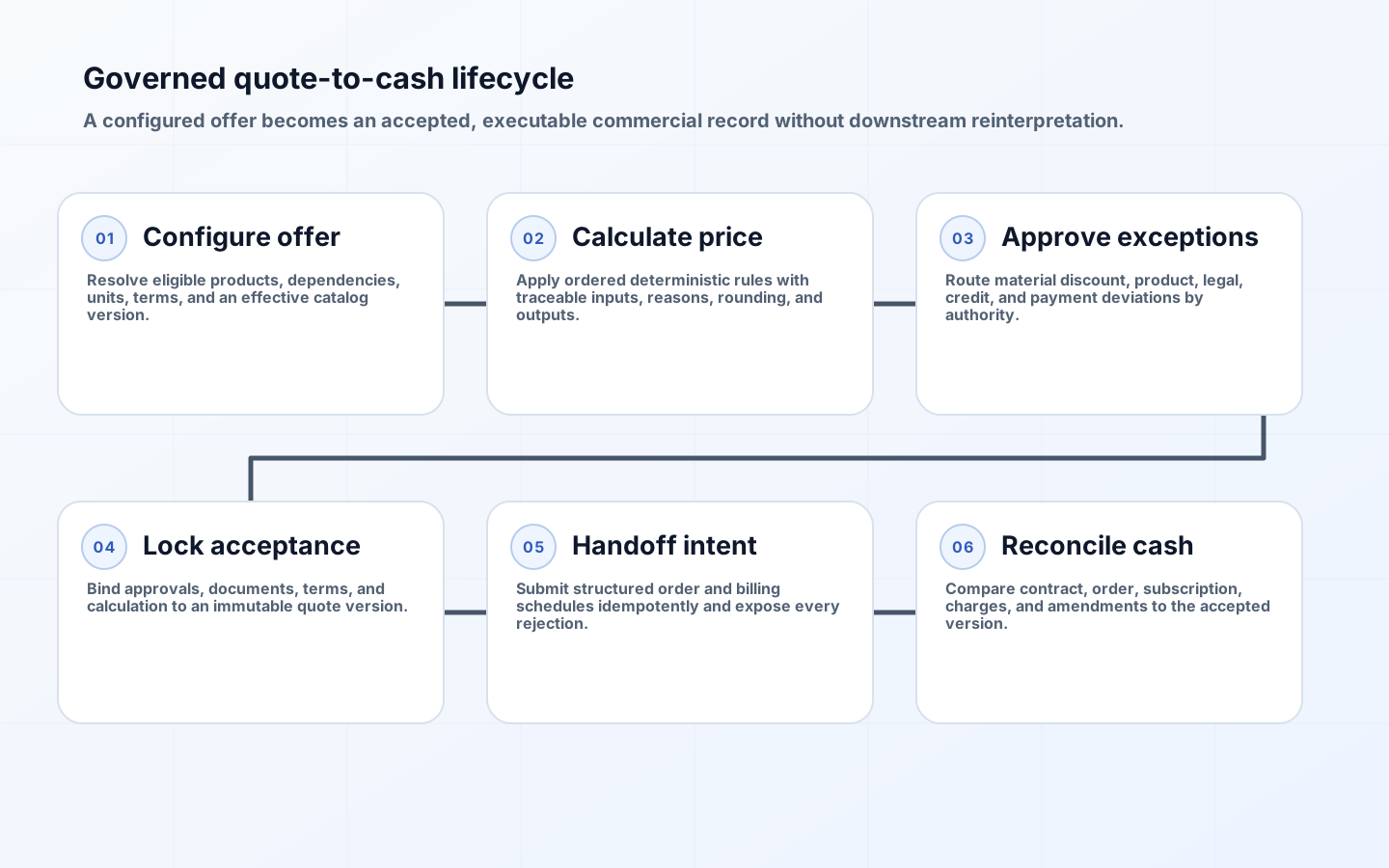
CPQ architecture turns a commercial proposal into a controlled transaction. It must configure a valid offer, calculate an explainable price, obtain approvals, preserve the accepted terms, and hand those terms to contract, order, fulfillment, billing, and revenue systems without reinterpretation. Complex B2B pricing combines subscriptions, usage, services, channel discounts, currencies, ramps, amendments, and exceptions, so a single CRM screen or spreadsheet is not a dependable source of truth.
The central design task is assigning authority. Product catalog owns what can be sold; pricing policy owns base rates and discount constraints; CPQ owns the quote configuration and calculation snapshot; approval owns exception consent; contract owns accepted obligations; ERP owns executable orders; billing owns charges and invoices; revenue systems own accounting treatment. Integrations carry immutable commercial intent across those boundaries and reconcile any rejection.
Map quote-to-cash authority before rules
Define every commercial object and state: product, bundle, option, price list, pricing rule, quote, quote version, approval, contract, order, subscription, entitlement, usage, invoice, and amendment. Name who may create and change each one. A CPQ implementation becomes fragile when CRM account data, ERP item masters, billing prices, and contract clauses are copied without ownership or synchronization policy.
Draw the forward and amendment flows. New sale, renewal, uplift, co-term, cancellation, expansion, return, and correction often need different calculations and effective dates. Decide which system calculates each downstream amount and whether it receives a final amount or recomputes from inputs. Recalculation after customer acceptance can create disputes; preserve the calculation version and accepted snapshot.
| Object | Authoritative owner | CPQ use | Handoff obligation |
|---|---|---|---|
| Product and compatibility | Product catalog or ERP/PIM by policy | Configure valid offer | Stable IDs, effective dates, and rules |
| Price book and discount policy | Pricing service or governed CPQ | Calculate commercial amount | Version, currency, unit, and eligibility |
| Quote version | CPQ | Negotiated proposal and calculation | Immutable accepted snapshot |
| Contract | Contract lifecycle system | Reference accepted terms | Link deviations and effective obligations |
| Order and billing schedule | ERP and billing | Consume approved commercial intent | Reject visibly; never reinterpret silently |
Model products independently from prices
Separate what is sold from how it is charged. A product or service has identity, eligibility, dependencies, units, tax classification, fulfillment, and entitlement. A price has currency, amount or formula, billing interval, tiers, effective dates, channel, and customer applicability. Stripe documentation similarly separates Products from Prices and treats several price attributes as effectively immutable, recommending a new price for a changed amount. That pattern preserves historical transactions.
Version bundles and compatibility rules. A quote should resolve against a catalog version effective for its commercial date, not whatever happens to be current at opening. Define how withdrawn products, grandfathered prices, migration offers, and region-specific options behave. Keep configuration constraints explainable to sellers: required option, incompatible combination, capacity limit, or eligibility rule. Avoid embedding product logic in UI visibility alone.
Build a deterministic pricing pipeline
Order the calculation stages explicitly: quantity and unit normalization, base price selection, attribute adjustment, tiers, term adjustment, bundles, promotions, discretionary discount, contractual override, currency, tax basis, rounding, and totals. Define whether discounts compound or add, and at which level rounding occurs. Stripe notes that line-level rounding behavior affects invoice totals; CPQ must align with the billing engine or provide final minor-unit amounts and accepted calculation details.
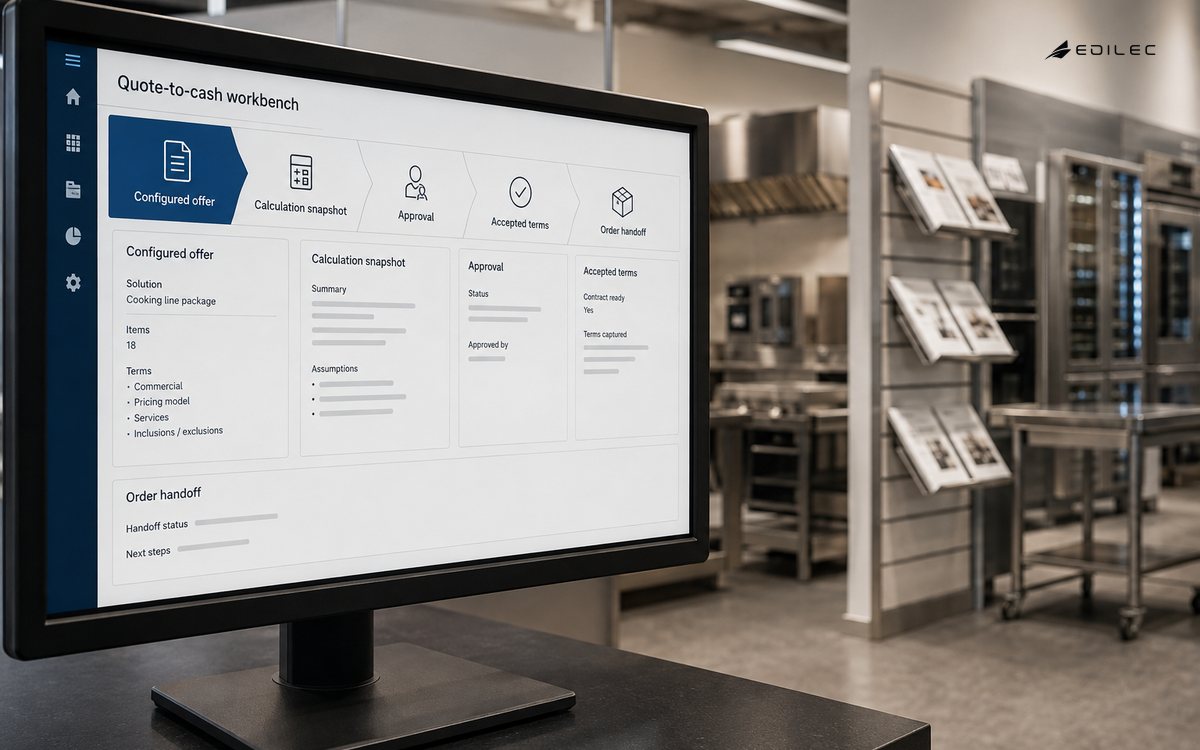
Store rule version, inputs, intermediate values, outputs, and reason codes. A price total without a calculation trace is hard to approve or dispute. Use pure deterministic functions where possible and test boundary quantities, overlapping rules, date edges, currency precision, null attributes, and negative adjustments. Separate recommendation from authority: an optimization model may suggest discount, while policy and approvers decide the offer.
Represent subscriptions, usage, and services explicitly
Model recurring interval, term, ramp phases, minimum commitment, included units, overage, tier method, measurement source, aggregation window, true-up, and cancellation. Stripe documents flat-rate, package, graduated, volume, and usage-based models; these labels are not interchangeable. A quote must communicate which units receive which rate and how future usage becomes a charge. Preview representative usage scenarios for the customer and approver.
Professional services need milestones, rates, expenses, assumptions, acceptance, and change control. Bundling subscription and services into one net number can hide delivery and revenue obligations. Preserve line-level allocation and contract references. For multi-year ramps, create effective-dated phases rather than an average rate that billing cannot execute. Validate that billing and revenue systems support the quoted model before sellers can select it.
Route approvals from policy exceptions
Generate approval requirements from material facts: discount below floor, nonstandard term, margin, liability, data residency, payment schedule, product exception, channel conflict, or manual price. Route to the decision owner with the quote delta, reason, financial impact, precedent, and requested expiry. Approval should authorize a specific immutable quote version. Any material edit invalidates affected approvals and recomputes the route.
Use thresholds and parallel routing to reduce delay, but preserve segregation of duties. A salesperson should not approve their own exceptional discount. Provide delegation and absence rules with audit. Measure cycle time by exception type and approver, then improve policy or product gaps that repeatedly cause overrides. Faster rubber-stamping is not a successful approval architecture.
| Exception | Decision evidence | Approver | Automatic invalidation |
|---|---|---|---|
| Discount below floor | List, net, margin, term, precedent | Sales and finance by threshold | Price, quantity, term, or cost change |
| Nonstandard contract term | Clause delta and risk owner analysis | Legal and business owner | Clause or affected product change |
| Usage commitment | Forecast, minimum, overage, downside | Finance or commercial operations | Metric, tier, or commitment change |
| Product exception | Compatibility, fulfillment, support impact | Product and delivery owner | Configuration change |
| Payment schedule | Cash flow, credit, milestones | Finance or credit authority | Customer, amount, or schedule change |
Version quotes and accepted terms immutably
Each negotiation revision needs stable identity, parent version, catalog and rule versions, inputs, output, approvals, documents, and status. Lock the accepted version. Create amendments as new commercial transactions referencing the contract and prior state. Do not edit an accepted quote in place to fix a downstream mapping; issue a controlled correction and preserve what the customer accepted.
Generate documents from structured fields and approved clauses, then verify the rendered output matches the calculation. A PDF alone is insufficient for downstream automation, while structured data alone may omit negotiated language. Bind both to the same quote version with a hash or immutable reference. Handle expiration explicitly: repricing may be required when rates, exchange assumptions, or availability change.
Create an idempotent downstream handoff
On acceptance, emit or submit a versioned order intent with quote ID, accepted version, customer and legal entity, product IDs, quantities, units, prices, discounts, tax basis, terms, schedules, and references. Use an idempotency key so retries cannot create duplicate orders or subscriptions. The receiving system validates capability and returns stable identifiers. Unknown outcomes trigger status lookup before repeat submission.
Never silently drop or substitute a line that ERP or billing rejects. Put the quote into an exception state, identify the incompatible field, and route it to the owning team. Reconcile accepted quotes to contracts, orders, subscriptions, billing schedules, and first invoices. Compare amounts, currency, dates, quantities, and terms, not merely record counts.
Design amendments and renewals from current state
An amendment must start from contracted and fulfilled reality, not a stale original quote. Retrieve active products, quantities, entitlements, billing phases, usage commitments, and prior discounts. Define co-term, proration, credit, and effective-date behavior with billing. Preserve the distinction between correcting an error and changing the commercial agreement because approvals and accounting may differ.
Renewal generation should not freeze assumptions months in advance without refresh. Re-evaluate eligibility, uplift, usage, support tier, and customer status at controlled checkpoints. Keep negotiated grandfathering explicit. If a product or price is archived for new sales, existing subscriptions may continue; downstream systems and CPQ need a shared lifecycle rule rather than treating archive as deletion.
Operate CPQ as a governed decision service
Monitor configuration failures, pricing latency, rule errors, approval backlog, manual overrides, document mismatch, handoff rejects, duplicate attempts, amendment failures, and quote-to-first-invoice variance. Correlate by quote version. Protect sensitive margins and discount authority with field-level access and audit. Separate configuration author, tester, approver, and production deployer for material pricing rules.
Release catalog and pricing changes through effective-dated packages with automated regression scenarios. Include representative customers, channels, currencies, boundaries, and amendments. Compare old and new results and require expected-difference approval. Salesforce Well-Architected emphasizes trusted, easy, and adaptable solutions; for CPQ, that means controlled commercial truth, usable seller guidance, and changeable rules without corrupting accepted deals.
Key takeaways
- Assign authority for catalog, pricing, quote, approval, contract, order, billing, and revenue objects.
- Separate product identity from effective-dated price records.
- Make pricing deterministic, traceable, and aligned with billing rounding and units.
- Bind approvals to immutable quote versions and invalidate them on material edits.
- Handoff structured commercial intent idempotently and expose rejections.
- Reconcile accepted terms through the first invoice and every amendment path.
Frequently asked questions
Should CPQ live entirely inside CRM?
The seller experience may live there, but catalog, pricing, contract, order, billing, and accounting authority can remain separate. Choose boundaries from ownership, transaction needs, and lifecycle rather than screen location.
Should a quote reprice every time it opens?
Drafts may refresh under policy, but accepted and approval-bound versions must preserve their calculation. Expired quotes can require an explicit reprice that creates a new version and invalidates affected approvals.
Can billing be the only pricing engine?
It can own executable charge calculation if CPQ can obtain a deterministic preview and preserve the accepted inputs and result. Sellers, customers, approvers, and billing must see the same commercial outcome.
Conclusion
CPQ succeeds when a complex deal remains one controlled commercial truth from configuration through cash. Clear authority, effective-dated catalog and prices, traceable calculations, exception-based approvals, immutable versions, idempotent handoff, and downstream reconciliation prevent spreadsheets and silent reinterpretation from governing revenue. The architecture should make valid deals easy and unusual deals explicit.