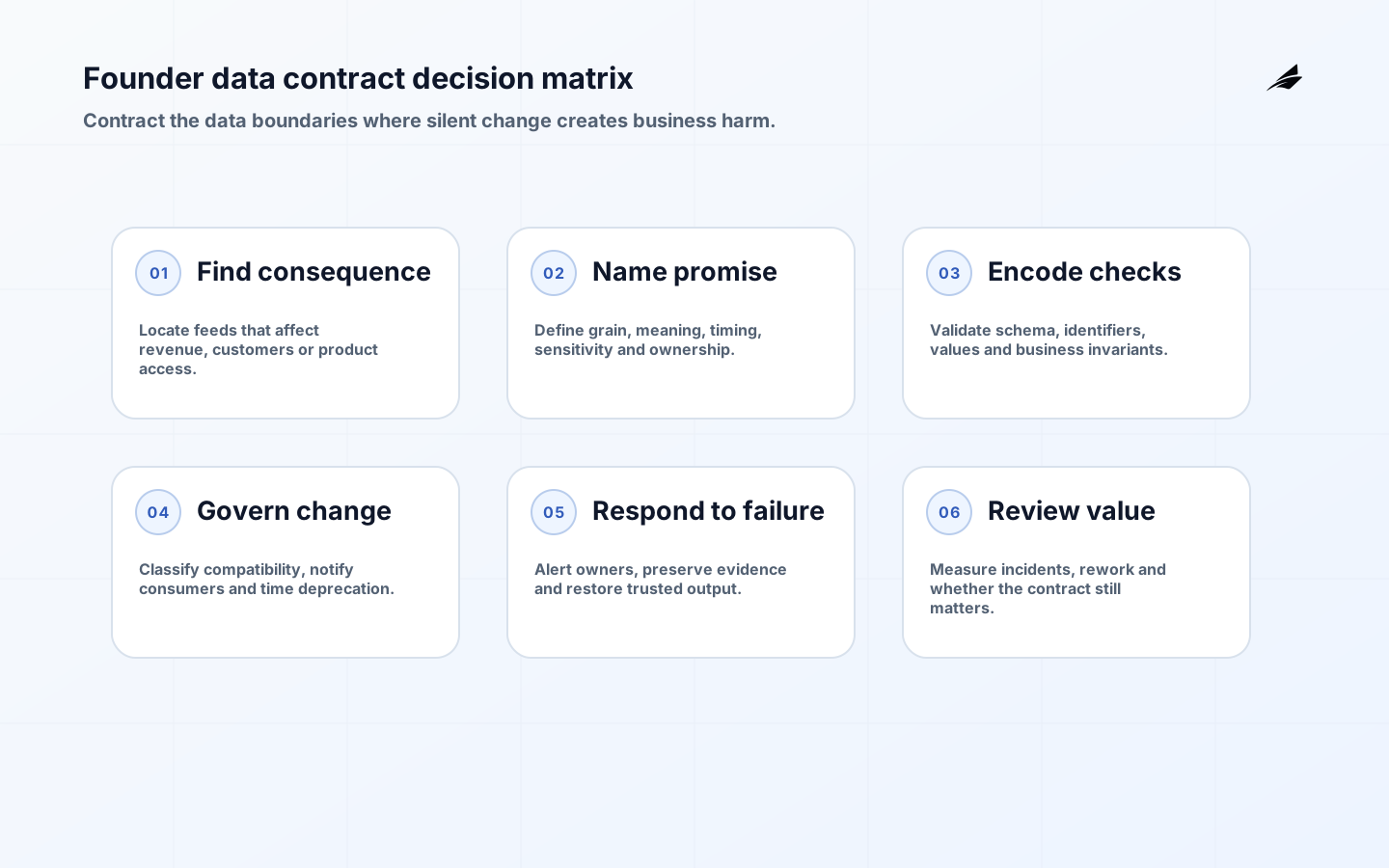
Data contracts for startups are explicit promises between a data producer and the people or systems that rely on its output. A useful contract says what a record or event means, which identifiers remain stable, which values are allowed, when it arrives, how sensitive fields may be used, who owns failures and how change is introduced. Founders should care when a quiet change can alter billing, customer communication, fulfillment, reporting, eligibility or a product feature. The goal is not paperwork across every table. It is fewer expensive surprises at the boundaries where one team or system makes a promise another depends on.
Start with business consequence. The data quality engineering guide helps quantify the cost of bad records, while the ELT workflow guide and lineage architecture guide cover adjacent implementation. A founder can sponsor the practice without reviewing schemas: choose the risky boundary, appoint producer and consumer owners, require a versioned promise and make incompatible change a deliberate business decision.
Recognize when a contract is worth the effort
Use a contract where a producer can change independently and a consumer takes consequential action. Subscription status flowing from billing to finance, product access and lifecycle email is a strong candidate. A scratch analysis used once by its author is not. Signals include recurring broken dashboards, duplicated metric logic, unexplained revenue differences, product events changed without notice, downstream teams afraid to deploy and incidents whose root cause is disputed ownership.
Prioritize by consequence, frequency of change, number of consumers, difficulty of detection and recovery cost. Do not contract the entire warehouse first. Select one exchange and state the consumer decision it protects. If the team cannot name that decision, more documentation will not create value. Some problems need a source-process fix, not a contract; a form that permits impossible dates should be corrected at capture.
Understand the minimum viable data contract
Name the dataset, API response, file or event and give it a stable identity and version. Define grain: what one row or event represents. List fields, types, required status, allowed values, units, time zone, identifier rules and sensitive classification. Add freshness or delivery expectation, completeness or reconciliation checks, retention, producer, consumers, support route, change notice, compatibility policy and deprecation window. Include examples and known limitations.

Machine-readable structure is valuable because delivery can enforce it. The JSON Schema specification defines a vocabulary for JSON structure and validation. dbt model contracts can enforce declared model columns and data types during builds. Neither captures business meaning automatically. A field can be a valid integer while representing the wrong currency, population or lifecycle state. Keep semantic rules and examples beside structural checks.
| Contract element | Founder-level question | Example promise | Evidence |
|---|---|---|---|
| Purpose | Which decision or action depends on it? | Controls product access after payment | Named consumer and workflow |
| Grain | What does one record represent? | One subscription state transition | Examples and uniqueness check |
| Meaning | Can two teams interpret it differently? | Amount is minor units in invoice currency | Definition and unit test |
| Delivery | When is late materially harmful? | Event available within five minutes | Timestamp and delay monitor |
| Change | What can evolve without coordinated work? | Optional field may be added | Compatibility test and notice |
| Ownership | Who restores trust after failure? | Billing producer owns correction | Alert route and response record |
Make change compatibility a product decision
Classify changes as compatible, conditionally compatible or breaking for the chosen format and consumers. Adding an optional field may be safe, while renaming a required field or changing meaning is usually breaking. Format rules matter: the Protocol Buffers guide warns against changing or reusing field numbers and explains wire-safe and unsafe evolution. For events, CloudEvents supplies a common envelope that improves consistency, but the business payload still needs its own ownership and evolution rules.
Require a proposal for breaking change: reason, affected consumers, migration path, parallel period, test evidence, owner and retirement date. Consumers should declare versions they use, and producers should publish deprecation rather than support every version forever. Emergency fixes still need a record. A deadline creates healthy pressure; an indefinite compatibility promise creates hidden operating cost.
Create a lightweight operating model
Keep contracts in version control near producer code or in a searchable registry linked to it. Run schema, freshness, uniqueness and business-rule checks in delivery or ingestion. Route failures to the producer and affected consumers with severity based on consequence. Quarantine or mark invalid records rather than silently dropping them. Preserve samples and lineage needed to diagnose the problem without overexposing sensitive data.
Assign one producer owner and at least one consumer representative. They review material changes and incident learning. The founder or executive sponsor resolves priority when a source fix competes with feature work. Track contract coverage for critical exchanges, breaking changes caught before release, incidents, time to restore, stale exceptions and consumer adoption. Do not reward the number of contracts; a small portfolio protecting important flows is better than broad ceremonial coverage.
Connect contracts to startup economics
Estimate current failure cost: engineer investigation, finance reconciliation, support contacts, missed or duplicate communication, delayed launch, incorrect customer treatment and decision uncertainty. Compare that with implementation and maintenance. A contract often pays back when several consumers independently recreate checks or when a defect remains silent for days. It may not pay back for a low-consequence internal feed with one owner and easy recovery.
Protect speed by standardizing the mechanics: templates, schema tooling, ownership metadata, compatibility checks and alerts. The discussion should focus on business meaning and change, not document formatting. Budget time for source corrections; contracts make defects visible but do not fix them. Treat platform work as an enabler only after one or two contracts prove the pattern.
| Failure pattern | Contract control | Business measure | Escalation trigger |
|---|---|---|---|
| Billing state arrives late | Freshness and sequence expectation | Invoices or access delayed | Critical window missed |
| Product event changes meaning | Versioned semantic definition | Experiment and funnel discontinuity | Consumer results diverge |
| Customer duplicated across systems | Stable key and merge rule | Duplicate outreach or entitlement | Material duplicate cohort |
| Historical data is restated | Correction and effective-date policy | Finance reconciliation effort | Published report changes |
| Sensitive field spreads | Classification and allowed-use rule | Unauthorized access or export | New unapproved consumer |
| Producer is retired | Deprecation and ownership transfer | Unsupported workflows | Consumer has no migration plan |
Work through a subscription example
Suppose checkout emits subscription events used by product access, finance and email. Define the event as one state transition, not the latest mutable customer record. Require event ID, subscription ID, prior and new state, effective time, recorded time, reason, plan, currency where relevant and schema version. State that events may arrive more than once and consumers must process idempotently. Define ordering and correction behavior. Mark payment details out of scope.
Before changing trial behavior, the producer publishes a new reason value and examples. Consumers test unknown values and deploy support before the producer emits it. Monitoring catches missing identifiers, invalid transitions and delay. If events fail, product access follows an approved temporary rule, finance receives an incident notice and email pauses messages that depend on uncertain state. The contract turns one technical feed into a coordinated business promise.
Preserve evidence without building bureaucracy
Link each published contract version to producer code, deployment and tests. Record source and transformations for consequential outputs. The W3C PROV overview offers concepts for entities, activities and agents that can guide provenance. A startup need not implement the whole model; collect enough to answer which input and version produced a disputed record, who changed it and which consumers were affected.
Use incident reviews to improve meaning, checks and ownership. If a valid-but-wrong value escaped, add a semantic invariant. If an alert had no responder, fix routing. If consumers ignored deprecation, improve dependency discovery and decision rights. Retire contracts with products and archive the final definition so historical data remains interpretable.
Set an explicit exception budget. A consumer may need temporary access to a deprecated field or a producer may be unable to meet a freshness target during migration, but the exception should name the affected decision, compensating check, owner, expiry and removal work. Review exceptions beside product risk, not in a forgotten data ticket queue. Repeated extensions indicate that the contract, migration plan or priority is unrealistic and needs an executive decision rather than another silent waiver.
Key takeaways
- Contract only boundaries where failure changes a meaningful business decision or customer action.
- Combine machine-enforced structure with human-readable meaning, ownership and change rules.
- Give breaking changes a migration plan, compatibility test and retirement date.
- Measure prevented incidents, restoration and business impact rather than document count.
- Use common tooling to keep the process light and spend review time on semantics.
- Preserve enough lineage to explain disputed records and historical results.
Data contracts for startups FAQ
Are data contracts only for large data teams? No. A small company can use a versioned schema, owner, tests and change rule for one critical event. The practice should scale with consequence.
Is an API specification a data contract? It can supply structural and interaction terms, but a complete contract may also need business meaning, delivery, quality, sensitivity, ownership and evolution.
Who owns a data contract? The producer owns the promise and recovery; consumers own declaring dependencies and handling agreed compatible change. A business owner resolves consequence and priority.
Do contracts prevent every incident? No. They make expectations testable and change visible. Source defects, misunderstood policy and operational failures still require monitoring and response.
Conclusion
Founders should think about data contracts as targeted business-risk controls. Choose a consequential producer-consumer boundary, define structure and meaning, automate the checks, assign owners and make change explicit. Done lightly, the contract lets teams move faster because they know which promises must remain stable. Done indiscriminately, it becomes documentation inventory. The difference is a clear decision, consequence and operating owner.