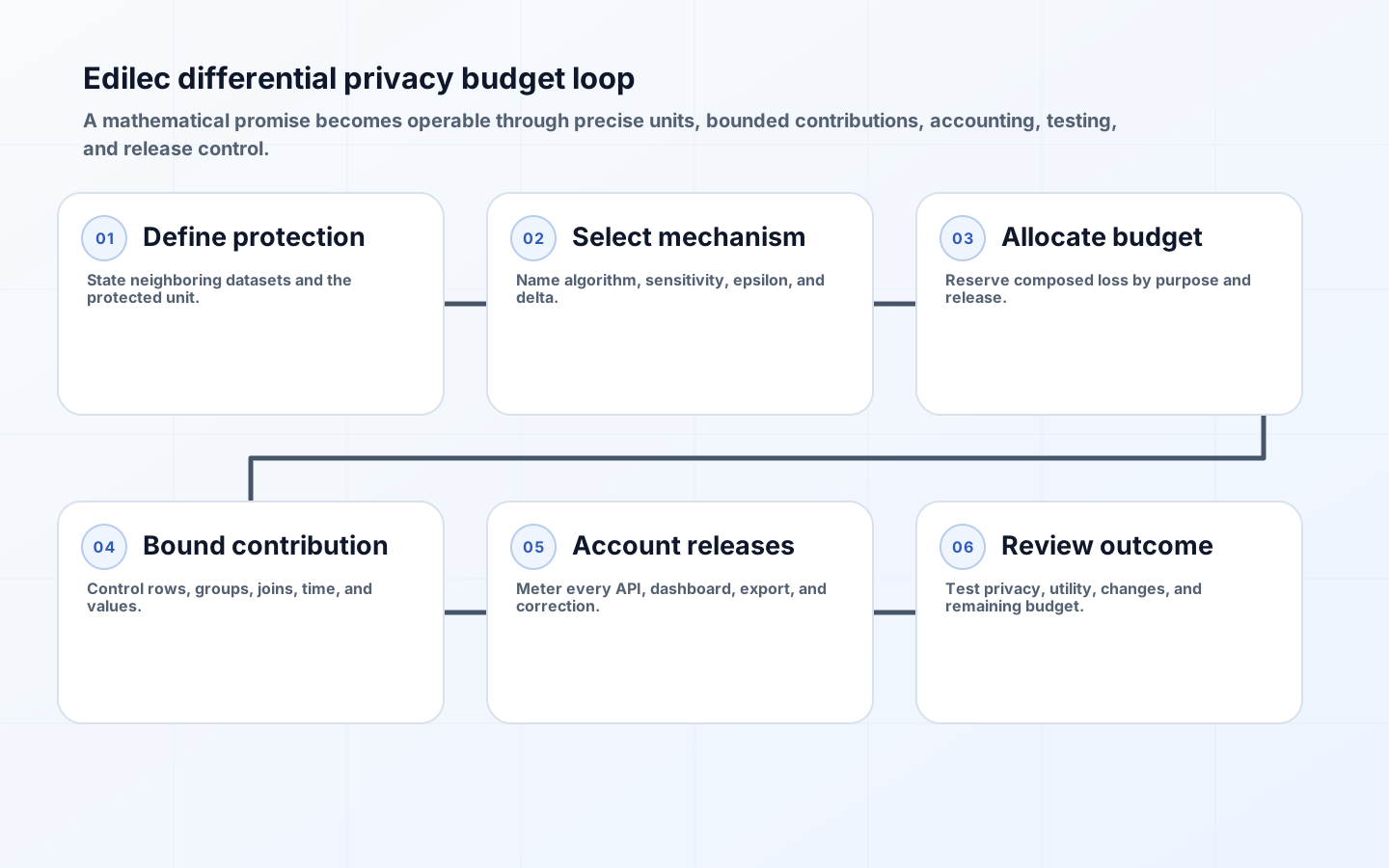
Differential privacy procurement should never begin and end with a supplier promising to add noise. A meaningful guarantee depends on the neighboring-dataset definition, protected unit, epsilon, delta where applicable, mechanism, contribution bounds, query sensitivity, composition across releases, implementation, and information exposed outside the mechanism. The buyer also needs utility acceptance criteria and an operating model that prevents repeated queries, exports, or product teams from quietly spending more privacy loss than the approved use case allows.
NIST SP 800-226 provides a durable evaluation structure and describes privacy hazards that appear when mathematical definitions become software. NIST does not prescribe one universal epsilon; context, sensitivity, purpose, and expert judgment matter. Procurement's job is therefore to make the supplier state the guarantee precisely, show its accounting, prove implementation behavior, and give the buyer controls to operate within an approved privacy-loss budget.
Define the protected unit and neighboring datasets
Decide whether neighboring datasets differ by one event, row, person, household, device, organization, or complete user contribution. Event-level privacy can be materially weaker for a person who contributes many events. State whether adjacency adds or removes a unit or substitutes one record. Map identifiers across devices and tables so contribution limits reflect the intended person. Document population, sampling, joins, preprocessing, public information, and what the attacker is assumed to know. Without this definition, an epsilon value cannot be compared across products.
Specify and allocate the privacy-loss budget
State epsilon and delta per mechanism and for the composed release program, the accountant used, allocation by purpose, reset policy, and who may approve changes. Smaller epsilon generally means a stronger guarantee and more noise, but values are not meaningful without adjacency and mechanism details. Delta should have an explicit rationale relative to population and risk, not a default copied from a library. Reserve budget for quality checks, recurring publications, drill-downs, model updates, and incident correction. A release catalog should show planned and actual spend before execution.
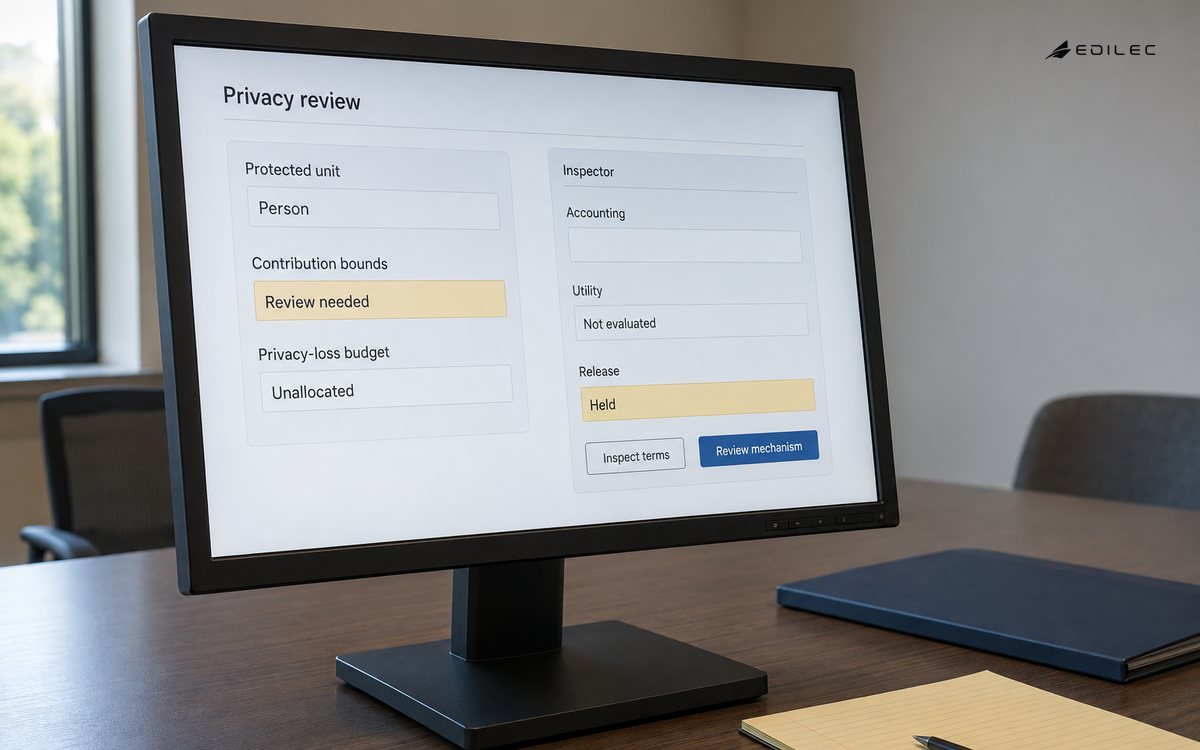
| Field | Buyer requirement | Evidence | Red flag |
|---|---|---|---|
| Protected unit | Person, event, household, or other unit | Adjacency specification | One row without user mapping |
| Parameters | Epsilon and delta per use and composed | Approved budget schedule | Epsilon available on request |
| Contribution | Rows, groups, time, and value bounds | Preprocessing tests | Unlimited user events |
| Mechanism | Named algorithm and sensitivity | Design and implementation version | Proprietary noise |
| Accounting | Composition method and release ledger | Machine-readable spend records | Manual spreadsheet only |
| Outputs | All statistics and side information | Interface and export inventory | Unmetered debug endpoint |
Bound contribution and sensitivity
Require deterministic or auditable controls for how many rows, groups, partitions, and value magnitude one protected unit can contribute. Decide clipping, sampling, deduplication, and join behavior before noise. Joins can multiply records and invalidate assumed sensitivity; data-dependent bounds can leak information if chosen carelessly. Test adversarial users with many events, extreme values, sparse groups, duplicate identities, and late-arriving records. The supplier should explain how preprocessing is included in the guarantee and which operations happen outside the differentially private boundary.
Test the guarantee and useful output
Acceptance needs two tracks. Privacy tests verify parameter enforcement, contribution bounds, secure randomness, sensitivity, composition, suppression behavior, deterministic seeding restrictions, access control, and absence of raw or unmetered side channels. Utility tests use representative workloads to assess error, bias, confidence, ranking stability, small groups, rare events, and decision thresholds. NIST's finalization announcement emphasizes the trade-off and hazards of poor noise choices. Never tune against a sensitive holdout repeatedly without charging or controlling the resulting leakage.
| Test | Pass condition | Artifact | Operational owner |
|---|---|---|---|
| Budget exhaustion | Further release is denied or approved explicitly | Enforcement log | Privacy owner |
| Repeated query | Composition is charged correctly | Accountant trace | Platform team |
| Extreme contributor | Bounds hold before mechanism | Property test result | Data engineering |
| Sparse group | Policy handles unsafe or unusable output | Suppression and error report | Analytics owner |
| Randomness | Approved secure source and no seed reuse | Implementation assessment | Security engineering |
| Utility | Pre-agreed decision metrics remain usable | Benchmark by subgroup | Business owner |
Assure the software and service boundary
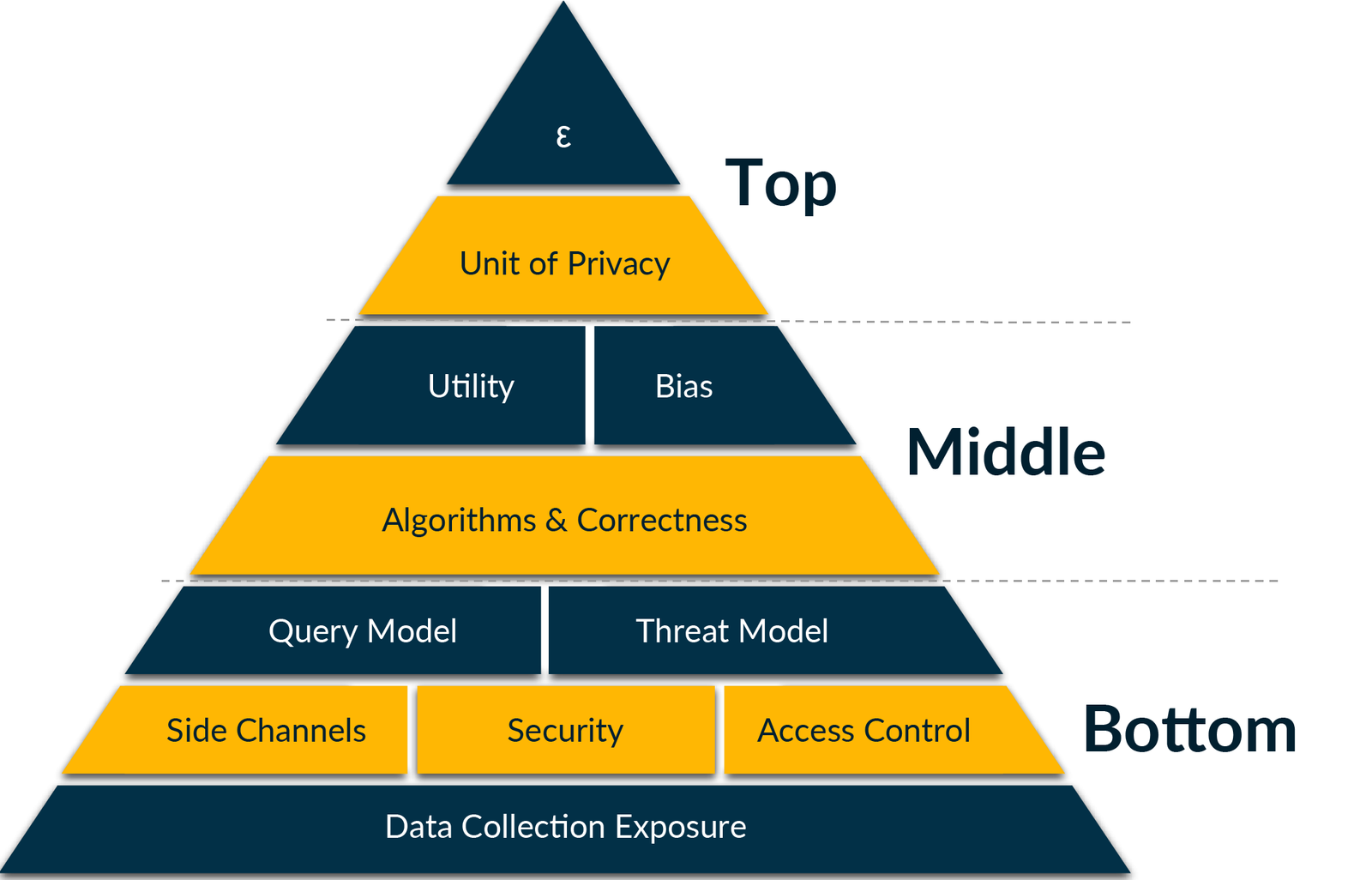
Request architecture, threat model, supported mechanisms, library versions, code or independent review, random-number design, tenancy isolation, administrator access, logs, vulnerability handling, and change control. Identify every output: dashboards, APIs, exports, cached results, notebooks, previews, telemetry, model artifacts, and support tools. A mathematically correct query service cannot protect raw data copied to an unrestricted notebook. The ICO PET guidance treats differential privacy as one privacy-enhancing technology within wider governance; it does not replace lawful basis, minimization, security, transparency, or rights.
Contract operating evidence and change rights
Require a release ledger with dataset and purpose identifiers, protected unit, mechanism, parameters, contribution policy, budget charged, accountant version, requester, approval, output, and timestamp. Set alerts and hard stops, retention for evidence, incident notice, and investigation support. Material changes to adjacency, mechanism, accountant, preprocessing, library, data model, interfaces, or defaults should trigger notice and retesting. Reserve export of configuration and ledgers, independent assessment rights, deletion and exit support, and a remedy if the marketed guarantee was not enforced. Monitor the NIST privacy-enhancing cryptography project for evolving technical work.
Run a differential privacy proof of value
Choose a real decision workload and controlled representative data with repeated users, sparse groups, joins, extremes, late events, and missing identifiers. Before results, require the supplier to state adjacency, protected unit, epsilon, delta, mechanism, sensitivity, contribution bounds, composition, and every output. Reconcile contribution across devices, accounts, tables, windows, groups, and joins; deliberately exceed each bound and inspect enforcement. Repeat overlapping queries through dashboards, APIs, exports, jobs, notebooks, previews, and support tools to prove one accountant covers all release paths. Exhaust a test budget and verify hard stop, alert, approval, ledger, and inability to bypass controls with filters or dataset variants.
Inspect randomness, seeds, tenant separation, administrator capability, caches, logs, raw access, debugging, backups, telemetry, and deletion. Benchmark error, confidence, rankings, threshold decisions, small populations, subgroup behavior, temporal stability, and reproducibility against agreed utility criteria. Have independent reviewers reproduce parameter and accounting claims. Model future releases and allocate budget among reports, exploration, quality checks, models, corrections, and emergency analysis rather than approving one isolated query. Convert results into contractual configuration, acceptance artifacts, change fields, operating roles, incident duties, evidence retention, portability, and a launch gate. Failure should produce a precise remediation plan, not a negotiated redefinition of the privacy claim after testing.
- Require the supplier to distinguish central and local differential privacy, since trust, data collection, utility, and the protected boundary differ materially.
- Ask how privacy amplification by sampling is justified and implemented; do not credit amplification when sampling assumptions, secrecy, or independence are absent.
- Specify floating-point, truncation, overflow, timing, and side-channel handling where implementation details can violate an otherwise correct mathematical mechanism.
- Include analyst interaction in the threat model. Adaptive query choice, correlated releases, external datasets, and manual exports can reveal more than a fixed one-query demonstration.
- Define correction policy before errors occur. Republishing a corrected statistic can consume additional budget, while silently replacing output can undermine auditability and downstream decisions.
- Test whether suppression or noisy small counts create fairness, safety, or allocation harms; privacy strength does not guarantee an acceptable business or public-policy decision.
- Require documentation understandable to privacy, legal, product, data-science, and security reviewers so no critical assumption exists only in a mathematician's notebook.
Assign three distinct authorities: a data owner who approves the purpose and population, a privacy owner who allocates and changes the privacy-loss budget, and an analytics owner who accepts utility. Security and platform teams assure implementation and access, but should not silently choose epsilon through a default. Establish a dispute path when useful output requires more budget than privacy risk permits. The legitimate outcome may be a narrower query, larger group, less frequent release, different data source, non-DP control, or no release. Making that decision visible is a core procurement benefit.
Retest those authorities and controls during every renewal cycle.
Differential privacy procurement takeaways
- Define the protected unit and neighboring datasets before comparing epsilon values.
- Set epsilon, delta, composition, purpose allocation, resets, and change authority as an explicit budget.
- Bound contributions and sensitivity across joins, duplicates, time, groups, and extreme values.
- Test privacy enforcement and decision utility separately using representative and adversarial cases.
- Inventory every interface and side channel outside the mathematical mechanism.
- Contract release ledgers, hard stops, material-change testing, incident support, and portable evidence.
Differential privacy procurement FAQ
What is a good epsilon? There is no universal value. Evaluate it with adjacency, sensitivity, composition, data context, harms, purpose, and utility.
Does differential privacy anonymize a dataset? It provides a defined guarantee for a mechanism or release under assumptions. Legal anonymity and the treatment of source data require separate contextual analysis.
Can a privacy budget reset annually? Only if the model and protected population justify it. Time passing does not automatically erase what prior releases revealed.
Conclusion
Buy differential privacy as a governed release system, not a noise feature. A precise protected unit, explicit composed budget, bounded contributions, tested mechanism, useful outputs, and immutable accounting make the privacy claim inspectable. Without those elements, the buyer cannot know what is protected or how quickly repeated use consumes the promise.