Crypto agility testing asks a harder question than whether a product supports a second algorithm: can the organization change cryptography across a live service within an acceptable time, without silent downgrade, irreversible data loss, broken counterparties, or uncontrolled rollback? An emergency may follow cryptanalysis, implementation compromise, certificate-authority failure, library defect, standards deprecation, or policy change. In each case, a configuration flag is only one dependency. Keys, certificates, trust stores, message formats, hardware, APIs, stored ciphertext, clients, partners, monitoring, and recovery procedures may all move together.
NIST defines crypto agility as capabilities for replacing and adapting algorithms across protocols, applications, software, hardware, firmware, and infrastructure while preserving security and operations. The 2026 NIST crypto-agility white paper emphasizes that the implementation environment determines the practical approach. A test program therefore needs representative systems and failure modes, not a generic unit test that swaps an algorithm identifier.
Set measurable cryptographic change objectives
Define a cryptographic change objective for each service tier: time to identify affected uses, approve a target, distribute new trust, migrate active operations, preserve required historical access, disable the old path, and verify completion. Pair it with a recovery objective for a failed transition. The target may differ by operation. Replacing an ephemeral TLS key exchange can be faster than re-signing years of firmware or re-encrypting an archive. State which safety conditions may never be traded for speed, including authenticity, key separation, auditability, and prevention of downgrade to a disallowed algorithm.
| Surface | Primary objective | Critical dependency | Failure to inject |
|---|---|---|---|
| Network key establishment | Move clients and servers without downgrade | Protocol and peer interoperability | Middlebox rejects new handshake |
| Digital signatures | Preserve verification across artifact lifetime | Format, trust anchor, verifier | Old verifier cannot parse signature |
| Data at rest | Maintain availability and integrity during re-encryption | Key mapping and recovery copies | Job interruption after partial rewrite |
| PKI | Issue, distribute, and revoke new credentials | CA, profiles, stores, automation | Partial trust-store rollout |
| Embedded product | Ship verified update within support window | Boot chain, memory, supplier | Firmware exceeds size limit |
| External exchange | Coordinate cutover with counterparties | Contract, test endpoint, clock | Partner misses agreed window |
Design scenarios that cross control boundaries
Build scenarios from the cryptographic inventory and threat model. A planned scenario can deprecate one key length over months; a shock scenario can declare a provider unusable within hours. Include algorithm replacement, parameter increase, key compromise, trust-anchor removal, random-number failure, certificate profile change, provider or HSM replacement, and protocol disablement. Each scenario should name affected services, trigger authority, target state, maximum dual-operation period, prohibited fallback, data compatibility rule, external dependencies, observability requirements, and rollback boundary. The NIST crypto-agility project is a useful program anchor, while local exercises make the capability measurable.

Build a layered test harness
At the component layer, use known-answer, negative, malformed-input, provider-selection, and serialization tests. At the protocol layer, test negotiation, authentication, downgrade resistance, replay behavior, session resumption, and mixed versions. At the service layer, run load, latency, memory, certificate rotation, deployment, failover, backup restore, and log validation. At the ecosystem layer, exercise browsers, devices, proxies, HSMs, SaaS integrations, and partner endpoints. Production-like data should be synthetic or appropriately protected, but topology, message sizes, policies, and operational constraints must be realistic enough to reveal failures.
| Test | Pass condition | Evidence retained | Owner |
|---|---|---|---|
| New-only positive path | All protected operations use target crypto | Handshake or operation trace | Service team |
| Old-only rejection | Disallowed crypto fails closed and visibly | Negative result and alert | Security engineering |
| Mixed-version period | Approved combinations interoperate only as designed | Compatibility matrix | Platform team |
| Fault during migration | State remains recoverable and attributable | Checkpoint and recovery log | Reliability team |
| Rollback | Returns only to approved secure state | Approval and restored-state proof | Change authority |
| Historical verification | Required old signatures or records remain verifiable | Corpus test results | Records owner |
Inject failures instead of testing the happy path
Interrupt key generation, deny HSM capacity, expire an intermediate certificate, remove a trust anchor from half the fleet, corrupt a migration checkpoint, skew a clock, block the new protocol at a proxy, and return an unsupported signature from a partner. Verify that the service fails in the intended direction and that operators can distinguish security rejection from availability failure. For data conversion, test idempotence and resumption; for signatures, test old and new verification horizons; for negotiated protocols, prove that an attacker cannot force a weaker approved-looking state. Fault injection converts architectural confidence into evidence.
Govern dual operation and rollback
Dual operation can reduce migration risk, but it also prolongs exposure and adds ambiguous states. Define whether both mechanisms must validate, either may validate, or one protects transport while the other protects an artifact. Set start and end dates, telemetry, exception authority, and the exact condition that disables the old path. Rollback must not mean restoring a known-vulnerable algorithm without controls. Pre-authorize secure fallback states, isolate affected flows where possible, time-limit the exception, and record who accepted residual risk. NIST SP 800-131A Revision 2 illustrates the importance of explicit transition status rather than treating all legacy use alike.
Rehearse, measure, and close the gaps
Run tabletop exercises to test authority and communication, then technical exercises to prove execution. Capture time to scope, percentage of cryptographic uses automatically located, systems changed without manual intervention, counterparties successfully tested, duration of dual operation, failed negative tests, and time to verified legacy disablement. The NCCoE PQC migration material can inform inventory and interoperability work, but the service owner must close local findings. Re-run scenarios after major architecture, provider, protocol, or supplier changes and include at least one surprise constraint.
Exercise a transition end to end
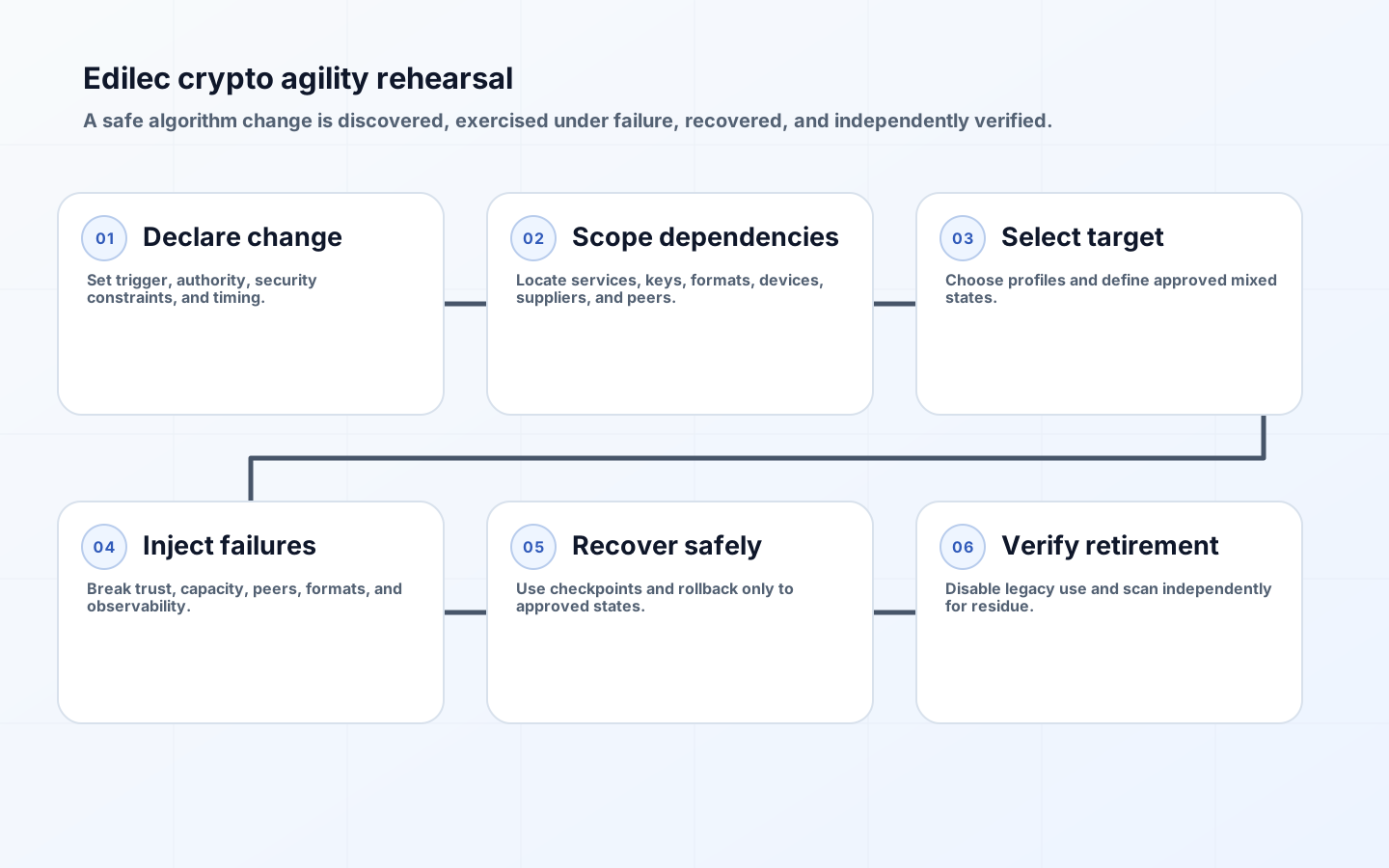
Issue a scenario directive naming the affected algorithm, evidence threshold, decision authority, completion time, and operations allowed temporarily. Require inventory owners to return affected services, components, keys, formats, devices, suppliers, and peers without undocumented expert memory. Architecture selects a target profile and records security, interoperability, capacity, and validation reasoning. Deploy to a representative slice containing old clients, proxies, hardware-backed keys, failover, recovery, and external integrations. Inject partial trust-store update, provider exhaustion, malformed target objects, delayed partner cutover, and monitoring loss. Trigger rollback after partial migration and prove checkpoints prevent loss, duplication, signature ambiguity, or restoration of prohibited crypto. Resume, disable legacy use, scan independently, reconcile exceptions, and verify historical obligations. Review communications and support behavior. Close only when target operation, old-key handling, exception expiry, automation improvements, and independent residual-use evidence are complete.
Repeat the exercise with a different cause. A key compromise emphasizes revocation, scope, and trust distribution; a standards deadline emphasizes portfolio sequencing; a provider defect emphasizes emergency replacement; a format transition emphasizes long-lived verification. Rotate incident commander and service participants so capability is institutional rather than dependent on one cryptography specialist. Include a system believed to be agile and one known legacy platform, then compare actual transition time with the stated objectives. Findings should distinguish missing inventory, architecture coupling, inadequate test environments, supplier blockage, operational authority, and observability. Each category needs an owner and funded corrective action, because a successful tabletop cannot compensate for a protocol or device that physically cannot accept the target.
- Include signing and verification across the full artifact lifetime; a new signer is useless if deployed verifiers cannot process it or evidence expires before records do.
- For encrypted stores, inventory primary data, indexes, replicas, backups, exports, caches, and recovery copies, then prove conversion can resume safely after interruption.
- Test key identifiers and metadata migration independently from ciphertext so operators cannot attach a valid new key to the wrong object or tenant.
- Require monitoring to identify selected algorithm, provider, key class, peer, error, and fallback without logging secrets or sensitive plaintext.
- Exercise emergency authority, but make every exception attributable, bounded, monitored, and automatically escalated before expiry.
- Feed observed duration and failure into architecture investment; repeated manual trust-store work or partner coordination is evidence of structural coupling, not merely an exercise inconvenience.
Crypto agility testing takeaways
- Measure the complete change from discovery through verified retirement, not algorithm support alone.
- Set different objectives for transport, signatures, stored data, PKI, embedded systems, and counterparties.
- Test component, protocol, service, and ecosystem layers with realistic constraints.
- Inject partial deployment, capacity, trust, format, clock, and partner failures.
- Time-box dual operation and permit rollback only to a pre-defined secure state.
- Retain traces, compatibility results, approvals, and closure evidence for every exercise.
Crypto agility testing FAQ
Does a provider abstraction create crypto agility? It helps centralize selection, but formats, keys, protocols, hardware, policies, and peers can still prevent change. Test the end-to-end system.
Should teams test deprecated algorithms? Use isolated fixtures where needed to prove rejection, migration, and historical verification. Do not restore insecure production exposure merely to make a test realistic.
How often should exercises run? Exercise critical paths on a defined cadence and after material changes. Smaller automated tests should run continuously; cross-team and counterparty rehearsals can run less often but must be completed before need becomes urgent.
Conclusion
Crypto agility is demonstrated by controlled change under adverse conditions. Set service-specific objectives, rehearse multiple transition causes, attack the mixed states, and prove both recovery and final retirement. The resulting evidence shows which systems can move quickly and which require modernization before the next cryptographic deadline arrives.