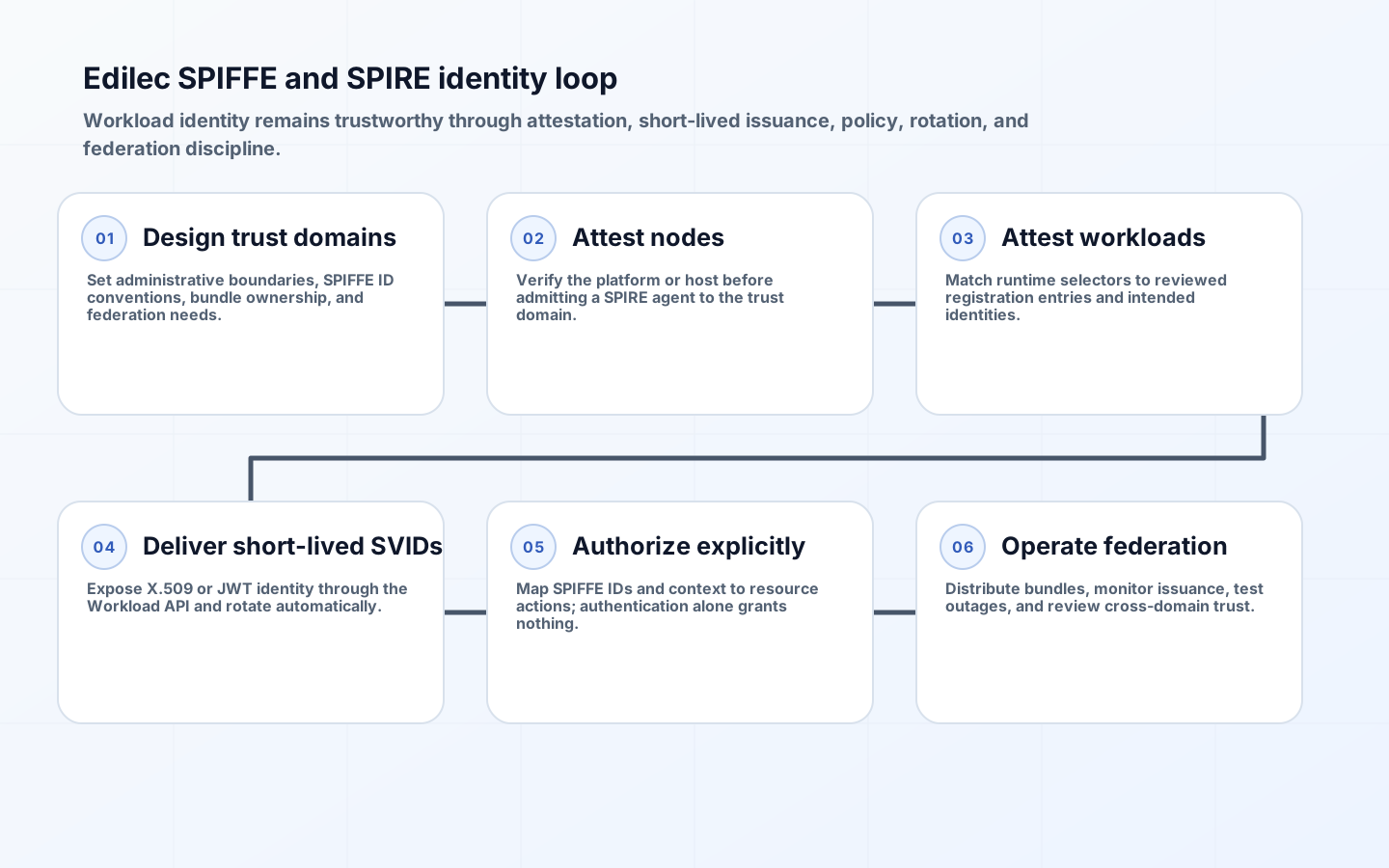
SPIFFE SPIRE workload identity gives software a portable cryptographic identity based on what the workload is, not where its current IP address happens to be. SPIFFE specifies identifiers, trust domains, verifiable identity documents, bundles, federation, and a Workload API. SPIRE is a production implementation that attests nodes and workloads and issues short-lived SPIFFE Verifiable Identity Documents, or SVIDs. This supports mutual authentication across dynamic infrastructure, but it does not decide what an authenticated workload may do.
The SPIFFE overview describes short-lived X.509 and JWT SVIDs obtained through an API and used for TLS or token authentication. NIST SP 800-207A identifies application identity infrastructure such as SPIFFE as part of cloud-native zero-trust enforcement. The business case is strongest when teams otherwise distribute certificates or secrets manually across Kubernetes, virtual machines, and multiple clouds. The engineering cost is a new identity control plane whose attestation, availability, signing keys, registration policy, and federation must be operated deliberately.
Decide where SPIFFE and SPIRE fit
Inventory workload-to-workload and workload-to-platform authentication. Identify shared secrets, manually issued certificates, IP allowlists, unstable service names, multi-cluster communication, and cross-cloud identity gaps. SPIFFE fits when workloads need consistent identity independent of location and can consume SVIDs directly or through proxies. It may be unnecessary for a small platform already covered by a capable managed identity system. State target outcomes such as automated rotation, per-workload attribution, mTLS, or cross-domain authentication before selecting deployment topology.
Separate authentication from authorization in the architecture. An SVID proves control of an identity issued by a trust domain; resource policy must still map that SPIFFE ID and context to actions. The zero-trust guide explains why identity evidence should support a current resource decision rather than confer implicit broad trust. Do not replace an IP allowlist with a trust-domain-wide allowlist and call it least privilege.
Design the trust domain and SPIFFE ID scheme
A trust domain is an administrative and cryptographic boundary represented in SPIFFE IDs and backed by a bundle of trust anchors. Choose boundaries according to independent administration, security policy, signing-key custody, incident containment, and federation, not merely cluster count. Production and development commonly need separate domains or strong separation. Acquisitions, subsidiaries, vendors, and edge environments may warrant distinct domains. Document who can create registration entries, operate servers, rotate anchors, publish bundles, and authorize federation.

Define SPIFFE ID paths from stable organizational concepts such as environment, platform, namespace, service, and workload role. Avoid embedding mutable pod names, IPs, or transient instance IDs in the logical identity. Keep the ID meaningful enough for policy but do not encode confidential data or every deployment attribute. Publish naming rules, collision prevention, migration procedure, and ownership. Treat renaming as an identity change requiring dual trust and policy transition, not a cosmetic string edit.
| Decision | Preferred basis | Failure if vague | Evidence |
|---|---|---|---|
| Domain boundary | Administrative control and incident blast radius | One compromise spans unrelated environments | Approved boundary and owner map |
| SPIFFE ID path | Stable workload role and environment | Policy breaks on every deployment | Naming standard and test cases |
| Root key custody | Protected signing and rotation operations | Unauthorized SVID issuance or prolonged outage | Key ceremony and access logs |
| Registration authority | Reviewed platform automation | Developers self-assign privileged identities | Change control and admission policy |
| Federation | Explicit cross-domain business need | Trust expands to an entire external domain | Bundle endpoint, policy and expiry |
| Recovery | Tested server, datastore and bundle restoration | Workloads cannot renew identities | Exercise results and recovery objectives |
Engineer node and workload attestation
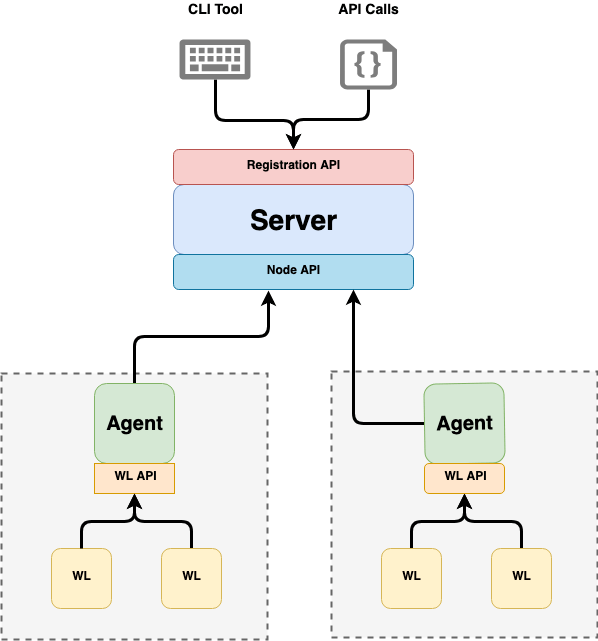
SPIRE first establishes confidence in the node running an agent, then the agent identifies local workloads and serves SVIDs through the Workload API. Choose node attestors based on platform evidence such as cloud instance identity, Kubernetes projected credentials, TPM-backed evidence, or controlled join tokens. Evaluate replay, image cloning, stolen bootstrap material, and decommissioned nodes. Rotate and expire node trust, constrain which selectors a node can claim, and monitor unusual re-attestation or issuance volume.
Workload attestation matches selectors such as Kubernetes namespace and service account, Unix UID, container metadata, or process attributes to registration entries. Selectors are security inputs. Prevent developers from changing a low-trust deployment so it matches a privileged identity. Use admission control, protected namespaces, reviewed service accounts, image policy where relevant, and infrastructure automation. Avoid ambiguous registration entries that match several workloads. Test that a neighboring pod, host process, debug container, and compromised namespace cannot obtain the target SVID.
Deliver and use SVIDs safely
Prefer the Workload API or an integrated proxy so applications do not write private keys to disk. X.509-SVIDs support mTLS and carry the SPIFFE ID in the certificate; JWT-SVIDs support token-style authentication to a named audience. Choose according to protocol and threat model. Validate trust bundle, identity, expiry, and intended audience. JWT-SVIDs are bearer-like once stolen, so use narrow audiences, short lifetimes, secure transport, and careful logging. Do not log private keys, complete JWTs, or unneeded certificate details.
Rotation should occur automatically before expiry without restarting workloads. Test overlapping SVIDs, connection pools, long-lived streams, clock skew, server or agent restart, and bundle rotation. Consumers must refresh trust bundles safely and reject expired identities. A service mesh can offload mTLS and SVID consumption, but mesh identity policy and application authorization remain separate concerns. The service-mesh decision guide helps assess that additional control plane.
Authorize SPIFFE identities at resources
Create policies that map exact or narrowly patterned SPIFFE IDs to resource actions, with environment, tenant, request, and user context where needed. Default deny unknown domains and identities. For user-initiated calls, preserve user delegation separately from the workload's own identity; service authentication should not erase the subject. Enforce policy close to the resource through application logic, gateway, proxy, or policy engine and test negative cases. Review broad path wildcards and trust-domain rules as privileged grants.
Record authenticated SPIFFE ID, trust domain, local workload, target resource, decision, policy version, and user or job context without retaining secrets. Correlate issuance with access so investigators can identify which node and attestation evidence produced an identity. The audit-log architecture guide supports this evidence design. Alert on identity use from unexpected environments, denied cross-domain access, unusual SVID volume, and authorization drift.
Federate trust domains cautiously
SPIFFE federation lets one trust domain authenticate identities issued by another by exchanging bundles. It does not require the receiving domain to authorize every external identity. Define exact external IDs or paths, resources, environments, owners, purpose, and expiry. Authenticate bundle endpoints, monitor anchor changes, plan cache and outage behavior, and remove federation when the business relationship ends. Cross-domain authorization should remain narrow even when the cryptographic bundle establishes a broad authentication capability.
| Failure or attack | Expected behavior | Evidence | Unsafe outcome |
|---|---|---|---|
| Neighbor workload requests privileged SVID | Attestation selectors do not match | Denied Workload API and registration logs | Namespace wildcard issues identity |
| SPIRE server unavailable | Existing SVIDs run to expiry; renewal alert fires | Availability and expiry timeline | Private keys are reused indefinitely |
| Trust bundle rotates | Consumers accept planned overlap then reject old anchor | Bundle and connection tests | Fleet-wide outage or endless old trust |
| Compromised node is removed | Node attestation and issuance stop | Revocation and new-request failure | Agent continues minting identities |
| External domain changes anchor | Change is authenticated and reviewed | Federation update event | Unannounced key replaces trusted bundle |
| Agent or socket is exposed | Local access controls prevent unauthorized retrieval | Host and workload negative tests | Any local process obtains any SVID |
Operate SPIRE as critical identity infrastructure
Harden servers, agents, datastores, administrative APIs, signing plugins, bundle endpoints, and telemetry. Separate registration administration from root-key operations. Back up and restore configuration and datastore, protect signing keys, define capacity and latency budgets, and deploy servers for required availability. Monitor attestation failures, issuance latency, SVID expiry margin, registration changes, agent health, bundle publication, federation updates, and signer errors. Exercise regional loss and key compromise, not only normal restart.
Roll out by a bounded service graph. Observe identity first, then enforce authentication, then replace old secrets after negative tests and recovery rehearsal. Keep rollback time-limited and visible. Update incident playbooks for forged or misissued identity, stolen SVID, signer compromise, malicious registration, node compromise, and federation breach. The broader Kubernetes decision guide helps teams assess whether they can support another distributed control plane.
Measure whether workload identity improves control
Track workloads covered, remaining shared secrets, SVID renewal failures, identities with broad authorization, registration entries without owners, attestation denials, bundle freshness, federation exceptions, and time to contain a compromised workload. Pair technical reliability with security outcomes: more SVIDs are not success if every identity receives the same policy. Review whether attribution is clearer, credential exposure is shorter, and workload moves require fewer manual trust changes.
SPIFFE and SPIRE workload identity takeaways
- Adopt SPIFFE for explicit workload-identity outcomes, not as a generic zero-trust label.
- Make trust domains reflect administration, key custody, and incident boundaries.
- Treat node and workload attestation selectors as high-impact security policy.
- Deliver short-lived SVIDs without writing private keys to application storage.
- Authorize narrowly on SPIFFE identity and context; authentication grants no action by itself.
- Operate signing, registration, bundles, federation, recovery, and telemetry as critical infrastructure.
SPIFFE and SPIRE FAQ
Does SPIFFE require a service mesh? No. Applications can use the Workload API or libraries directly, and proxies can consume SVIDs without a full mesh. A mesh is one integration model.
Does an SVID authorize a workload? No. It authenticates an identity from a trust domain. A resource still needs policy mapping that identity and context to permitted actions.
Should every cluster be a trust domain? Not automatically. Boundaries should follow independent administration, cryptographic custody, incident containment, and federation needs; several clusters may share a domain or require separation.
Conclusion
SPIFFE and SPIRE can replace location and distributed secrets with attested, short-lived workload identity across heterogeneous platforms. The value appears only when trust-domain boundaries, selectors, registration, authorization, key operations, and federation are controlled. Build the identity loop as production infrastructure, test who cannot obtain each SVID, and keep authorization explicit. Then workload movement no longer has to erase accountability.