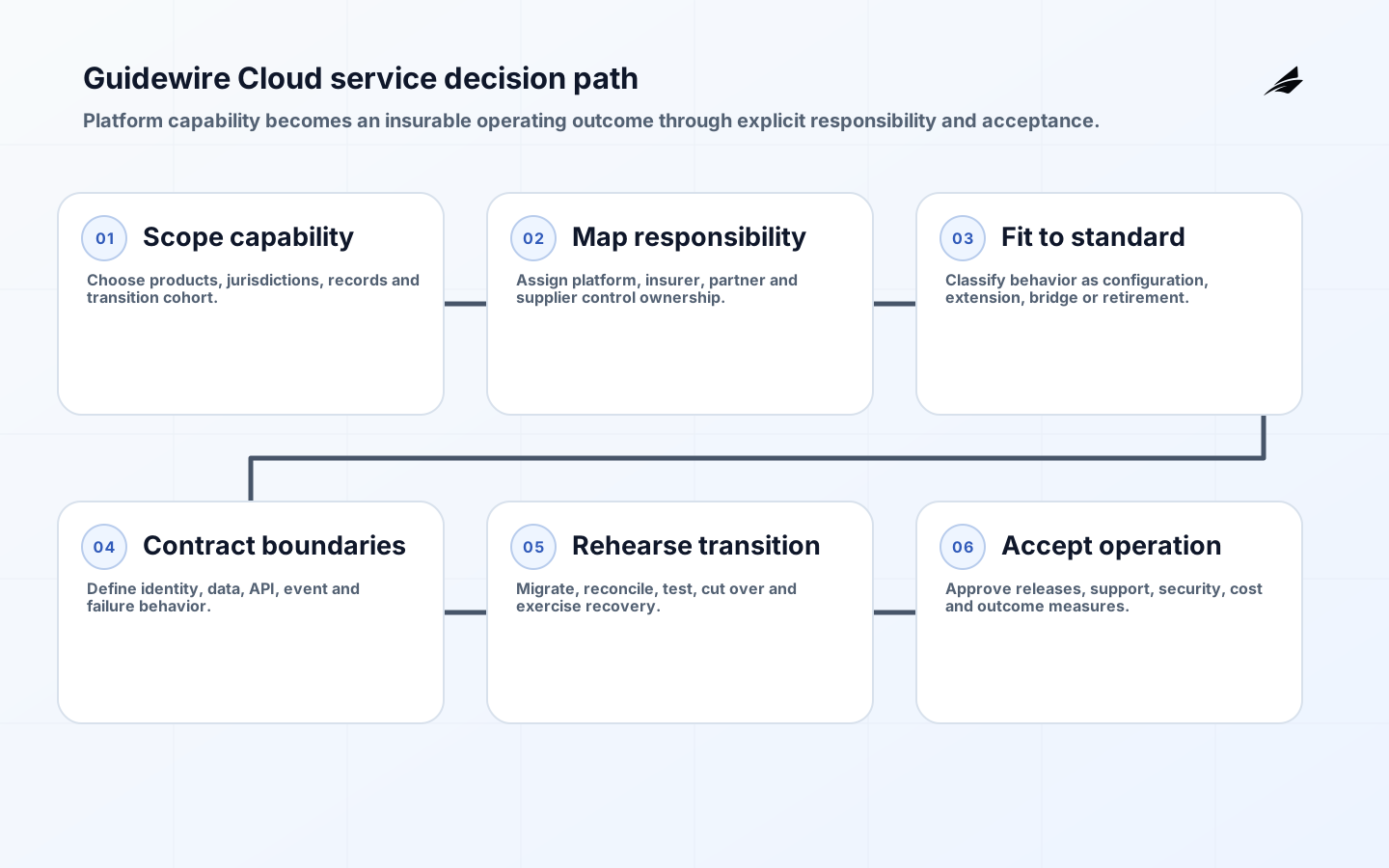
Guidewire Cloud services combine managed platform capabilities with insurer-owned configuration, integrations, data governance and operating decisions. The central buying question is therefore not simply whether infrastructure moves to a vendor cloud. It is whether the insurer can modernize policy, billing or claims workflows while retaining clear authority over controls, releases, downstream systems and customer outcomes.
This Guidewire Cloud FAQ is for P&C technology leaders, architects, delivery owners and control functions evaluating or preparing a program. Use it with the Guidewire Cloud scope and delivery plan, implementation checklist and Guidewire Cloud solution planning guide. Product capabilities and commercial terms change, so confirm release-specific details in current Guidewire documentation and contracts.
What does Guidewire Cloud manage, and what remains ours?
Guidewire’s Cloud Platform documentation describes platform services for building, deploying, testing, authentication, monitoring and data access. That removes substantial infrastructure work, but it does not transfer accountability for insurance products, workflow design, access decisions, integration behavior, data quality or regulatory obligations. Draw a responsibility matrix for each environment and control rather than relying on a generic cloud statement.
Guidewire’s security guidance explicitly presents a shared-responsibility model. The insurer remains responsible for its data, configurations and access. That means a program needs owners for identity federation, role design, production support, secrets introduced by integrations, lower-environment data, retention, audit evidence and vendor oversight. Contract language, architecture and runbooks should express the same boundary.
| Capability | Platform or vendor contribution | Insurer decision and evidence |
|---|---|---|
| Cloud runtime | Managed platform, environments and platform operations | Approved topology, service targets and dependency plan |
| Application configuration | Supported development and deployment toolchain | Product rules, extensions, code quality and ownership |
| Identity | Platform authentication and integration options | Identity provider, lifecycle, roles and access reviews |
| Data protection | Platform security and compliance capabilities | Classification, permitted use, residency, masking and retention |
| Integrations | Cloud APIs and integration application patterns | Contract, idempotency, monitoring and downstream recovery |
| Release management | Build promotion and deployment facilities | Acceptance suite, change authority and business readiness |
How should we scope a Guidewire Cloud migration?
Scope by business capability and data journey, not by a count of screens or interfaces. Inventory products, jurisdictions, active and historical records, documents, payments, correspondence, reports, batch processes, users, partners and control evidence. For each, decide whether to migrate, rebuild, integrate, archive or retire. A claim may be technically loaded yet unusable if its notes, financial history, documents or policy context are missing.
Choose a transition unit that operations can validate and support: a line of business, region, new business cohort or bounded claim segment. Define coexistence explicitly. During transition, state which system owns policy, billing, claim, party and financial status; how late changes synchronize; and how a customer or adjuster sees one coherent history. Big-bang migration can be appropriate in constrained circumstances, but it should be a risk decision supported by rehearsal rather than a default ambition.
How much should we configure or customize?
Prefer supported configuration, extension points, Cloud APIs and marketplace integrations when they satisfy the outcome. Custom code is justified when it protects a material differentiator or unavoidable obligation and has a named lifecycle owner. Every extension should document the business rule, supported interface, data touched, failure behavior, automated tests and release-compatibility evidence. Recreating legacy behavior without asking why it exists preserves cost rather than capability.
Use a fit-to-standard workshop around real cases, including exceptions. Ask an adjuster or underwriter to complete the workflow and identify where standard behavior changes policy, service or control outcomes. Classify each gap as mandatory, valuable, temporary or obsolete. Require approval for mandatory deviations and an expiry date for temporary bridges. This keeps the backlog tied to business decisions instead of stakeholder familiarity.
How should integrations and network connectivity work?
Treat each integration as a product with a contract and service owner. Guidewire documents network connectivity options, including public TLS connections and supported private connectivity patterns. Select the pattern from data sensitivity, latency, throughput, availability and operational constraints. Do not assume a private path fixes weak authentication or poor message design.
For APIs and events, define source authority, schema version, authentication, authorization, timeout, bounded retry, idempotency key, ordering needs, reconciliation and a dead-letter process. Avoid synchronous chains across many legacy systems for a customer-facing transaction. Where an external service is unavailable, preserve the insurance intent and expose an operational state instead of silently losing work or repeatedly producing a payment, document or notification.
| Integration question | Design evidence | Failure acceptance |
|---|---|---|
| Who owns the record? | Field-level source-of-truth map | No conflicting updates during coexistence |
| Can a request repeat? | Stable idempotency key and replay test | Duplicate has no additional business effect |
| What if the dependency is slow? | Timeout, queue or degraded-path decision | User and operator can see pending state |
| How is change managed? | Versioned contract and consumer tests | Old and new versions coexist for agreed window |
| How is completeness proven? | Counts, totals and exception reconciliation | Every break enters an owned queue |
| How is access revoked? | Workload identity and credential inventory | Compromised identity can be isolated promptly |
How do releases and upgrades affect delivery?
Cloud delivery changes upgrade work from occasional transformation to continuing product stewardship. Review the current Guidewire Cloud Platform release notes on a fixed cadence. Assess changes against configured workflows, extensions, integrations, data pipelines, controls and training materials. Maintain a regression inventory by business consequence so testing effort follows exposure rather than application size.
Guidewire’s deployment documentation separates development, preproduction and production use and describes build promotion. Define who may build, promote and deploy; what evidence is attached; and what requires business approval. Rehearse a representative release with data migration, smoke tests, integration checks and communications. The rollback plan must account for records written after exposure, not only application binaries.
What security and data controls need explicit design?
Start with Guidewire’s current security resources and map them to the insurer’s policies and jurisdictional duties. Federate workforce identity, automate joiner-mover-leaver flows, minimize privileged roles, separate routine administration from emergency access and review service identities. Test authorization through business operations: viewing a claim, changing reserves, approving payment, exporting records and modifying configuration are distinct privileges.
The Guidewire data security and governance guidance calls for sensitive-data and integration-flow inventories and warns against unapproved production PII in lower environments. Define masking or synthetic-data patterns, document export controls, monitor bulk access and propagate retention or legal holds through connected stores. Confirm region, subprocessor, encryption, backup, restoration and evidence obligations contractually.
What testing proves readiness for cutover?
Build acceptance around insurance outcomes. Test quote or policy changes, billing consequences, first notice of loss, coverage verification, reserves, payments, recovery, correspondence and closure as applicable. Include permission denial, duplicate requests, catastrophe volume, inaccessible dependency, late-arriving data and manual correction. Reconcile financial totals and record counts independently; a successful API response does not prove accounting or operational completeness.
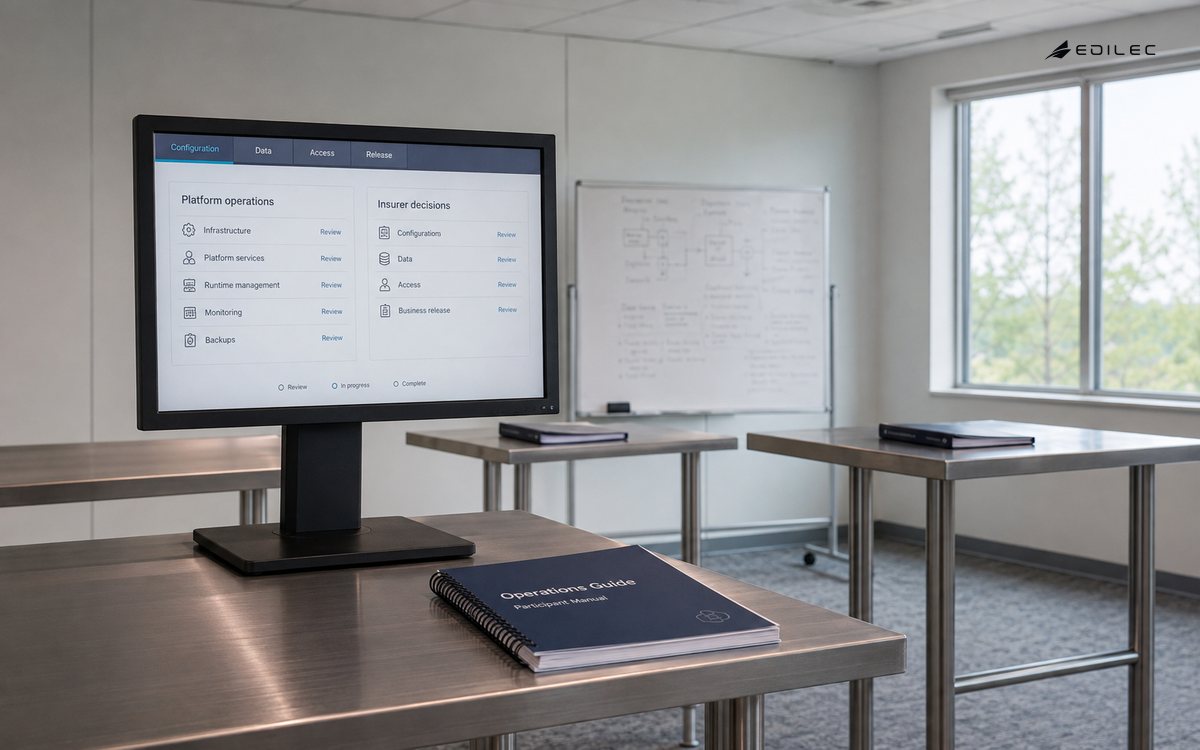
Run at least one production-like rehearsal with measured duration. Validate migration extract, transformation, load, document availability, reconciliation, identity, integrations, reports, operational queues, monitoring and support lookup. Define go/no-go thresholds and decision authority before the rehearsal. Cutover should have a command structure, business checkpoints, customer communication triggers and a bounded hypercare exit criterion.
How should cost, support and success be measured?
Model total program cost across subscription, implementation, data remediation, integration replacement, testing, environments, network services, partner capacity, training, business backfill, decommissioning and ongoing release stewardship. Separate one-time transition cost from steady-state operation. Ask how usage-based platform resources are measured and alerted, and assign an owner for forecasts and anomalous consumption.
Define success by operating outcomes: cycle time by claim or policy segment, straight-through completion with quality, payment accuracy, leakage indicators, customer contact, adjuster workload, release lead time, failed changes, service recovery and control exceptions. Baseline before migration and segment results so portfolio changes do not masquerade as system improvement. Include adoption and workaround measures; staff exporting data to spreadsheets can conceal a poor workflow.
- Confirm business outcomes, products, jurisdictions and transition unit.
- Approve the shared-responsibility, data and environment model.
- Classify legacy behavior as standard fit, justified extension, bridge or retirement.
- Contract every integration and rehearse its failure and reconciliation paths.
- Prove migration, security, insurance journeys and financial completeness.
- Cut over with named authority, observable thresholds and a funded operating model.
Key takeaways
- A managed cloud platform does not remove insurer accountability for configuration, data, access or outcomes.
- Scope modernization by business capability, authoritative data and coexistence behavior.
- Use supported configuration and interfaces unless a justified deviation has lifecycle ownership.
- Design releases, regression evidence and operating readiness as continuous capabilities.
- Measure customer, insurance, financial and control outcomes rather than migration activity alone.
Frequently asked questions
How long does a Guidewire Cloud implementation take?
There is no defensible universal duration. Product count, jurisdictional variation, legacy data quality, integration estate, customization, testing evidence and transition strategy drive the plan. Estimate each release slice from verified inventory and a pilot, then include remediation, rehearsal and business readiness rather than quoting configuration effort alone.
Do we need a Guidewire implementation partner?
Many insurers use accredited specialists for product and migration depth, but the insurer must retain architecture, product, data, control and acceptance authority. Contracts should define named skills, deliverable ownership, knowledge transfer, environment access, defect obligations and exit. Test transfer by having the internal team operate and release a representative change.
When can legacy systems be retired?
After authoritative records and documents are migrated or lawfully archived, reconciliations are accepted, operational and regulatory access works, dependent interfaces are removed, retention and legal holds are preserved, and rollback dependence has closed. Decommissioning should include access revocation, data disposition, monitoring removal and cost confirmation.
Conclusion
Guidewire Cloud services succeed when platform capability, insurance process and operating accountability are designed together. Make boundaries explicit, reduce unjustified legacy behavior, contract integrations, prove data and control outcomes, and prepare for continuous releases. That creates a modernization program the insurer can govern after the migration team leaves.