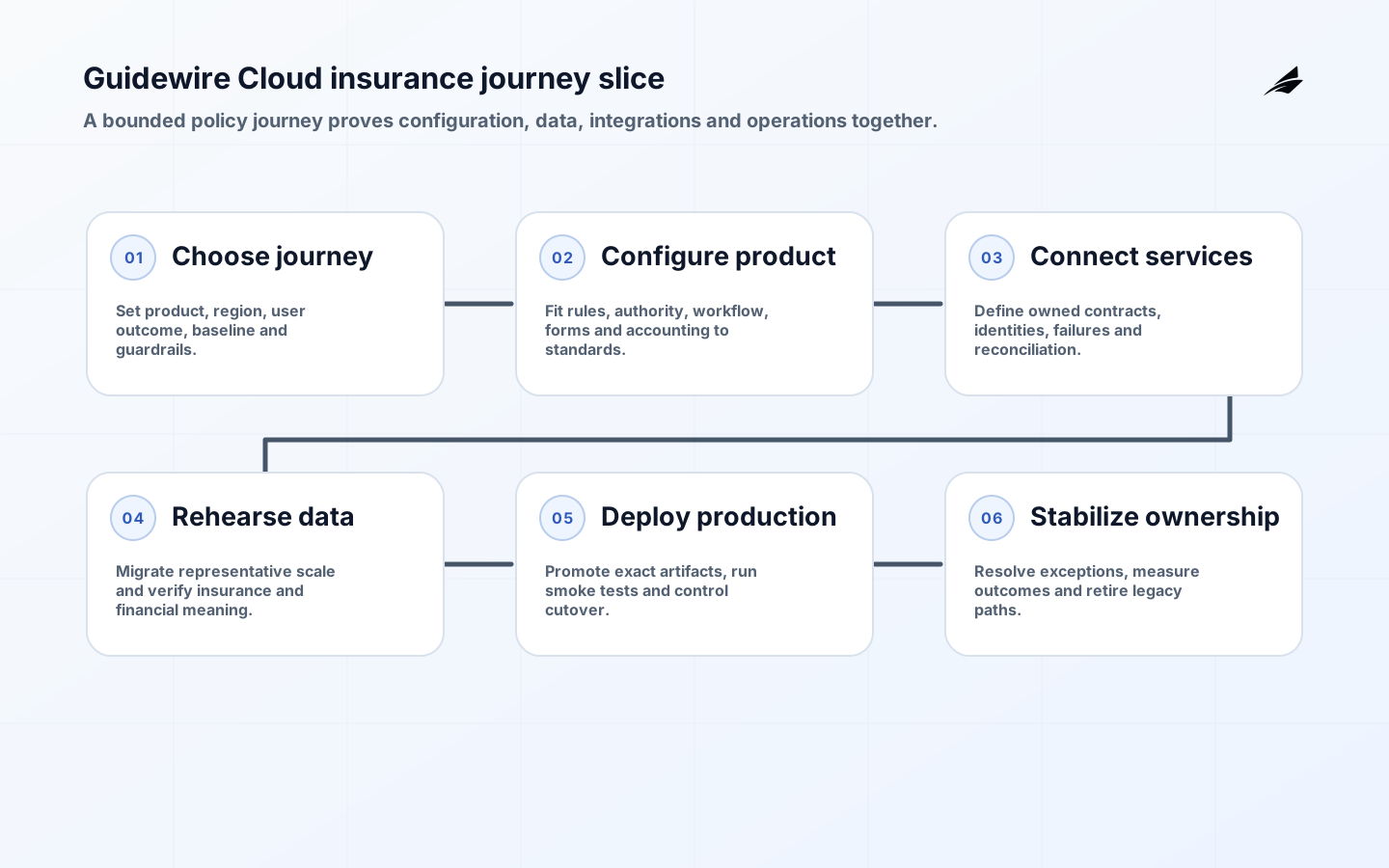
A Guidewire Cloud solution is a core insurance change program, not an infrastructure move. Policy, billing and claims behavior must be redesigned or confirmed; products and authority need configuration; data must reconcile; integrations must survive change; and operations must adopt the platform's release and security model. The program succeeds when a bounded insurance journey works in production with traceable financial and customer outcomes, not when an application instance is provisioned.
This plan is for P&C insurers moving to or expanding Guidewire Cloud. Use the Guidewire Cloud implementation checklist for execution and the Guidewire Cloud FAQ for stakeholder decisions. Teams comparing service models can also review the Guidewire Cloud services delivery guide. Product capabilities and contract terms evolve, so confirm current Guidewire documentation and the insurer's agreement at each architecture and release decision.
Frame the insurance business case
Define the line of business, jurisdictions, distribution channels and operational outcome. Useful goals include shortening product change lead time, improving straight-through processing, giving adjusters a coherent claim workspace, reducing billing exceptions or retiring unsupported core infrastructure. Establish current cycle time, leakage, manual touches, defect, outage, operating cost and customer measures. Separate benefits created by Guidewire capabilities from benefits that depend on process, data or organization change.
| Business decision | Evidence needed | Named owner |
|---|---|---|
| Initial product and region | Volume, complexity, learning value and dependency map | Business sponsor |
| Target operating process | Current exceptions and approved future workflow | Operations lead |
| Configuration policy | Fit-to-standard principles and exception authority | Product owner |
| Migration approach | Book characteristics, data quality and transition risk | Data owner |
| Success measures | Baseline, target, guardrails and measurement source | Benefits owner |
Build the roadmap around complete insurance journeys, such as quote-bind-issue, endorsement, renewal, invoice-payment or first-notice-to-claim-payment. A journey exposes product, workflow, documents, permissions, accounting, data and integrations together. Module-by-module plans can report progress while postponing the cross-system risks until late integration.
Set scope and fit-to-standard rules
Inventory products, forms, rules, roles, authority, reports, interfaces, batch work, data and regulatory variation. Classify each requirement as configure, integrate, extend, change process or retire. Require a business rationale and lifecycle owner for every extension. Recreating a legacy screen or workaround preserves cost and complicates future platform change. Equally, forcing a standard flow that breaks a necessary underwriting or claims control creates operational risk.
| Treatment | Choose when | Approval evidence |
|---|---|---|
| Configure | Supported product, rule, workflow or authority behavior fits | Demonstrated scenario and maintainability review |
| Integrate | Another system remains authoritative or provides a service | Contract, ownership, failure and reconciliation design |
| Extend | Differentiating or mandatory behavior has no supported fit | Value, security, testing and upgrade cost |
| Change process | Legacy behavior adds no required value | Operations and control-owner acceptance |
| Retire | Report, interface or workaround is no longer needed | Usage, retention and dependency confirmation |
Create an extension budget and review it by journey. Complexity accumulates through small decisions in rules, plugins, integrations and data model changes. Record the supported mechanism, owner, tests and removal trigger. Review current Guidewire Cloud Standards and implementation guidance available to the program; do not rely on patterns carried forward from an older self-managed release without validation.
Understand the Cloud Platform delivery model
Guidewire's current documentation describes Cloud Platform capabilities for building, deploying, accessing and observing applications. Initial provisioning includes development code, a CI/CD environment and cloud database infrastructure, while the insurer applies its own configuration and integrations. Documentation describes development, pre-production and production environments and controlled build promotion. Translate this model into the insurer's branch, release, access, evidence and support procedures.
- Confirm contracted applications, environments, regional services, limits and responsibilities.
- Federate workforce identity and automate lifecycle where supported; avoid shared engineering accounts.
- Define repository, branching, review, build promotion and artifact ownership.
- Separate environment configuration, certificates, secrets and runtime properties from source.
- Map Guidewire, implementation partner and insurer support boundaries for every operational component.
- Establish current documentation and release-note review as part of architecture governance.
Keep an insurer-owned architecture map for core applications, integration apps, digital experiences, data services and external platforms. Vendor diagrams explain the platform, not the insurer's complete service. Add payment, document, identity, rating, fraud, repair, banking, regulatory and analytics dependencies with their owners and recovery behavior.
Design data migration and integrations together
Profile policy, account, billing, claim, contact, document, producer and reference data early. Decide which history must be operationally available, which can be archived with usable access, and which should not be moved. Define source-to-target keys, transformations, defaults, code mappings, financial reconciliation and exception ownership. Row counts are insufficient: premiums, receivables, payments, reserves and claim transactions need business totals and sample traceability.
| Integration pattern | Use | Control |
|---|---|---|
| Synchronous API | Immediate lookup or validated command | Timeout, authentication, idempotency and error contract |
| Asynchronous event | Durable state change and decoupled consumers | Schema version, duplicate handling and replay |
| Batch exchange | High-volume or scheduled partner flow | Manifest, completeness, cutoff and reconciliation |
| User link or embedded flow | Specialist experience outside core | Identity propagation, context and session failure |
| Analytical export | Reporting, actuarial or data science | Lineage, privacy, latency and semantic ownership |
Assign one system of record for each state transition. Avoid uncontrolled dual writes between old and new cores during coexistence. If a temporary bridge is required, use durable identifiers and reconciliation, and date its retirement. Test partner limits, delayed responses, duplicate messages and outage recovery. An integration is complete only when support can diagnose it and business owners can reconcile its effects.
Implement shared security responsibilities
Guidewire's security material states that Guidewire provides a cloud foundation while customers retain application-level responsibilities. Confirm the current contractual model rather than inferring it. The insurer should own role design, least privilege, joiner-mover-leaver processes, secrets and certificates under its control, integration identities, data classification, application configuration, security monitoring and incident coordination.
| Control area | Implementation question | Evidence |
|---|---|---|
| Business authority | Can users approve only the right product, amount and jurisdiction? | Role matrix and negative tests |
| Privileged access | Is elevation individual, time-bound and auditable? | Access review and session record |
| Integration identity | Does each service have narrow independent permissions? | Credential inventory and rotation test |
| Sensitive data | Are access, masking, export and retention purpose-bound? | Data-flow and lifecycle verification |
| Incident response | Can insurer and Guidewire coordinate quickly? | Joint scenario and contact validation |
Threat-model customer portals, producer access, service accounts, document and payment paths, and custom extensions. Test authorization at service boundaries, not only through screens. Preserve logs needed for fraud, security and audit while applying privacy and retention rules. Track security exceptions to an owner and expiry, especially when migration deadlines create pressure for broad temporary access.
Build production-quality release evidence
Create layered tests for product rules, rating, underwriting authority, billing, claim financials, documents, integrations, migration, performance, security and critical journeys. Build reusable product examples with expected premiums, forms, transactions and accounting. Automate deterministic regression, then use skilled exploratory testing for complex adjuster, underwriter and billing scenarios. Include accessibility and operational usability in customer and staff experiences.

Guidewire's current production deployment documentation describes preparation, pre-production dry runs using a production database backup, build promotion, smoke tests and deployment verification, with deployment options and rollback behavior subject to supported change types. Build the program runbook from the current release and contract. Rehearse with production-scale data, exact artifacts, certificates and integrations; measure each step and define the point of no return.
- Promote the exact reviewed build and configuration through controlled environments.
- Restore and protect production-derived data according to insurer policy.
- Run migration, batch, integration and high-value journey reconciliation in the rehearsal.
- Verify application status, nodes, smoke tests and business transaction totals after deployment.
- Prepare rollback, forward-fix and communication paths for each failure class.
- Require business, technology, security and operations owners to accept evidence before cutover.
Cut over by controlled business wave
Choose transition by product, state, cohort or renewal where the insurance book permits. A big-bang conversion may simplify coexistence but concentrates data, integration and operational risk. Phased migration reduces concentration while requiring routing and cross-system service. Decide how call-center staff, producers, adjusters, finance and reporting locate the authoritative record during the transition.
Create a command center with one incident taxonomy and decision authority. Monitor quote, bind, issue, payment, document, claim and financial flows, not merely application health. Route data and integration exceptions to teams that can correct and reconcile them. Define stabilization exit using error rate, backlog, manual work, user proficiency, customer impact and close-cycle evidence. Transfer the remaining work into durable product and platform teams rather than dissolving knowledge at go-live.
Estimate cost and manage the largest risks
Total cost includes subscription and usage terms, implementation partner, insurer product experts, data remediation, integrations, environments, testing, security, training, change, cutover and post-launch product ownership. Model volume, growth and optional services under the current contract. Compare against avoided legacy infrastructure, upgrade, license and operational cost, but do not count savings until the old systems, interfaces and contracts are actually retired.
| Risk | Early indicator | Response |
|---|---|---|
| Legacy replication | Rising extension count and unchanged process | Fit-to-standard review with business authority |
| Data surprise | Unowned mappings and growing exceptions | Profile earlier and rehearse reconciliation |
| Integration fragility | Late contracts and manual recovery | Build journey slices and failure tests |
| Release bottleneck | Large branches and unstable regression | Smaller changes, automation and current platform guidance |
| Operational rejection | Training without role practice and duplicate work | Involve users, simplify workflow and support waves |
| Perpetual coexistence | No retirement owner or date | Fund decommissioning as a release outcome |
Key takeaways
- Treat Guidewire Cloud as an insurance operating-model and core-product change.
- Scope complete insurance journeys and govern every configure, integrate, extend or retire decision.
- Reconcile financial and operational meaning, not only migrated record counts.
- Adopt the platform's current promotion and security model while owning insurer-specific controls.
- Rehearse production, support transition waves and fund legacy retirement explicitly.
Frequently asked questions
Can Guidewire Cloud be customized?
It supports configuration, integrations and supported extension mechanisms, subject to current standards and contract. Use the least complex supported mechanism and justify extensions through business value, security, testing and future-change cost.
Should all historical policy and claim data migrate?
Not automatically. Decide from operational need, customer service, regulation, litigation, analytics and archive usability. Prove that retained history remains accessible and linked without loading low-value complexity into the new core.
How long does a Guidewire Cloud implementation take?
Duration depends on products, regions, data quality, integrations, extensions, testing and transition strategy. Estimate by journey and evidence gate. A narrow product wave can deliver learning earlier than a portfolio-wide cutover.
What should an implementation partner own?
The partner can lead configuration, engineering, migration and integration delivery, but insurer owners must retain product, risk, data, architecture and release decisions. Require transparent artifacts, platform-aligned skills and continuous knowledge transfer.
Conclusion
Guidewire Cloud can provide a modern delivery and operating foundation for core P&C workflows, but value comes from disciplined insurance design and transition. Bounded journeys, fit-to-standard governance, reconciled data, resilient integrations, shared security and rehearsed production evidence give the program a credible route from provisioned platform to dependable insurance operation.