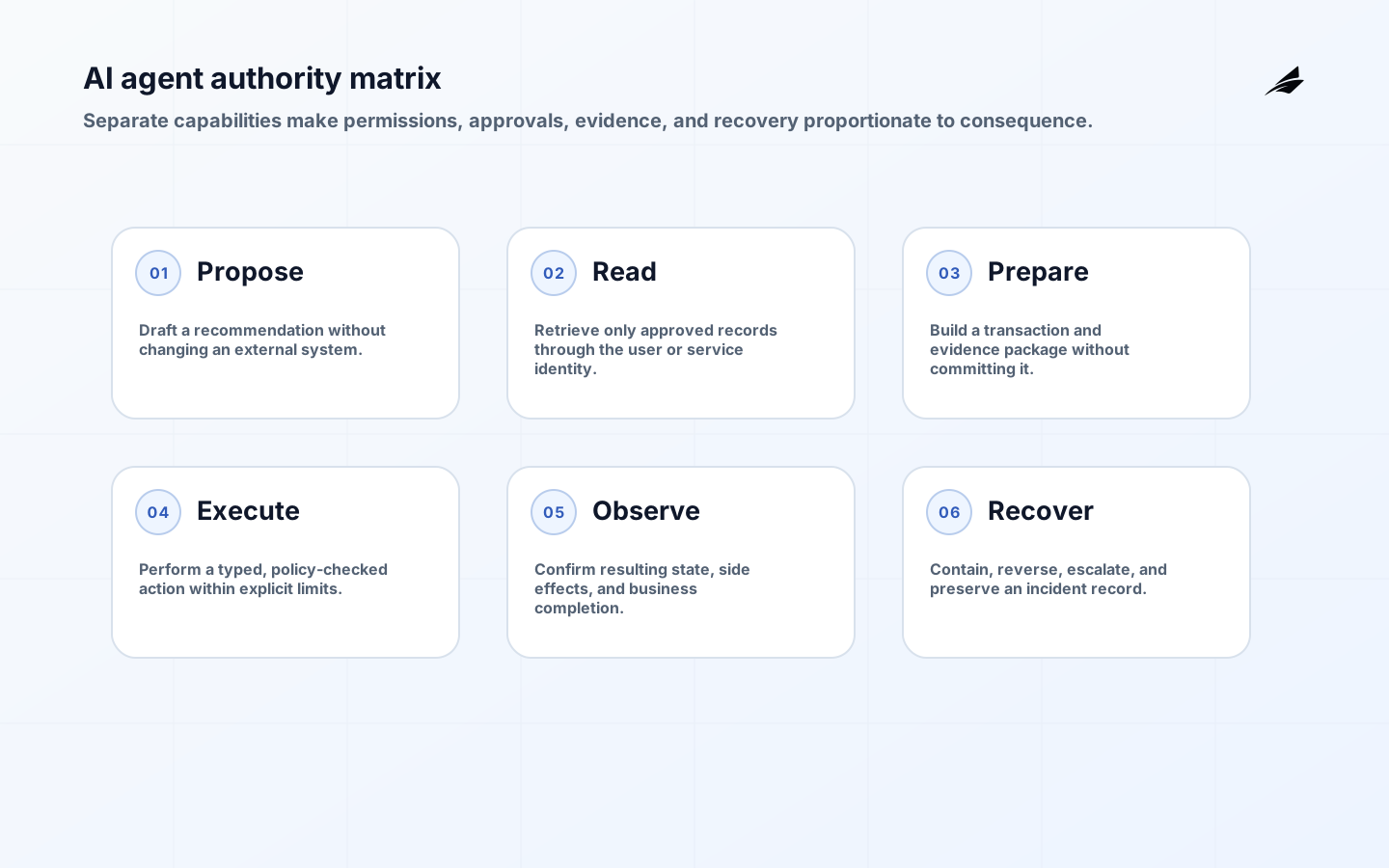
AI Agent Control Plan for Business Workflows begins with a distinction that is easy to miss: an agent can propose work, gather information, or execute an action, and each level needs different controls. Calling all of them “automation” hides where authority actually sits. A system that drafts a service response is not equivalent to one that changes an order or grants access. A control plan gives product, operations, and security teams a shared description of what the agent is permitted to attempt, what independently enforces that permission, and what evidence remains after a result. The NIST AI Risk Management Framework helps frame these choices around real impact rather than around enthusiasm for autonomy.
Define the agent’s authority in business terms
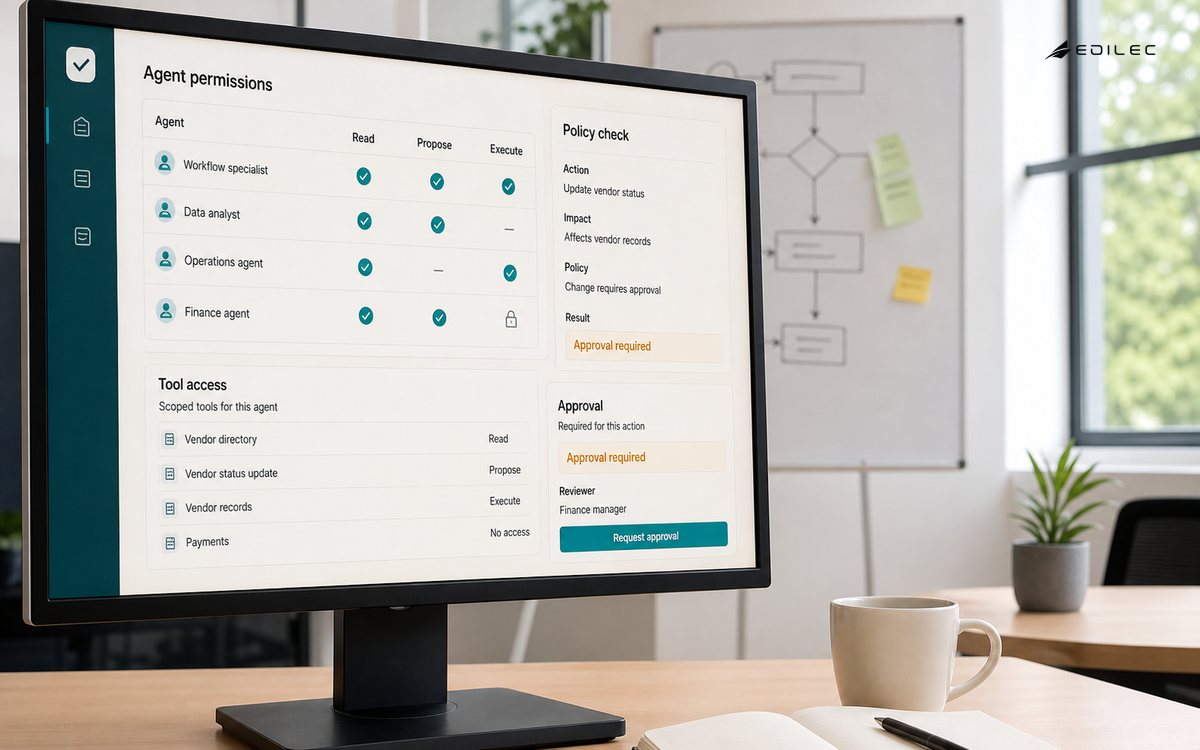
List the workflows the agent supports, users it serves, data it may read, tools it may call, state it may change, monetary or safety limits, and conditions that require human approval. State prohibited actions just as clearly. Then map each permission to the system that enforces it: identity provider, application policy, database row policy, payment rule, or service API. An instruction in a prompt is not an enforcement point. The agent should receive the minimum context and the minimum tool scope for the current job, rather than a standing credential that can reach every system it might someday need.
| Authority level | Example | Required control |
|---|---|---|
| Inform | Summarize permitted case records. | Read authorization, citations, and output handling. |
| Prepare | Draft a change or route a ticket. | Schema validation, owner, and editable preview. |
| Recommend | Propose an approval or exception. | Evidence packet and independent decision rule. |
| Execute | Apply a permitted system change. | Current policy check, confirmation or approval, audit, and recovery. |
Use scoped tools and independent policy checks
Design tools around narrow business tasks and validate them at the server. A tool should confirm the user, tenant, role, target record, amount or time limit, and current state before it acts. Give write operations an idempotency key and make them return a durable outcome reference. The OWASP Top 10 for LLM applications provides important context for prompt injection and excessive agency: content seen by an agent may attempt to redirect it, but downstream policy must remain based on authenticated context and trusted business rules.
Place approvals where consequence increases
Approval can be required by action type, value, customer segment, data sensitivity, or uncertainty. Keep it specific: show the approver what will change, the reason, the source evidence, and the expiry of the authorization. For routine low-impact actions, a deterministic rule may provide a faster independent check. For exceptions, route a packet to a qualified person. Avoid an approval button that merely rubber-stamps a long model response. The design should make the material choice understandable and should allow a reviewer to edit the proposed action or send it back with a reason.
| Event | Record needed | Why it matters |
|---|---|---|
| Agent starts task | User, purpose, policy context, and tool set. | Explains what the agent was allowed to attempt. |
| Tool denied | Rule, target class, and safe reason. | Supports investigation without leaking protected data. |
| Action approved | Approver, scope, and expiry. | Separates decision authority from generation. |
| Action completed | Before and after state and correlation ID. | Allows reconciliation, correction, and audit. |
Monitor behavior and rehearse recovery
Track tool calls by type, denial rate, retries, action latency, approval age, correction rate, and unusual sequences such as large exports or repeated failed attempts. Pair metrics with trace samples that let an operator see the business context. Define how to disable a tool, revoke an integration credential, pause a workflow, reconcile partial actions, and notify affected owners. The MITRE ATLAS knowledge base can help teams explore adversarial tactics, but the response plan should be rehearsed against the exact systems and permissions the agent uses.
- Give each agent workflow an explicit business owner and technical owner.
- Limit tools to task-shaped operations with server-side validation.
- Use current policy and system state to authorize every material action.
- Create an approval packet that makes consequences easy to inspect.
- Retain outcome references and rehearse disabling or reconciling the workflow.
Turn the plan into release and operating practice
Review the plan whenever a model, tool, source system, permission, or workflow state changes. Test normal work, malformed inputs, prompt injection, revoked access, duplicate delivery, provider outage, and partial completion. Include operational staff in these exercises because they know which changes are hard to undo and which exceptions need urgency. A control plan that is embedded in tool contracts, policy tests, dashboards, and incident playbooks is more valuable than an impressive diagram that nobody consults after launch.
Use scenarios to find missing controls
Review agent outcomes with the domain owner at a regular cadence. They can identify subtle changes in customer commitment, financial treatment, or operational safety that a technical metric may not reveal. Pair their observations with the audit record and policy-denial data, then update tool boundaries or approval thresholds when evidence supports it. This keeps the control plan connected to the changing reality of the workflow instead of freezing it at launch.
Keep the plan readable for the people who will operate it at two in the morning, not only for the people who approved it. A concise control summary should identify the agent’s permitted tasks, current tool scopes, high-impact approval points, alerts, disable steps, and escalation contacts. Link each item to the detailed implementation or runbook, but do not require an incident responder to decipher a long policy before they can pause a risky action. Clear operational materials are a control in their own right because they reduce delay and uncertainty during a failure.
Use a tabletop exercise to connect the control plan to people and systems. Give the team a realistic request, an unexpected document instruction, a policy denial, and a downstream timeout. Ask the product owner what the user should see, ask the technical owner where enforcement occurs, and ask the operator how they would find and correct the affected work. Note every answer that depends on a person's memory or a hidden dashboard. Those are practical gaps to close before a broader rollout, and the exercise is much cheaper than discovering them during a customer incident.
Consider an agent asked to expedite a delayed customer order. It may retrieve the order, identify an approved shipping rule, and draft the update. But before it changes the order, the service should verify the requester’s authority, inventory status, delivery cutoff, and any commercial limit. If those conditions are unavailable, the correct result is a review packet, not a confident promise to the customer.
Consider an agent that handles account access requests. A malicious document or email may contain instructions intended to make the agent reveal another user’s records. The agent should treat that text as untrusted content, while the tool checks the authenticated requester, target account, and authorization policy. A denial should be clear enough for the support process to continue but should not expose why another account is protected.
Consider a downstream timeout after an approved refund request. The control plan needs an idempotency key, a way to query outcome status, an alert for unresolved cases, and a human correction route. Without those elements, retry behavior can create duplicate financial events and leave staff reconstructing the truth from inconsistent messages.
Use assurance cases for consequential agent actions
A consequential agent action should carry a small assurance case: what business objective authorized it, which identity initiated it, what data and tools influenced it, which policy decision allowed it, what changed, and how the change can be reversed. This evidence is more useful than a transcript alone. Transcripts may contain sensitive data and model reasoning that is inconsistent or incomplete; the control record should instead capture durable facts about inputs, permissions, approvals, tool calls, outputs, and resulting system state.
| Control boundary | Enforcement point | Evidence to retain |
|---|---|---|
| Business authority | Workflow policy and case state | Objective, requester, permitted action, amount or scope limit |
| Identity and tenancy | Identity provider, token broker, and resource policy | Actor, tenant, role, delegated authority, and token lifetime |
| Tool use | Typed tool gateway with allowlisted operations | Validated arguments, target resource, response code, and changed record |
| Human approval | Independent approval service | Approver identity, evidence shown, decision, conditions, and expiry |
| Recovery | Compensating workflow or reversible transaction | Original action, containment step, restoration result, and incident owner |
Independent enforcement is essential. A prompt that says not to exceed a refund limit is guidance; an authorization service that refuses the operation is a control. The NIST Generative AI Profile extends the AI RMF with generative-AI risks, while MITRE ATLAS catalogs adversarial tactics relevant to AI-enabled systems. Use those references to design abuse cases such as injected instructions, poisoned retrieved content, compromised tools, privilege escalation, and misleading confirmations.
The broader Edilec library explains agent tool permissions, human approval design for AI automation, and policy engines for AI workflows. Combine them with an AI agent control plan so product, security, and operations teams can test the same boundary before release and during an incident.
Key takeaways
- Agent capability should be described as business authority, not as a vague autonomy level.
- Prompts cannot replace server-side authorization, validation, and state checks.
- Approvals work when they present a concise, inspectable consequence.
- Every material tool action needs a durable event and reconciliation path.
- Scenario testing exposes control gaps before real customers or records do.
Frequently asked questions
Should an agent have a permanent service account?
Avoid broad, permanent privileges where a scoped, short-lived credential or delegated user context is possible. The right design depends on the system, but the objective is consistent: bind the action to an authorized purpose, limit what the credential can do, and make revocation and investigation practical.
Does every agent action need a human approval?
No. Low-impact, reversible, and well-bounded actions can be automated when independent policy checks and monitoring are in place. Use human review when impact, ambiguity, novelty, or access sensitivity makes automated execution inappropriate. The threshold should be a documented product decision, not an accident of implementation.
Conclusion
An agent control plan makes capability easier to use responsibly because it draws a line between helpful preparation and accountable action. Give the agent narrow authority, enforce rules outside the model, preserve evidence, and prepare for recovery. Those controls let automation grow without making operations mysterious.