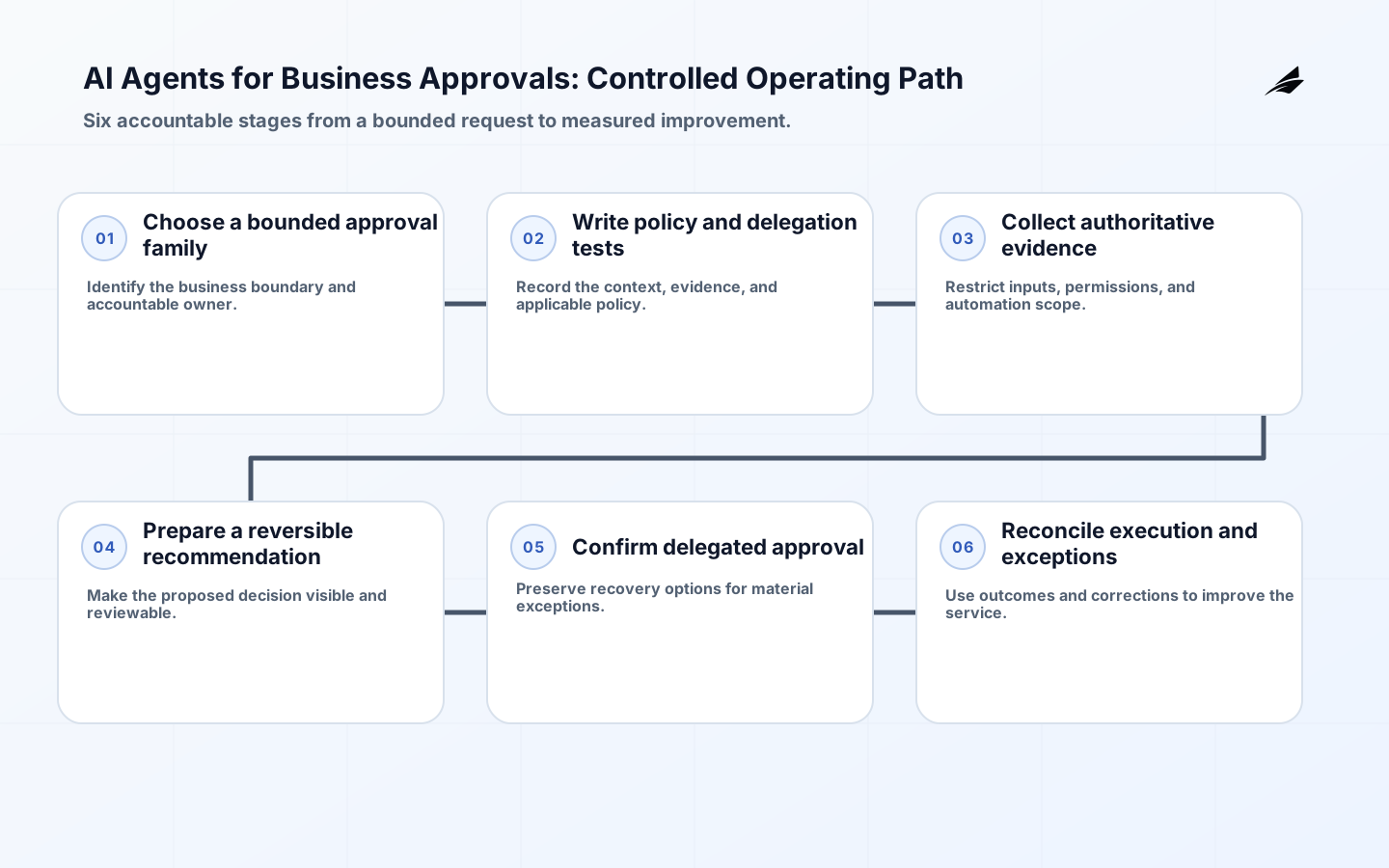
AI agents for business approvals are useful only when they make a specific piece of work easier to complete without blurring who owns the result. For founders, finance leaders, product owners and engineering leads, that means treating an agent that assembles evidence and proposes an approval for spending, supplier onboarding, discounting, or a launch decision as an operating capability rather than a conversational feature. An approval is a business commitment, so an agent that can initiate actions without bounded authority can create financial, legal, and customer harm faster than a manual process. Begin with one real case and follow it from request to outcome with the people who do the work today. The practical question is not whether a model can produce a fluent response; it is whether the workflow can show what it used, what it was allowed to do, who could disagree, and how the team recovers when the answer or handoff is wrong.
Define the AI agents for business approvals decision boundary
Write the first release as a case contract. An agent may collect facts, compare them with a written policy, and prepare a recommendation; only a delegated approver can bind the company or release funds, terms, access, or a public commitment. Name the initiating event, the accountable business owner, the sources of truth, the permitted assistant behavior, and the state that proves completion. Then document the refusal path: what the service must hold, escalate, or decline when evidence is missing. This is where a project becomes testable. It lets product, operations, security, and engineering distinguish an incomplete recommendation from a binding action, and it stops an attractive demonstration from becoming an undocumented policy engine.

| Control question | Checklist decision | Evidence to retain |
|---|---|---|
| Business outcome | State the measurable outcome for an agent that assembles evidence and proposes an approval for spend, supplier onboarding, discounting, or a launch decision, including the person accountable for quality and harm. | Case identifier, owner, baseline, and acceptance criteria. |
| Authoritative inputs | List the records that may inform the service and the sources it must ignore or treat as untrusted. | Source owner, version, effective date, access decision, and retrieval or intake trace. |
| Action boundary | requires a human approver whose authority matches the amount, entity, category, and exception being considered | Policy rule, authority decision, confirmation, and execution result. |
| Exception handling | Design a visible route for prompt injection in an attached document, missing conflicts of interest, changed approval authority, duplicate execution, and a recommendation built from stale records. | Reason code, assignee, service target, resolution, and any downstream repair. |
| Recovery | Define how to pause automation, preserve evidence, and return work to a safe manual process. | Pause event, affected cases, reconciliation record, and restart approval. |
Make evidence useful to the person who must act
Evidence is not a long transcript. It is the compact record that allows an operator or reviewer to answer: what happened, what does the system propose, why, and what may happen next? For this use case, keep the request, policy version, source records, delegated authority, conflicts, recommendation, approver identity, decision, and any post-approval change. Preserve enough context to reconstruct a decision without indiscriminately retaining sensitive prompts or documents. Version the model, instructions, tools, retrieval configuration, and policy together. A later reviewer should be able to tell whether a problem arose from poor source material, changed access, a model behavior, an integration defect, or a human operating decision.
Design the worker experience around informed intervention. Show the original case facts separately from generated text, make uncertainty visible, and give the person a practical route to correct, defer, reject, or escalate the suggestion. The reviewer must not need a second dashboard or private chat to discover the relevant record. Capture a short reason for material changes so the team can improve the service without turning review into bureaucratic narration. The workflow requires a human approver whose authority matches the amount, entity, category, and exception being considered. When the answer is not supported by the permitted evidence, abstention is a valid and often safer outcome.
Test the normal path and the awkward path
Build an evaluation set from actual work, not only clean examples that resemble a product demo. Include normal cases, changes in source data, ambiguous requests, incomplete information, denied permissions, and the failures people currently resolve by experience. For AI agents for business approvals, test prompt injection in an attached document, missing conflicts of interest, changed approval authority, duplicate execution, and a recommendation built from stale records. Run those cases through the full system boundary, including identity, retrieval or intake, tools, policy checks, human queues, and downstream confirmation. Agree in advance which outcomes are acceptable, which must be reviewed, and which require the workflow to stop. A test that only grades wording cannot prove that an operational system behaves safely.
| Test condition | Expected behavior | Operational measure |
|---|---|---|
| Ordinary eligible case | Complete the permitted assistive step and show the evidence needed for the next decision. | recommendations with complete evidence |
| Evidence is incomplete or conflicts | Hold the case, name the missing fact, and route it without fabricating a resolution. | approval cycle time split by normal and exception paths |
| Identity, policy, or permission fails | Deny the protected action at the enforcement point and retain a useful reason. | policy exceptions and unauthorized attempts |
| Dependency or model service is unavailable | Preserve the case and use the documented manual or deterministic fallback. | duplicate or failed downstream executions |
| A person corrects the result | Record the correction, protect the original trace, and turn recurring defects into owned work. | rate at which approvers change the proposed outcome |
Release a bounded service, not a broad promise
Start with a low-value, repeatable approval where the policy and source records are already stable. This slice should include the common path, one consequential exception, a named support route, and a way to reconcile the result against the system of record. Do not expand because a small pilot looks popular; expand when the team can explain its errors, measure its queue behavior, and operate its fallback. Assign owners for business policy, data quality, technical reliability, security, and user support. Meet after launch with a sample of completed, rejected, and unresolved cases. That operating review is where a workflow earns the right to take on more volume or more authority.
- Observe one end-to-end case before selecting a model or tool for AI agents for business approvals.
- Write the allowed action, prohibited action, decision owner, and closure evidence in one case contract.
- Keep authoritative records and entitlement checks outside generated prose.
- Test the normal path, a realistic exception, an unauthorized request, and the manual fallback.
- Give reviewers enough context, authority, time, and a visible way to disagree.
- Use corrections, overrides, and near misses to update the source, policy, tests, or design.
Measure signals that lead to an operating decision
A useful dashboard connects a signal to an owner who can change something. Track recommendations with complete evidence; approval cycle time split by normal and exception paths; policy exceptions and unauthorized attempts; duplicate or failed downstream executions; rate at which approvers change the proposed outcome. Define the numerator, denominator, time window, exclusions, and review cadence before publishing the number. Pair speed with a quality or harm signal, because a shorter cycle can conceal a growing correction backlog. Break results down by meaningful case characteristics rather than relying on one aggregate score. Review a small sample of cases with the people who performed the work; their explanations often expose a source, policy, capacity, or interface problem that a chart cannot diagnose.
Key takeaways
- AI agents for business approvals need an explicit decision boundary before they need more automation.
- Evidence must support the next accountable action, not merely explain a model output after the fact.
- Human review is meaningful only when the reviewer has context, authority, time, and a real ability to disagree.
- Permission checks and policy controls belong at the protected action, not only in instructions to the model.
- A narrow pilot with a real exception and fallback teaches more than a wide launch with optimistic metrics.
Frequently asked questions
How narrow should the first AI agents for business approvals release be? Make it narrow enough that one business owner can state the outcome, one team can observe the entire case path, and a reviewer can inspect the evidence without stitching together multiple systems. Include an ordinary case and at least one exception that matters. Exclude adjacent work whose policy, owner, source data, or recovery path is still unsettled. The goal is a dependable operating pattern, not a claim that the service understands every request.
Can an approval agent approve routine requests on its own? It can prepare a routine recommendation, but a binding approval needs delegated authority and a policy that clearly permits automation at that amount and risk level. Keep the agent's evidence gathering separate from the approver's decision, verify the authority at the moment of approval, and reconcile the downstream action. That separation prevents convenience from quietly becoming an uncontrolled commitment.
Conclusion
The durable version of AI agents for business approvals is a service that helps people complete bounded work while preserving accountable judgment. Set the boundary, make evidence available, test failure behavior, and release with a manual recovery route. When the operating signals show that the team can detect and repair problems, expand deliberately. That is how AI assistance becomes a reliable part of the workflow rather than another source of untracked risk.