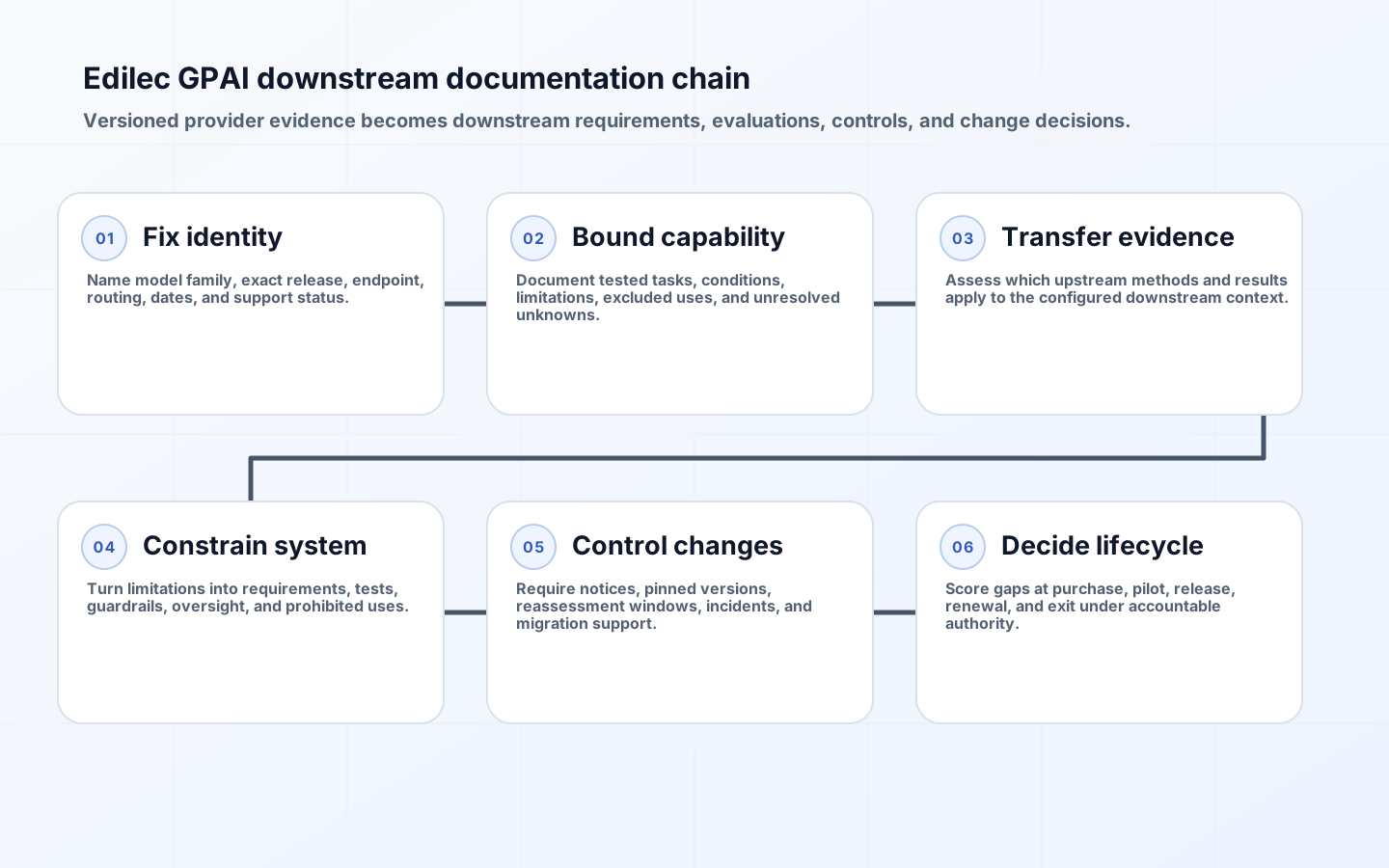
GPAI downstream provider documentation is the evidence bridge between a reusable model and a system that must work in a specific context. A downstream builder needs more than a feature page and benchmark chart. It must understand model identity, capabilities, limitations, interfaces, input and output conditions, evaluation methods, data and copyright information relevant to integration, safety controls, security, changes, and support. Without that package, the builder cannot design appropriate tests, instructions, human oversight, monitoring, or change control.
Article 53 of Regulation (EU) 2024/1689 requires GPAI model providers to maintain technical documentation and make information and documentation available to downstream AI-system providers so they can understand capabilities and limitations and comply with their obligations. The Commission's GPAI Q&A also distinguishes model-level duties from system-level requirements. Documentation enables downstream work; it does not perform that work for the integrator.
Define what remains downstream accountability
The downstream provider defines the AI system's intended purpose, user experience, retrieval and tool integrations, prompts, policies, output consumers, human oversight, monitoring, and release decision. It must evaluate the assembled system in its context. A strong base-model report cannot establish that a benefits assistant gives lawful advice, a recruiting workflow treats candidates appropriately, or a support agent executes refunds safely. System behavior emerges from the model plus data, orchestration, controls, users, and operating environment.
Assign an internal evidence owner before procurement. That person coordinates architecture, evaluation, security, privacy, legal, procurement, and product reviewers; records gaps and compensating actions; and keeps the package current. Treat unknown information explicitly. A vendor's confidentiality concern may justify controlled disclosure, but a critical unknown still affects whether the use can proceed.
Request a structured GPAI downstream provider documentation package
Ask for a machine-readable inventory plus human-readable documents. The inventory should name model family, exact versions, release and retirement dates, modalities, context limits, supported languages, regions, hosting, interfaces, dependencies, and change channels. The narrative package should explain intended and excluded uses, capability boundaries, evaluation design, known limitations, risk mitigations, security assumptions, and downstream integration duties. Require document version, effective date, owner, confidentiality class, and update trigger.

| Evidence domain | Minimum request | Downstream decision | Red flag |
|---|---|---|---|
| Identity and lifecycle | Model IDs, versions, dates, support and retirement | Pin, migrate, and reproduce | Silent alias changes |
| Capabilities and limits | Tasks, modalities, languages, context, known failure modes | Set intended use and guardrails | Only marketing claims |
| Evaluation | Methods, data provenance, slices, conditions, raw or detailed results | Design system tests and thresholds | One aggregate score |
| Interfaces and controls | APIs, parameters, filters, logging, tool behavior | Build secure orchestration | Undocumented defaults |
| Change and incidents | Notices, severity, timelines, corrective support | Operate monitoring and rollback | No binding notification |
Translate capabilities and limitations into design constraints
Capability documentation should describe the tasks and conditions under which evidence was collected, not claim generalized intelligence. Capture modality, language, domain, prompt sensitivity, long-context behavior, uncertainty, tool use, adversarial robustness, and observed failure modes. Ask what was not tested. A model may perform well on a public benchmark yet fail on your document formats, jargon, accessibility needs, latency budget, or high-consequence edge cases.
Convert each material limitation into a system requirement: retrieval grounding, restricted scope, mandatory source display, human confirmation, structured output validation, blocked action, monitoring signal, or prohibited use. The Commission's GPAI provider guidelines page emphasizes helping downstream providers understand model capabilities and limitations. A document becomes useful only when requirements and tests reference it.
Test whether upstream evaluation transfers to your context
Build an evaluation crosswalk with upstream claim, test population and data, model version, inference settings, metric, threshold, limitations, and your corresponding system test. Mark each claim as transferable, partially transferable, or non-transferable. Re-run critical behavior with production prompts, retrieval, tools, policy filters, and representative users. Include the current non-AI process as a baseline and measure failure severity, not only frequency.
Request enough methodology to understand leakage, contamination, grader reliability, sample selection, and confidence. For safety evaluations, ask which mitigations were active and whether results apply to API, hosted product, or downloadable weights. Store test artifacts with the exact release. Edilec's quality assurance guide provides a useful risk-based structure for deciding test depth.
Separate regulatory transparency from data rights
Article 53 includes provider duties relating to a Union copyright policy and a public summary of training content. The Commission's obligations Q&A summarizes these duties and the open-source conditions. A public training-content summary supports transparency, but it is not automatically a complete data lineage, warranty, license grant, or indemnity for every downstream use.
Procurement should separately assess customer-input use, retention, training opt-in or opt-out, subprocessors, data locations, deletion, generated-output terms, rights reservations, confidentiality, personal-data roles, and claims support. Ask which data terms differ by product tier and whether abuse monitoring involves human access. Link decisions to the data model documentation discipline so production flows match contract assumptions.
Contract for model changes and evidence continuity
Model behavior can change without your application deployment. Require advance notice for version, weights, fine-tuning, system prompt, safety policy, filter, tool interface, context limit, data handling, geography, pricing that changes architecture, and deprecation. Define materiality by impact on validated behavior or obligations, not solely by the vendor's version label. Preserve access to pinned versions long enough to evaluate and migrate.
| Change class | Notice and evidence | Downstream action | Fallback |
|---|---|---|---|
| Compatible patch | Release note and affected behavior | Targeted regression | Continue prior release |
| Model upgrade | Updated card, evaluations, limitations, migration guide | Full risk-based reassessment | Pinned version |
| Safety-control change | Policy delta and test evidence | Revalidate blocked and allowed behavior | Local enforcement |
| Data-term change | Contract and flow impact | Privacy, legal, and architecture review | Disable optional processing |
| Retirement | Timeline, export, successor evidence | Migration and exit test | Alternative provider or local model |
Create a release quarantine: new vendor versions enter evaluation before production routing. Use canary traffic only where affected-person and data risks permit it. If the API alias moves automatically, place a gateway or configuration control in front of it. Require incident cooperation, relevant logs, root-cause information, corrective timelines, and notification of serious model or security events that affect your system.
Score evidence quality before pilot and renewal
Score completeness, specificity, recency, version linkage, methodological transparency, contract enforceability, update mechanism, and ability to verify. Weight each domain by use-case risk. A missing low-value benchmark may be acceptable; missing security boundaries or model-change notice may block a consequential deployment. Record conditions, compensating controls, owner, and deadline instead of averaging every weakness into a reassuring total.
Use the procurement workflow guide to route exceptions and the AI governance operating model to assign acceptance authority. The GPAI Code of Practice page can help reviewers understand one voluntary route providers may use for relevant obligations, but adherence does not remove product-specific diligence.
Define acceptance criteria for documentation gaps
Classify requested evidence as mandatory, conditionally required, or informative for the specific use. Mandatory evidence might include production model identity, relevant limitations, data terms, security boundaries, and change notification. A gap can be closed by direct evidence, independent assurance, buyer testing, architecture constraint, or a narrower use. Some gaps cannot be compensated, especially when the buyer cannot identify what runs or how sensitive inputs are used.
Maintain a gap ledger with question, risk, vendor response, evidence, owner, due date, compensating control, decision authority, and expiry. Do not mark an item complete because the vendor held a meeting; link the answer that changed the decision. Renewal should reopen waivers and compare promised documentation improvements with delivery. Repeated evasive or unverifiable answers are themselves a supplier-risk signal.
For multi-model products, require a routing description. The service may select among proprietary, third-party, regional, or smaller models based on cost or task. Ask whether routing is deterministic, what metadata leaves your environment, which documentation applies to each route, and how logs identify the actual model used. A product-level name cannot support reproducibility if the underlying executor is hidden.
Create a controlled question set shared by procurement and engineering so vendor answers do not fragment across email. Each question should state why it matters, acceptable evidence forms, responsible reviewer, and linked requirement. Let the supplier update one canonical response with version history. This reduces repeated requests while making contradictions visible, such as a sales answer promising no retention and a technical document describing abuse-monitoring storage.
Test the package with one integration decision before signing. Ask engineers to set a version pin, evaluators to identify applicable test claims, security to map trust boundaries, and product to state prohibited uses. If they cannot act without a new vendor meeting, the documentation is not yet operationally sufficient. Record the unresolved decisions and require written evidence before expanding the pilot.
Key takeaways
- Treat upstream documentation as input to downstream system design and evaluation, not as inherited compliance.
- Request versioned evidence on identity, capabilities, limits, evaluation, interfaces, data, controls, changes, and incidents.
- Translate every material limitation into a system requirement, test, operating control, or prohibited use.
- Distinguish public training-content transparency from contractual data rights and warranties.
- Contract for advance change notice, pinned-version continuity, reassessment time, incident cooperation, and exit.
Frequently asked questions
Is a model card enough for downstream compliance?
No. It can describe the model, but the downstream system needs contextual evaluation, role and risk classification, data and integration controls, instructions, oversight, monitoring, contracts, and lifecycle evidence.
What if the provider cites trade secrets?
Use confidentiality controls, clean rooms, summaries, third-party assurance, or contractual access where appropriate. Then decide whether remaining unknowns are tolerable for the use; confidentiality does not make the risk disappear.
Do open-source models eliminate documentation needs?
No. Particular provider obligations may have conditions or exemptions, but builders still need model identity, provenance, licenses, evaluation, limitations, security, modification, and system-level evidence.
Conclusion
Good GPAI downstream provider documentation makes a model governable inside a real product. Demand evidence that can be tied to versions, requirements, evaluations, contracts, and change events. Keep upstream and downstream accountability distinct, close critical unknowns before release, and preserve a path to revalidate or exit. The goal is not the largest document pack; it is enough reliable evidence to build and operate the resulting AI system responsibly.