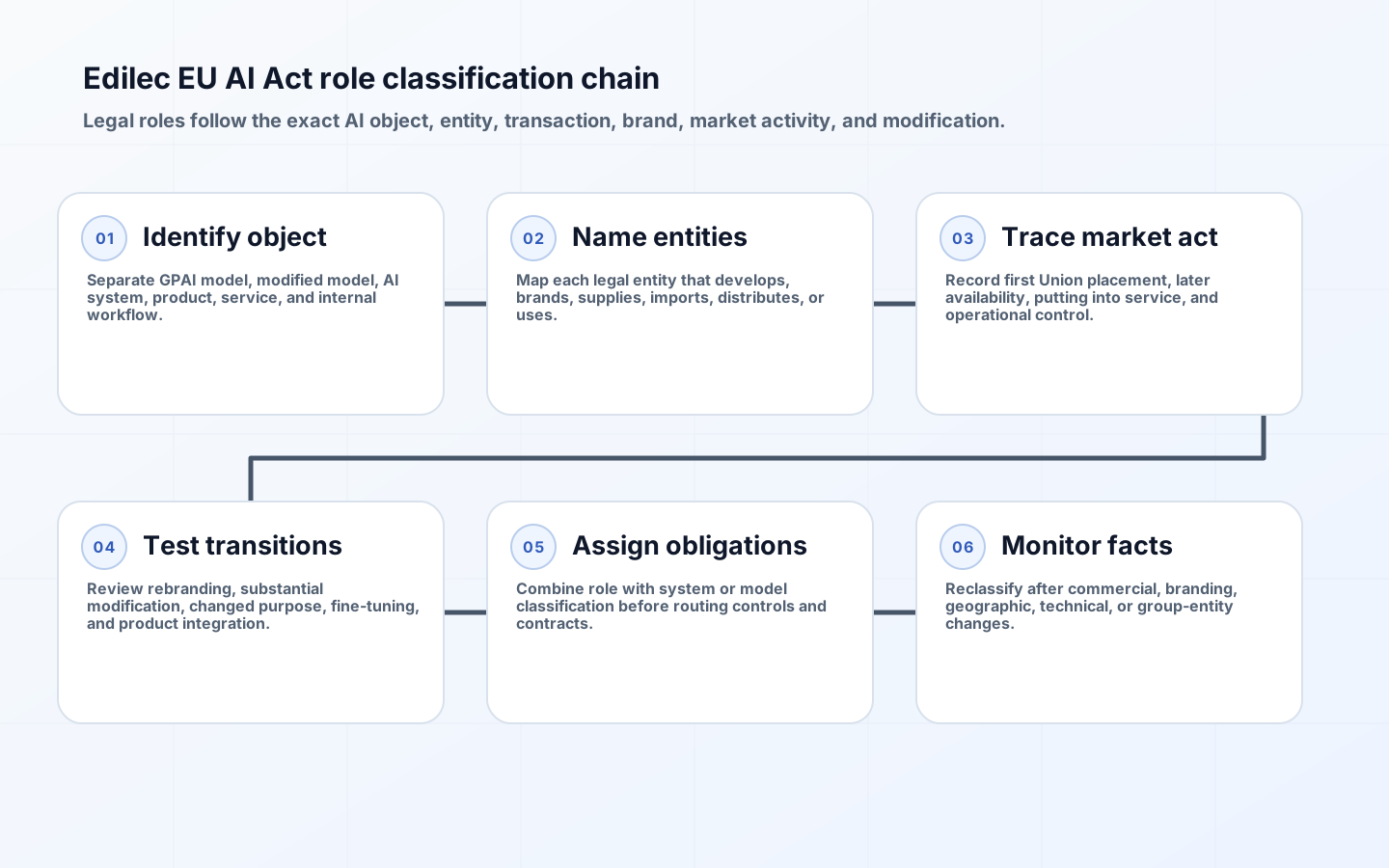
EU AI Act provider vs deployer classification cannot be answered once for an entire company. One organization may provide a branded AI system, deploy another supplier's system internally, import a third-country system into the Union, and distribute a separate product. Roles attach to facts around a particular AI system or general-purpose AI model and a particular market activity. Classify each transaction before assigning controls, contract terms, technical documentation, or conformity work.
The controlling source is Regulation (EU) 2024/1689. Commission materials help implementation but do not replace the enacted text or authoritative judicial interpretation. This guide turns role definitions into an evidence workflow; product counsel should confirm conclusions for material cases, especially rebranding, substantial modification, fine-tuning, and cross-border supply.
Start with the Act's defined market roles
A provider develops an AI system or GPAI model, or has it developed, and places it on the market or puts an AI system into service under its own name or trademark. A deployer uses an AI system under its authority, excluding personal non-professional activity. An importer is established in the Union and places on the market a system bearing the name or trademark of a person established outside the Union. A distributor in the supply chain makes a system available on the Union market and is neither provider nor importer.
These labels are not synonyms for software vendor, customer, reseller, or integrator. A customer that rebrands a high-risk system or substantially modifies it can acquire provider duties. A cloud marketplace may perform distribution activity, but factual control and contractual structure matter. A systems integrator can be a deployer for its own operations and a provider for a customer-facing solution under its brand.
Classify the exact system and transaction
Define the object first: base model, modified model, AI system, product containing a system, managed service, or internal workflow. Record who developed it, who commissioned development, whose name or trademark appears, who first supplies it in the Union, who makes it available afterward, who controls its operational use, and whether anyone changed intended purpose or made a substantial modification. Preserve contracts, product pages, labels, technical architecture, release records, and market dates.

| Commercial scenario | Likely role to investigate | Decisive facts | Evidence |
|---|---|---|---|
| EU company buys SaaS AI for staff | Deployer | Use under its authority; supplier retains brand | Subscription, configuration, use policy |
| EU company launches white-label AI | Provider | Own name or trademark on placed system | Branding, product terms, release approval |
| EU entity first sells third-country branded system | Importer | EU establishment and first Union placement | Supply chain, customs, market date |
| Reseller makes EU system available | Distributor | Supply-chain role without provider/importer facts | Reseller agreement, catalog listing |
| Customer changes high-risk intended purpose | Potential provider under value-chain rules | New purpose or substantial modification | Change specification, validation, marketing |
Detect when a downstream actor becomes a provider
Article 25 addresses responsibilities along the value chain for high-risk systems. A distributor, importer, deployer, or other third party may be treated as provider when it places its name or trademark on a high-risk system, makes a substantial modification while it remains high-risk, or changes intended purpose so the system becomes high-risk. Contractual allocation helps cooperation, but parties cannot use a contract to erase regulatory status created by facts.
Do not equate configuration with substantial modification automatically. Record the provider's intended purpose, validated operating envelope, approved changes, actual modification, and effect on compliance. A prompt change, new retrieval source, autonomy increase, new population, or downstream integration can be operationally material even when legal analysis reaches a different conclusion. Trigger legal and technical review before release, not after marketing fixes the facts.
Separate GPAI model roles from AI system roles
A company can use a GPAI model to provide an AI system without becoming provider of the underlying model. Conversely, sufficiently significant model modification may create a new GPAI provider role. The Commission's GPAI guidance page explains that only significant modifications are intended to trigger provider treatment, while the associated GPAI Q&A discusses an indicative training-compute criterion and limits documentation for qualifying modifications to the modification itself.
Maintain separate role determinations for the model and system. A downstream builder needs upstream documentation about model capabilities and limitations but remains responsible for its system's intended purpose, integrations, evaluation, instructions, and legal classification. Fine-tuning does not transfer every upstream fact, and an API contract does not make the model provider the provider of every downstream system.
Route obligations only after role and risk are known
Role is one axis; system classification is another. Determine whether the object is prohibited, high-risk, subject to transparency duties, a GPAI model, or outside a particular provision. Then map provider, deployer, importer, distributor, authorized representative, product manufacturer, or GPAI duties. The Commission's AI Act overview explains the risk-based structure, while Navigating the AI Act summarizes major categories and milestones.
| Role | Operational focus | Questions for controls | Contract need |
|---|---|---|---|
| Provider | Design, documentation, evaluation, conformity, monitoring | Can we prove intended purpose and compliance? | Upstream information and downstream instructions |
| Deployer | Use, oversight, inputs, monitoring, workplace and impact duties | Are we using within instructions and authority? | Support, logs, incidents, changes |
| Importer | Pre-market verification and traceability | Is required provider evidence and representation in place? | Access to documentation and corrective action |
| Distributor | Pre-supply checks and nonconformity response | Are markings, documents, and conditions intact? | Escalation, withdrawal, cooperation |
| Downstream modifier | Change analysis and possible provider transition | Did brand, purpose, or compliance-relevant behavior change? | Technical cooperation and responsibility transfer |
Make value-chain cooperation contractually operable
Contracts should identify each object and role without pretending the label decides the law. Specify documentation exchange, instructions, change notification, model and data provenance, logging, evaluation support, incident notice, regulator cooperation, corrective action, audit access, retention, intellectual-property safeguards, and transition support. Require notification before changes that can affect intended purpose, risk classification, performance, cybersecurity, data handling, or legal status.
Connect role records to the procurement workflow and the compliance-ready delivery process. Preserve an audit trail of the facts, counsel rationale, source version, approval, and changes. A role matrix without evidence will not survive a product rename or architecture change.
Reclassify at defined change events
Review roles when branding changes, a system is introduced into the Union, a reseller or importer is added, intended purpose expands, a high-risk use is enabled, model modification crosses internal thresholds, a product manufacturer integrates AI, or responsibilities move between group entities. Also review acquisitions and white-label arrangements. One legal entity's role cannot be assumed for every affiliate.
Maintain a role ledger by system, object, legal entity, geography, activity, effective date, classification, rationale, source, counsel owner, and next trigger. The broader AI governance operating model can assign ownership for keeping that ledger synchronized with product and commercial reality.
Analyze group companies and market scenarios separately
Corporate groups should map the legal entity that performs each activity. A parent may contract with a model provider, one subsidiary may configure the system, another may place a branded service on the Union market, and local affiliates may deploy it. Shared technology and branding do not collapse these entities into one operator. Intercompany agreements should support documentation, monitoring, incident response, and corrective action across those boundaries.
Consider free products, internal services, and open-source distribution carefully. Market availability can occur without payment, while internal use can still amount to putting an AI system into service under the provider definition in relevant circumstances. Research and development exclusions and open-source provisions have conditions. Record commercial context, development stage, release method, recipients, and whether the system affects third-party services or natural persons.
Use scenario walkthroughs with sales, product, and engineering before launch. Ask what happens if the buyer adds its trademark, the integrator changes purpose, a non-EU provider sells directly, or an affiliate becomes first Union supplier. Convert answers into contract positions and release checks. The exercise often reveals that commercial language and technical deployment imply different roles; resolve that contradiction before publication.
Keep role terminology consistent in customer documents, technical files, inventory records, privacy notices, and incident procedures. If sales calls the company a mere processor while product documentation shows a branded system developed under its direction, escalate the discrepancy. Regulators and customers will examine conduct across artifacts. A quarterly sample of launches and major deals can detect mismatches before they spread across contracts and deployed configurations.
Key takeaways
- Classify roles per AI object, transaction, legal entity, and market activity, not once per company.
- Use enacted definitions first and preserve evidence about development, brand, market placement, operational control, and modification.
- A downstream actor can become provider of a high-risk system through rebranding, substantial modification, or changed intended purpose.
- Classify GPAI model roles separately from downstream AI system roles.
- Trigger reclassification before commercial, technical, or branding changes take effect.
Frequently asked questions
Is every enterprise customer a deployer?
Often, but not always. A customer can also provide a branded system, import a third-country system, distribute a product, or acquire provider status through changes. Classify the exact activity.
Is a systems integrator always a provider?
No. It depends on who develops or commissions the system, whose name it bears, who places it on the market or puts it into service, and what modifications and purposes are involved.
Can a contract assign the provider role to another party?
A contract can allocate tasks, information, and liability between parties, but statutory status follows the applicable facts and law. Contract terms should support the role rather than contradict observable conduct.
Conclusion
EU AI Act provider vs deployer analysis is a value-chain mapping exercise. Define the model or system, trace development, branding, Union market activity, operational control, intended purpose, and modification, then assign evidence-backed roles to each entity. Revisit the decision when facts change. Precise classification keeps legal advice, engineering controls, procurement terms, and operational accountability pointed at the same reality.