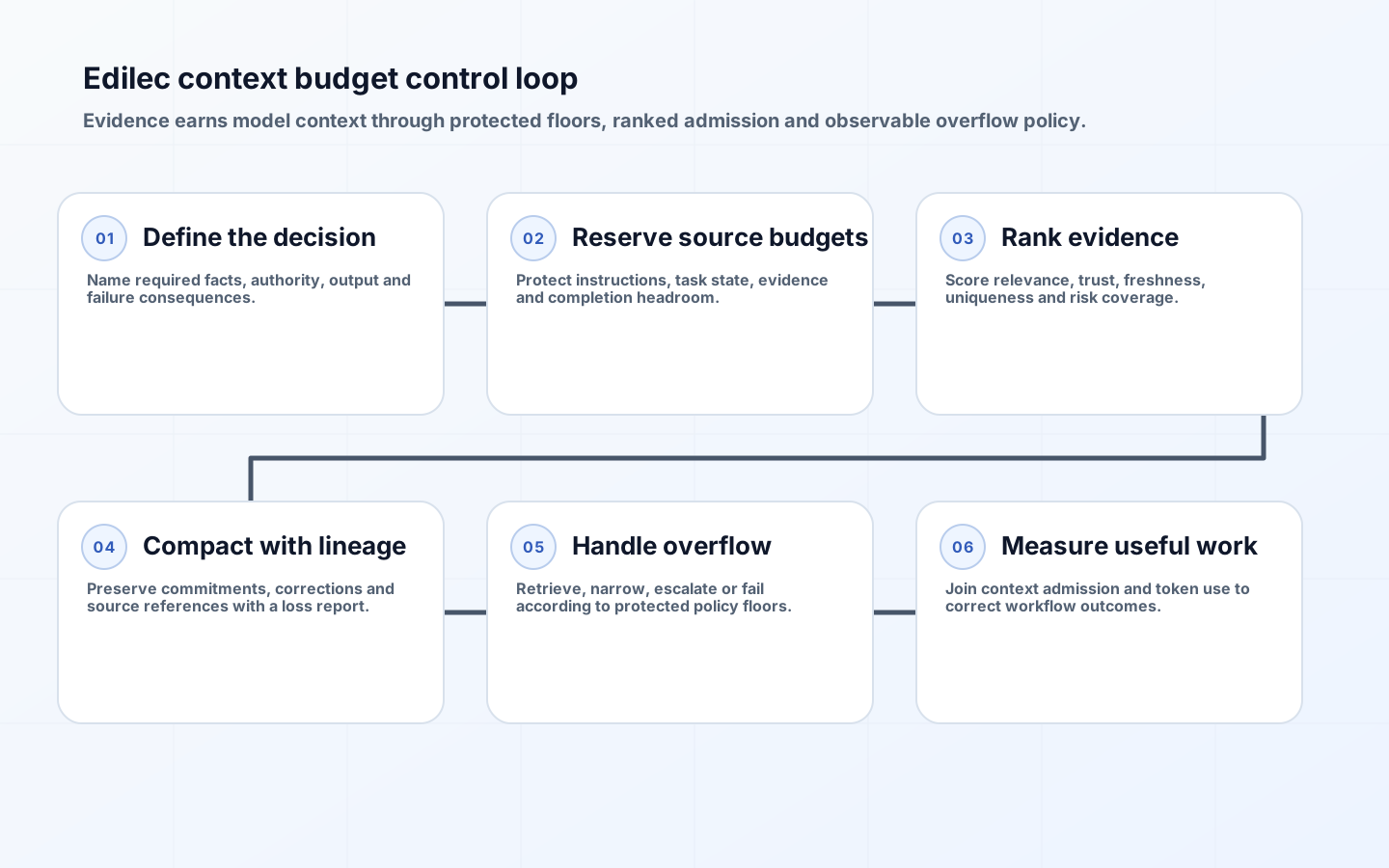
An AI agent context budget is an explicit allocation of scarce model input to instructions, current task facts, retrieved evidence, conversation state, tool results and completion headroom. It is more useful than a single maximum-token setting because it says what the system will preserve when demand exceeds capacity. A large context window changes the ceiling, but it does not eliminate input cost, latency, irrelevant material, privacy exposure or the possibility that weak evidence distracts the model from decisive facts.
Production teams should treat context as a governed runtime resource. The OpenAI Agents SDK context guide distinguishes local application context from information actually exposed to the model, while its usage tracking guide records input and output tokens across calls, tools and handoffs. Together, those surfaces enable a control loop: classify candidate material, reserve capacity by business value, measure actual use, and change policy when truncation or noise harms outcomes.
Define the budget around the decision
Start with the decision the agent must support, not the model's advertised capacity. List the facts that can change the action, the instructions that constrain authority, the evidence a reviewer would need, and the output structure the downstream system expects. A support-drafting agent may need the current ticket, entitlement state and relevant policy passages. A purchasing agent may need supplier identity, approved amount, segregation-of-duties rules and a quote. Material that is merely related should not outrank facts that determine permission or correctness.
Define a useful-work objective for the context policy. Examples include successful completion without a second retrieval, correct abstention when mandatory evidence is absent, or preservation of every policy clause cited by an approval rule. Add negative objectives: no secret fields in model input, no stale memory overriding current records, and no truncation of the output reserve. This gives engineering and product owners a basis for deciding whether an extra thousand tokens creates value or only hides poor selection.
Allocate the AI agent context budget by source class
Use source classes with separate floors, targets and ceilings. Floors protect non-negotiable content such as authority limits and current user intent. Targets represent normal operating capacity. Ceilings prevent a verbose tool or long conversation from consuming the run. Keep a completion reserve outside the input pool, and retain a small contingency for tool schemas, serialization overhead and provider-specific framing. Percentages are easier to transfer between models, but production enforcement should convert them into measured token counts for the selected tokenizer and request format.

| Source class | Priority rule | Typical treatment | Overflow action |
|---|---|---|---|
| Authority and safety instructions | Mandatory and highest precedence | Protected floor; deduplicate exact repeats | Stop the run if the floor cannot fit |
| Current task and user constraints | Required for intent | Keep verbatim where wording changes meaning | Ask for a narrower task |
| Authoritative records and retrieved evidence | Rank by decision impact, freshness and trust | Select passages with identifiers and timestamps | Run targeted retrieval or abstain |
| Conversation and memory | Keep unresolved commitments and corrections | Summarize settled history; expire low-value detail | Compact with a loss report |
| Tool results | Keep fields consumed by the next decision | Project structured fields; store full artifact externally | Request pagination or a narrower query |
| Output and contingency reserve | Never available to retrieval | Hold capacity before assembling input | Reduce optional input, never the reserve |
The allocation is a policy baseline, not a promise to fill every bucket. Unused conversation capacity can be borrowed by evidence only if authority instructions, output reserve and privacy constraints remain protected. Borrowing should be deterministic and observable. Record the requested tokens, admitted tokens, discarded items and reason for every reduction. That evidence lets operators distinguish an inadequate model window from a retrieval system that routinely returns oversized or low-value material.
Score evidence by value, trust and marginal utility
A ranking score should combine decision relevance, source authority, freshness, uniqueness and risk coverage. Do not use semantic similarity alone. A highly similar forum comment may be less valuable than a less similar signed policy. Freshness matters differently by source: a current account balance can become stale in seconds, while an approved procedure may remain valid for a year. Uniqueness reduces repeated chunks that state the same fact. Risk coverage favors evidence that confirms a prerequisite or exposes a reason not to act.
Estimate marginal utility at the chunk level. Admit an item when it contributes a new constraint, corroborates a high-impact fact, or supplies a citation the workflow must retain. Reject it when its useful claims are already represented. The MCP specification separates resources, prompts and tools at the protocol level; a context assembler should preserve that distinction because a server-provided resource is evidence, not an instruction with automatic authority. Source type is part of value, not decorative metadata.
Compact conversations with a loss-aware policy
Compaction should preserve commitments, unresolved questions, user corrections, granted approvals, rejected alternatives and identifiers needed to fetch durable records. It can usually remove greetings, repeated explanations, already-executed plans and raw tool payloads that have been stored elsewhere. Separate a factual state summary from a narrative summary. The factual state can be validated against source records; the narrative helps continuity but should not silently become a trusted fact store.
Every compaction should emit a manifest: input span covered, summary version, retained source references, omitted categories and known uncertainty. Re-run safety or authority checks after compaction rather than assuming their earlier result remains valid. For a broader retention design, the agent memory buyer and CTO guide explains correction, deletion and ownership; the context budget adds the per-run admission decision that memory design alone does not solve.
Make overflow behavior explicit and testable
| Condition | Unsafe shortcut | Preferred response | Observable record |
|---|---|---|---|
| Mandatory instructions exceed allocation | Truncate the end | Fail closed and reduce task scope | Rejected run and violated floor |
| Retrieval returns too many passages | Take the first results | Rerank, diversify and cap by source | Candidate and admitted rankings |
| One tool emits a large payload | Send all fields to the model | Project required fields and retain artifact URI | Projection schema and artifact hash |
| Conversation history dominates | Drop oldest turns blindly | Compact resolved work and preserve corrections | Compaction manifest |
| Output reserve is threatened | Shorten the requested result silently | Remove optional input or request a narrower deliverable | Reserve breach prevented |
| Evidence conflicts | Prefer the most recent chunk automatically | Apply trust and validity rules or escalate | Conflict set and resolution owner |
Overflow is a business behavior, not an internal exception. A low-risk drafting assistant may ask a clarifying question after dropping optional history. An agent preparing a regulated filing should halt when a required record does not fit or cannot be validated. Encode those differences by task risk tier. Avoid recursive summarization without limits: repeated compression can erase qualifiers while producing fluent text. Set a maximum compaction depth and force retrieval from the original source when a summary becomes the only surviving evidence.
Measure budget quality, not only token consumption
Track utilization by source class, admission rate, truncation count, retrieval retries, compaction depth, cache reuse and output-reserve breaches. Pair these with task measures: grounded completion, correct refusal, reviewer correction, tool success and cost per completed workflow. Aggregate token totals are useful for finance but insufficient for engineering. A run that uses fewer tokens after removing the decisive policy passage is cheaper and worse. The LLM cost controls guide provides portfolio-level controls; this policy supplies the evidence needed to optimize one step responsibly.
Sample the discarded set during evaluation. Ask whether rejected passages would have changed the correct decision, whether retained duplicates displaced more useful evidence, and whether summaries preserved exceptions. Compare fixed and adaptive allocations on a scenario library rather than one average prompt. Segment results by task, language, data sensitivity and conversation length. Any policy change should be versioned so operators can attribute a regression to the context assembler instead of blaming the model generically.
Govern exposure, retention and policy changes
The NIST Generative AI Profile frames risk management across governance, mapping, measurement and management. Apply that cycle to context: name an owner, document permitted source classes, map sensitive data paths, test selection behavior and define incident responses. Context logs can themselves be sensitive. Store identifiers, scores and hashes where possible; retain raw prompt material only when there is a justified operational need, appropriate access control and a deletion schedule.
Change control should cover ranking features, tokenizer versions, chunking, source quotas, compaction prompts and model migrations. Use shadow evaluation before enforcement. During rollout, expose budget diagnostics to engineers without exposing user data broadly. The model observability guide helps connect these diagnostics to traces, evaluations and review outcomes. A context policy is ready when an operator can explain why an item was included, why another was excluded and what the system did when a protected floor was at risk.
Key takeaways
- Allocate context by source class and decision value, not arrival order.
- Protect authority instructions and completion headroom with non-borrowable floors.
- Rank evidence using trust, freshness, uniqueness and risk coverage as well as relevance.
- Compact resolved history with a manifest that records loss and retained references.
- Define fail, retrieve, compact, ask and escalate behaviors for every overflow condition.
- Measure whether admitted context improves correct workflow outcomes, not merely whether token use falls.
Frequently asked questions
Should every request use the full context allocation? No. The budget is a ceiling and priority policy. Empty capacity is not a reason to add weak evidence. Smaller, decisive context is often easier to audit and less expensive to process.
Can a model summarize its own context safely? It can propose a summary, but the runtime should preserve source references, validate critical facts and record what was removed. Self-summary is not a substitute for deterministic retention rules.
How often should quotas change? Review them when scenarios, data sources, model behavior or economics change. Promote a new policy only after replaying representative and adverse cases, and keep the prior version available for comparison.
Conclusion
A production AI agent context budget turns a model limit into an accountable allocation decision. Define the work, protect mandatory content and output capacity, score evidence by contribution, compact with visible loss, and make overflow behavior part of the product contract. Then trace the policy against correct outcomes and privacy obligations. Larger windows will continue to arrive, but teams that can explain what earned a place in context will build agents that are cheaper to operate, easier to investigate and less likely to act on the wrong material.