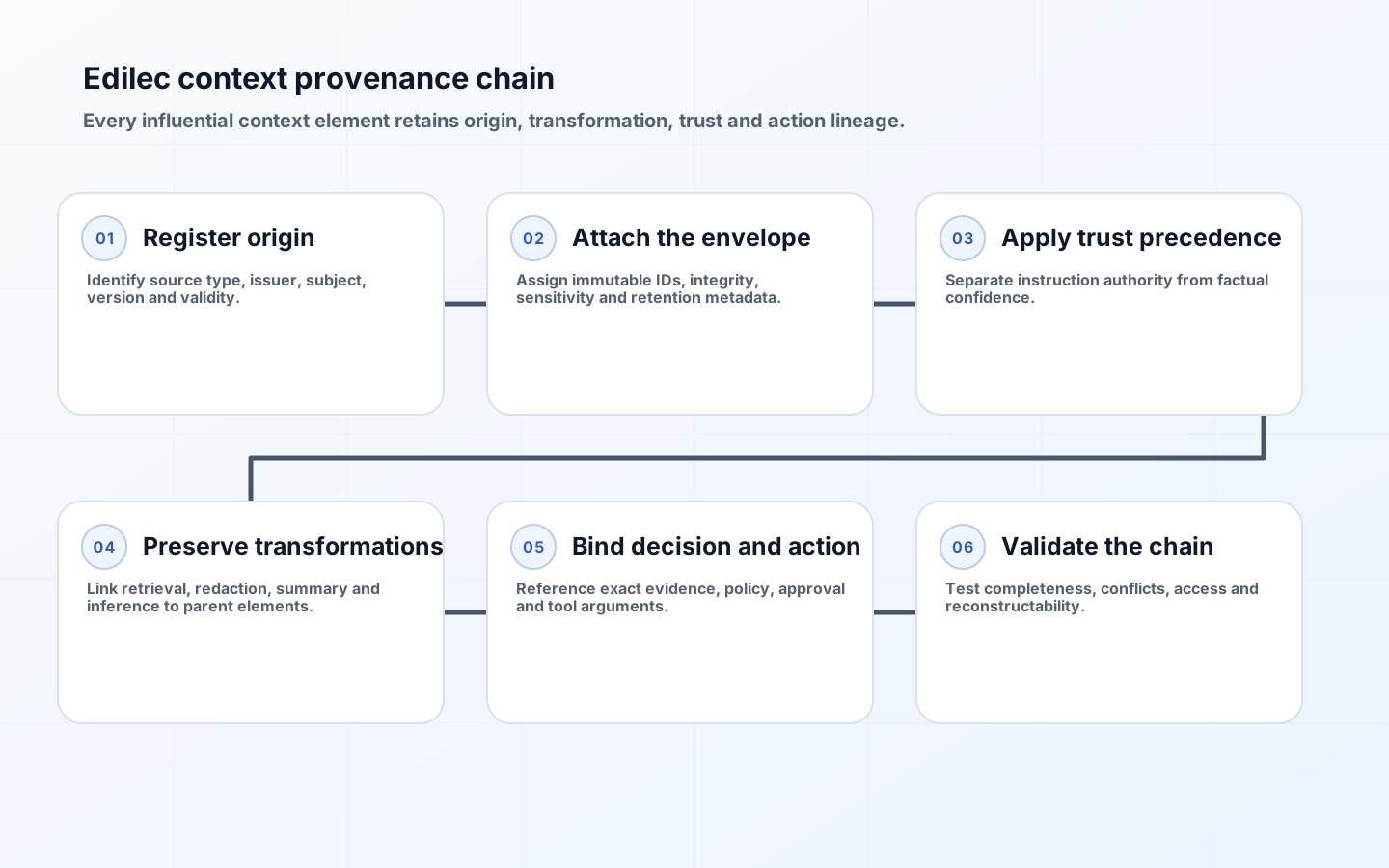
Agent context provenance is the lineage attached to every instruction, fact, tool result, memory item and transformation that can influence an agent. It answers more than 'what source can we cite?' A production record must identify who or what introduced an item, when it was valid, how it entered context, whether it was transformed, what authority it carried and which action depended on it. Without that chain, conflict resolution becomes guesswork and an audit can reproduce the answer text but not the conditions that produced the decision.
An agent may combine developer instructions, user requests, retrieved documents, application state, remote tool output and compacted history in one model call. The OpenAI context guide explicitly separates local runtime context from model-visible context and describes multiple ways to introduce information. That architectural distinction should remain visible after assembly. Provenance is the mechanism that stops a retrieved paragraph, a user assertion and a signed system policy from becoming indistinguishable strings.
Define what provenance must prove
Set proof obligations by workflow. For an answer, provenance may need to show which passages support each material claim. For an action, it should also prove the instruction hierarchy, user authority, current record state and tool version. For an approval, reviewers need the proposed change, evidence set and any unresolved conflict. Avoid a universal metadata blob that no consumer understands. Define the questions an operator, reviewer, security investigator and affected person must be able to answer, then capture the smallest durable fields that answer them.
Provenance has three layers. Origin describes the source object and issuer. Processing describes retrieval, filtering, redaction, summarization or inference. Use describes where the item appeared, which decision consumed it and what happened next. A citation usually covers only origin. A complete lineage record links all three. This is especially important when the displayed evidence is a summary: the reviewer should be able to reach the source version and see that a transformation occurred rather than mistaking generated prose for an original record.
Attach a provenance envelope to every context element
| Field | Purpose | Example treatment | Failure response |
|---|---|---|---|
| elementid and runid | Join context, trace and action records | Opaque immutable identifiers | Reject unjoinable high-risk elements |
| sourcetype and sourceuri | Distinguish policy, user input, record, tool or memory | Canonical locator plus system name | Label as unknown; do not elevate trust |
| issuer and subject | Identify who asserted what about whom | Workload identity, user ID or organization | Require verification for authority claims |
| observedat and validat | Separate retrieval time from business validity | Timestamp and effective interval | Refresh or mark stale |
| integrity and version | Detect substitution and reproduce input | Hash, ETag, schema and revision | Quarantine integrity mismatch |
| transformation_chain | Expose parsing, redaction and summary steps | Ordered operation IDs with versions | Fall back to original or human review |
| trust_label and rationale | Apply precedence without hiding judgment | Policy-defined class and rule ID | Treat as untrusted evidence |
| sensitivity and retention | Control exposure and deletion | Classification, purpose and expiry | Exclude or route to approved environment |
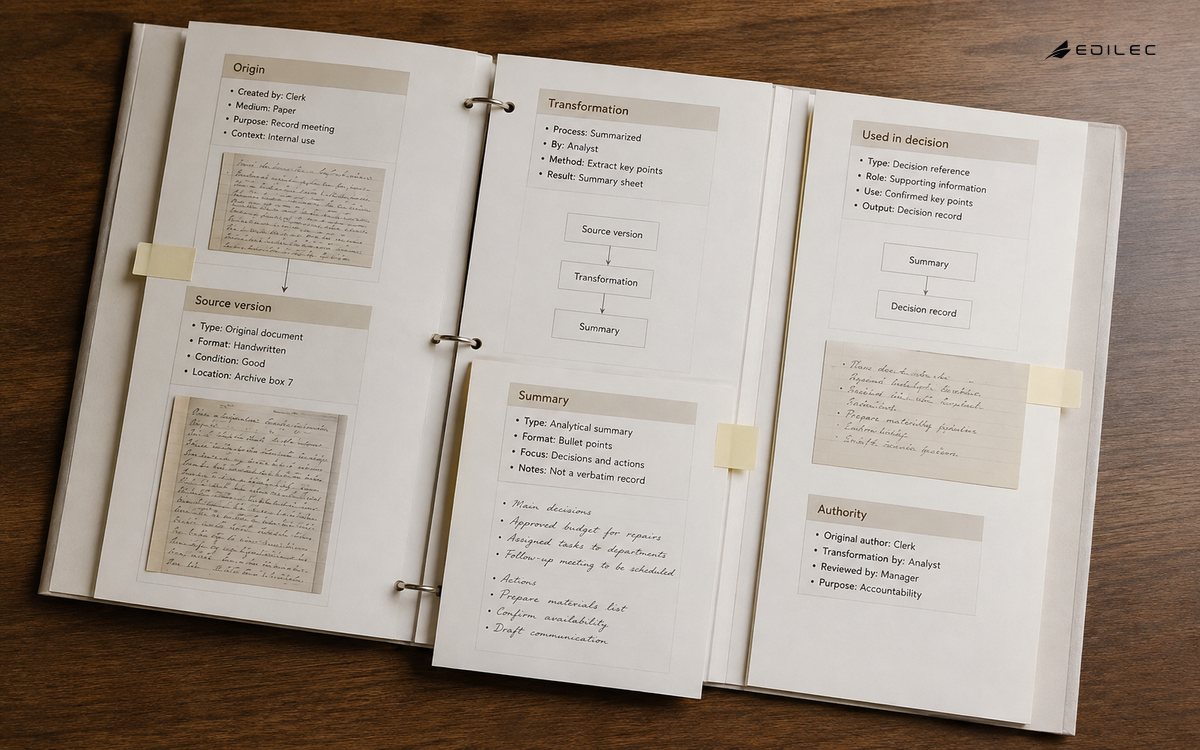
Keep the envelope outside free-form prompt text and pass only the labels the model needs. The runtime owns canonical metadata and should prevent model output from rewriting its own provenance. When a model derives a conclusion, create a new element whose parents reference the supporting elements. Do not replace those parents with the conclusion. This graph supports later challenges: an operator can inspect whether the decision rested on a current record, an unverified user statement or a summary that omitted a limiting condition.
Separate instruction precedence from evidence confidence
Instruction authority and factual confidence are different axes. A developer instruction may have high control precedence but contain no business fact. A database record may be authoritative evidence but cannot redefine the agent's permitted actions. A user request can specify intent within granted authority but should not override policy. Encode these axes separately. This avoids the dangerous shortcut of assigning one global trust score that lets a highly reliable data source act like a higher-level instruction or lets a privileged instruction make an unsupported fact true.
Define precedence in runtime policy and show the rule identifier in traces. The MCP specification exposes distinct protocol capabilities for resources, prompts and tools. Preserve those semantic categories when MCP content enters an agent. A prompt offered by a server is not automatically an enterprise policy, and tool output is not automatically verified merely because a call succeeded. The production MCP server guide provides the complementary authorization and server-boundary model.
Resolve conflicts without erasing them
| Conflict | Decision rule | Agent behavior | Audit evidence |
|---|---|---|---|
| User request versus enterprise policy | Policy limits action; user controls intent inside limit | Refuse or narrow the request | Both elements and precedence rule |
| Current record versus memory | Current system of record normally wins | Refresh state and mark memory superseded | Record versions and timestamps |
| Two authoritative records | Use domain validity and named owner, not recency alone | Pause consequential action | Conflict set and escalation |
| Tool output versus retrieved document | Compare source purpose, freshness and integrity | Seek corroboration or disclose uncertainty | Tool call, document revision and comparison |
| Original text versus summary | Original governs when wording is material | Retrieve source span | Transformation chain |
| Model inference versus explicit fact | Fact remains evidence; inference stays derived | Label conclusion and confidence | Parent links and evaluation result |
Never 'resolve' a conflict by dropping the losing item from the record. Keep it with a status such as superseded, rejected, out of scope or pending review. The agent may omit irrelevant conflict details from a concise response, but the decision log should retain them. When no deterministic rule applies, escalation is the correct outcome. The reviewer must see the competing values and why the runtime could not choose, not a fluent synthesis that conceals disagreement.
Track retrieval and transformation as first-class events
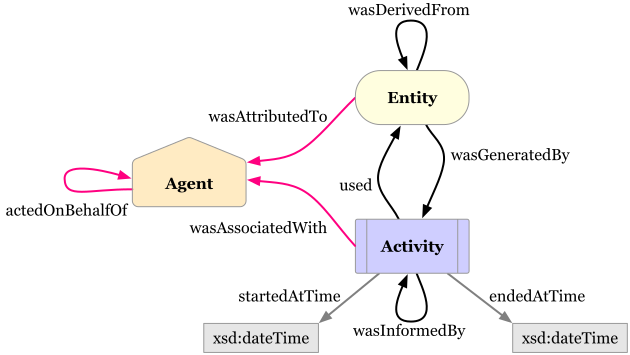
Retrieval provenance should include query or intent identifier, index version, access-control decision, rank, chunk boundaries and parent document revision. Parsing provenance should capture parser and extraction versions. Redaction should record the policy and fields removed without storing sensitive values in an unrestricted log. Summarization should link input elements, model and prompt versions, output hash and validation result. These details make it possible to determine whether a wrong action came from a bad source, stale index, lossy transformation or later reasoning failure.
Keep original artifacts in their governed systems instead of duplicating them into the trace store. Use stable references plus integrity values and retention-aware access. The RAG architecture guide covers retrieval quality and security; provenance extends that design by following evidence after retrieval into conflict handling, decisions and actions. If a source can lawfully change or be deleted, the lineage record should preserve the fact of use and approved audit evidence without defeating the source system's retention obligations.
Link context elements to actions and approvals
At action time, record the selected tool, normalized arguments, authority decision, approval state and evidence element IDs. Mark which fields came from user input, which were retrieved and which were inferred. This supports field-level review: an approver can see that the payee account came from a verified vendor record while the payment memo was generated. For mutable targets, record the precondition or version observed before execution so investigators can distinguish bad reasoning from a race with another system update.
The AI agent control plan explains permissions, approvals and audit trails at the workflow level. Context provenance makes those controls evidentially complete. Approval should create its own signed event linked to the exact proposal and context snapshot, not a general permission that survives argument changes. If execution differs from the approved proposal, the chain should branch and require a new decision according to risk policy.
Protect the provenance system as sensitive infrastructure
Lineage can reveal user identity, internal policies, document locations, tool capabilities and business relationships even when prompt bodies are excluded. Apply least privilege, tenant separation, encryption, append-aware integrity controls and purpose-limited retention. Separate operational search from privileged content access. Logs should make tampering evident and should record who viewed sensitive evidence. The goal is not an immortal copy of every prompt; it is sufficient, governed proof that the system can reconstruct material influence.
The NIST Generative AI Profile emphasizes risk governance and measurement, while NIST SP 800-218A extends secure-development practices for AI systems. Apply both to the lineage service itself: threat-model ingestion, validate metadata schemas, test cross-tenant access, review third-party collectors and rehearse loss or corruption. Provenance that cannot be trusted during an incident is an expensive telemetry stream, not a control.
Validate provenance completeness with scenarios
Create scenarios for stale records, forged metadata, contradictory policies, reordered tool results, summary omissions, deleted source documents and changed action arguments. Assert both behavior and lineage: the agent should choose or escalate correctly, and the record should expose every material input and rule. Measure missing-envelope rate, unresolved source identifiers, stale evidence admitted, transformations without parents, actions without authority references and reviewer time to reconstruct a decision.
Run completeness checks before a high-risk action, not only in an offline audit. A policy engine can require current issuer identity, valid integrity, approved sensitivity route and a complete parent chain. Lower-risk drafting may continue with clearly labeled unknown provenance. Publish a provenance schema and compatibility policy so tool teams know which fields are mandatory. The existing audit logs checklist offers useful operational questions for retention and access around these records.
Key takeaways
- Track origin, transformation and use for every material context element.
- Represent instruction precedence and factual confidence as separate properties.
- Keep provenance metadata under runtime control rather than editable prompt text.
- Retain conflicts and their resolution rules instead of deleting the losing item.
- Link approvals and tool arguments to the exact evidence snapshot that supported them.
- Protect lineage records because metadata alone can expose sensitive operations.
Frequently asked questions
Is a response citation enough provenance? No. A citation identifies a source for reader verification. Operational provenance also records instruction authority, transformations, versions, conflicts and the action that consumed the element.
Should the model see every provenance field? Usually not. Give it useful trust and freshness labels, while the runtime retains canonical identifiers, hashes, sensitivity and access metadata outside the prompt.
Can provenance prove that an action was correct? It proves what influenced the action and which controls ran. Correctness still requires validated policies, reliable sources, evaluations and, where appropriate, human judgment.
Conclusion
Agent context provenance makes influence inspectable. Give each element a durable envelope, preserve protocol and authority distinctions, record transformations, resolve conflicts with explicit rules and connect the resulting evidence to approvals and actions. Secure that chain and test whether it survives adverse scenarios. When a consequential agent decision is challenged, the organization should be able to reconstruct more than the final prompt: it should show where every material instruction and fact came from, why it was trusted and exactly how it affected the outcome.