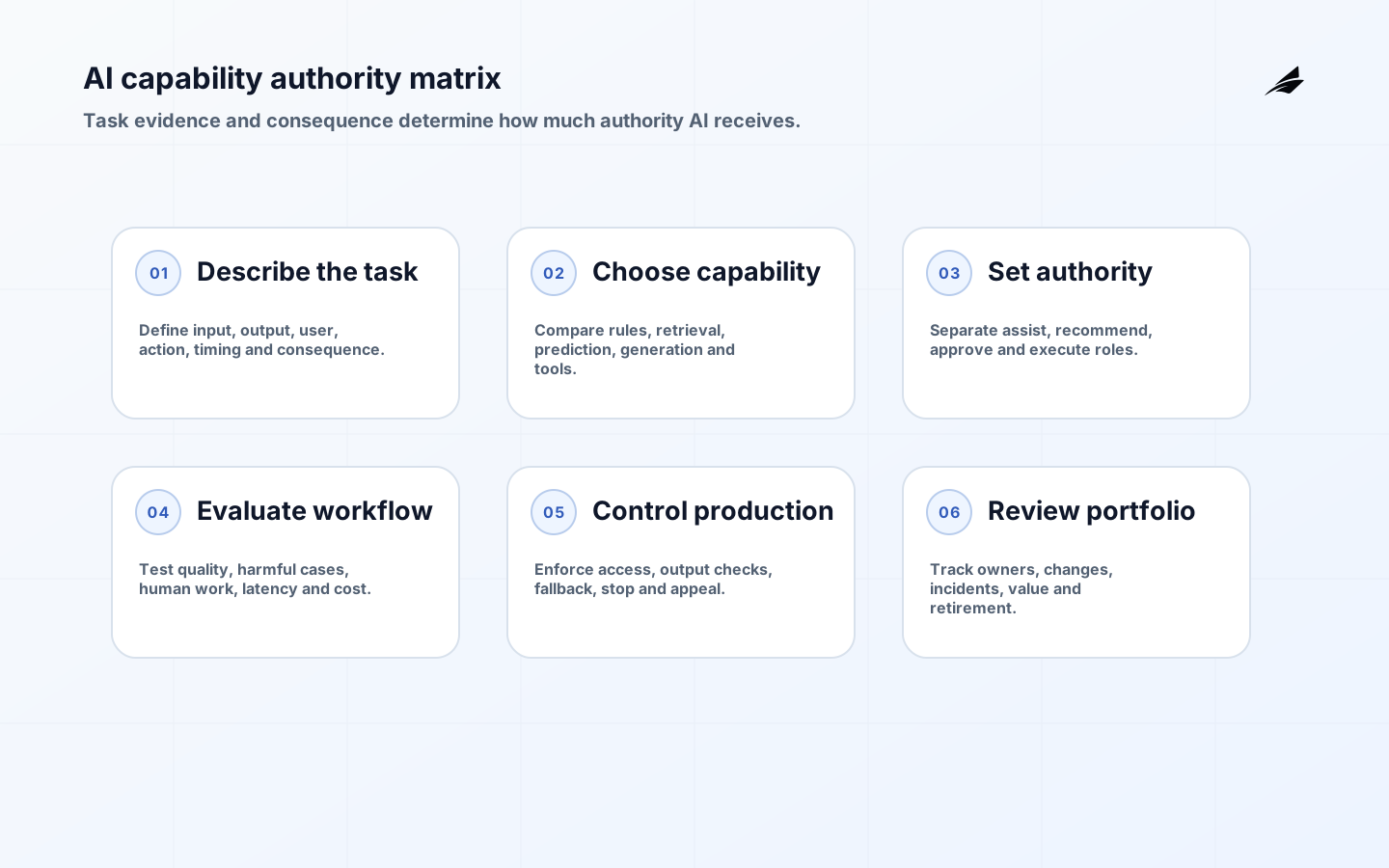
These artificial intelligence capabilities are designed for teams moving from research to an accountable delivery decision. Use the AI capabilities implementation checklist to plan implementation, the AI capabilities FAQ to resolve operating questions, and the AI services delivery plan to define scope, cost, risk, and ownership. Require named owners, explicit boundaries, representative tests, and a way to stop or correct the system when assumptions fail.
Artificial intelligence capabilities are methods that infer from inputs to produce predictions, content, recommendations or decisions that can influence environments. Business teams should describe the task and consequence before choosing a model. The OECD’s updated AI-system definition distinguishes machine-based inference and varying autonomy, while the NIST AI RMF provides voluntary lifecycle risk management. Neither implies that every statistical model or generated answer should be granted operational authority.
Map capabilities to business tasks
Use a practical capability map: perception converts images, audio or signals into structured observations; classification assigns categories; prediction estimates future values or likelihoods; ranking orders options; optimization proposes choices under constraints; retrieval finds relevant evidence; generation creates text, code, images or audio; and agents plan and invoke tools across steps. Most useful products combine these with deterministic software, rules, search and human work. Describe input, output, user, action, timing and consequence for each candidate. “Use generative AI in support” is vague; “draft a response from authorized case records for an agent to approve” is testable. Check whether rules, process repair or conventional analytics solve the need more reliably. AI is valuable when variability and scale justify inference, not merely because the interface appears conversational.
Understand what different capabilities can and cannot prove
A classifier can estimate a category but does not establish ground truth. A forecast expresses uncertainty and can drift when behavior changes. Optimization depends on objectives and constraints chosen by people. Generative models produce plausible content from learned patterns; they do not inherently verify facts, current policy or authorization. Retrieval can provide relevant source material but can return stale, conflicting or malicious content. Agents can sequence tools, yet their plans and generated parameters remain untrusted until application controls validate them. Combine capabilities deliberately: retrieve authorized policy, generate a draft with citations, validate required fields, then let a qualified person approve. Avoid assigning policy choices to the model. The system’s authority comes from surrounding software, identities and workflow, not from fluency or model size.
| Capability | Typical output | Useful business task | Critical limit |
|---|---|---|---|
| Classification | Label or route | Triage incoming cases | Errors need exception path |
| Prediction | Value or probability | Forecast demand | Uncertainty and drift |
| Retrieval | Relevant evidence | Find authorized policy | Freshness and access |
| Generation | Draft content | Prepare response | Plausibility is not truth |
| Agentic tools | Planned actions | Coordinate bounded steps | Permissions and autonomy |
Select use cases by value, feasibility and consequence
Score candidates on user value, frequency, baseline pain, data rights and quality, evaluability, integration, reversibility and harm. Good early cases have bounded inputs, observable outputs, available feedback and low-cost correction. High-volume document extraction may be attractive when fields can be checked; an opaque recommendation affecting employment or credit needs deeper governance and legal review. Include affected people, not only buyers and operators, in mapping. Define prohibited use, human authority, appeal and stop criteria. Estimate total workflow change: a model that saves drafting time may increase verification or exception queues. Pilot the smallest consequential slice and compare against current process and a simple baseline. A capability demo on hand-picked examples is discovery evidence, not a business case.

Evaluate the system, workflow and impact
Build representative, permissioned test sets covering normal, rare, ambiguous and adversarial cases. Define task metrics plus unacceptable outcomes, abstention, evidence, latency and cost. Segment results by relevant population, language, channel and time. The NIST AI RMF Core organizes outcomes under govern, map, measure and manage and stresses continuous lifecycle work. Record data, model, prompt, retrieval, tools and policy versions. Evaluate end-to-end action, not only model output: authorization, generated parameters, human correction and downstream effects can dominate risk. Use blinded review where feasible, quantify disagreement and preserve examples. Set release thresholds by consequence rather than one average score. Production monitoring must detect input change, quality drift, overrides, harmful incidents and missing feedback.
Design privacy, security and meaningful human control
Minimize data, document purpose and retention, restrict access and assess derived sensitivity using the NIST Privacy Framework. Treat external content and generated output as untrusted. OWASP’s LLM application risks include prompt injection, sensitive-information disclosure, improper output handling and excessive agency. Enforce permissions outside the model, give tools narrow typed interfaces, validate outputs and require confirmation for material actions. Human review needs source evidence, time, competence and authority to reject; a mandatory click without understanding is not control. Provide manual service, correction and appeal where appropriate. Log accountable decisions without exposing sensitive content broadly. Red-team realistic misuse and dependency failure, then translate findings into application controls and operating procedures.
| Decision factor | Low-consequence pilot | Higher-consequence system | Evidence |
|---|---|---|---|
| Authority | Draft only | Recommendation or action | Explicit role and limits |
| Evaluation | Correctable task quality | Harm by segment and edge case | Versioned test results |
| Human control | Optional editing | Qualified approval and appeal | Observed review behavior |
| Release | Internal cohort | Staged exposure with stop | Canary and incident exercise |
| Monitoring | Use and correction | Outcome, drift and harm | Owned review cadence |
Plan production architecture and economics
Choose build, buy or hybrid from task differentiation, data sensitivity, latency, integration, control, skills and exit. Design data ingestion, retrieval, model gateway, evaluation, workflow state, tools, telemetry and fallback as explicit components. Avoid coupling business records to one provider’s opaque state. Measure quality and user outcome beside latency, availability, token or compute use, human review and support. Calculate cost per successfully completed case, not cost per model call. Use caching, batching, smaller models and deterministic rules where evaluation confirms equivalent outcomes. Version releases, canary by cohort and keep rollback and kill switches. Review provider data use, regions, subprocessors, deprecation, security and incident terms. Architecture should make model substitution possible at defined boundaries, though every substitution requires fresh evaluation.
Govern a portfolio without freezing learning
Maintain a register of owner, purpose, affected users, data, model or provider, authority, evaluation, review date, incidents and retirement trigger. Scale review according to consequence and novelty. Product teams should own outcomes; data, security, privacy, legal, risk and operations provide required expertise and independent challenge. The NIST generative AI profile identifies risks and suggested actions specific to generative systems, but organizations must select controls for their context. Review material changes to model, prompt, retrieval, tool access, population or policy. Create incident channels and disclose appropriately. Retire experiments, credentials and retained data when no longer justified. Governance is effective when it shortens the path to safe evidence and makes stop decisions possible.
Create a capability decision record and acceptance exercise
For every material capability, record owner, affected users, task, selected method, alternatives, data rights, authority, evaluation population, thresholds, human role, controls, provider, deployment boundary, monitoring, incident path and retirement trigger. State why AI is needed and which simple baseline it must beat. Update the record when model, prompt, retrieval, tools, population, policy or consequence changes so a drafting experiment cannot silently become an action system. Link evidence with dataset date, construction, version and uncertainty. Test according to failure mode: calibration and drift for prediction; authorization, freshness and conflicting sources for retrieval; unsupported claims, harmful content and disclosure for generation; environmental and population conditions for perception; and tool denial, parameter validation, repetition, budget and safe stopping for agents. Simulate provider outage and manual fallback. Compare completed-work quality and time with baseline, including review and exception labor. Approve only authority supported by evidence. A system may be fit for internal drafting but not customer communication; preserving that distinction enables useful adoption without pretending capability is universal.
Review AI systems on a cadence proportionate to authority and change. Low-consequence drafting may need periodic sampling; systems influencing access, finance, employment, health or safety require stronger independent oversight, incident review and legal analysis. Trigger reassessment after provider or model changes, new tools, population shift, policy updates, severe errors, drift or unexpected user adaptation. Reviewers should see outcome and harm evidence, not only aggregate model scores. Keep a route for affected users and frontline staff to report problems. The authority to pause or narrow use must be assigned before an incident. Continuous review matters because an unchanged model can become inappropriate when its environment changes.
Key takeaways
- Reassess scope whenever users adapt the workflow or a provider changes behavior, because operational context can invalidate earlier evidence without changing application code.
- Describe the task and authority before selecting a model.
- Combine AI with deterministic controls, evidence and human work.
- Evaluate representative and harmful cases end to end.
- Treat fluent output and retrieved content as untrusted.
- Measure completed outcomes, human effort, risk and cost throughout operation.
Frequently asked questions
Which AI capability should a business start with?
Start with the lowest-authority capability that addresses a measurable bottleneck. Retrieval, extraction or draft assistance often provides clearer evaluation and correction than autonomous execution.
Does a larger model always provide better business results?
No. Model size is only one factor. Data, prompt, retrieval, workflow, latency, cost and controls shape results. A smaller model or deterministic method can be preferable when it meets the task threshold.
What makes human review meaningful?
The reviewer needs relevant source evidence, competence, time, independence and authority to reject or escalate. Track correction and disagreement; a required approval click alone does not reduce risk.
Conclusion
Artificial intelligence capabilities become useful when business teams connect inference to a bounded task, accountable action and measurable outcome. Choose the least authority needed, evaluate the complete workflow, protect people and systems, and expand only when production evidence supports it. Capability is not the same as permission, reliability or value.