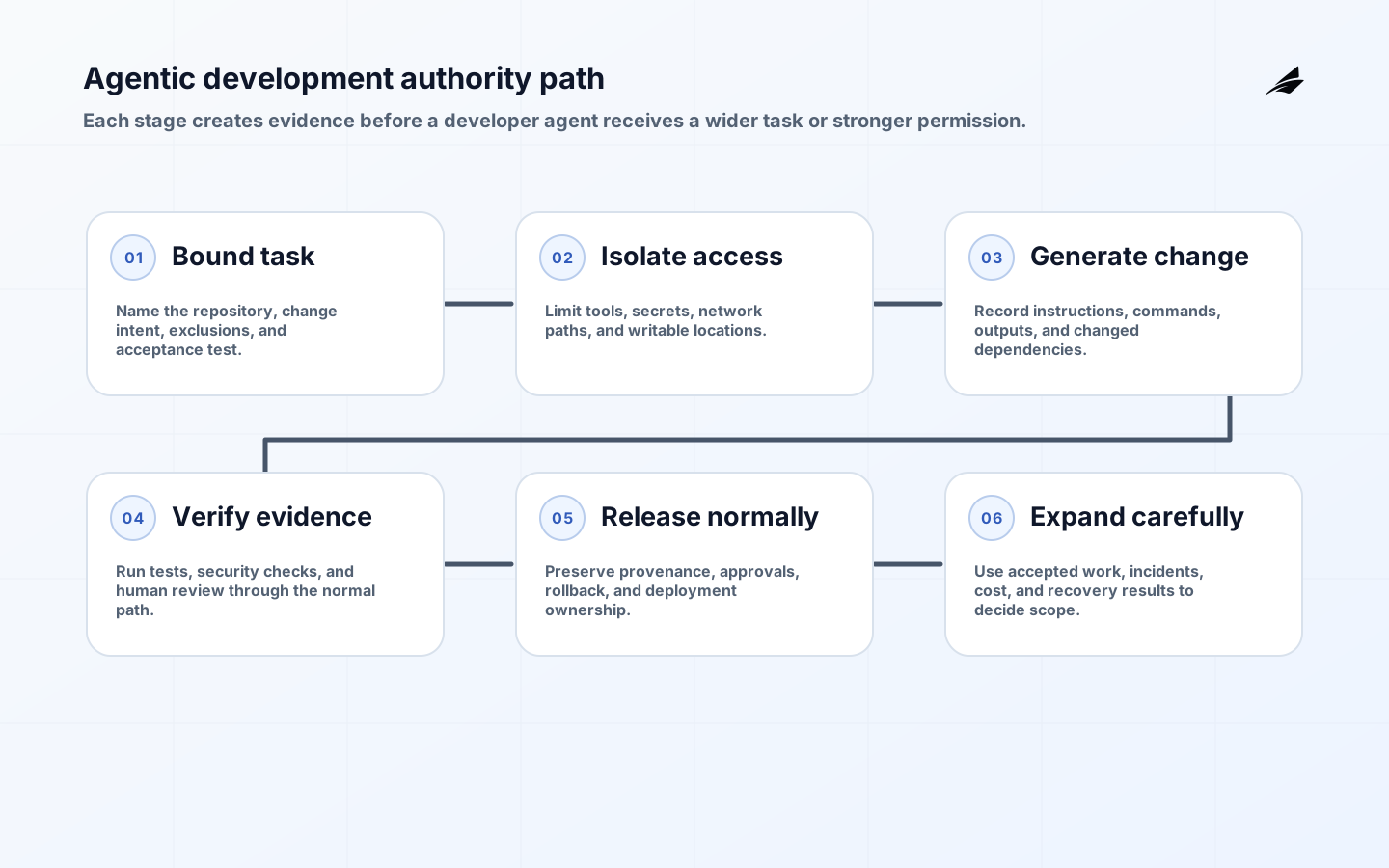
An agentic development platform can help engineers explore a codebase, draft changes, run approved tools, and prepare review material. It is not a substitute for product decisions, architecture ownership, or secure release practice. The adoption question is therefore narrower than whether an agent can produce code: which development tasks can it assist with, what authority should it have, and how will the team verify its work? A credible delivery plan starts with constrained tasks and evidence, then expands authority only when engineers can explain the outcomes and recover from mistakes.
Scope the first developer-agent tasks
Choose tasks with clear acceptance conditions and an existing human review point. Examples include locating relevant modules, proposing tests, updating a well-defined integration, summarizing a change, or opening a draft pull request. Avoid beginning with production access, broad repository write access, or a promise to autonomously ship features. The NIST Secure Software Development Framework is useful context because it keeps attention on secure practices across preparation, production, response, and improvement. The platform should fit those practices rather than bypass them.
| Task type | Appropriate early authority | Required check |
|---|---|---|
| Codebase exploration | Read approved repositories and produce a cited summary. | Engineer confirms the sources and interpretation. |
| Change proposal | Create a local or draft change limited to a declared module. | Tests, code review, and ownership check. |
| Tool use | Run an allowlisted formatter, test command, or static analysis task. | Bounded environment, logs, and resource limits. |
| Release work | Prepare evidence but do not independently deploy initially. | Existing release approval and provenance controls. |
Estimate the full operating cost
Cost includes platform licensing or model use, but also repository preparation, identity integration, sandboxed execution, logging, policy design, developer training, security review, and time spent checking outputs. Agent runs may consume more compute than interactive assistance because they explore files and invoke tools. Establish limits for time, spend, concurrency, and the size of accessible context. Measure whether the platform reduces time to a reviewed change or simply shifts work into debugging generated output. Treat early productivity observations as hypotheses, especially when teams are still learning the interface and task boundaries.
- Which repositories, branches, and environments the platform can access.
- Expected tool calls, model context, execution time, and retry behavior.
- Engineering time for review, incident response, and maintenance of instructions.
- Security controls for credentials, dependencies, and generated artifacts.
- Training needed to help developers challenge rather than blindly accept suggestions.
- Exit or migration work if a provider, model, or platform changes.
Limit permissions and tool use
The highest-risk design choice is often not code generation but agency: what the platform can read, alter, execute, and send outside the environment. Apply least privilege to repository scopes, branch protections, package registries, CI credentials, cloud accounts, and network access. Treat issue text, documentation, and dependencies as potentially untrusted input. The OWASP guidance for LLM applications is relevant where prompts or retrieved content could influence tool calls. Require explicit confirmation for consequential actions and make it impossible for the agent to grant itself broader access.
| Control | Implementation example | Why it helps |
|---|---|---|
| Repository boundary | Use a dedicated identity limited to selected repositories and branches. | Reduces exposure if instructions or tools are misused. |
| Tool allowlist | Permit named test and analysis commands with constrained arguments. | Prevents arbitrary shell or network activity. |
| Secret isolation | Inject short-lived credentials only into approved, sandboxed tasks. | Keeps sensitive values out of prompts and logs. |
| Change provenance | Link task, inputs, agent version, tool activity, diff, and reviewer decision. | Supports audit, debugging, and rollback. |
Verify changes through normal engineering evidence
A generated diff is a proposal, not proof. Verify behavior through tests that matter to the change, static analysis, dependency and security checks, code review, and a product-level acceptance condition. Reviewers should understand the task boundary and be able to reject a change without pressure to preserve agent output. The SLSA specification describes supply-chain concepts that can complement this work, including provenance and build integrity. Do not weaken existing branch protection or release gates to make a demonstration feel autonomous.
- A task description with accepted scope and forbidden actions.
- A reproducible environment and logged tool activity.
- Automated checks appropriate to the modified code and dependencies.
- Human review by someone responsible for the affected system.
- A rollback or remediation path for merged defects.
- A record of recurring failure patterns that changes prompts, policies, or training.
Plan a staged rollout
Begin with volunteers or a team whose delivery practices are already observable. Compare assisted work with a baseline, but do not reduce the result to lines of code or completed tickets. Consider review time, defect escape, developer confidence, accessibility of evidence, and incidents. Expand from read-only exploration to draft changes, then to bounded tool use only when the operating controls are exercised. The NIST AI Risk Management Framework supports this iterative approach: context, measurement, and management should change together as the platform's authority changes.
Frequently asked questions
- Can an agent merge its own changes? Not as an early default; separation between generation, review, and release protects quality and accountability.
- Should it have production access? Usually no for initial adoption. Production actions require a task-specific case, constrained credentials, and established approvals.
- How do we measure value? Look at time to a reviewed, correct change alongside rework, defects, and developer experience.
- What is the first red flag? A platform that needs broad credentials or weakened controls to demonstrate usefulness.
Define acceptance evidence before increasing authority
An agentic development platform should be evaluated against the engineering evidence it produces, not the apparent speed of a demonstration. Before a pilot starts, define the repository boundary, allowed commands, network destinations, secret-handling rule, review owner, and artifacts required for acceptance. The NIST Secure Software Development Framework treats secure development as practices integrated into the software lifecycle. Developer agents should pass through those practices rather than creating a parallel path around them.
| Evidence gate | Minimum proof | Decision it supports |
|---|---|---|
| Change intent | Issue, acceptance criteria, affected components, and prohibited scope | Whether the task is bounded enough for agent assistance |
| Repository evidence | Readable diff, tests changed, dependency changes, and generated-file disclosure | Whether a reviewer can understand the proposed change |
| Execution evidence | Approved commands, exit results, test logs, and static-analysis findings | Whether the result was exercised under known conditions |
| Supply-chain evidence | Dependency provenance, lockfile review, build identity, and artifact attestation where applicable | Whether the output can enter the normal release path |
| Recovery evidence | Revert plan, failed-test behavior, and owner for follow-up | Whether an error can be contained without improvisation |
Cost should include more than model tokens. Count engineering review time, failed or repeated runs, isolated execution capacity, observability, security administration, vendor controls, and work needed to keep instructions current as the codebase changes. A narrow task that saves fifteen minutes but requires an hour of uncertain review is not yet a productivity gain. Compare completed, accepted work over a representative period, and separate exploration time from production-ready output.
The SLSA specification helps teams reason about build provenance and tamper resistance, while OWASP guidance for LLM applications highlights prompt injection, excessive agency, and insecure output handling. Connect those controls with Edilec guides to agent tool permissions, LLM evaluation for internal tools, and AI workflow failure modes. Together they turn a platform trial into a governed software-delivery experiment.
Key takeaways
- Start with narrow tasks and clear acceptance conditions.
- Account for security and review effort in cost estimates.
- Give agents the least authority needed for each task.
- Keep normal testing, review, and release controls intact.
- Expand only when operational evidence supports it.
Conclusion
Agentic development platforms can be genuinely useful when they augment a disciplined engineering system rather than become a parallel one. Keep task authority, evidence, and recovery visible at every stage. The related guides on agent tool permissions and LLM evaluation offer useful next checks.