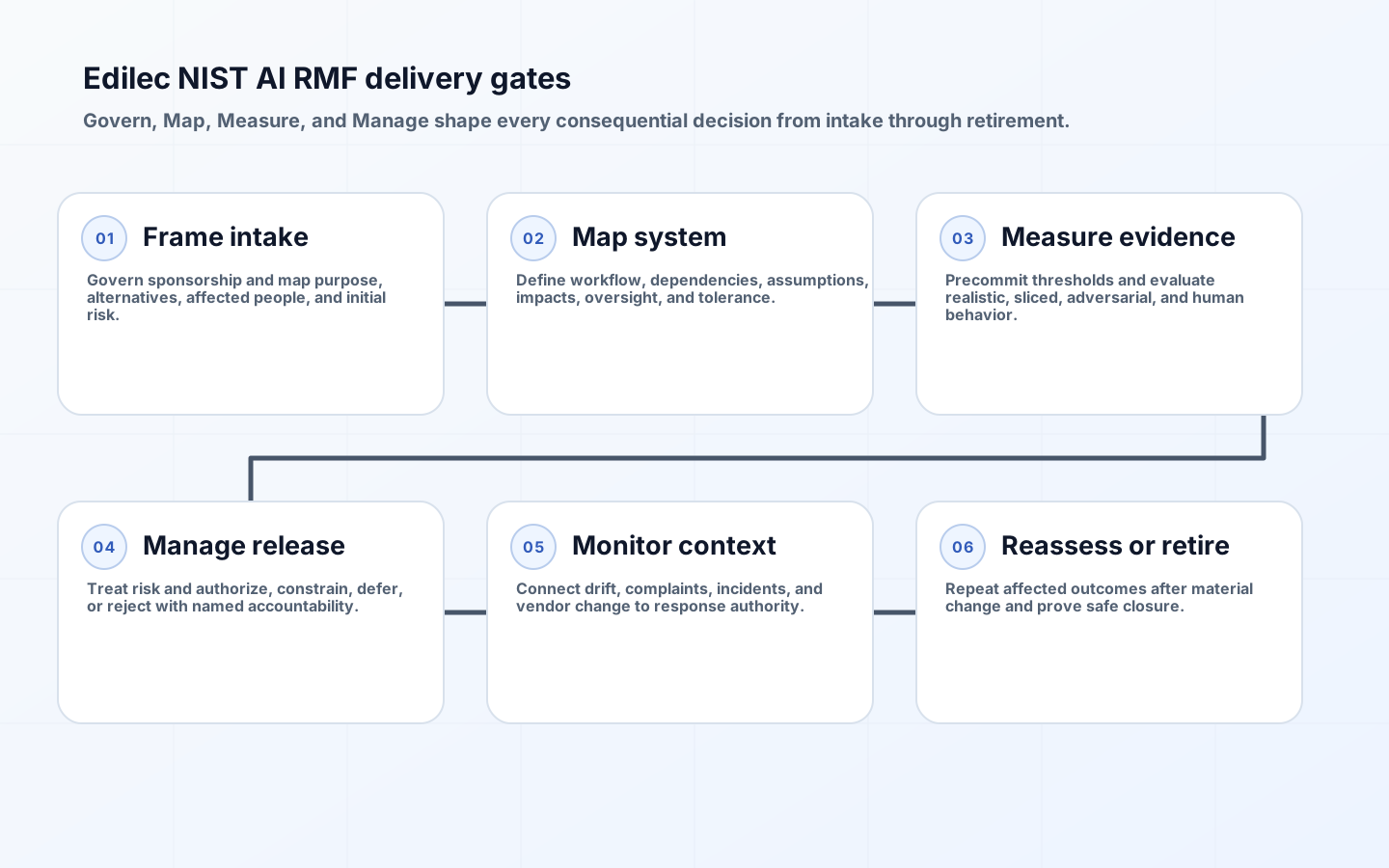
NIST AI RMF implementation fails when teams treat Govern, Map, Measure, and Manage as four document folders. The functions describe outcomes for managing AI risk, not a prescribed project sequence. Delivery still needs explicit moments when accountable people decide whether a use may proceed, what evidence is adequate, which residual risks are accepted, and what conditions apply. A practical operating model maps RMF outcomes into existing product, procurement, security, and change-management gates rather than creating a parallel responsible-AI ceremony.
The NIST AI RMF is voluntary, rights-preserving, non-sector-specific, and use-case agnostic. NIST also notes that version 1.0 is being revised. Therefore, organizations should record which framework and profile version their controls map to. Use the RMF as a structured set of desired outcomes, then design evidence and decision rights suitable for the organization's systems, risk tolerance, law, and sector.
Use the four functions as a continuous operating model
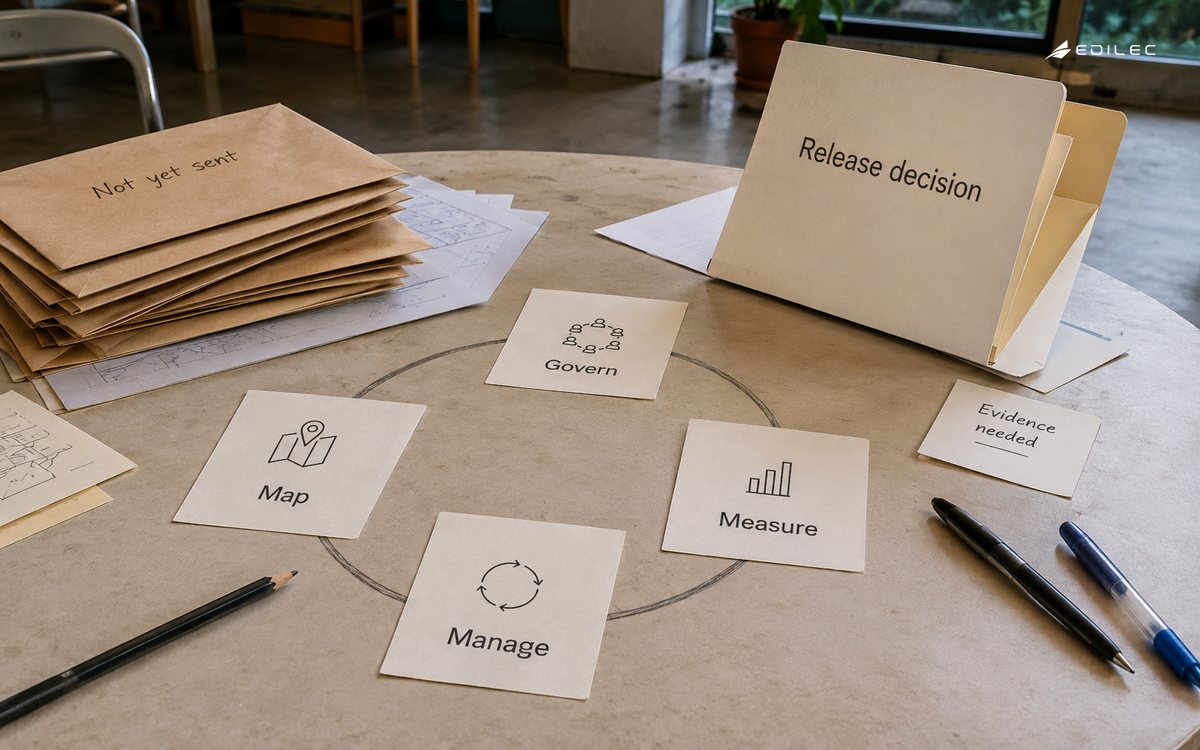
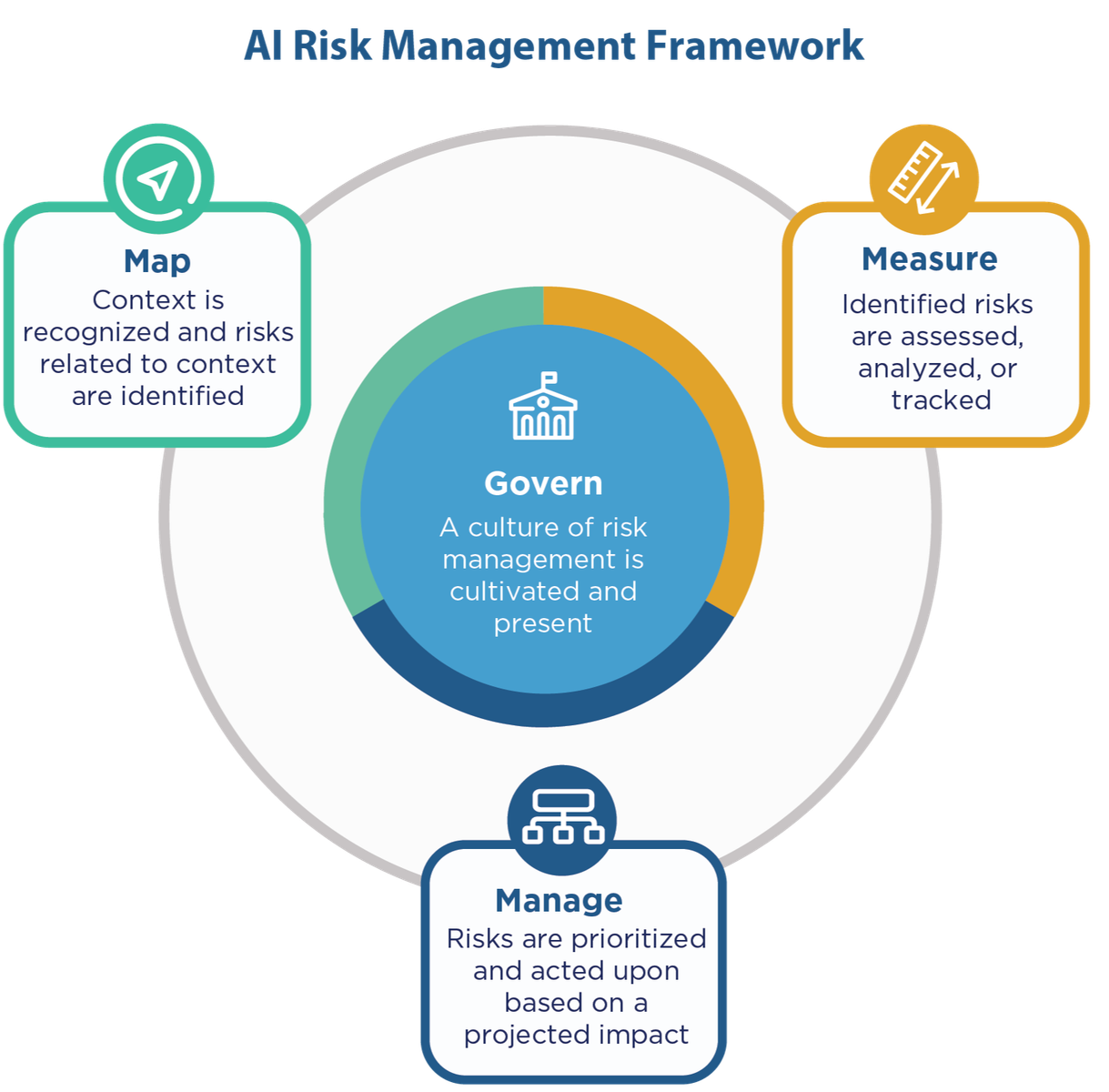
Govern establishes policies, accountability, culture, inventory, and oversight across the lifecycle. Map establishes context: intended purpose, stakeholders, impacts, dependencies, assumptions, and risk tolerance. Measure uses qualitative and quantitative methods to analyze trustworthiness and impact. Manage prioritizes risks, selects responses, allocates resources, and decides whether the system should proceed. The AI RMF Core explicitly describes governance as cross-cutting, which means it cannot be postponed until launch review.
Each delivery stage should invoke all four functions at an appropriate depth. Discovery governs sponsorship, maps the problem, measures baseline harm and benefit, and manages the option of not using AI. Evaluation governs test independence, maps expected conditions, measures performance and harm, and manages residual gaps. Monitoring governs response authority, maps changed context, measures drift and incidents, and manages continuation, restriction, rollback, or retirement.
Design gates around irreversible or consequential commitments
Place gates where the organization commits money, data, user exposure, decision authority, or legal position. Common points are use-case intake, architecture selection, data readiness, evaluation readiness, production release, material change, and retirement. A gate is not a meeting. It is a versioned decision package with entry criteria, named decider, evidence, exceptions, conditions, result, and expiry. Low-risk uses may pass through an automated path; consequential uses require multidisciplinary review.
| Gate | RMF emphasis | Minimum evidence | Decision |
|---|---|---|---|
| Intake | Govern and Map | Purpose, owner, affected groups, alternatives, initial classification | Reject, explore, or assess |
| Design | Map and Manage | Data flow, dependencies, oversight, threat and impact analysis | Accept or revise architecture |
| Evaluation | Measure | Test plan, slices, baselines, limitations, independent review | Evidence sufficient or not |
| Launch | Manage and Govern | Control status, residual risks, monitoring, incident and rollback plan | Release with conditions or stop |
| Change or retirement | All functions | Changed context, outcome history, dependency and retention evidence | Continue, reassess, restrict, or close |
Map the real system before choosing metrics
A model benchmark does not define the use. Map the workflow, decision, users, affected people, recourse, human authority, input provenance, output consumers, downstream automation, vendor dependencies, geographic reach, foreseeable misuse, and non-AI alternative. State assumptions that would invalidate the design. The RMF Core asks teams to document intended purposes, knowledge limits, costs, benefits, and impacts, giving a disciplined basis for test design.
Engage domain experts and affected stakeholders early enough to change requirements. Document disagreements rather than forcing artificial consensus. Tie each material risk to an owner and a planned measurement or control. Edilec's AI governance operating model helps position executive, product, technical, and risk accountability around this work.
Set measurement thresholds before seeing results
Define acceptance thresholds, uncertainty, slices, sample design, test independence, and escalation before running the final evaluation. Include task quality, reliability under realistic variation, security, privacy, harmful content, bias relevant to the context, human factors, and business-process failure. Compare against a meaningful baseline such as trained human performance, the current process, or a non-AI rule. Aggregate scores can hide unacceptable outcomes for a small but important group.
For generative systems, use the NIST Generative AI Profile to tailor risk analysis. Its purpose is to help organizations identify risks distinctive to generative AI and select aligned actions. Treat a profile as a prioritization aid, not proof that every risk applies equally. Preserve prompts, model and policy versions, evaluation data, grader instructions, raw outcomes, and reviewer rationale so results can be reproduced.
Turn residual risk into an explicit management decision
Controls do not erase inherent risk. The launch package should show the risk before controls, implemented control, evidence of effectiveness, residual exposure, monitoring signal, incident action, owner, and review date. The person accepting residual risk must have authority over the affected business outcome, not merely technical knowledge. Conditions such as limited geography, lower autonomy, mandatory review, usage caps, or a pilot cohort should be machine-visible where possible.
The NIST Playbook provides suggested actions aligned to RMF subcategories but states that it is neither a checklist nor a complete sequence. Select actions because they address mapped risks and expected outcomes. A control library should therefore record the RMF outcome, local control objective, implementation, test method, evidence, and limitations. This makes exceptions intelligible instead of producing a binary checklist.
Operate the RMF after release
Monitoring should connect technical signals to user and organizational harm. Track input and output shifts, task success, abstention, overrides, complaints, appeals, incidents, control failures, vendor changes, model releases, cost, and service reliability. Predefine action thresholds and who can throttle, disable, roll back, or notify. Monitoring without response authority only produces dashboards. Review whether the intended purpose, population, and human workflow still match the approved Map evidence.
| Signal | Trigger example | Immediate action | RMF response |
|---|---|---|---|
| Context drift | New population, geography, or decision use | Restrict unassessed use | Remap and reapprove |
| Quality regression | Critical slice falls below threshold | Rollback or add review | Measure and manage |
| Control failure | Filter, access, or logging gap | Suspend affected path | Govern corrective action |
| Vendor change | Model, terms, data handling, or endpoint changes | Open dependency review | Map and measure delta |
| Harm report | Credible complaint or incident | Preserve evidence and mitigate | Manage impact and lessons |
Use the organization's compliance-ready delivery process and risk-based quality strategy rather than inventing a separate release train. Add AI-specific evidence and deciders to familiar workflows. Record traceable decisions following the audit trail guide.
Roll out with one representative system
Select one system with meaningful impact, a cooperative owner, and an upcoming release. Map its current lifecycle to RMF outcomes, identify evidence already produced, and close the few gaps that affect decisions. Time each activity and remove artifacts nobody uses. Then create a tiered path for low, medium, and high scrutiny. Build reusable templates only after observing actual decision needs. Train reviewers with a completed case, including a rejected or conditional decision.
Maintain a framework crosswalk rather than duplicating controls for every standard. NIST publishes AI RMF crosswalk resources and emphasizes alignment with other resources. A local control can map to several obligations while retaining one owner and evidence stream. Version mappings, because frameworks, guidance, systems, and organizational risk tolerances change.
Test whether the operating model works
Assurance should sample decisions end to end. Select a released system and reconstruct intake facts, Map analysis, evaluation thresholds, control tests, risk acceptance, production configuration, monitoring, and changes. Confirm that evidence existed before the decision, the decider had authority, release conditions reached technical enforcement, and monitoring can trigger action. Document presence alone cannot show that a process influenced behavior.
Use scenario tests for the governance system itself. Present a late vendor model change, a newly affected geography, a serious complaint, an expired evaluation, or an executive request to bypass a condition. Observe whether owners, routing, evidence, and stop authority work under time pressure. Correct systemic causes such as unclear ownership or inaccessible records, not only the sampled project's paperwork.
Report a small portfolio view to leadership: systems by risk and lifecycle, overdue conditions, accepted residual risks, recurring control failures, incidents, reassessments, and retirement gaps. Pair counts with decisions needed. The goal is not a favorable score; it is to direct resources to the risks and process weaknesses that teams cannot resolve within ordinary delivery authority.
Document the economics of controls as well as their coverage. A costly manual review may be appropriate for a small high-impact queue and impossible at full scale; an automated detector may reduce common failures while missing the cases that matter most. Record capacity, latency, operating cost, and failure dependencies during gate review. A control that cannot be staffed or sustained under expected volume should not support the release decision without a bounded operating limit.
Key takeaways
- Treat Govern, Map, Measure, and Manage as continuous functions, not sequential document phases.
- Put gates at consequential commitments and require versioned evidence, a decider, and explicit conditions.
- Map the socio-technical workflow before selecting metrics or buying controls.
- Set evaluation thresholds and slices before final results are visible.
- Connect production signals to predefined authority for restriction, rollback, reassessment, and retirement.
Frequently asked questions
Does NIST AI RMF implementation create certification?
No. The AI RMF is a voluntary risk framework, not a certification scheme. Organizations can assess implementation and provide assurance, but should not imply that NIST certified the program.
Must every Playbook action be implemented?
No. NIST says the Playbook is not a checklist to follow in full. Select and document actions that help achieve relevant RMF outcomes for the system and context.
Who should own an AI delivery gate?
The accountable business or product owner should own the proceed decision, advised by technical, security, privacy, legal, domain, and affected-stakeholder expertise. Control owners attest to their evidence; they should not silently accept enterprise risk for the business.
Conclusion
NIST AI RMF implementation becomes real when framework outcomes alter delivery decisions. Map each system in context, measure against precommitted thresholds, manage residual risk through authorized choices, and govern the process across its lifecycle. Embed those behaviors in intake, design, evaluation, release, monitoring, change, and retirement. The evidence should help a decider understand whether to proceed and operators understand when to stop.