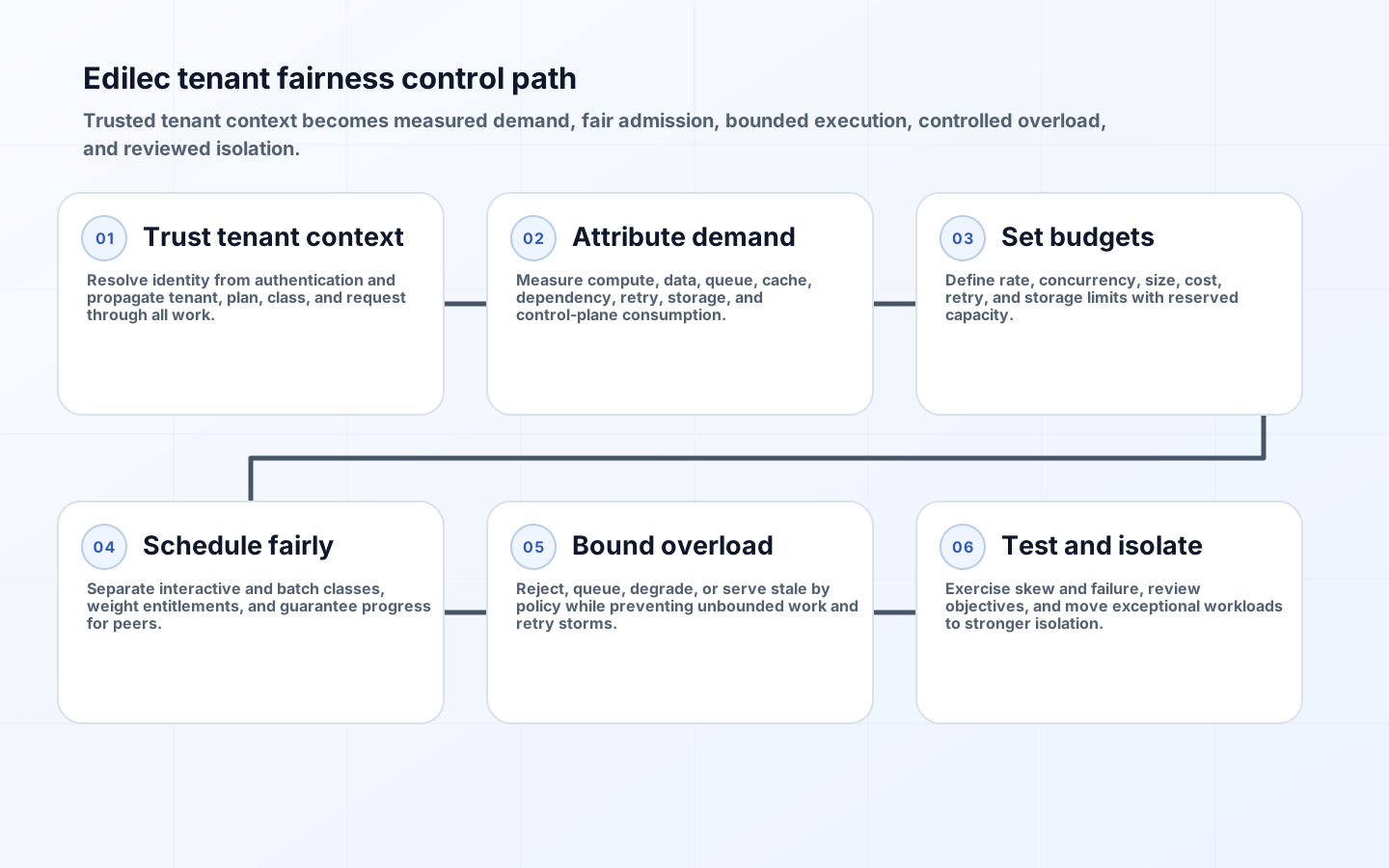
A multi-tenant noisy neighbor exists when one tenant’s activity consumes a shared resource and degrades another tenant’s experience. CPU saturation is only the obvious form. Connection pools, database locks, hot partitions, queue workers, cache memory, outbound provider quotas, search shards, object-store request rates, logging pipelines, and control-plane APIs can all become the contested resource.
The remedy is a tenant-aware control system: propagate trustworthy tenant identity, attribute consumption, define budgets, schedule fairly, protect reserves, shed work predictably, and move exceptional workloads to stronger isolation when economics justify it. Autoscaling alone is insufficient because scaling can lag, a downstream limit may not scale, and one tenant can consume every new unit as it appears.
Map every contention surface
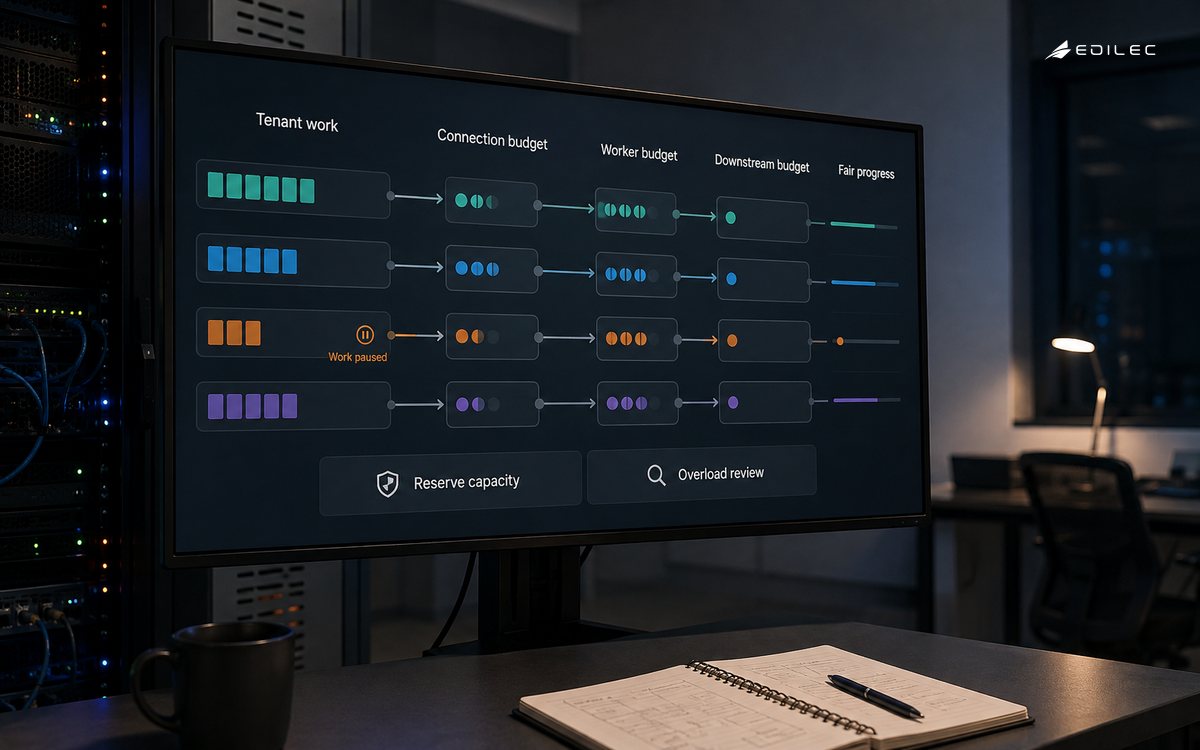
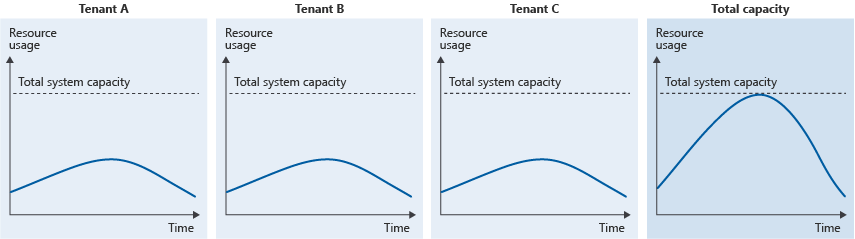
For each request and background job, follow resource use from edge to storage. Identify the finite capacity, allocation unit, queue, admission point, scaling behavior, and failure mode. Microsoft’s multitenant compute guidance notes that consolidation improves density but increases noisy-neighbor likelihood and recommends capacity planning, quotas, API limits, monitoring, and appropriate isolation.
| Resource | Tenant consumption unit | Pressure signal | Primary control |
|---|---|---|---|
| API and compute | Requests, CPU time, memory, concurrency | Queue delay, throttles, saturation | Token bucket plus concurrency cap |
| Relational database | Queries, rows scanned, locks, connections | Wait time, pool exhaustion, hot tables | Query budget, pool partition, statement limits |
| Queue workers | Messages, processing seconds, retries | Oldest age and per-tenant backlog | Fair queues, weighted dispatch, retry budget |
| Cache | Bytes, operations, expensive misses | Eviction, hit rate, memory by namespace | Tenant namespace, size cap, admission policy |
| Search or analytics | Queries, scan bytes, index growth | Shard latency and rejected work | Workload groups and asynchronous jobs |
| External provider | Calls, tokens, bytes, provider quota | 429s, spend, regional limit | Per-tenant budget and global reserve |
Measure demand distribution rather than only averages. Record peak concurrency, burst length, payload size, data skew, expensive operation mix, and retry amplification by tenant and plan. Keep labels bounded: raw tenant IDs may create costly metrics cardinality, so combine sampled per-tenant detail, heavy-hitter reporting, logs, and aggregated plan or shard metrics. Preserve a route from an aggregate alert to the responsible tenants.
Propagate trusted tenant context
Resolve tenant identity from authenticated membership or a trusted routing boundary, not from an arbitrary request header. Carry tenant, plan, workload class, and request identity through synchronous calls, queue envelopes, scheduled jobs, database sessions where supported, cache keys, and trace context. Reject work whose tenant context is missing or inconsistent. A resource budget cannot be enforced if asynchronous work becomes anonymous after enqueue.
Isolation for performance and isolation for authorization overlap but are not identical. AWS’s isolation mindset stresses that authentication and authorization alone do not establish tenant isolation. Shared enforcement should prevent developers from accidentally omitting tenant scope, while resource governors independently constrain how much valid work a tenant may consume.
Set budgets and fairness policy
Define budgets per dimension because requests are not equally expensive. An endpoint may have a request-rate limit, concurrent execution cap, maximum payload, database cost ceiling, background-job rate, storage allowance, and external-call budget. Use a token bucket for bursts with sustained-rate control, but pair it with concurrency limits for long work. Reserve capacity for health checks, incident operations, and small tenants so a large backlog cannot consume every worker.
Fair does not always mean equal. Weighted fair scheduling can reflect purchased capacity while still guaranteeing progress for base tiers. Separate interactive, batch, and administrative classes; a bulk export should not sit ahead of a password reset. Make plan entitlements and emergency safety limits distinct. Product policy can grant more capacity, while platform safety can still reject a workload that threatens the service.
Apply controls at admission, scheduling, and execution
| Layer | Control | Protects against | Design caveat |
|---|---|---|---|
| Edge admission | Per-tenant rate, payload, and concurrency limits | Request floods and oversized work | Must use authenticated tenant identity |
| Queue | Tenant partition or fair scheduler | One backlog monopolizing workers | Too many physical queues increase operations |
| Compute | Requests, limits, worker pools, workload classes | CPU and memory contention | Hard limits can throttle legitimate bursts |
| Data | Connection quotas, workload management, partitioning | Pool exhaustion, hot keys, scans | Tenant data skew can defeat simple hashing |
| Cache | Namespaced keys, memory policy, miss coalescing | Eviction and stampede amplification | Global hot objects may deserve shared treatment |
| Dependency | Per-tenant circuit, retry, and spend budget | Downstream quota exhaustion | Excessive partitioning reduces shared efficiency |
In Kubernetes, a ResourceQuota limits aggregate resource consumption in a namespace and can constrain compute and object counts. It does not by itself make application requests fair or stop tenants sharing one pod from interfering. The Kubernetes API Priority and Fairness feature queues and limits API server requests by priority level; it is a useful model for protecting shared control planes, not a substitute for application-level scheduling.
Design explicit overload behavior
Choose what happens when a budget is exhausted: reject with a retry hint, queue up to a bounded deadline, degrade an optional feature, return cached data with disclosed freshness, or move the job to a slower class. Never let queues grow without bound. The accepted-work response must state whether work is durable, how status is queried, and when it expires. Retrying clients need jitter and a deadline or throttling becomes a synchronized retry storm.
Protect global service health with a second limit above tenant controls. If shared saturation crosses a threshold, tighten admission, preserve reserved classes, and stop nonessential batch work. Keep the policy deterministic enough for support teams to explain. An incident switch that silently blocks one customer without audit or expiry is not a mature isolation mechanism.
Test skew, bursts, failures, and isolation tiers
Build load scenarios with many ordinary tenants, one sustained heavy tenant, synchronized bursts, a hot data partition, slow downstream responses, retrying failures, and large backlogs. Verify both the aggressor’s policy outcome and unaffected tenants’ latency and success objectives. AWS SaaS Lens foundations guidance specifically calls for multi-tenant load, data-distribution, and tenant-isolation testing because workload profiles shift and uneven data can expose hidden bottlenecks.
Use pooled, bridge, and silo models per component. AWS describes pool isolation as efficient but exposed to noisy-neighbor and attribution challenges. Move a tenant or workload to a dedicated shard, worker pool, database, or full stack when required isolation, compliance, predictability, or revenue covers lower density and higher operational cost. Keep onboarding, deployment, telemetry, and policy unified so dedicated infrastructure does not become bespoke hosting.
Review budgets using observed cost and service objectives. Track throttled work, queue delay, fairness share, top consumers, rejected expensive queries, tenant-level objective breaches, isolation moves, and unused reserved capacity. Changes to plans, features, or data shape can invalidate old limits. Version the policy, communicate customer-visible changes, and preserve an emergency override with approval and expiry.
Database isolation deserves query-level evidence. One tenant can consume little storage yet issue unbounded scans, hold locks, or exhaust connections. Tag sessions or statements with safe tenant context, constrain expensive query classes, and use separate pools or replicas where needed. Partitioning by tenant helps only if hot tenants can be moved and cross-tenant indexes, maintenance, and vacuum work do not remain shared bottlenecks.
Background retries need a separate budget from original work. Otherwise a failing downstream dependency lets one tenant multiply its own demand until all workers process retries. Cap attempts and cumulative retry time per operation, apply jitter, stop on nonretryable errors, and reserve worker share for fresh traffic and remediation. Surface discarded or quarantined work to the tenant and operators with a stable status.
Cache fairness is more than namespacing. Apply per-tenant size or admission controls where one tenant can create many low-reuse entries, and protect a shared set of genuinely global hot objects. Monitor evictions caused by each workload class and cap expensive miss concurrency, because a tenant can harm peers through origin load even when its keys never collide with theirs.
Key takeaways
- Map compute, data, queue, cache, dependency, and control-plane contention separately.
- Propagate authenticated tenant context through every synchronous and asynchronous path.
- Combine rate, concurrency, size, cost, retry, and storage budgets; one request counter is inadequate.
- Schedule interactive and batch work fairly and reserve capacity for service recovery.
- Test skewed tenant demand and move exceptional components to stronger isolation only with an explicit business and operating case.
Frequently asked questions
Does autoscaling solve noisy-neighbor problems?
No. Autoscaling adds supply after a signal and may be constrained by startup time, quotas, or downstream capacity. A dominant tenant may consume added supply. Admission, fairness, bounded queues, and per-tenant attribution are still required.
Should premium tenants always receive dedicated infrastructure?
Only when the promised isolation or predictable capacity warrants the cost and operational burden. Weighted pooled capacity or a dedicated component may satisfy the requirement. Price and architecture should reflect a measurable service commitment, not a vague premium label.
How can teams monitor tenants without exploding metric cardinality?
Use low-cardinality service metrics by plan, shard, and workload class, plus heavy-hitter analysis, sampled traces, structured logs, and on-demand per-tenant diagnostics. Alerts should identify the constrained resource and provide a controlled drill-down to tenant evidence.
Conclusion
Noisy-neighbor isolation is a full-path scheduling problem. Trusted tenant context and consumption evidence must reach every finite resource, where budgets and fair admission protect other customers without destroying shared economics. With bounded overload behavior, skewed-load tests, and intentional isolation tiers, multitenancy becomes an operated capacity model rather than a hope that average demand stays polite.