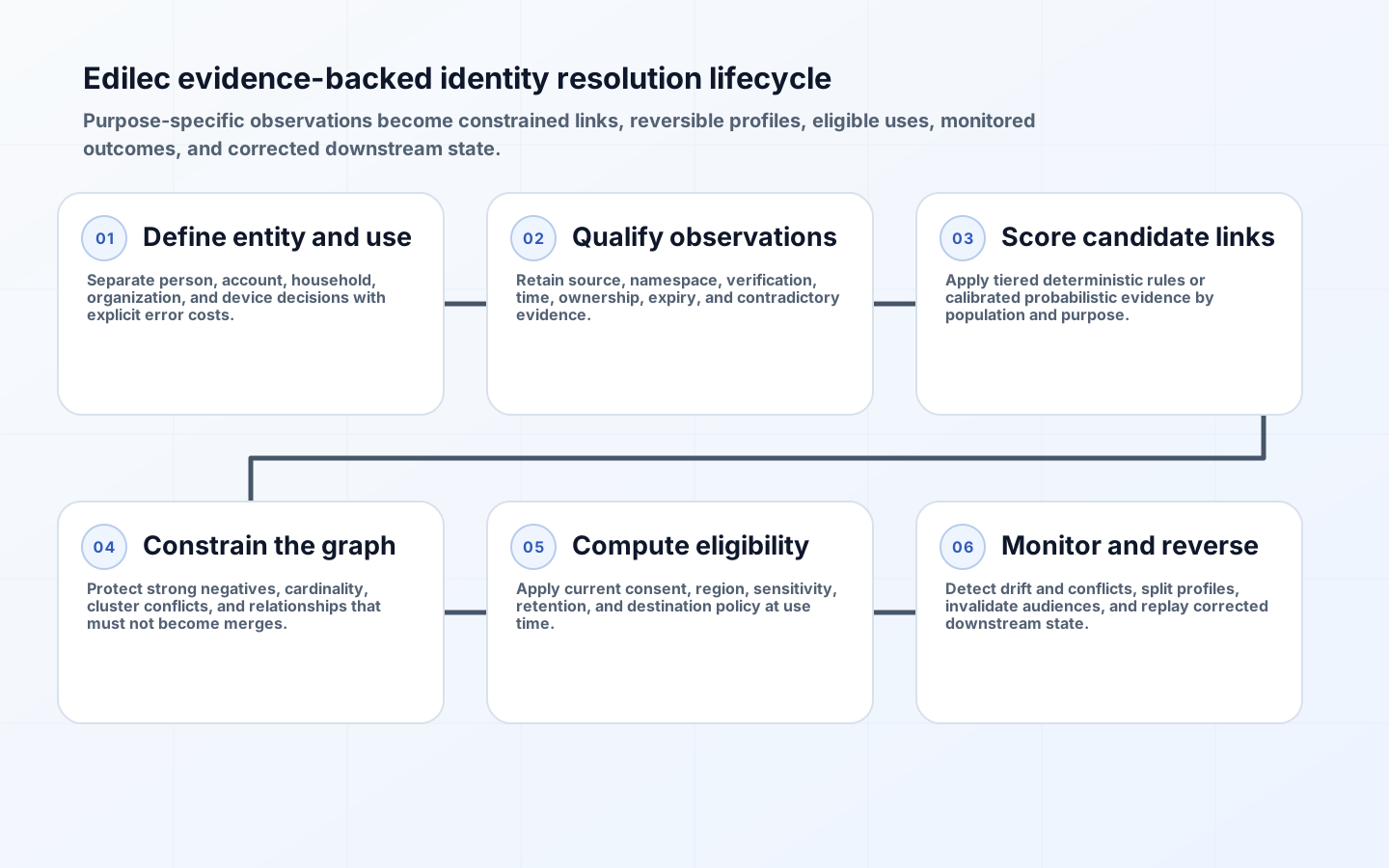
Customer identity resolution decides whether records from different events and systems refer to the same person, account, device, or household. That decision can change personalization, attribution, support history, fraud controls, access requests, and deletion. The goal is not the largest possible profile. It is an evidence-backed identity graph whose links are appropriate for a stated purpose and whose errors can be detected, explained, and reversed.
Deterministic matching uses rules such as equality on a verified account ID. Probabilistic matching combines weaker comparisons and estimates confidence. Neither label guarantees correctness. Direct identifiers can be recycled, mistyped, shared, or mapped to the wrong namespace; statistical scores can be miscalibrated when populations and collection paths change. A mature design therefore separates observed identifiers, match evidence, inferred links, canonical profiles, household relationships, and activation eligibility.
Define the entity and purpose before matching
Start by naming what a node represents. A natural person, login account, organization, household, browser, mobile advertising identifier, loyalty membership, and delivery address are not interchangeable. Model them as distinct entity types with explicit edges. A household relationship may support reach measurement but should not silently merge support cases or privacy preferences. A device-to-person observation may expire quickly; a verified account relationship may persist until account closure.
State the consequence of each use. False merges can disclose one person's purchases to another, suppress a valid acquisition, apply the wrong consent, or produce an incomplete data-subject response. False splits can duplicate messages, fragment service history, undercount frequency, or miss deletion copies. Set separate tolerances by purpose. A link acceptable for aggregate measurement may be too uncertain for customer-facing personalization or rights fulfillment.
| Decision | False merge consequence | False split consequence | Suitable evidence posture |
|---|---|---|---|
| Support profile | Agent sees another person's history or entitlement | Context is missing and service repeats work | Verified account ownership; uncertain records remain linked but separate |
| Marketing frequency | Messages or exposures are suppressed across different people | One person receives duplicates | Purpose-limited person or household edge with expiry |
| Revenue attribution | Credit crosses customers or accounts | Journey value is fragmented | Calibrated links with uncertainty reported in analysis |
| Personalization | Sensitive behavior influences the wrong experience | Relevant context is absent | High-confidence, current, consent-eligible evidence |
| Access or deletion request | Another person's data is disclosed or erased | Responsive records are omitted | Authoritative verification plus broader candidate search and human review |
Design a tiered deterministic and probabilistic match policy
Create evidence tiers rather than one global score. Tier A might require an immutable first-party subject ID issued after authentication. Tier B could accept a verified email plus consistent account history. Tier C may use name, postal address, phone, device, time, and behavioral comparisons to produce a candidate link. Tier D contains contextual associations, such as co-location, that are never sufficient for a person merge. Rules must include namespace, issuer, verification state, observed time, source reliability, and expiry.

Probabilistic models compare candidate pairs rather than every record with every other record. Blocking keys reduce the search space but can create false splits when the blocking field is missing or wrong. Features should distinguish agreement from commonness: matching on a rare surname generally carries different evidence from matching on a common one. Train and evaluate on representative labeled pairs, preserve a clerical-review band where justified, and calibrate scores so thresholds correspond to observed error rates in each important population.
Recognize deterministic matching failures
Exact equality fails when identifiers are not stable or uniquely controlled. Families share email addresses and phone numbers. Phone numbers and addresses are reassigned. CRM imports may put placeholder addresses into many records. Guest checkout can reuse an address without creating account ownership. Vendor IDs collide when tenant or source namespace is omitted. Case folding and Unicode normalization can improve syntactic comparison while also collapsing values that were distinct in the source.
Treat verification as an event, not a permanent property. Store who asserted an identifier, how it was verified, when it was first and last observed, and when it ceased to be valid. Never merge solely because a contact field changed to a value already held by another profile. Instead, create a candidate conflict, assess temporal overlap and ownership evidence, and preserve both histories. Strong identifiers should anchor a graph; they should not erase contradictory evidence.
Recognize probabilistic matching failures and graph amplification
A model can fail because labels are biased, match and non-match rates shift, a feature leaks a prior merge decision, or a score is used outside its validated population. Name transliteration, rural addresses, multi-generational households, corporate email aliases, and privacy-preserving relay addresses can behave differently. Monitor performance by source, region, language, entity type, acquisition channel, and time, subject to privacy and sample-size safeguards.
Pairwise accuracy is not enough. Transitive closure can amplify one weak edge: if A matches B and B matches C, a system may collapse all three despite contradictory A-to-C evidence. Use constrained clustering. Protect strong negative evidence, enforce cardinality rules where the domain supports them, and calculate cluster-level diagnostics such as conflicting verified identifiers, implausible household size, simultaneous distant activity, or abrupt profile growth. Some relationships belong as edges, not merges.
| Evidence | Typical strength | Common failure | Recommended graph treatment | Expiry or review |
|---|---|---|---|---|
| Authenticated internal subject ID | High within its issuer namespace | Tenant omission, account transfer, source defect | Anchor node with issuer and namespace | Review on account lifecycle events |
| Verified email | High but not unique forever | Shared inbox, recycling, relay rotation | Time-bounded identifier ownership edge | Reverify after change or long inactivity |
| Phone number | Medium when recently verified | Family sharing, reassignment, formatting | Weighted edge with country and verification context | Decay after loss of verification |
| Postal name and address | Context-dependent | Households, moves, spelling and transliteration | Candidate person edge or explicit household edge | Review on address change |
| Device or cookie | Low for person identity | Shared devices, reset, blocking, multiple users | Device-to-profile observation, never person merge alone | Short purpose-specific lifetime |
| Behavioral similarity | Supporting only | Popular patterns and feedback loops | Model feature with strict use limits | Continuous drift and fairness review |
Make every profile merge reversible
Do not destructively overwrite source records into a golden row. Preserve immutable observations and construct a resolved view from versioned graph operations. Each link or unlink event should record input entities, evidence, policy and model version, score, threshold, actor, time, purpose, and downstream publications. W3C PROV-O concepts such as entities, activities, agents, generation, derivation, and invalidation provide a useful vocabulary for lineage, even if the implementation is relational rather than RDF.
A split operation must propagate. Recompute surviving clusters, restore field provenance, invalidate derived audiences, correct destination mappings, and assess whether past disclosures or decisions require response. Maintain an append-only merge ledger and deterministic replay from source observations. Test multi-step errors, including splitting a profile that had already been merged into another cluster. A manual database edit without lineage is not a recovery mechanism.
Keep consent and eligibility separate from identity
Identity resolution answers “might these records concern the same entity?” It does not answer “may this data be combined or activated for this purpose?” Attach consent, notice, contract, regional restriction, sensitivity, and retention to source observations or purpose-specific edges. At query or activation time, compute an eligible view using current policy. Do not let one permissive record overwrite a restrictive preference from another channel without an explicit precedence rule.
Rights workflows need broader logic than marketing activation. A request may require searching candidate records under former identifiers without first merging them into a marketing profile. Keep proof of how candidates were identified and verified. Where automated identity decisions have meaningful effects, provide review and correction paths. Privacy engineering should examine linkability and unexpected secondary use, not only storage encryption.
Operate identity resolution as a controlled production system
Build a labeled evaluation set with confirmed matches, confirmed non-matches, hard negatives, shared identifiers, changed identifiers, and representative languages and sources. Split evaluation by entity or time to avoid leakage. Track precision and recall at each automatic threshold, review-band yield, cluster conflict rate, merge reversals, profile-size distribution, unmatched rate, source coverage, score calibration, and downstream incidents. Avoid a single “accuracy” number that hides the error type and use.
Deploy policy or model changes in shadow mode, compare graph deltas, sample high-impact additions and removals, then release by source or purpose. Set hard stops for spikes in cluster size, verified-ID conflicts, merge volume, or destination invalidations. Provide customer-support and privacy teams with explainable evidence and a controlled correction route. Monitor source schema changes because a harmless upstream normalization update can alter match behavior at scale.
Key takeaways
- Model people, accounts, organizations, households, and devices as distinct entities with explicit relationships.
- Set merge thresholds from the consequence of false joins and false splits for each purpose.
- Preserve source, namespace, verification, time, policy, score, and model version for every link.
- Use constrained clustering so one weak pairwise match cannot silently contaminate a large profile.
- Keep identity evidence separate from consent and make merges, splits, and downstream corrections replayable.
Frequently asked questions
Is deterministic matching always safer than probabilistic matching?
No. It is easier to explain, but an exact field can still be shared, recycled, malformed, or missing its namespace. Safety comes from evidence quality, temporal context, purpose, conflict rules, and reversible operations.
What is a good probabilistic match threshold?
There is no universal value. Calibrate scores on representative labeled data, estimate false-merge and false-split rates, and choose thresholds according to the consequence and review capacity of each use case.
Should household members share one customer profile?
Usually not. Represent a household as its own entity connected to separate people. That supports household-level analysis without mixing individual purchases, support cases, entitlements, or preferences.
Conclusion
Reliable customer identity resolution is a governed evidence system, not a one-time deduplication job. Define entities and consequences, tier deterministic and probabilistic evidence, constrain graph formation, preserve provenance, and separate identity from permission. The best implementation is not the one that joins the most records; it is the one that can justify each consequential link and repair the full downstream effect when the link is wrong.