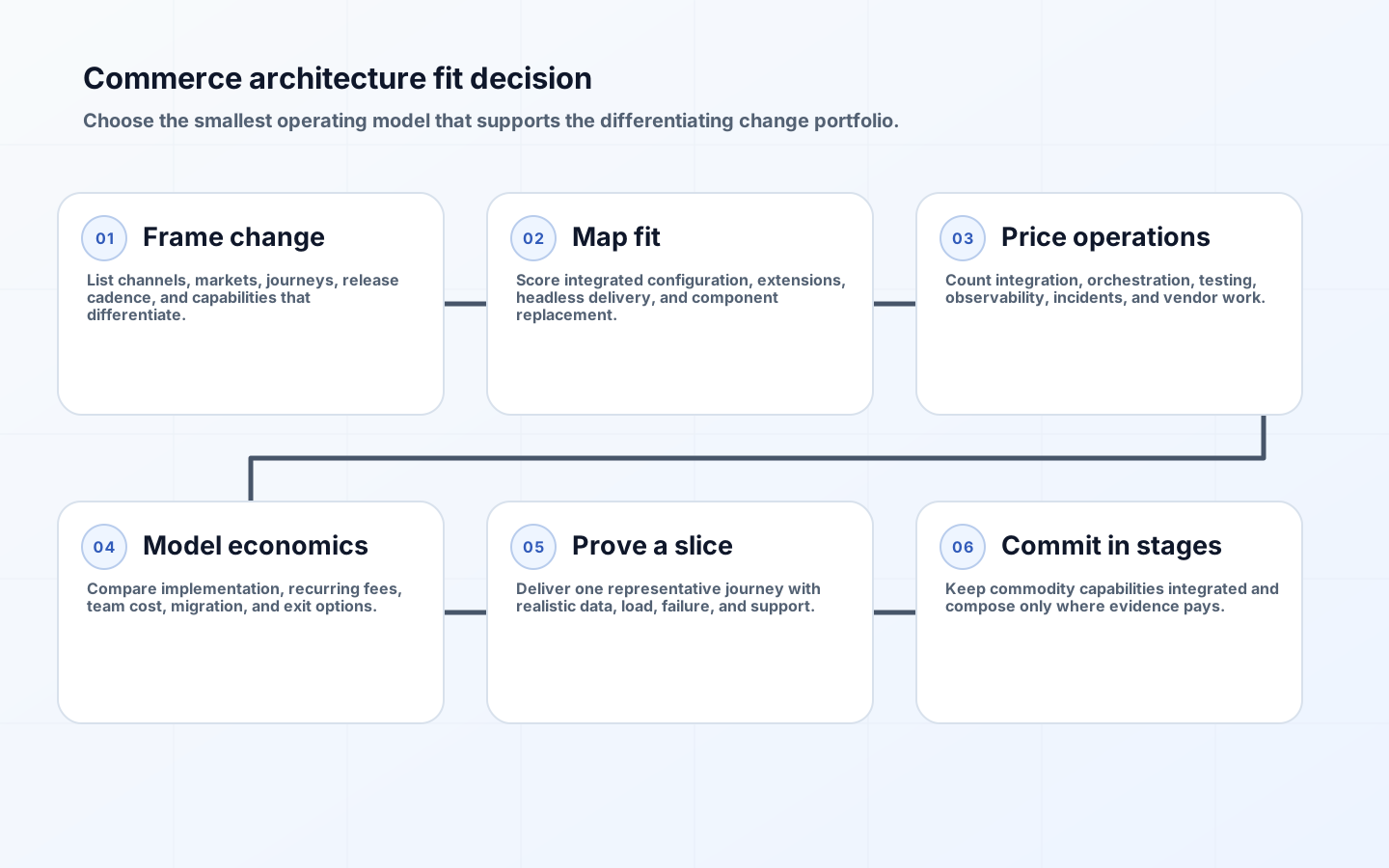
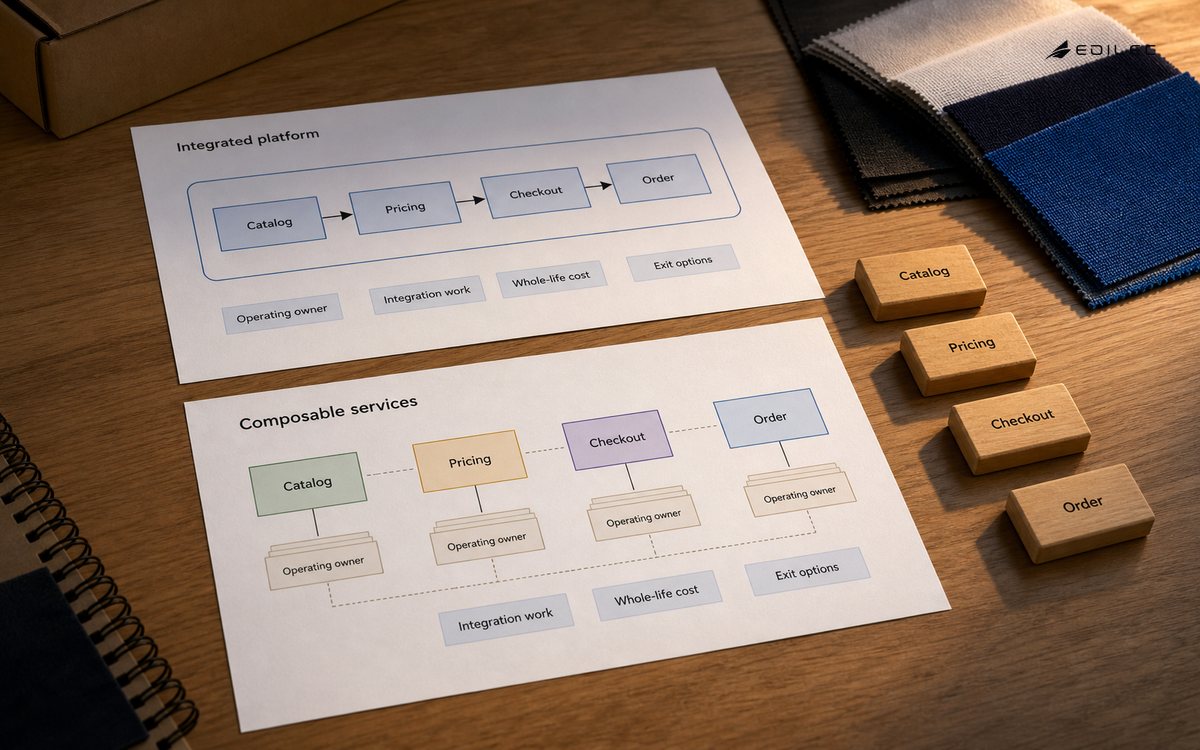
The composable commerce vs traditional ecommerce decision is not a contest between modern and obsolete technology. It is a choice about where product boundaries, change authority, and operational responsibility sit. An integrated platform supplies a coordinated set of catalog, pricing, promotion, checkout, order, administration, and storefront capabilities. A composable model assembles selected capabilities through APIs and experience layers. That can improve independent change, but the merchant owns more integration and service behavior.
Use the smallest architecture that supports the business’s differentiated change portfolio. A standard retail journey with modest market variation may gain more from integrated configuration and extensions than from replacing every capability. A business serving many brands, channels, complex offers, or region-specific workflows may need independent components. The comparison should cover implementation, recurring fees, team load, observability, testing, incidents, data consistency, vendor coordination, and future exit, not only license quotes or frontend velocity.
Frame the decision around differentiated change
List business outcomes and the changes expected over three to five years: new countries, brands, channels, marketplaces, stores, subscriptions, B2B models, product types, promotions, fulfillment partners, loyalty, content experiences, and acquisitions. For each, state frequency, lead-time need, revenue or risk significance, and which capability must change. Separate differentiating behavior from commodity operations. A unique merchandising journey may justify a custom experience; tax calculation and payment tokenization usually reward mature managed capability.
Map present constraints to their cause. Slow change may result from organization, data quality, approval, or test environments rather than a monolith. API-first components do not remove those issues. Conversely, an integrated platform may be technically capable but constrained by a rigid vendor roadmap or release model. Prove the bottleneck with change lead time, failure rate, dependency waits, and abandoned requests. Architecture should address a demonstrated limit, not act as a proxy for delivery reform.
| Condition | Integrated platform fit | Composable fit | Question to resolve |
|---|---|---|---|
| Standard web and store journeys | Strong when configuration meets needs | May add unnecessary ownership | Which capabilities truly differentiate? |
| Many distinct channels or experiences | Headless option may be sufficient | Strong when channels need independent composition | Can one commerce contract serve all channels? |
| Complex regional capability mix | Platform markets and apps may cover it | Useful when regions replace components independently | Who governs cross-market consistency? |
| Small product engineering team | Managed suite reduces operational surface | Risk of integration and on-call overload | Can the team own the dependency graph? |
| Frequent specialist replacement | Suite boundaries may constrain change | Independent components can reduce replacement scope | Are data and contracts genuinely portable? |
| Strict end-to-end accountability | One vendor simplifies escalation but not all dependencies | Merchant must coordinate multiple providers | Who restores checkout during a cross-vendor incident? |
Define capability, data, and experience boundaries
Model capabilities such as product information, search, pricing, promotion, inventory, cart, checkout, payment, order management, content, customer, and fulfillment. For each, identify system of record, authoritative decision, API, events, latency, consistency, failure mode, owner, and replacement boundary. MACH Alliance principles describe open, composable, and connected components; practical value depends on clean contracts and portable data. Splitting one process across products without authority creates distributed ambiguity, not composability.
Keep the storefront or channel layer separate from commerce authority. Shopify’s custom storefront guidance defines headless as an independent frontend using Shopify’s commerce engine. That is one intermediate option: custom experience without assembling every backend capability. Similarly, an integrated platform can expose APIs and events, while a composable stack can contain tightly coupled vendor modules. Evaluate the architecture actually purchased and operated, not the category label.
Choose consistency by business invariant. Prices and discounts shown at checkout need authoritative recomputation. Inventory may be an availability promise with bounded staleness. Product content can often propagate asynchronously. Orders require durable identity and idempotent transitions. Define canonical identifiers and versioned contracts, then test consumer compatibility. Event choreography and an orchestration layer are products to operate; include replay, dead letters, reconciliation, and schema evolution in the design.
Price total ownership, including the merchant integration layer
For the integrated case, include subscription or license tiers, transaction fees, apps, implementation, extensions, themes or headless frontend, data migration, environments, support, upgrades, testing, and vendor constraints. For the composable case, include each component, API usage, integration platform, event infrastructure, search indexing, edge delivery, identity, observability, test environments, developer tooling, SRE coverage, security, data operations, and vendor management. Apply the same demand, markets, availability, and support hours to both.
Model internal team capacity as a real recurring cost. Product engineers who maintain integration contracts, frontend composition, release pipelines, incident response, and reconciliation are not free because their salaries are already budgeted. Show opportunity cost: what differentiating work they cannot deliver. Also value control where it matters. Owning an experience layer may shorten experimentation lead time; owning commodity order plumbing may only add undifferentiated toil. Use ranges for traffic, API pricing, implementation effort, and vendor increases.
| Cost domain | Integrated platform | Composable architecture | Evidence source |
|---|---|---|---|
| Core products | Suite tier, transactions, modules | Multiple component subscriptions and usage | Contracted volumes and price bands |
| Build and migration | Configuration, extensions, data, integrations | Domain decomposition, contracts, composition, data movement | Representative backlog and proof slice |
| Run operations | Platform admin, apps, support, custom code | Integration, orchestration, observability, on-call, data reconciliation | Operating model and service hours |
| Change and upgrades | Vendor releases, regression, extension upkeep | Independent upgrades plus cross-component compatibility | Release history and contract tests |
| Reliability | Suite incidents and external dependencies | More service edges and merchant-owned degradation | Failure scenarios and SLO model |
| Exit and optionality | Data export, extension rewrite, vendor transition | Component replacement plus contract/data portability | Tested export and replacement exercise |
Compare reliability and operational accountability
Draw the end-to-end customer journey and identify every synchronous dependency. A composable product can be individually reliable while the assembled checkout has lower availability because failures multiply and fallback behavior is missing. Define service objectives for browse, cart, checkout, and order capture; allocate latency and error budgets; and design degradation. Search can fall back to cached results, recommendations can disappear, and content can serve stale. Price, payment, and order commitments need stricter behavior and reconciliation.
For each incident, decide who detects, communicates, mitigates, and coordinates vendors. Integrated platforms still rely on payment, tax, carriers, apps, and merchant integrations, so one contract does not mean one failure domain. Composable stacks require stronger correlation IDs, distributed tracing where supported, synthetic journeys, contract monitoring, and business reconciliation. Establish access and data-sharing rules before an incident. Count 24-hour support and escalation effort in the operating model.
Test change velocity with a representative business slice
Select a slice that exercises catalog, price, promotion, content, inventory, cart, checkout, order, fulfillment, analytics, localization, and an external integration. Implement it in realistic candidate environments with production-like data volume and failure tests. Measure elapsed delivery time, handoffs, deploy frequency, regression effort, performance, incident diagnosis, merchant administration, and the effort to change one component. A polished storefront demo that bypasses returns, operations, and reconciliation is not an architecture proof.
Assess team readiness during the proof. Can engineers design APIs, events, idempotency, security, observability, and automated tests? Can merchandisers operate the tools without engineering? Can finance reconcile orders and payments? Can support diagnose a failed journey? If the target operating model requires capabilities the organization will not fund, choose a more integrated boundary or a managed integrator. Architecture cannot sustainably depend on future staffing that has no owner or hiring plan.
Choose an incremental commitment and preserve exit options
The answer can be hybrid. Keep stable commodity transactions on an integrated engine, add a custom storefront where experience differentiates, externalize search or product information when a clear requirement appears, and introduce event contracts around durable business facts. Replace one capability only after defining authority, data ownership, failure behavior, and retirement of the old path. This reduces simultaneous change and creates evidence about the organization’s ability to operate composable boundaries.
Negotiate data export, API limits, change notice, observability, incident support, subprocessor information, sandbox access, termination assistance, and continued access during transition. Periodically export and restore critical data. Maintain contract tests and a component register. Portability is not achieved by contract language alone, but rights and technical evidence together improve leverage. Reassess the architecture as change demand and team capability evolve; an integrated choice today need not become permanent, and composability should not become an obligation to split further.
Key takeaways
- Choose architecture from differentiated change and proven constraints, not from a modernity label.
- Evaluate integrated, headless, hybrid, and composable options at actual capability boundaries.
- Include the merchant-owned integration, testing, observability, incident, reconciliation, and vendor load in TCO.
- Prove one end-to-end business slice with realistic operations and failures before broad commitment.
- Compose incrementally where independent change creates measurable value and preserve data and contract exit evidence.
FAQ
Is headless commerce the same as composable commerce?
No. Headless separates a channel frontend from the commerce backend. Composable architecture additionally assembles replaceable capabilities. A custom storefront on one integrated commerce engine is headless but not necessarily a multi-component composable backend.
Is composable commerce cheaper?
It can be for organizations that gain material value from independent capability change and use components efficiently. It can cost more when product fees, integration, team load, observability, testing, and incidents exceed that value. Compare whole-life scenarios at the same service level.
Does composable architecture eliminate vendor lock-in?
It can reduce the replacement scope of one component, but data models, APIs, orchestration, search indexes, and team skills still create switching costs. Preserve canonical identities, portable data, governed contracts, export rights, and replacement tests.
Conclusion
The best commerce architecture is the least complex operating model that supports the changes the business must make. Integrated platforms concentrate capability and accountability; composable systems can localize change while transferring integration and reliability work to the merchant. A fair TCO, representative proof, and incremental boundary choices reveal where that ownership earns a return and where managed integration remains the stronger product decision.