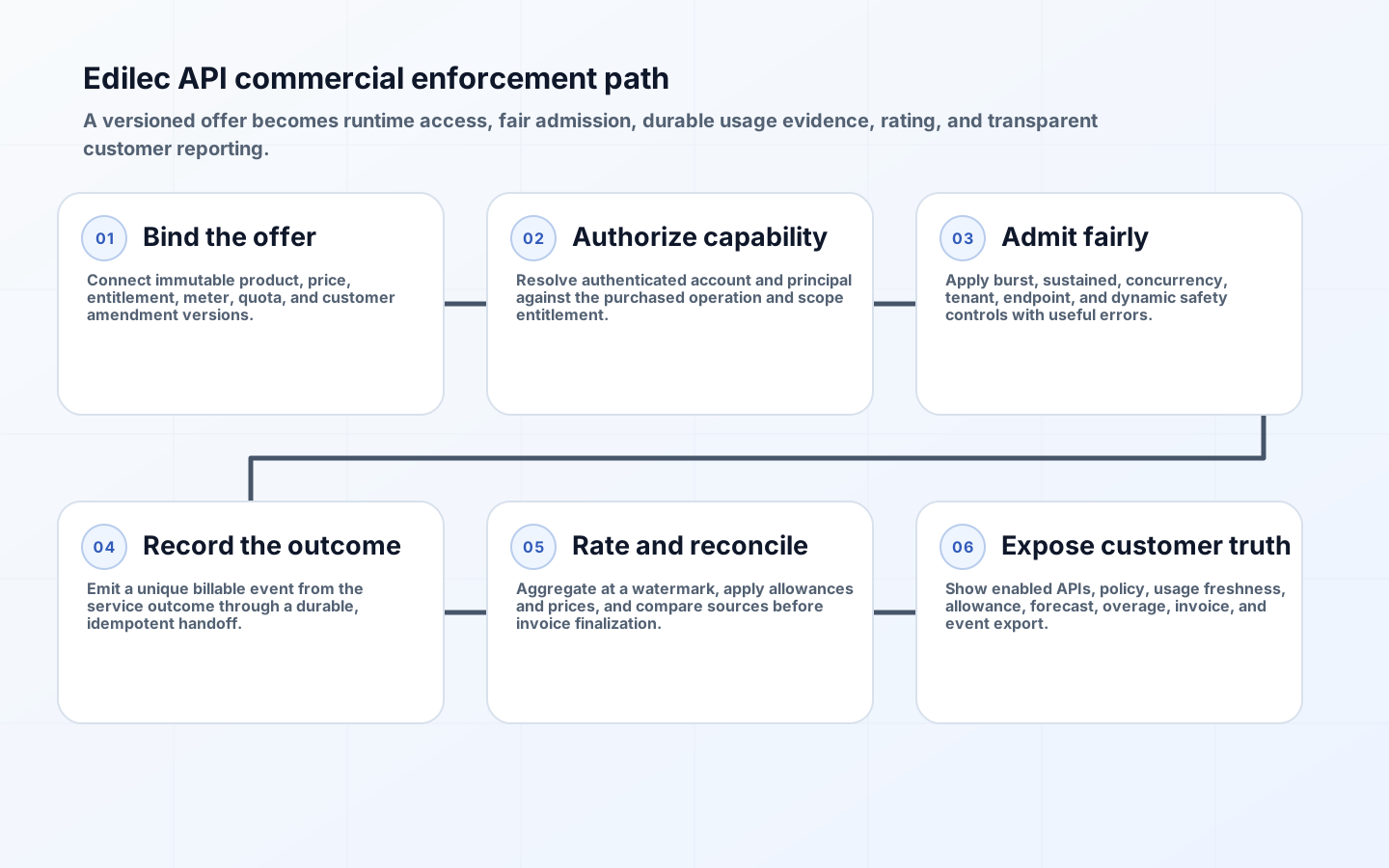
API monetization architecture turns a commercial package into consistent runtime and invoice behavior. The buyer needs to know which operations are available, how much may be consumed, how usage is measured, when requests are throttled, and how charges can be verified. If the price catalog, gateway policy, meter, entitlement service, and portal each implement a different interpretation, support cases and revenue leakage are inevitable.
Begin with the value unit and customer promise rather than a gateway counter. Requests are simple to count but may poorly represent cost or value: one report request can scan gigabytes while one batch call can replace thousands of single-item calls. The selected unit shapes idempotency, dimensions, aggregation, limits, customer reporting, fraud controls, and the economic incentive placed on integration design.
Translate packaging into a versioned API contract
| Commercial term | Technical representation | Enforcement point | Customer evidence |
|---|---|---|---|
| Endpoint or capability access | Versioned entitlement and scope | Authorization service and gateway | Portal capability list |
| Included usage | Allowance by meter and period | Rating or credit allocation | Current usage and forecast |
| Burst limit | Short-window rate and concurrency policy | Gateway or service admission | Response headers and documentation |
| Sustained quota | Longer-window budget | Distributed quota service | Remaining budget with update time |
| Overage | Price and approval behavior | Rating and billing workflow | Projected and finalized charges |
| Service tier | Priority, SLO, and support policy | Scheduler, routing, operations | Status and support commitments |
Version product, price, entitlement, meter, and policy independently, then bind them in an effective-dated offer. An active subscription points to an offer version; runtime decisions resolve that snapshot, not the latest marketing catalog. Include customer-specific amendments and grandfathered terms as explicit overrides with provenance and expiry. Never encode plan names such as Pro directly in endpoint code because names survive while their contents change.
Use an OpenAPI document as the interface source for operations, parameters, security schemes, errors, and deprecation metadata. The OpenAPI Specification defines a language-agnostic description that humans and tools can understand without source access. Monetization metadata can use documented vendor extensions, but keep the commercial catalog authoritative and validate references during delivery so portal and enforcement do not drift.
Choose a measurable, explainable usage unit
Define a meter event with event ID, account, credential or application, operation, quantity, occurrence and receipt times, region, response class, product dimensions, and source version. State whether failed requests, cache hits, retries, partial responses, batch items, and asynchronous completions count. Decide aggregation and lateness rules before launch. Stripe's meter guidance illustrates sum, count, and last aggregation and treats meter configuration as effectively fixed after creation.
Meter at the point that knows the billable outcome. The gateway knows admitted requests and identity but may not know items processed or expensive downstream work. The service knows outcome but can miss requests rejected earlier. Often two signals are useful: operational admission events for quota and service completion events for billing. Link them with a stable request or job ID and define which is financially authoritative.
Separate entitlements, quotas, and billing
| Layer | Question | Latency expectation | Failure posture |
|---|---|---|---|
| Authentication | Who is calling and for which tenant? | Per request | Reject unknown identity |
| Authorization | May this principal invoke the operation? | Per request, cacheable briefly | Fail closed for privileged access |
| Entitlement | Has the account purchased the capability? | Per request or session | Use signed/cacheable snapshot with bounded age |
| Quota admission | Is capacity available under current policy? | Per request | Reject, queue, or degrade by explicit class |
| Metering | What billable usage occurred? | Durable asynchronous write acceptable | Buffer and recover; never silently drop |
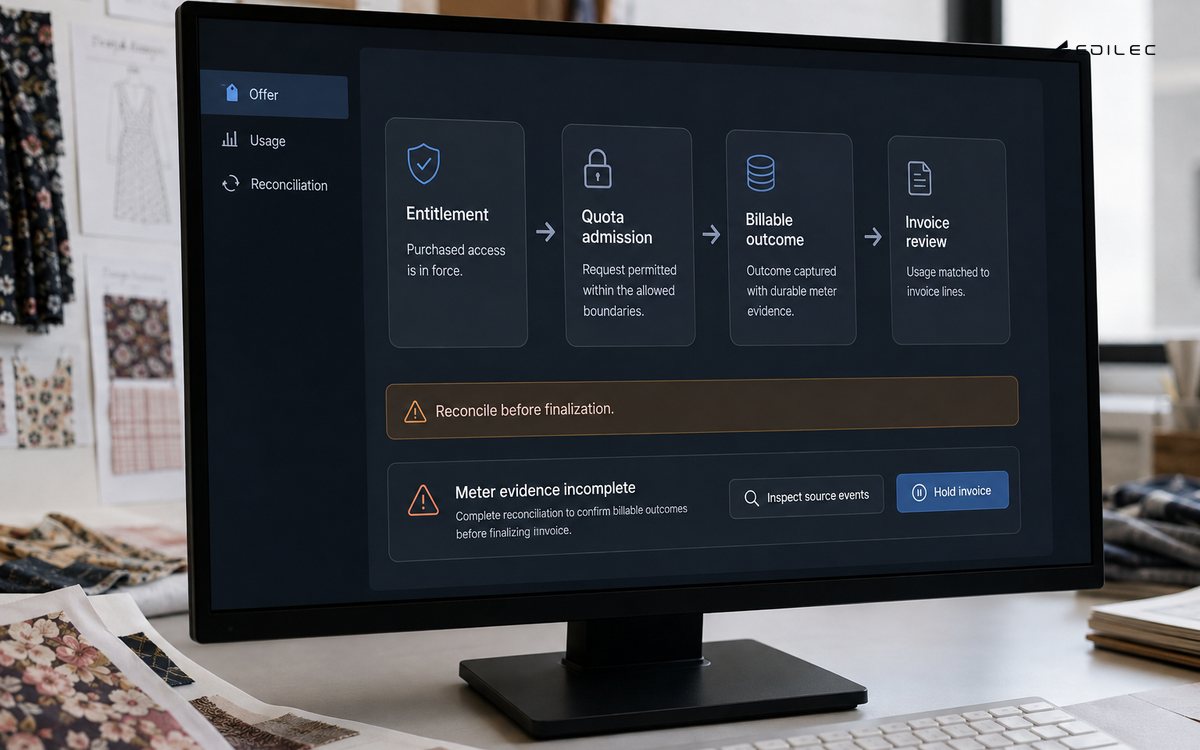
| Rating and invoice | What amount is owed? | Period or near-real-time batch | Reconcile before finalization |
An entitlement is permission; a quota is a consumption or protection boundary; a meter is evidence; a price converts evidence into money. A customer may be entitled to an endpoint but temporarily rate-limited, or may exceed an included allowance while remaining entitled and accruing overage. Keeping the models separate permits grace periods, prepaid commitments, contractual caps, and safety throttles without contradictory checks.
Design quota admission for fairness and resilience
Apply limits at meaningful scopes: tenant, application, user, credential, endpoint group, region, and expensive resource. Combine a burst algorithm such as token bucket with concurrency caps and a longer-window budget. Reserve capacity for control operations and callbacks needed to recover. Shard counters by trusted account key, define clock and consistency behavior, and protect the quota service from becoming a global dependency through local leases or bounded cached allocations.
Return HTTP 429 for temporary rate limits where appropriate, include Retry-After, and provide a machine-readable problem response. RFC 9457 defines Problem Details for HTTP APIs, including type, title, status, detail, instance, and extensions. Give clients a stable problem type, violated policy ID, safe retry time, and support correlation ID without exposing infrastructure capacity or another customer's activity.
As of 2026-07-13, RateLimit response fields remain an IETF Internet-Draft, not an RFC. The current RateLimit header fields draft defines RateLimit-Policy and RateLimit structures, but its status can change. If adopted, pin the draft semantics in your API documentation and client tests. Treat advertised availability as guidance rather than a guaranteed future admission because concurrent requests and dynamic protection can change it.
Build a durable usage and reconciliation pipeline
- Assign a unique billable-event ID and validate tenant, meter version, dimensions, and occurrence time.
- Commit the business outcome with an outbox record or equivalent durable handoff.
- Ingest idempotently and quarantine invalid events without losing source evidence.
- Aggregate by account, meter, price interval, and published lateness watermark.
- Rate usage against the subscription's effective offer and apply allowances or credits.
- Reconcile source outcomes, meter events, customer reports, and invoice lines before close.
At-least-once delivery is practical when event identity and deduplication are strong. Do not generate a new ID on every retry. Preserve adjustments as separate events that reference the original. Monitor event age, invalid rate, duplicate rate, accounts with traffic but no meter events, meter totals without successful outcomes, and differences between provisional portal totals and finalized invoice totals. Document the reporting lag so customers can act on honest data.
Make commercial behavior part of developer experience
The portal should show exact plan and effective date, enabled APIs, credential scopes, sandbox behavior, quota policies, current usage with data freshness, included allowance, projected overage, invoices, event-level export, status, changelog, and support. Offer test credentials whose limits and billing semantics resemble production without creating real charges. Provide examples for retries, pagination, idempotency, 429 handling, asynchronous jobs, and webhook verification.
Avoid selling a nominal request allowance that good client behavior can accidentally multiply. Specify whether pagination pages, polls, retries, validation failures, and idempotent repeats consume quota or billable units. Prefer idempotency keys for create operations and completion webhooks over aggressive polling. Give customers enough dimensions to optimize cost, but suppress sensitive user-level details unless authorized and necessary.
Govern pricing and policy changes independently
A quota increase may be an operational protection change, a purchased entitlement, or both. Record initiator, reason, effective interval, account scope, and whether billing changes. Roll out new meters in shadow mode and compare against the current model before charging. For a price migration, preview historical representative usage, obtain required approval, preserve old contracts, and monitor access and invoice differences by cohort.
Run abuse and overload tests. A paying customer is still untrusted input, and a high plan limit is not permission to exhaust a shared database. Distinguish contractual quota from dynamic safety controls and disclose that protective throttling can occur. Provide service credits or incident handling according to the agreement rather than manipulating meter data to hide availability failures.
Key takeaways
- Choose a value unit whose measurement and customer meaning can be explained.
- Bind versioned offers to entitlements, meter definitions, quota policies, and prices.
- Keep access, admission, metering, rating, and invoicing as linked but distinct decisions.
- Meter durably at the point that knows the billable outcome and reconcile end to end.
- Expose limits, freshness, usage, overage, and errors as part of the API product.
- Label evolving standards accurately and pin any draft semantics customers depend on.
API monetization FAQ
Should failed API requests be billed?
Usually only when the contract defines a valuable or costly outcome that occurred. Authentication failures and server errors are poor billing units. Validation failures may consume protective quota to deter abuse without creating a charge. Document each response class and test it against meter output.
Do quotas require strongly consistent global counters?
Not always. Strict prepaid exhaustion may need reservations or a consistent account authority. Protective rate limits can use regional counters or leased budgets with bounded overshoot. State the tolerance, account for concurrency, and keep financial allocation separate from approximate admission counters.
Must portal usage be real time?
It should be timely enough for the customer's decision, with an explicit as-of time. Provisional near-real-time totals can coexist with a finalized billing total after lateness and reconciliation. Claiming real time while silently excluding delayed events creates more surprise than a clear processing delay.
Conclusion
An API becomes a credible paid product when commercial language and runtime evidence agree. Versioned entitlements, resilient quota admission, outcome-aware metering, deterministic rating, transparent developer tooling, and pre-invoice reconciliation let customers integrate confidently while the provider protects capacity and revenue.