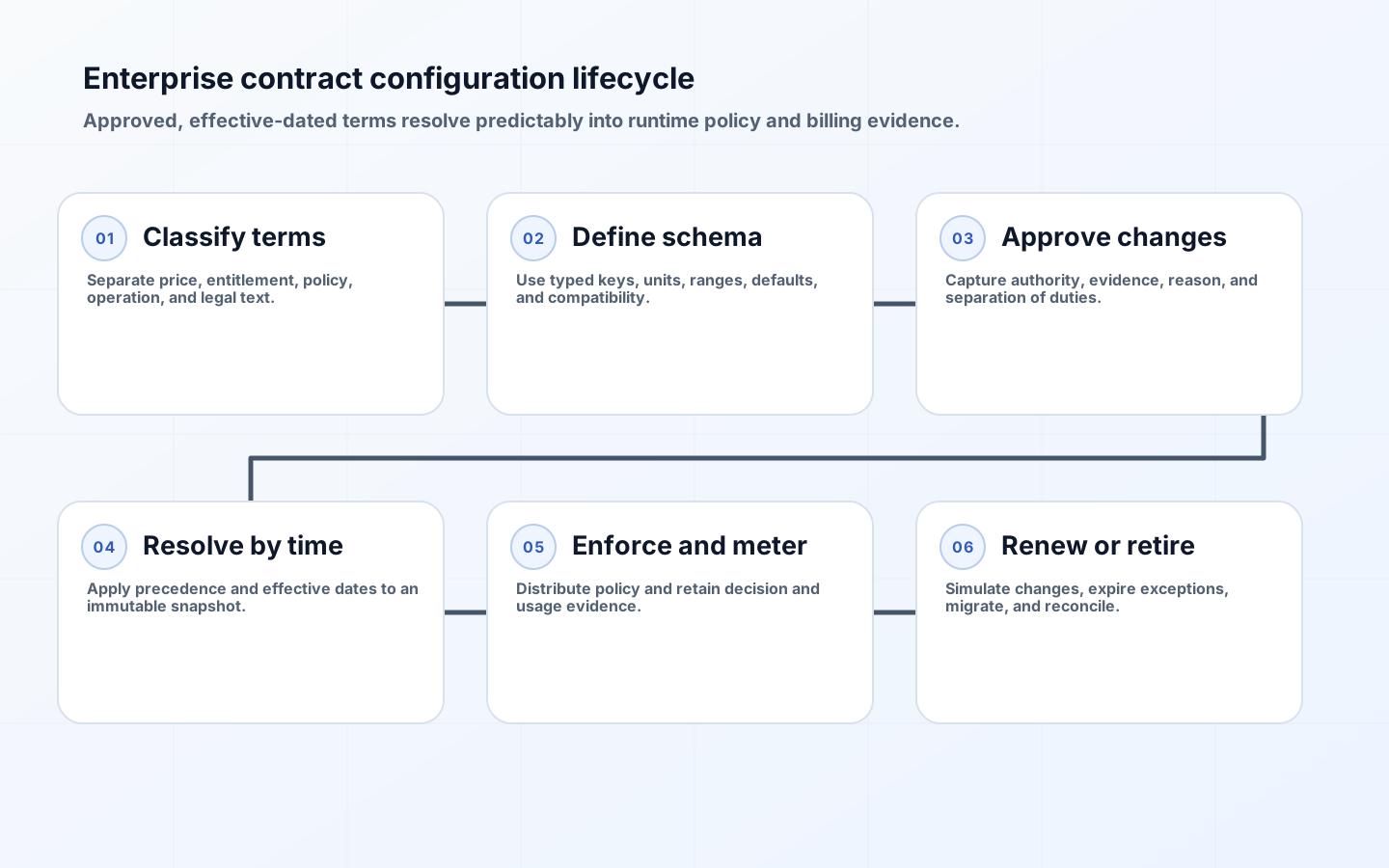
Enterprise SaaS contract configuration turns negotiated terms into predictable product behavior without adding if customer equals branches. Deals can vary price, included usage, seats, support, service levels, retention, residency, identity, export, rollout, and feature access. Some terms affect billing, some authorization, some infrastructure, and some remain legal obligations that software cannot enforce. A safe model classifies those differences, gives them typed schemas and effective dates, resolves precedence, and preserves approval evidence.
The alternative grows quietly: a salesperson writes a term in an order form, operations enters a value in a spreadsheet, an engineer adds a tenant flag, and billing applies a separate discount. At renewal, no one can explain which value is authoritative or when it changed. Configuration should not replace the contract repository; it should be a governed projection of approved operational terms linked to contract, quote, amendment, and decision evidence.
Classify terms by the system behavior they control
Create a term catalog with stable key, business definition, type, unit, allowed values, default, owner, approving role, source system, enforcement points, meter, billing treatment, effective-date rules, compatibility, and retirement policy. Group terms into price, entitlement, quota, data policy, deployment, support, release, identity, and legal narrative. A negotiated indemnity belongs in contract management, not runtime configuration. A ninety-day retention term may require policy in storage, backup, export, deletion, and support tooling, not one integer in an application table.
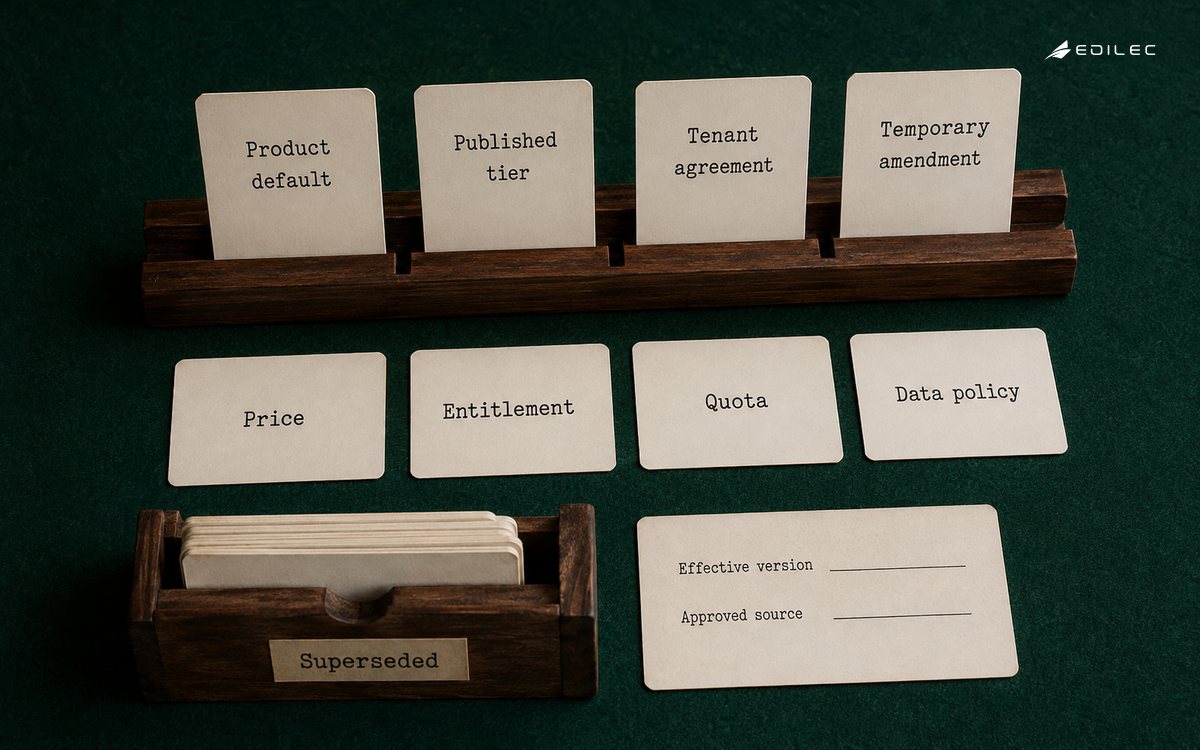
Distinguish capabilities from limits and commercial treatment. Feature access answers whether an operation is permitted. Quota answers how much is allowed in a period. Metering records what occurred. Price converts measured units under a commercial agreement. Support priority affects service workflow. Keeping these concerns separate prevents an unlimited billing quantity from accidentally granting access or a feature flag from becoming the financial ledger. Link them through stable product and term identifiers.
| Term class | Example | Authoritative projection | Critical evidence |
|---|---|---|---|
| Price | Rate per active seat | Billing catalog and subscription version | Currency, interval, quantity, effective period |
| Entitlement | Advanced export enabled | Policy snapshot | Approved contract term and tier |
| Quota | Ten million events monthly | Usage policy and meter | Window, unit, overage behavior |
| Data policy | Regional storage and retention | Placement and lifecycle policy | Scope, region, deletion and backup rules |
| Support | Priority response target | Support routing profile | Coverage hours, severity, exclusions |
Use typed, versioned configuration instead of free-form overrides
Define each value as boolean, enum, integer, decimal with currency, duration, region set, quantity with unit, schedule, or structured object. Validate range, dependencies, and incompatible combinations. Store contract term ID, source document reference, requested and approved values, effective start and end, reason, approvers, schema version, created time, and superseded record. Append versions rather than editing history. Encrypt sensitive references and keep legal documents in the contract system with appropriate access.
RFC 6902 provides operations for expressing changes to JSON documents, including a test operation useful for conditional updates, but a patch format is transport, not governance. Validate the fully resolved target state, authorize every changed path, and retain before and after snapshots. Avoid arbitrary JSON blobs that let one tenant invent unsupported structure. A term schema should permit controlled product evolution, generate forms and validation, and identify which services must understand a new version before activation.
Resolve precedence and effective time deterministically
Define an inheritance order such as product default, published tier, regional policy, tenant agreement, and approved temporary amendment. Do not rely on write order. Some policy minima must not be weakened by commercial override; encode those constraints explicitly. Resolve the complete configuration for a tenant and timestamp into an immutable snapshot with input versions, output hash, effective interval, and resolver version. Reject overlapping or contradictory records unless the term's merge behavior is deliberately defined.
Use business effective time separately from record creation and deployment time. Future renewals can be approved now and activate later. Backdated changes need exceptional approval and a defined effect on usage, invoices, access, and historical decisions. Handle time zones and inclusive boundaries consistently. At a renewal boundary, workers and request services must agree on the same snapshot; precompute and stage changes, then activate atomically. Preserve the policy version used for consequential requests and billing calculations.
Connect commercial approval to technical activation
Map quote and contract approval outputs to structured term requests. Validate that the request references an approved product, legal entity, tenant, dates, currency, and authority. Apply separation of duties for material discounts, data-policy changes, or unsupported service promises. A technical owner should assess feasibility and enforcement coverage before signature where nonstandard terms are proposed. After signature, activation should consume approved structured data, not rekey prose manually.
Use lifecycle states such as proposed, technically reviewed, commercially approved, contracted, scheduled, active, superseded, expired, and canceled. Record why transitions occurred. Prevent activation when required enforcement services have not acknowledged the schema or when provisioning is incomplete. For urgent temporary exceptions, require scope, expiry, risk owner, monitoring, and automatic removal. Route failed activations to a visible queue; do not leave contract systems marked active while runtime remains on an old tier.
| Change scenario | Required simulation | Activation control | Post-activation check |
|---|---|---|---|
| Renewal price | Representative quantities and invoice periods | Boundary-aligned billing version | First invoice line reconciliation |
| Quota increase | Current usage and burst behavior | Policy snapshot acknowledgement | Limit and meter agree |
| Retention decrease | Data, backup, hold, and deletion impact | Legal and data-owner approval | Deletion evidence without protected loss |
| Residency change | Placement and migration plan | Target acceptance before routing | Data-flow and location verification |
| Feature retirement | Dependent workflows and exports | Notice and compatibility window | No calls on retired entitlement |
Distribute configuration to enforcement and metering points
Publish a compact, signed or integrity-protected snapshot containing tenant, configuration version, schema, effective period, and applicable decisions. Services cache the last valid version and report acknowledgement or incompatibility. Evaluate entitlements from trusted tenant context, not client-supplied claims. OpenFeature's evaluation context formalizes contextual inputs and a targeting key, but avoid unnecessary personal information and do not let general feature targeting replace contract authority. Record evaluation reason and version for high-consequence decisions.
Map every term to enforcement coverage: API gateway, application service, job scheduler, storage lifecycle, deployment control plane, support platform, usage meter, and billing. Test deny and allow paths. A term is not implemented because one UI hides a button. Server-side controls, background work, exports, APIs, and administrative routes must agree. Meter events need tenant, metric, quantity, unit, event time, source, deduplication identity, and configuration context so charges and limits can be reproduced.
Reconcile contracts, runtime, usage, and invoices
Run a regular control that joins contracted active terms, resolved tenant snapshots, data-plane acknowledgements, usage policy, and billing configuration. Detect missing tenants, stale versions, unsupported keys, date gaps, overlapping values, unmetered entitlements, and invoice-plan mismatch. Sample customer-facing behavior and invoices. Stripe recommends creating a new price when an amount changes and archiving old prices rather than changing the amount in place; that immutable-price pattern supports historical reproducibility even if another billing platform is used.
Before renewal, report every negotiated exception, actual use, operational cost, incidents, support burden, enforcement gaps, and proposed default. Retire obsolete exceptions rather than carrying them forward automatically. Simulate the next term against representative usage and effective boundaries. On downgrade or expiration, sequence notice, export, access, retention, billing, and data actions carefully. Keep historical snapshots and source references under retention policy so disputes can reconstruct what the product should have allowed and charged at the time.
Build a contract-fixture suite with standard tiers, common amendments, boundary dates, conflicting overrides, unsupported combinations, and expired exceptions. Assert the resolved snapshot, API authorization, background-job behavior, usage aggregation, invoice preview, and audit reason together. Run fixtures whenever the resolver, term schema, billing adapter, or enforcement service changes. Production canaries should use noncustomer test tenants with future and expiring terms to detect activation drift before a real renewal boundary.
Key takeaways
- Classify negotiated terms into price, entitlement, quota, data, deployment, support, release, and legal concerns with distinct owners and enforcement.
- Use typed, versioned, effective-dated records linked to approved contract evidence instead of tenant-specific branches or free-form blobs.
- Resolve product, tier, region, tenant, and amendment precedence deterministically into immutable snapshots.
- Connect commercial approval to feasibility review and technical activation, with separation of duties and expiring exceptions.
- Reconcile active contracts with runtime policy, metering, and billing, then retire exceptions deliberately at renewal.
Frequently asked questions
Are feature flags enough for negotiated terms?
No. Flags can be an enforcement mechanism for some entitlements, but contracts also need authority, effective dates, precedence, approval, units, billing links, audit, and retirement. Keep the governed contract projection above any flag provider.
How many tenant overrides are too many?
The warning signs are unsupported keys, manual code, unowned exceptions, incompatible combinations, missing expiry, and high support burden. Frequently negotiated values may deserve a standard tier or option rather than remaining exceptions.
Can a contract change be backdated?
Only through an exceptional, approved workflow that defines effects on historical access, usage, invoices, and data policy. Never silently rewrite prior snapshots or metering evidence. Financial adjustments and policy corrections should remain traceable.
Conclusion
Enterprise terms become manageable when they are modeled as governed product data rather than customer code. Typed schemas, explicit precedence, effective time, approved activation, distributed enforcement, and cross-system reconciliation let commercial teams negotiate within clear technical boundaries. The product remains one product, while each tenant receives the behavior the organization can prove it promised.