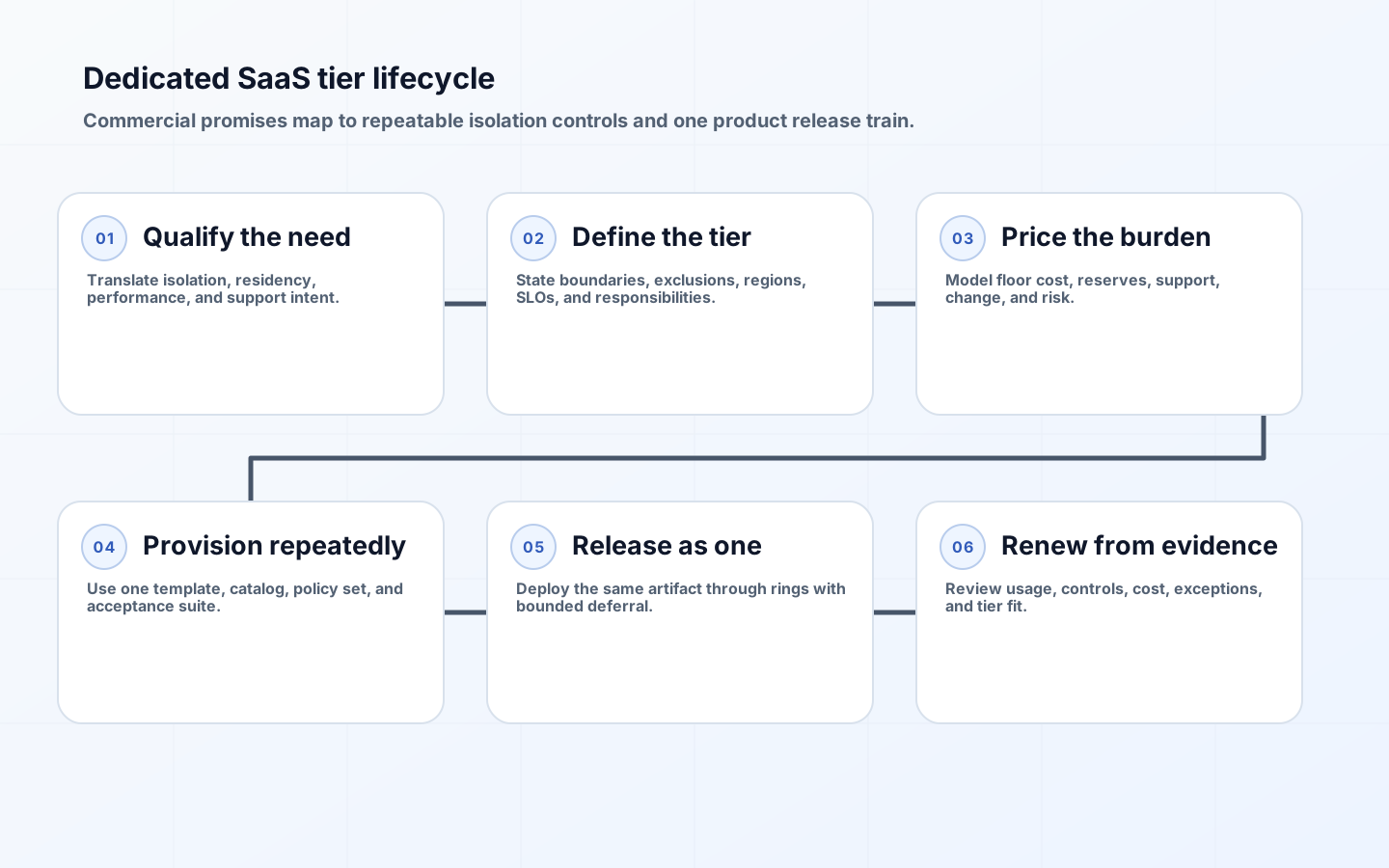
A dedicated SaaS tier gives an enterprise customer some isolated infrastructure, placement, capacity, or operating treatment while the provider retains a shared product and management model. Buyers may ask for it to address data residency, noisy-neighbor risk, regulated boundaries, private connectivity, recovery, or support. The provider must translate that intent into precise controls. A vague promise of single tenant can be expensive without satisfying the customer's actual requirement.
Dedicated does not have to mean a customer-specific fork or managed installation. AWS describes silo isolation as a valid SaaS variation when separate stacks remain surrounded by unified identity, onboarding, metering, monitoring, deployment, analytics, and operations. Its tier-based guidance also notes that premium silo tenants should normally run the same product version as pooled tenants. That shared lifecycle is the commercial and engineering constraint that preserves SaaS leverage.
Qualify the outcome behind the dedicated request
Ask which asset, threat, regulation, workload, or service outcome requires separation. Does the buyer need a database, encryption key, compute pool, cloud account, network, region, backup, or entire stack? Is the goal preventing cross-tenant data access, reducing contention, proving residency, obtaining static egress, meeting a restore target, or controlling maintenance timing? Capture evidence and acceptance criteria. Dedicated compute does not prove a data-residency boundary if logs, backups, support exports, or analytics leave the region.
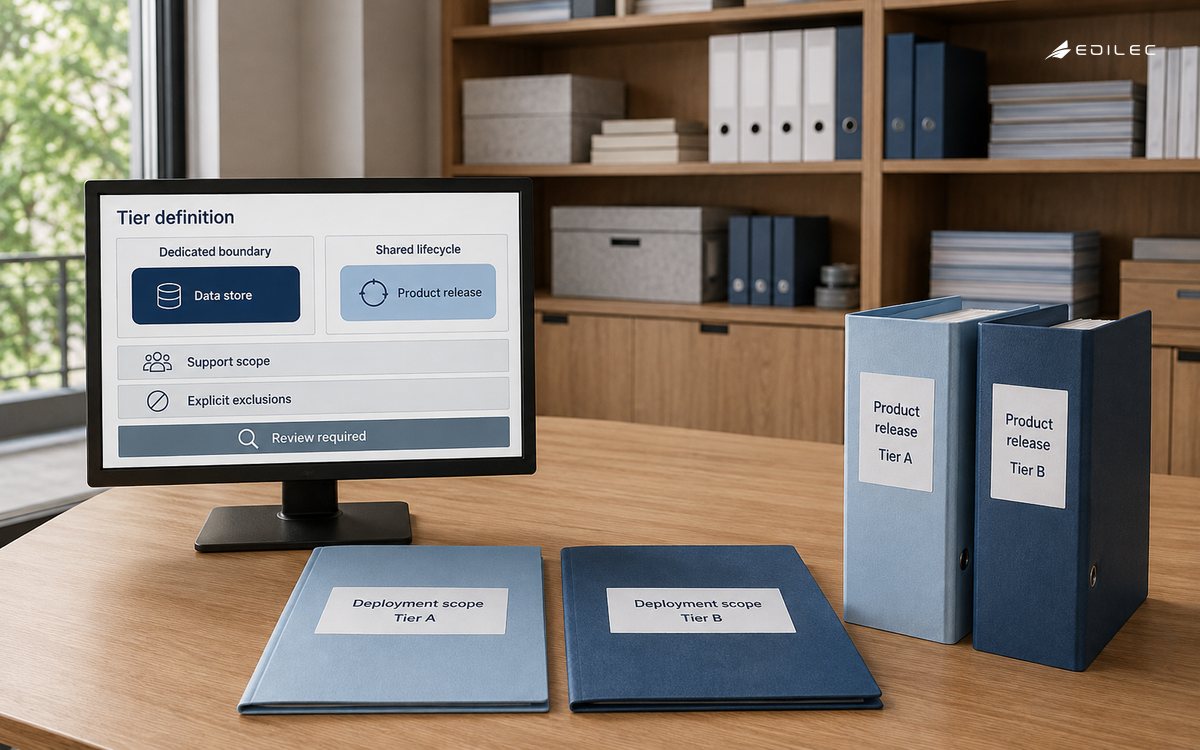
Challenge absolutes constructively. Targeted isolation may satisfy the requirement at lower cost: a dedicated database with shared stateless compute, customer-managed key with pooled infrastructure, regional cell, or reserved capacity. Document exclusions such as global identity metadata, billing records, provider telemetry, and approved support systems. Security and legal stakeholders should approve claims. Sales language must match deployed controls and subprocessor reality, not an architecture nickname.
| Buyer outcome | Possible control | What it does not prove | Acceptance evidence |
|---|---|---|---|
| Data isolation | Dedicated database or stack | Application authorization correctness | Tenant access and restore tests |
| Residency | Region-bound data and backups | All telemetry or support data stays local | Data-flow and storage inventory |
| Performance | Reserved compute and quotas | Unlimited throughput | Load profile and SLO measurements |
| Network boundary | Private link or tenant-specific ingress | No shared service dependency | Connectivity and path tests |
| Change control | Release ring and bounded notice | Permanent version freeze | Published release policy |
Publish a standard tier definition and exclusions
Define the isolation boundary, regions, supported topology, identity model, encryption and key ownership, network options, backup, disaster recovery, capacity envelope, service levels, maintenance windows, release policy, logging, support access, export, deletion, and customer responsibilities. State shared components and metadata plainly. Separate included controls from paid options and unsupported requests. Use a small number of tier variants so provisioning, assurance, and support remain repeatable.
Specify activation lead time, minimum term, renewal, downgrade, relocation, and offboarding. A dedicated environment may require quota requests, domain and identity validation, private network coordination, migration, and customer acceptance. Define what begins the service clock. Establish capacity change lead times and burst behavior. If maintenance deferral is offered, set a maximum supported window and rules for urgent security changes. Never promise indefinite version pinning; it creates a fork in practice even when the repository branch remains shared.
Price the complete operating burden
Model direct fixed infrastructure, reserved idle capacity, backup, network, keys, observability, test environments, licensing, and data transfer. Add variable workload, provisioning and migration labor, dedicated support obligations, compliance evidence, incident communication, fleet-tooling development, release validation, and decommissioning. Allocate shared control-plane and engineering cost consistently. Include contingency for minimum cloud resource sizes and recovery capacity. A gross-margin model based only on monthly compute will underprice the tier.
Use a commercial floor that covers fixed annual burden at realistic utilization, then price capacity bands and optional controls transparently. A minimum term can recover onboarding and migration; overage rules should align with measurable dimensions. Do not sell isolation as a substitute for application security, and do not charge for an undefined adjective. Review actual cost per dedicated tenant, support hours, change burden, reserved headroom, and exception count. Feed evidence into renewal and future packaging.
| Cost component | Driver | Commercial treatment | Review signal |
|---|---|---|---|
| Fixed footprint | Minimum resources, backup, keys, monitoring | Base annual or monthly floor | Idle and reserved capacity |
| Variable use | Compute, storage, transfer, transactions | Included band plus measured overage | Unit cost and peak |
| Onboarding | Provisioning, network, migration, acceptance | Setup fee or minimum term | Actual elapsed effort |
| Support | Coverage, response, named obligations | Tier premium | Cases, escalation, after-hours load |
| Exceptions | Custom controls or deferrals | Explicit scoped addendum | Count, age, engineering burden |
Provision from one template and control plane
Treat dedicated environments as single-tenant deployment stamps created from the same versioned infrastructure modules used elsewhere. The tenant catalog records tier, region, placement, template, capacity, policy, software version, and lifecycle. A durable onboarding workflow validates contract inputs, reserves quotas, provisions resources, configures keys and network, seeds product state, runs security and functional acceptance, activates routing, and records evidence. Every step must be idempotent and resumable.
Prevent hand-built variation with policy checks and drift detection. Store approved tenant configuration as data, not code branches or copied deployment scripts. Allow only typed parameters within supported ranges. Emergency changes need approval, expiry, and reconciliation back to the template. Aggregate health and cost centrally while preserving tenant-specific drill-down. Provider support should use just-in-time, least-privilege access with tenant, purpose, duration, and activity recorded.
Keep every tier on one product release train
Build one artifact and promote it through test, pooled canary, dedicated canary where appropriate, and controlled rings. Maintain backward compatibility across the bounded rollout window. Run the same core acceptance suite in pooled and dedicated topologies, plus tier-specific network, key, capacity, and residency checks. Customer notice can describe timing and material behavior, but customers should not select arbitrary source branches. A documented emergency patch policy must override ordinary windows when risk justifies it.
Track version skew and deferral age as fleet risk. A customer-approved deferral needs a reason, expiry, accountable approver, compatibility assessment, and commercial consequences if it creates extra support. Test backups and restoration under the dedicated topology, including key and network dependencies. During an incident, determine whether scope is tenant-local, tier-wide, regional, or global; communicate evidence rather than assuming dedicated infrastructure makes every failure isolated.
Operate migration, renewal, and exit as product workflows
Promotion from pooled to dedicated requires target provisioning, data transfer or replication, semantic reconciliation, integration and identity validation, routing switch, monitoring, and source retirement after a rollback window. Preserve tenant and user identity so the move does not look like a new product. Downgrade needs equal care: verify the tenant fits pooled limits and that contract, residency, keys, network, and retention allow the move. Define customer downtime and validation responsibilities in advance.
At renewal, compare promised controls with deployed evidence, actual capacity and support, incidents, exceptions, cost, and upcoming requirements. Retire unused options and reprice sustained burden. At exit, provide approved export, revoke identity and network access, honor retention or legal holds, dispose of resources and keys, and produce deletion evidence. The control plane should verify no orphan backups, logs, routes, secrets, or invoices remain outside policy.
Support operations must also preserve the tier boundary. Central diagnostics should collect only approved metadata and maintain regional or tenant separation where promised. Remote access into a dedicated stack needs customer-independent provider authorization, just-in-time credentials, session evidence, and revocation. Test whether incident tooling, crash dumps, log export, and third-party support channels follow residency and retention commitments. Operational convenience is a common route by which a technically dedicated deployment breaks its commercial assurance.
Customer assurance should map each contractual statement to a control owner, implementation reference, test cadence, evidence location, and exception process. Revalidate that map after topology, subprocessor, support-tool, or region changes. This turns questionnaires and renewal reviews into evidence retrieval rather than fresh interpretation, and it exposes promises that no system or team can currently prove.
Key takeaways
- Translate dedicated requests into specific isolation, residency, performance, network, recovery, or support outcomes with acceptance evidence.
- Publish a bounded tier definition with shared components, exclusions, responsibilities, capacity, maintenance, and exit terms.
- Price fixed footprint, idle reserves, onboarding, support, assurance, fleet tooling, migration, and decommissioning, not compute alone.
- Provision dedicated stamps through the shared control plane and versioned templates with drift detection and central operations.
- Keep one product artifact and bounded release train, then review controls, cost, exceptions, and fit at renewal.
Frequently asked questions
Is single-tenant deployment still SaaS?
It can be when tenants share the product version, onboarding, identity, metering, deployment, monitoring, and operating model. A one-off installation with customer-specific code and manual lifecycle behaves more like a managed custom system.
Does a dedicated region guarantee data residency?
No. Inventory primary data, replicas, backups, logs, support exports, analytics, identity metadata, and subprocessors. Residency is an end-to-end data-flow property, not only the location of the main database.
How should a dedicated tier be priced?
Start with a floor covering fixed footprint and operating burden, add included capacity and measurable overage, and price optional controls or support explicitly. Validate the model against actual cost and obligations at renewal.
Conclusion
A dedicated tier is sustainable when the promise is precise, the topology is repeatable, and the economics include its full lifecycle. Shared control-plane operations and one release train prevent premium isolation from fragmenting the product. The provider can then meet justified enterprise requirements while preserving the consistency and leverage customers expect from SaaS.