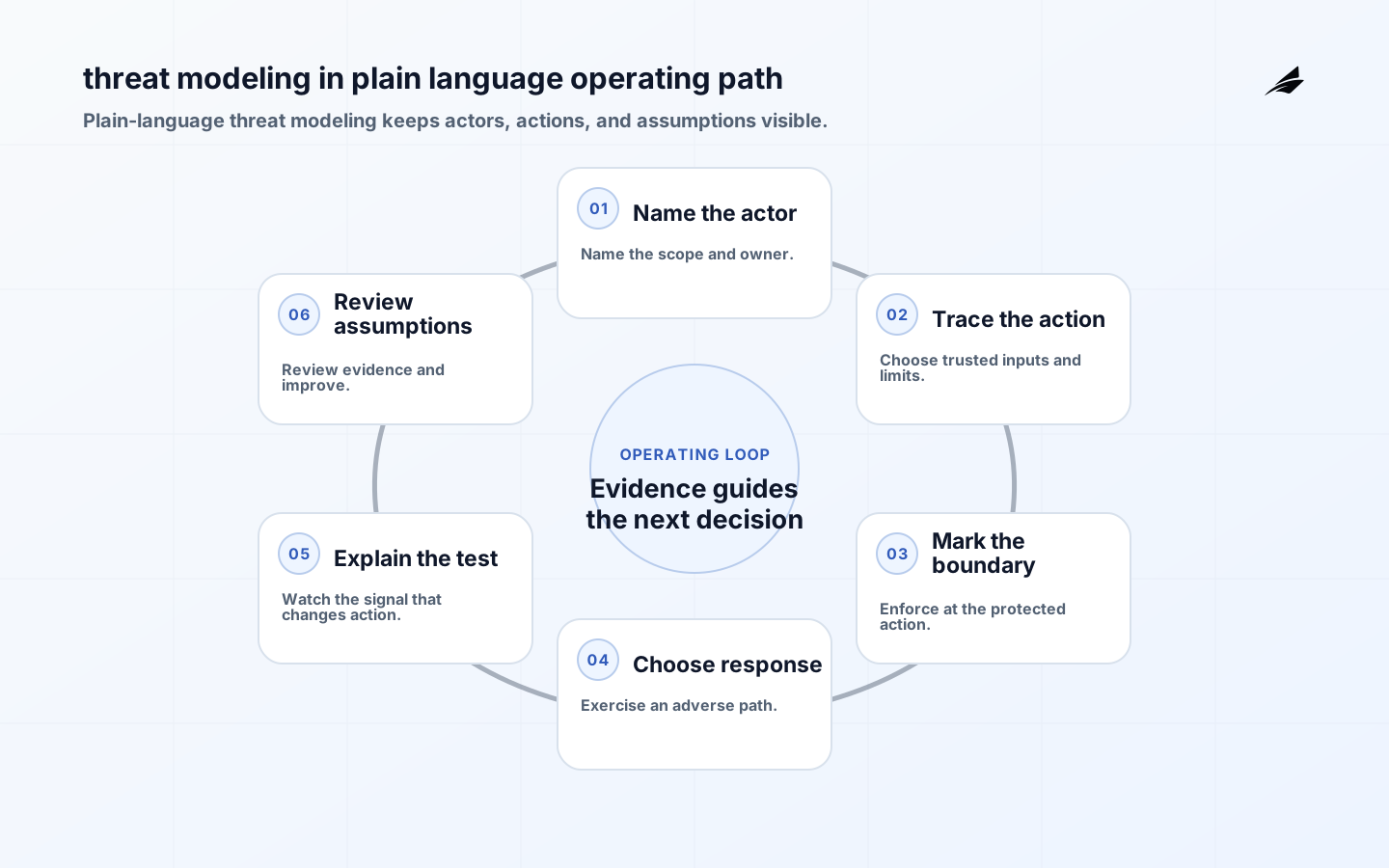
Threat modeling is a structured way to ask how a system can be misused, where an attacker could cross a boundary, and which protections are worth building. It is not a meeting that produces a long list of frightening possibilities. The output should be a small set of decisions that engineering, operations, and product owners can test, fund, and revisit when the system changes.
Model the system before naming threats — plain-language threat modeling
Start with a simple system view: people and services, data stores, external dependencies, entry points, privileged operations, and the flows between them. The OWASP Threat Modeling Cheat Sheet describes the work as modeling a system from a security perspective, identifying applicable threats, and determining responses. A diagram is useful only when it shows where trust changes or data becomes valuable.
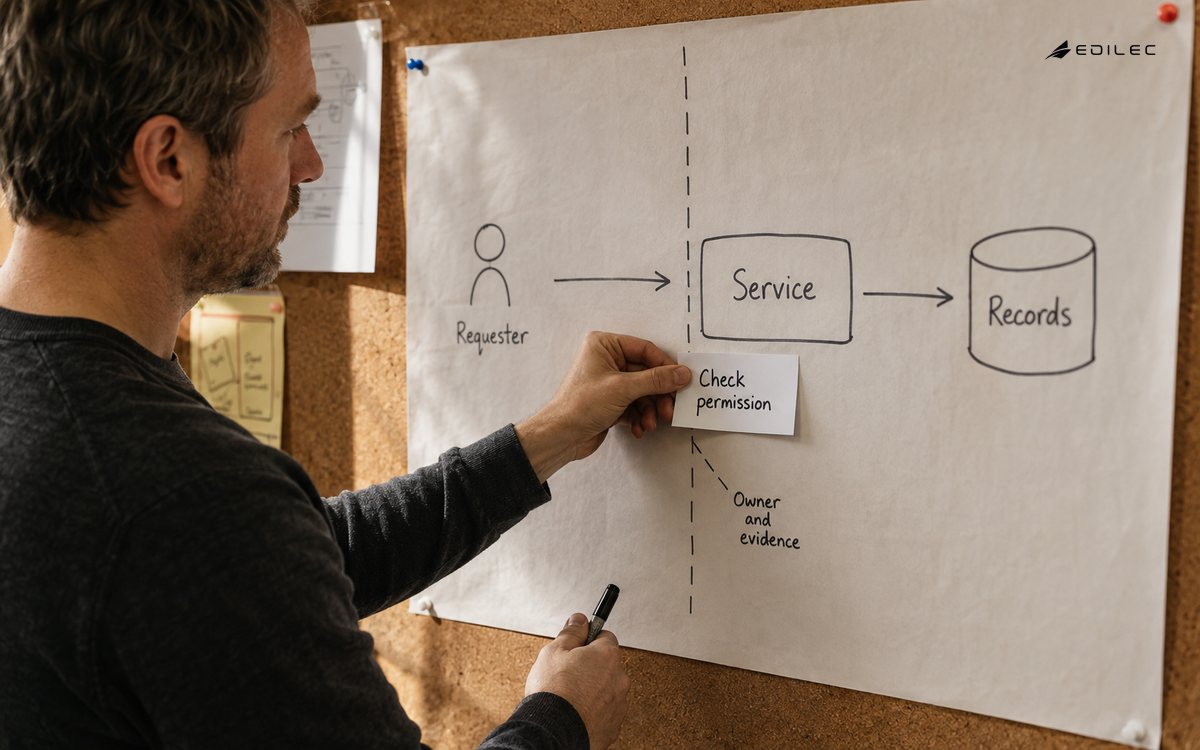
For each flow, ask who controls the input, what identity is established, what authorization is checked, what data moves, and what an attacker gains if the step fails. Focus on concrete abuse cases such as an attacker replaying a password reset, a compromised integration exporting another tenant’s data, or an operator bypassing a required approval. Prioritize using consequence, exposure, and the plausibility of the path, not a score that hides disagreement.
| Design decision | Question to answer | Evidence |
|---|---|---|
| System element | Question | Example outcome |
| Public endpoint | Who can invoke it? | Abuse-resistant authentication and quotas |
| Tenant data store | How is tenant identity bound? | Server-side scoping on every query |
| Admin workflow | Can one person complete the action? | Approval or separation-of-duties control |
Find trust boundaries and valuable actions — plain-language threat modeling
A threat is not complete until it has a response. Possible responses include changing the design, adding a preventive control, detecting abuse quickly, accepting a documented residual risk, or avoiding the feature. NIST SP 800-154 frames data-centric threat modeling as an activity supporting risk management; that connection is important because a finding needs an owner, due date, and evidence of completion rather than a place in a slide deck.
- Avoid: Starting with a generic threat catalogue before understanding the architecture.
- Test for: Ranking every issue as critical and leaving no decision about scope.
- Do not accept: Treating mitigations as complete without testing the abuse path or detection signal.
Turn threats into design choices — plain-language threat modeling
The practical standard for threat modeling practice is not a perfect diagram or a successful demonstration. It is whether the control still makes the intended decision when data is incomplete, a dependency is slow, an operator is rushed, or an attacker chooses the least protected path In the plain-language threat modeling workflow, the owner records that result. Use focused tests for denial, stale state, unusual volume, and recovery. Keep the result with the change record so later reviewers can see what was expected and what was actually verified In the plain-language threat modeling workflow, the owner records that result.
| Operating signal | What it may reveal | First investigation |
|---|---|---|
| Response | When it fits | Evidence |
| Prevent | A control can block the abuse | Negative test or enforced policy |
| Detect | Some risk remains after prevention | Alert with owner and playbook |
| Accept | Cost exceeds bounded residual harm | Named approver and review date |
Keep the model alive through change — plain-language threat modeling
Revisit the model at meaningful changes: a new external integration, data category, administrator capability, identity flow, cloud account, or machine-learning component. Confirm whether the old trust assumptions still hold. Review incidents and near misses as model inputs. A model that produces no updates after real-world failures is not a living control; it is a snapshot of a system that no longer exists.
Use a short review cadence for the parts of threat modeling practice that can cause material harm: privileged access, exception paths, high-value data, and emergency changes. The NIST Cybersecurity Framework 2.0 is helpful as an organizing model because it links governance, protection, detection, response, and recovery for the plain-language threat-modeling audience. The goal is a control that a named owner can explain, test, and improve rather than a setting no one revisits In the plain-language threat modeling workflow, the owner records that result.
Implementation Details That Matter — plain-language threat modeling
Threat-model workshops work best with people who know different failure modes: the engineer who owns the service, the operator who handles incidents, the product owner who understands harmful outcomes, and an identity or data specialist where needed. Give them a concrete change and a short timebox. Ask them to trace a user request and a privileged change through the system. This produces better findings than asking a large group to name threats in the abstract, and it makes ownership clearer when a mitigation crosses a team boundary.
Use attack trees or abuse stories when a flow has several possible paths. For example, an attacker seeking a customer export might compromise a support account, exploit a missing tenant check, abuse an administrator capability, or replay an integration credential. Each branch suggests different controls and detection signals. The exercise should not claim to enumerate every adversary technique. Its purpose is to reveal where a single assumption, such as “internal callers are trusted,” would let several branches succeed at once.
Connect mitigations to verification. A claim that an endpoint requires authorization should lead to a direct negative test; a claim that exports are monitored should lead to an alert exercise; a claim that backups are unavailable to ordinary operators should lead to an access review. Record the test and residual risk alongside the design decision. This guards against a familiar failure: a threat model says a control exists, while a later implementation replaces it with a feature flag, proxy rule, or manual process that no longer satisfies the original intent.
Operational leaders can use the model to sequence investment. Address conditions that let a low-effort attacker cross a high-value boundary before spending on refinements that do not alter the likely path. Revisit priorities after a merger, a vendor integration, a new data class, or a production incident. The model should change because the system changed. Keeping earlier decisions and their rationale is useful; it shows whether a new risk was already accepted, whether a mitigation degraded, or whether the architecture now needs a different boundary.
Threat Modeling in Plain Language: make the decision record useful — plain-language threat modeling
A concrete decision example — plain-language threat modeling
For threat modeling in plain language, make one risk decision reviewable: name the actor, protected action, trusted boundary, failure state, owner, and evidence that proves the mitigation. Keep the case small enough to discuss with non-specialists and specific enough to guide support when the normal path fails.
Plain language preserves rigor when it names actor, action, target, boundary, consequence, and response. “The API is protected” is weak; “the export service checks tenant and permission immediately before reading records” can be reviewed and tested.
Use one abuse story: an altered identifier, a direct service call, a replayed callback, or a suspended account halfway through a job. Record assumptions separately from controls because assumptions become tests and monitoring requirements.
| Decision point | Minimum record | Proof |
|---|---|---|
| Scope | Protected action and owner | Named boundary |
| Failure | Safe fallback and escalation | Adverse-path test |
| Change | Review trigger and expiry | Versioned evidence |
| Outcome | Signal and next action | Owner review |
A plain-language review should end with someone outside the original design group retelling the abuse case. If they cannot say what the attacker controls, what the service trusts, and what happens on failure, the explanation is not yet operational. Keep examples tied to the product: a tenant export, a password reset, an approval, a callback, or a deployment artifact. Avoid claiming that one control eliminates the whole threat. State the residual exposure and the signal that would reveal it. This makes the document honest and useful during incident response, when a responder needs to know which assumption to challenge first and which action is safe while evidence is still incomplete.
Practical Takeaways
- Tie threat modeling decisions to a bounded action and a named owner.
- Make enforcement happen in a trusted service or policy boundary, not in a browser or a document In the plain-language threat modeling workflow, the owner records that result.
- Treat exceptions, recovery, and observability as part of the design from the start In the plain-language threat modeling workflow, the owner records that result.
- Use representative negative tests and review evidence after changes, not only before launch In the plain-language threat modeling workflow, the owner records that result.
Threat modeling FAQ
For implementation context, consult NIST systems security engineering guidance, NIST security engineering practice, NIST risk management framework guidance, and Microsoft’s threat modeling guidance. Use them to keep actors, boundaries, mitigations, tests, and change review connected.
Is threat modeling a one-time implementation? No. The initial design establishes a baseline, but systems, identities, dependencies, and risks change In the plain-language threat modeling workflow, the owner records that result. Review it whenever a high-impact workflow changes and use incidents or recurring exceptions as evidence that the operating model needs adjustment In the plain-language threat modeling workflow, the owner records that result.
What should be measured first for threat modeling? Start with the decision it protects, then measure successful and denied actions, exception volume, corrective work, and the time required to establish what happened In the plain-language threat modeling workflow, the owner records that result. Those signals reveal whether threat modeling is supporting the intended workflow or simply moving risk to a less visible path.
How should a small team start with threat modeling? Choose one high-consequence workflow, map its current inputs and failure states, assign an owner, add the smallest dependable control, and test both normal and adverse cases In the plain-language threat modeling workflow, the owner records that result. That bounded work creates evidence for the next threat modeling decision without claiming the entire estate can be redesigned at once.
The threat-model record should state assumptions as explicitly as mitigations. Examples include “the identity provider validates this assertion,” “only approved workloads can reach this queue,” or “the support tool always scopes by tenant.” Assumptions are valuable because they become tests and monitoring requirements. Assign an owner and a review trigger to each material one. During a design review, ask what evidence would prove the assumption false and what control would contain the result. This is especially important at organizational boundaries, where a vendor contract, cloud configuration, or shared platform may change outside the feature team’s release cycle. A well-kept list of assumptions often predicts the next meaningful security review better than a long generic threat list.
When a mitigation is deferred, write the specific attacker path it leaves open and the event that would force reconsideration. A dated acceptance with an owner is far safer than an unlabeled backlog item. It tells incident responders and future engineers which boundary remains weak and prevents the team from assuming the issue was already solved.
Conclusion
Threat modeling is dependable when it maps to real work, uses authoritative inputs, makes a defensible decision at the point of action, and leaves an evidence trail for review. Start with one bounded workflow, make the recovery path real, and expand only after the team can explain what the control prevented, what it allowed, and who owns the next decision In the plain-language threat modeling workflow, the owner records that result.
For adjacent implementation context, see related Edilec guide 1, related Edilec guide 2, related Edilec guide 3 In the plain-language threat modeling workflow, the owner records that result.
The most useful plain-language question is often “what would have to be true for this action to be safe?” The answers become assumptions, policy inputs, and test cases. Ask the same question for a normal user, a support operator, a workload, and an attacker who can alter identifiers or replay a message. The resulting record can stay short while still showing where the system makes a consequential choice. That clarity is what makes threat modeling practical across product, engineering, and operations.