Incident playbooks changes in production because it must work during ordinary releases, partial failures, and the occasional urgent request. For founders, the practical problem is that a security or availability event forces people to decide ownership, evidence, customer communication, and recovery criteria for the first time. A useful implementation begins with one important workflow and a named owner, then makes the control visible in the way the system actually operates. This guide focuses on decisions a team can test: what is protected, who or what may act, where the decision is enforced, how exceptions are handled, and what evidence remains after the event. The relevant guidance in NIST SP 800-61 Rev. 2: Computer Security Incident Handling Guide is a useful starting point, but the durable outcome is an operating habit rather than a document.
Define the incident playbooks boundary
The first boundary is the outcome, not the tool. State the asset or action at stake, the identities and systems involved, the trust assumptions, and the person who can accept a temporary exception. For this topic, the central production decision is to write short playbooks around concrete incident patterns and decision points, then exercise them with the people and tools used in production. That statement should be specific enough that engineering, operations, and security can recognize whether it happened. It also exposes dependencies early: identity providers, queues, caches, deployment tooling, customer tenants, or third-party services can all influence the result. OWASP Logging Cheat Sheet reinforces the value of designing controls that are explicit and verifiable rather than relying on convention.

| Playbook element | What it should answer | Production value |
|---|---|---|
| Declaration | Who can declare and how severity is chosen | Prevents delay while people debate labels. |
| Containment | Which actions are pre-approved and reversible | Reduces harm without improvising authority. |
| Communications | Who updates customers, leadership, and partners | Keeps technical work from becoming rumor management. |
Assign ownership and evidence before rollout
Production controls fail quietly when ownership is implied. Assign a service owner for the workflow, an operational owner for the change path, and a reviewer for exceptions or high-impact events. Decide what must be retained to demonstrate the decision later: declared roles, a timeline template, contact and access checks, preserved event records, exercise notes, and post-incident actions with owners. Keep the evidence focused on actor, target, time, configuration or version, result, and correlation. Do not collect sensitive values merely because they are available. NIST SP 800-53 Rev. 5: Security and Privacy Controls is especially clear that security evidence needs protection of its own; a record that exposes credentials, private data, or unrestricted system detail creates another risk surface.
Build incident playbooks into the workflow
The implementation principle is straightforward: separate incident coordination from technical investigation while giving the incident lead authority to set priorities and record decisions. Start with a small set of credible scenarios: suspected credential exposure, abnormal privileged access, malicious dependency alert, data access concern, or service compromise. Each playbook should state how to declare the incident, who leads, how technical and business decisions are recorded, what evidence to preserve, which containment actions are pre-approved, and who owns customer or regulatory communication. Do not make the playbook a long policy document. Under pressure, people need a sequence that points to the next decision and a clear path to bring in expertise. Put the policy or configuration under normal change control, with a clear owner and a way to compare the intended state to the deployed state. Avoid a big-bang conversion. Start with a bounded service, environment, action, or cohort whose operational behavior the team understands. That makes it possible to distinguish a genuine control failure from an undocumented dependency and to improve the rollout without turning every exception into a permanent bypass.
- Write the protected action and decision boundary in language an operator can use during an incident.
- Make the enforcement point and configuration source visible to the people who own the workflow.
- Provide a time-bounded, recorded path for legitimate urgent work instead of relying on informal access.
Test normal work, denial, and recovery
A configuration review cannot prove production behavior. Run a tabletop and at least one technical exercise that uses the real communication channel, on-call path, dashboards, and access controls. Give participants incomplete information, because that is what production incidents provide. Check whether the team can establish a timeline, contain without destroying useful evidence, make a reversible change, and communicate an accurate status without speculation. Measure not only speed but decision quality: were authority, facts, assumptions, and next updates clear? Test from the perspective of the caller and the protected resource, including the route that bypasses the preferred user interface. Capture the result in a repeatable check that can run after meaningful releases. When a test fails, resist the reflex to broaden access or silence a rule. First establish whether the workflow is missing a dependency, the policy is too broad or too narrow, or the enforcement point is not seeing the required context. This is where a small, well-instrumented rollout pays for itself.
| Exercise prompt | Expected evidence | Improvement if absent |
|---|---|---|
| Suspected secret exposure | Timeline, revocation decision, consumer impact | Add access and rotation steps. |
| Unauthorized export | Scope assessment and communication decision | Improve audit query and data ownership. |
| Compromised build artifact | Artifact trace and rollback plan | Strengthen provenance and release records. |
Use signals to keep the control honest
After launch, incident playbooks needs a review rhythm. Watch time to acknowledge, time to assign an incident lead, gaps in timeline evidence, changes made outside the incident record, access failures during response, repeated scenario types, and actions that remain open after the review. A playbook should evolve from these signals. If a step repeatedly requires a person who is unavailable or a tool that cannot be accessed, change the system rather than merely reminding people to be prepared. Pair quantitative signals with a short human review of meaningful exceptions and recent changes. A good review asks whether the control still protects the intended boundary, whether it is creating avoidable friction, and whether the evidence would support a real investigation. Metrics should inform a decision, not become a reason to declare success. The most valuable trend is often a disappearing unknown: fewer unowned assets, fewer unexplained access paths, or faster verified recovery.
Connect the control to adjacent work
This topic is stronger when it is connected to the surrounding system instead of managed alone. The incident playbooks guide explains a closely related production concern and is a useful companion when defining ownership and test evidence. Link operational records across identity, deployment, logging, and incident response so that the team can move from a symptom to a responsible system without guessing. The connection does not need a new platform: consistent identifiers, named owners, and a practiced review loop are often the decisive pieces. In incident playbooks, that link helps prevent a policy from becoming isolated from the operational records that make it usable.
A practical first month for incident playbooks
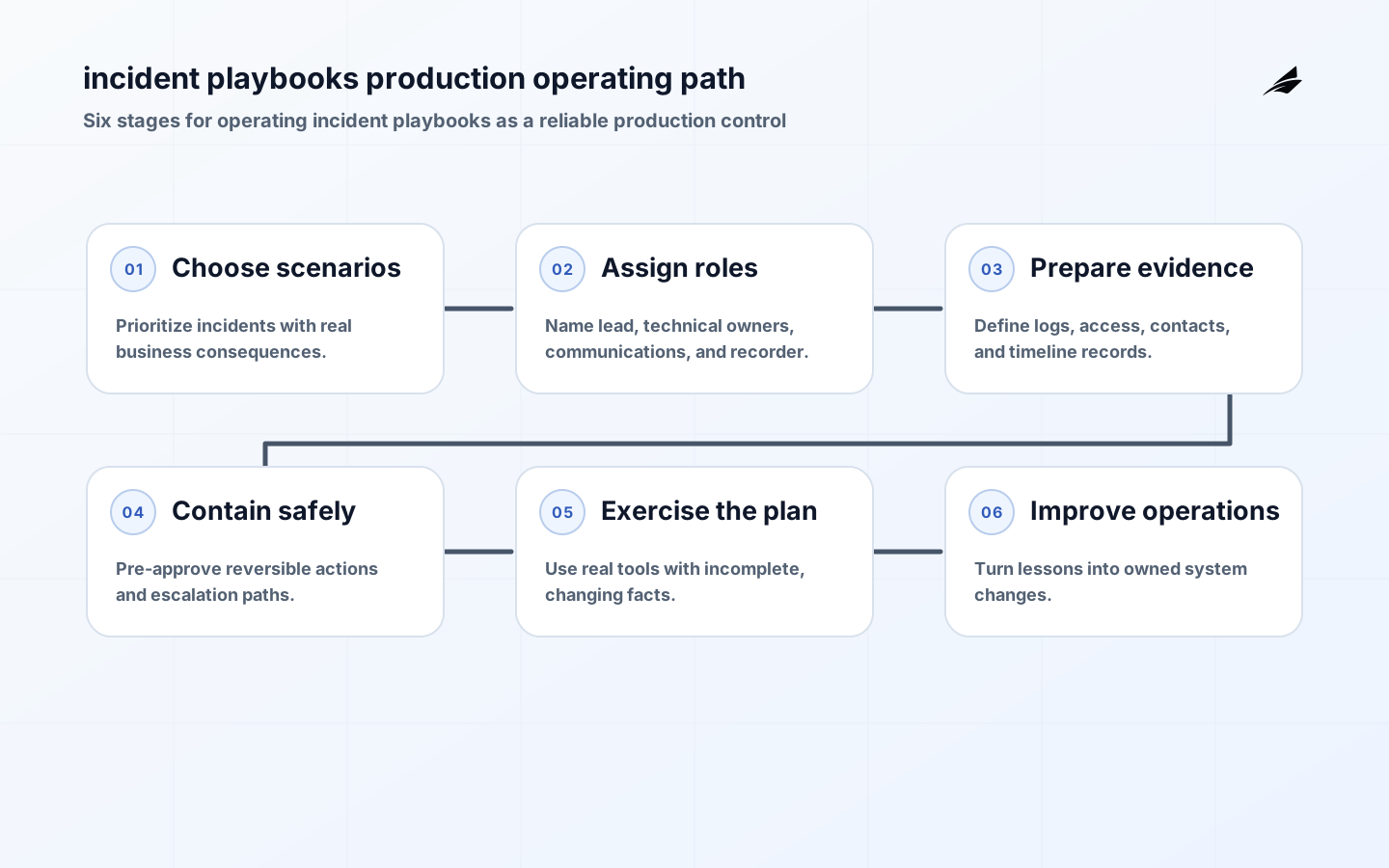
In the first week, choose one realistic incident scenario and name the incident lead, technical lead, communications owner, and recorder. In week two, verify that those roles can reach the real log, deployment, identity, and communication tools without hunting for access. In week three, run a short tabletop with incomplete facts and require a recorded containment decision and next-update time. In week four, exercise one technical containment or rollback step and convert friction into owned improvement work. A short practiced playbook is more valuable than a detailed document nobody can execute under pressure. Before approving the next response exercise, use the NIST incident-handling guide to check that preparation, containment, evidence, and recovery decisions have owners.
Key takeaways
- Incident playbooks is a production decision with a protected boundary, not just a setting.
- Start with a narrow workflow, then expand only after normal, denial, and recovery paths are tested.
- Retain evidence that explains the actor, target, rule or version, outcome, and exception.
- Use recurring review to remove stale access, unknown dependencies, and fragile workarounds.
Frequently asked questions
What should the first incident playbooks release include?
Choose one workflow with a clear owner and business boundary. The first release should include a named enforcement point, a minimal policy or configuration, a normal-path test, a denied-path test, a recovery path, and a record of the outcome. It should not attempt to solve every historical exception. The point is to produce evidence that the control works under real conditions before it reaches a wider audience. For incident playbooks, first run one realistic scenario using the real on-call, communication, and evidence tools.
How should a team handle exceptions?
Make exceptions explicit, time bounded, and reviewable. Record the reason, affected scope, approving authority, compensating control, expiry, and next action. An exception should preserve the ability to deliver necessary work without pretending the risk disappeared. When the same exception recurs, treat it as design feedback: either the base policy is wrong, the workflow is incomplete, or an adjacent system needs a better interface. For a playbook exception, record the unavailable step, the temporary workaround, and the owner of the permanent repair.
Conclusion
The production standard for incident playbooks is not perfection on the first release. It is a control that has a clear boundary, accountable ownership, observable enforcement, a humane recovery path, and evidence that survives a difficult day. Build those pieces into one bounded workflow, test them together, and let the results determine the next expansion. That approach gives founders a system they can operate, explain, and improve.