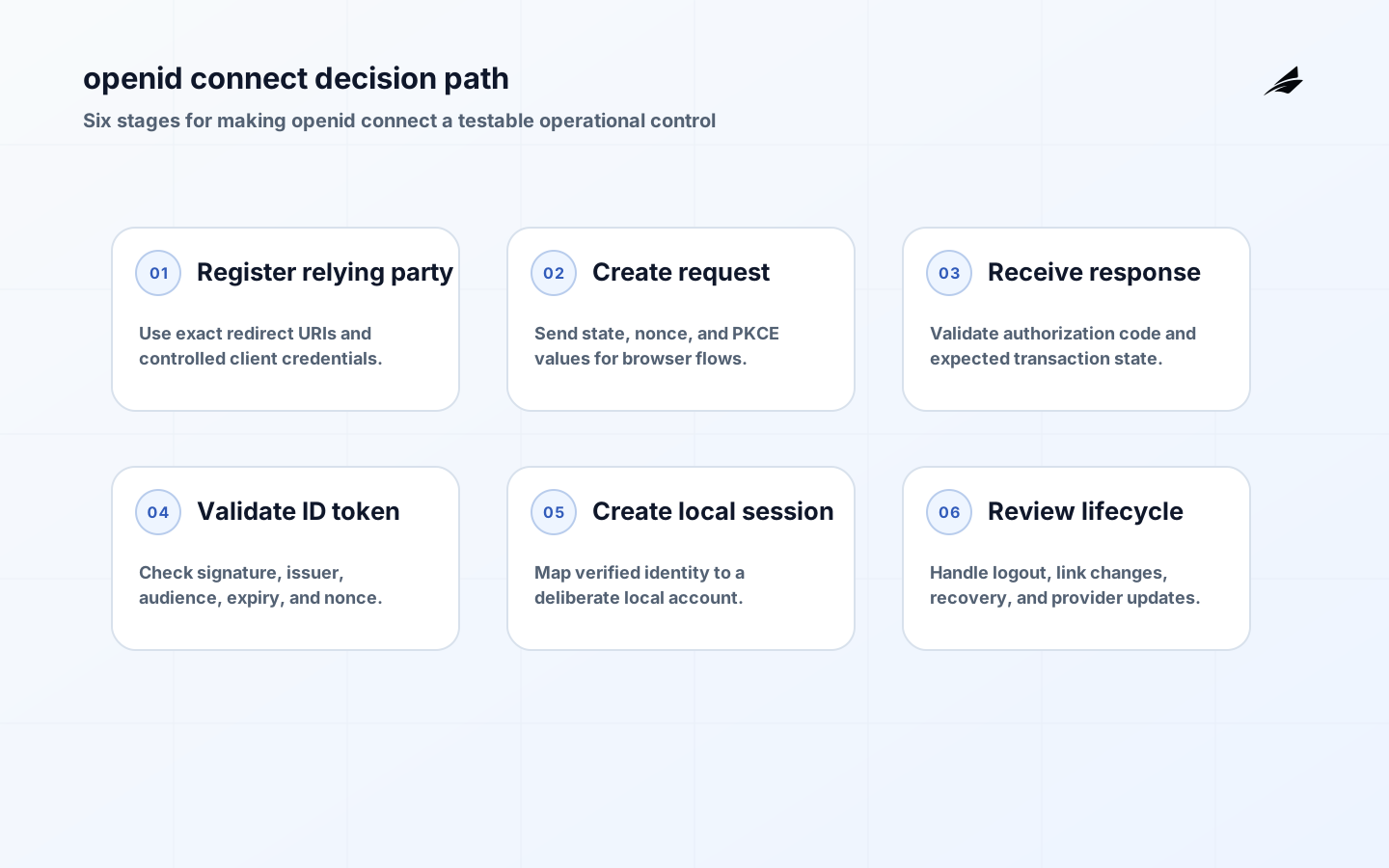
OpenID Connect is useful only when it changes a real decision in a SaaS sign-in flow that relies on an external identity provider and returns users to the product. A practical program starts by naming the local application session created after federated sign-in, the people and services that touch it, and whether the received identity response belongs to this client, this transaction, and this intended user. That framing prevents a familiar failure: installing a control while the risky path simply moves to an integration, recovery procedure, or administrator account. The goal is not a security slogan. It is a repeatable way to allow legitimate work, refuse unsafe requests, and explain the result afterwards.
Define the OpenID Connect decision
Begin with one consequential workflow rather than an enterprise-wide diagram. Follow a representative request from its entry point through identity checks, policy evaluation, application logic, data access, and the system of record. For OpenID Connect, write down the protected resource, initiating actor, available context, enforcement point, and owner of the business decision. Then describe what a safe denial looks like. A denial that produces an opaque error or an informal workaround is not an operating control; it is a delay that will be bypassed under pressure.

| Question | Practical answer | Evidence to retain |
|---|---|---|
| What is protected? | the local application session created after federated sign-in | A short inventory with data classification and dependency owner. |
| Who requests it? | A named human, workload, client, or automated process with a distinguishable identity. | Representative request and identity attributes. |
| Where is it enforced? | At the closest dependable application, gateway, identity, or storage boundary. | Configuration, policy version, and test result. |
| What happens when context is missing? | Use a bounded failure path, escalation route, or temporary review instead of an implicit allow. | Denied-case trace and accountable exception record. |
Design the OpenID Connect boundary
A sound OpenID Connect design separates authentication, authorization, data handling, and operational approval. They often happen in the same request, but they answer different questions. A strong login does not by itself authorize a refund; an encrypted database does not decide who may export it; a network location does not prove a service call is expected. Make each input explicit, identify its authoritative source, and give it a freshness rule. This is also where teams should state the conditions that must stop the workflow rather than being guessed away.
- Use OpenID Connect to protect a named action or resource, not an abstract technology category.
- Keep the normal path quick enough that staff do not need an unofficial alternative.
- Treat emergency access as attributable, time-limited, and reviewed after use.
- Separate a policy decision from the code or console command that happens to enforce it.
- Read the RBAC design guide when the workflow crosses the adjacent identity or application boundary.
Implement OpenID Connect at the enforcement point
Implementation choices should follow the path, not vendor terminology. In this case, whether the received identity response belongs to this client, this transaction, and this intended user. Place the decision where a bypass is difficult and where the required context is available. Prefer a small, versioned policy or configuration with deterministic behavior over duplicated rules scattered across screens and services. Build the denial response deliberately: preserve enough information for support and investigation, avoid disclosing sensitive detail to an attacker, and tell the legitimate caller what supported next step exists. Confusing ID tokens with API authorization, accepting tokens for another audience, skipping nonce checks, and auto-linking accounts on weak identifiers are usually design issues, not mere configuration mistakes.
Test OpenID Connect with real cases
A credible test set contains ordinary success, clearly unauthorized access, stale context, partial dependency failure, and an approved exception. For each case, capture the input, expected result, observed result, event record, and person who can act on a discrepancy. Exercise the test through the same route that production users take; a direct backend test can miss a proxy, browser, queue, or identity transformation. This is especially important when a retry or fallback changes the actor, audience, tenant, or data scope after the first request. For OpenID Connect, the cases below must reflect the actual protected request and owner.
| Test case | Expected behavior | Failure that should be visible |
|---|---|---|
| Known-good request | The request completes with only the approved scope and a traceable result. | Unexpected privilege, wrong tenant, or missing evidence. |
| Known-bad request | The request is denied before the protected action and does not leak sensitive detail. | A client-side-only block or a backend bypass. |
| Stale or missing context | The system requires renewal, re-verification, or a bounded review route. | An implicit allow based on old state. |
| Dependency degradation | The service fails safely, records the condition, and avoids repeated uncontrolled retries. | Silent fallback that weakens the intended boundary. |
Operate OpenID Connect as a service
After launch, the difficult work is preserving the assumptions that made the control trustworthy. Review issuer or audience failures, nonce mismatch, unexpected claim changes, session anomalies, and account-linking conflicts. A metric is useful when it prompts a concrete question: did a new integration create an unowned path, did a product change alter the resource boundary, or did a support workaround become normal practice? Pair aggregate monitoring with periodic inspection of a few complete request traces. That combination catches failures that a dashboard cannot label, such as a correct decision made for the wrong customer record or a valid session mapped to the wrong local account.
Manage change and recovery in OpenID Connect
Changes to identity providers, deployment topology, data classification, client software, or ownership can invalidate OpenID Connect without producing a visible outage. Treat material changes as a review trigger. Reconfirm the resource, policy inputs, enforcement location, recovery route, and evidence owner before expanding use. Recovery deserves the same attention as the happy path: the team needs a documented method to restore legitimate access or service without creating a durable bypass. Practice that method with the people who would actually approve and execute it, then remove temporary access when the event is closed.
Decision checkpoint: before adding another OpenID Connect provider, decide which claims are authoritative for local account mapping and which are only display information. Providers can change optional claims, subject formats, and logout behavior. Preserve the immutable provider subject with the issuer, retain a clear account-linking history, and give support a controlled route for resolving a legitimate identity mismatch without weakening token validation for everyone else.
A OpenID Connect implementation example
For OpenID Connect, decide how verified provider subjects map to local accounts before launching federation. Document whether email is merely a display claim, what proves account ownership, and how a changed or removed provider identity is handled.
For OpenID Connect, test an ID token with the wrong issuer, wrong audience, expired time claim, and a nonce from a different browser transaction. Exercise account recovery and identity-provider migration too. The product must make a deliberate local-account decision when a provider subject is new, changed, or associated with an email address that was previously claimed through another route.
Suppose a team is changing the local application session created after federated sign-in. Before rollout, it draws the request path and identifies each point at which identity, policy, or data changes form. It then selects one expected success case and one case that must be refused, runs both through a non-production environment, and compares the resulting event trail with the stated decision. The team records the owner for the exception route, the maximum duration of any bypass, and the evidence needed to close the change. That small exercise makes hidden dependencies visible and gives the rollout a clear stop condition instead of relying on confidence.
Key takeaways for OpenID Connect
- Anchor OpenID Connect in a named resource, action, and accountable decision.
- Make the required context, enforcement point, denial behavior, and evidence path explicit.
- Test normal, rejected, stale, and degraded cases through the production-like route.
- Review exceptions and material changes before they become permanent hidden access paths.
- Measure operational behavior, not deployment activity alone.
Frequently asked questions about OpenID Connect
What is the best first step for OpenID Connect?
Choose the smallest workflow where the protected outcome, actor, and owner can be named. For OpenID Connect, a narrow path reveals assumptions quickly and produces usable evidence before the team attempts broader coverage. In this guide, the starting boundary is openid connect decision path.
Do we need a new platform before using OpenID Connect?
Not necessarily. Start by clarifying the decision and testing whether current identity, application, gateway, or storage controls can enforce it reliably. New tooling is justified when the existing path cannot gather trustworthy context, apply the rule consistently, or provide evidence for review. For OpenID Connect, the decision should be driven by the specific request path and evidence requirements, not by a platform procurement cycle.
How often should OpenID Connect be reviewed?
Set a recurring review based on the workflow's risk, but also review after incidents, material architecture changes, ownership changes, and new integrations. The important test is whether the assumptions behind the decision still match the system people operate today. For OpenID Connect, keep the review tied to the owner of the protected workflow so findings turn into an operational decision.
Conclusion: make OpenID Connect dependable
OpenID Connect earns its place when it makes a sensitive workflow safer without making ordinary work mysterious. Define the resource and decision, enforce close to the action, rehearse failure and recovery, and keep evidence someone can retrieve. That is how a one-time security initiative becomes a dependable part of product and operations work.