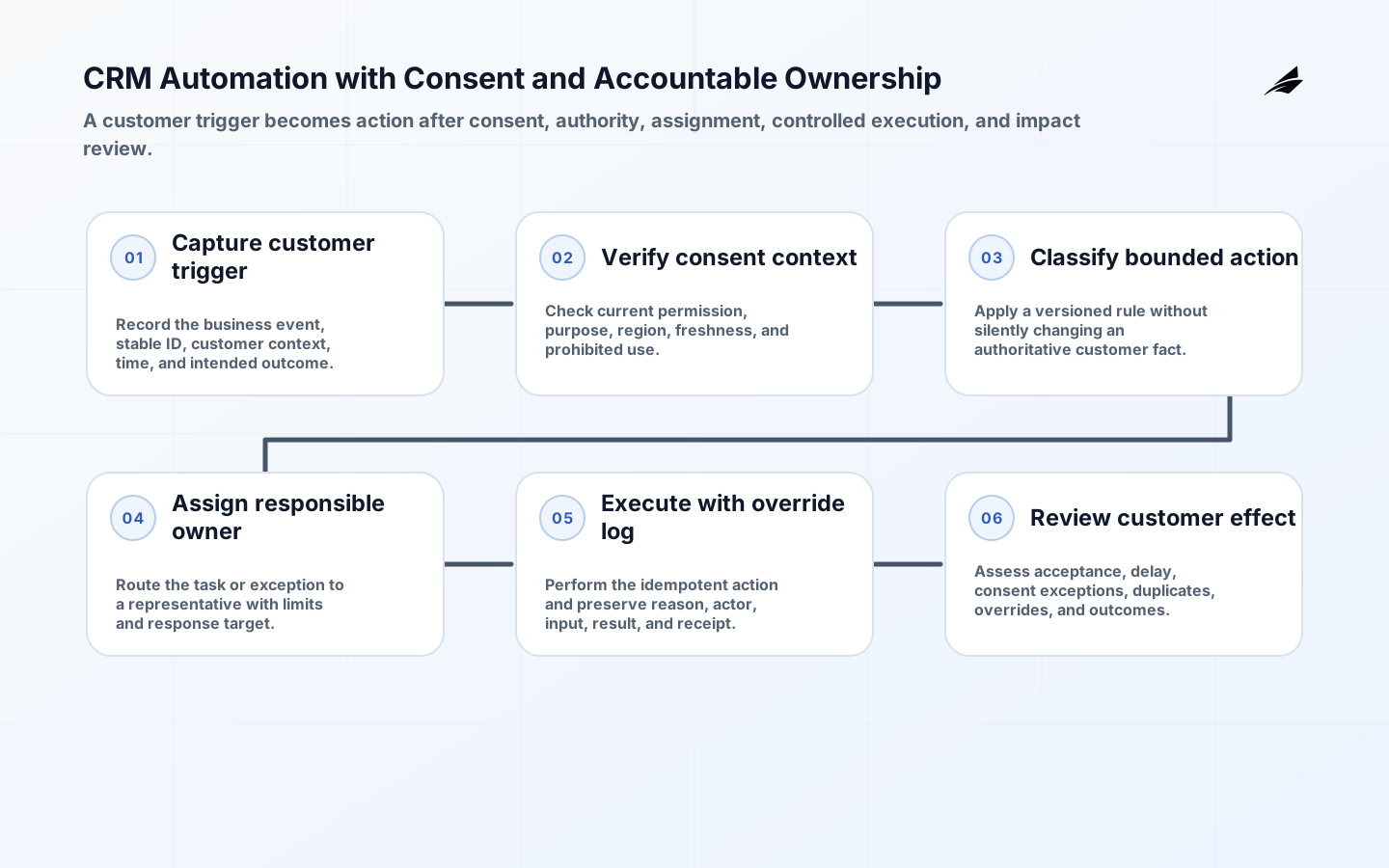
CRM automation becomes a different proposition the moment it carries real work. A prototype can demonstrate a screen or an integration; a production service must make a customer-triggered action that should help a representative act sooner without creating hidden or inappropriate automation understandable during normal work, delay, correction, and review. For CTOs, the first useful question is not which platform has the longest feature list. It is which decision must happen reliably, who is accountable for it, and what record proves the result. This guide treats CRM automation as an operating capability. It starts with a bounded workflow, names the data and authority involved, then adds the controls that let people recover when reality does not resemble the happy-path demo. That framing prevents a familiar failure: a polished interface backed by unclear ownership, invisible exceptions, and a queue that only specialists know how to interpret.
Set the CRM automation operating boundary

Begin by writing the outcome in ordinary language: a customer-triggered action that should help a representative act sooner without creating hidden or inappropriate automation. Then list the records that must remain understandable after a handoff: customer profile, consent, trigger, qualification, assignment, message, and override. The boundary matters because the CRM owns customer interaction history and accountable assignment; connected tools own their specialist engagement or enrichment data. Do not collapse those responsibilities into an assertion that every system is a source of truth. Instead, state which service may create, change, approve, publish, or correct each fact. A simple responsibility map should include the initiating role, accountable business owner, technical owner, and responder for failed work. This is also where teams decide what must be synchronous. A user may need a prompt confirmation of receipt while a downstream update can be durable and asynchronous. Treating those two expectations as one integration call is how temporary outages turn into duplicated action, lost context, or an unexplained manual workaround.
| Decision area | Question to settle | Evidence to retain |
|---|---|---|
| Business outcome | What counts as a complete CRM automation outcome? | Named state and accountable role |
| Record authority | Which system may change each critical fact? | Ownership and field-level rule |
| Exception path | What happens when the normal transition cannot finish? | Queue, responder, and recovery target |
| Audit trail | How can a reviewer reconstruct the decision? | Timestamped actor, input, and result |
Model states, authority, and exceptions before screens
A production workflow needs more than a sequence of statuses. Define what each state means, who may enter it, what evidence is required, and which transition is prohibited. For this use case, the most important failure to rehearse is this: automation changes a customer record or sends a message without clear consent, context, or a human recovery route. The design response is explicit trigger criteria, consent checks, assignment rules, suppression logic, and override logging. Put the rule close to the action rather than relying on a training slide or an informal approval channel. An authorization check should consider the actor, the specific record, the action, and the relevant context; a broad role alone rarely expresses the policy safely. Where a person may override a rule, capture the reason, authority, scope, and expiry. Where software retries work, use a durable identifier so a repeat request can locate the earlier outcome rather than perform the effect again. These choices make the workflow legible to support and audit teams without forcing every ordinary user to become an administrator.
- Name the event that starts the CRM automation workflow and the user-visible result that ends it.
- Describe allowed states, prohibited transitions, and the authority required for each change.
- Keep an immutable reference to the input, policy version, and decision evidence.
- Separate a retryable technical failure from a business exception requiring judgment.
- Give every exception queue a business owner, a response target, and a correction path.
- Test access with records owned by another team, region, customer, or legal entity.
Build a release that can be observed and reversed
Delivery should create a small but complete operating slice, not a collection of disconnected configuration tasks. Use representative records, including a missing value, a late dependency, a duplicate request, and an authorized-but-unusual scenario. Record correlation identifiers at system boundaries and make them searchable by the people who handle questions. Release additive changes first when possible, then keep a controlled route back if a policy, mapping, or integration proves wrong. Migration planning must distinguish facts that are copied once from facts that continue to synchronize; the latter require a clear conflict rule. During acceptance, ask a reviewer to trace one real-looking item from intake to outcome using only the records and permissions they would have in production. If the trail cannot explain why the system acted, the build is incomplete even when the interface tests pass. For CRM automation, make the acceptance trace prove consent-aware triggers and human override; that final rehearsal often exposes the missing handoff before customers do.
| Production risk | Practical control | Signal for review |
|---|---|---|
| Duplicate effect | Use a durable request or business-event identifier | Repeat attempts and conflicting outcomes |
| Stale or missing data | Validate freshness and expose an exception state | Age of blocked items |
| Unauthorized change | Evaluate actor, target record, action, and context | Denied actions and override use |
| Unrecoverable release | Version mappings and preserve a rollback route | Correction time after deployment |
Operate from signals that change a decision
The operating dashboard should help a person decide what to do next, not merely display activity. Track automation acceptance, override rate, routing delay, consent exceptions, duplicate contact rate, and conversion by path. Segment the measures by workflow type, owner, source, or customer group where that distinction changes action. A global average can make a serious local blockage disappear. Pair every threshold with a named response: investigate, pause a release, reroute work, contact an affected user, or start reconciliation. Review the oldest unresolved items, not just counts, because aged exceptions often reveal a missing authority or an integration dependency that no metric label fixes. Keep structured event history long enough to connect the initiating input, policy evaluation, external call, and final outcome. A retrospective should change either a control, a test, a runbook, or an ownership rule. Otherwise it becomes an account of a bad day rather than an investment in the next one.
Keep change control proportional and explicit
Governance is most helpful when it resolves a concrete change rather than producing a separate ceremony. Maintain a short decision record for new states, policy exceptions, field mappings, and integrations: purpose, accountable owner, affected records, evidence, release condition, recovery method, and review date. Give business owners a way to approve meaning while technical owners approve feasibility and observability. This distinction is vital when a request sounds small, such as adding a field or bypassing a queue; it may alter authority, reporting, retention, or a downstream contract. For CRM automation, publish a change inventory that names dependencies and consumers before retirement. A controlled deprecation is a measured transition with adoption evidence, not a date quietly placed on a roadmap.
Use authoritative guidance to verify the controls
The operational recommendations here align with NIST control guidance, NIST log-management guidance, OWASP authorization guidance, and HTTP Semantics. NIST guidance frames control selection and log-management expectations; OWASP provides a practical lens for record-level authorization; the IETF specification clarifies reliable HTTP behavior at integration boundaries. These sources do not replace domain policy or legal review. They give a team a shared, inspectable baseline when deciding how to protect sensitive actions, capture evidence, handle retries, and communicate failure across systems. Apply the relevant vendor documentation as well when a platform implements a control differently. For CRM automation, use that baseline to examine consent-aware triggers and human override, then document any domain-specific rule that narrows or extends it.
Key CRM automation takeaways
- Define CRM automation around one accountable business outcome before expanding scope.
- Name the owner of every important record, state transition, and exception queue.
- Make authorization and evidence part of the workflow rather than a final review.
- Release with traceable identifiers, representative failure tests, and a correction route.
- Use automation acceptance, override rate, routing delay, consent exceptions, duplicate contact rate, and conversion by path to trigger concrete operational decisions.
- Turn recurring exceptions into changes to policy, design, test coverage, or ownership.
CRM automation FAQ
Should the first release automate every exception? No. Automate repeatable, well-understood decisions and make judgment work visible in a queue with a clear owner. What is the minimum audit evidence? Keep the actor or service identity, relevant input or version, policy or rule applied, timestamp, outcome, and any override reason. How do we know the boundary is wrong? Repeated manual reconciliation, contradictory records, or responders who must consult private knowledge are strong evidence that ownership or state rules need revision. For CRM automation, the most useful early review is a real delayed or disputed item, because it exposes whether consent-aware triggers and human override remains clear when time pressure rises.
Conclusion: make CRM automation trustworthy in production
Trustworthy CRM automation is not defined by the number of integrations or screens. It is defined by whether ordinary work, exceptions, and corrections have clear ownership and reconstructible evidence. Start with the bounded outcome, model the state and authority carefully, then operate it with signals that lead to action. That is how a useful workflow survives the first real production week and becomes easier to improve afterwards.