What Changes When System of Record Design Moves into Production
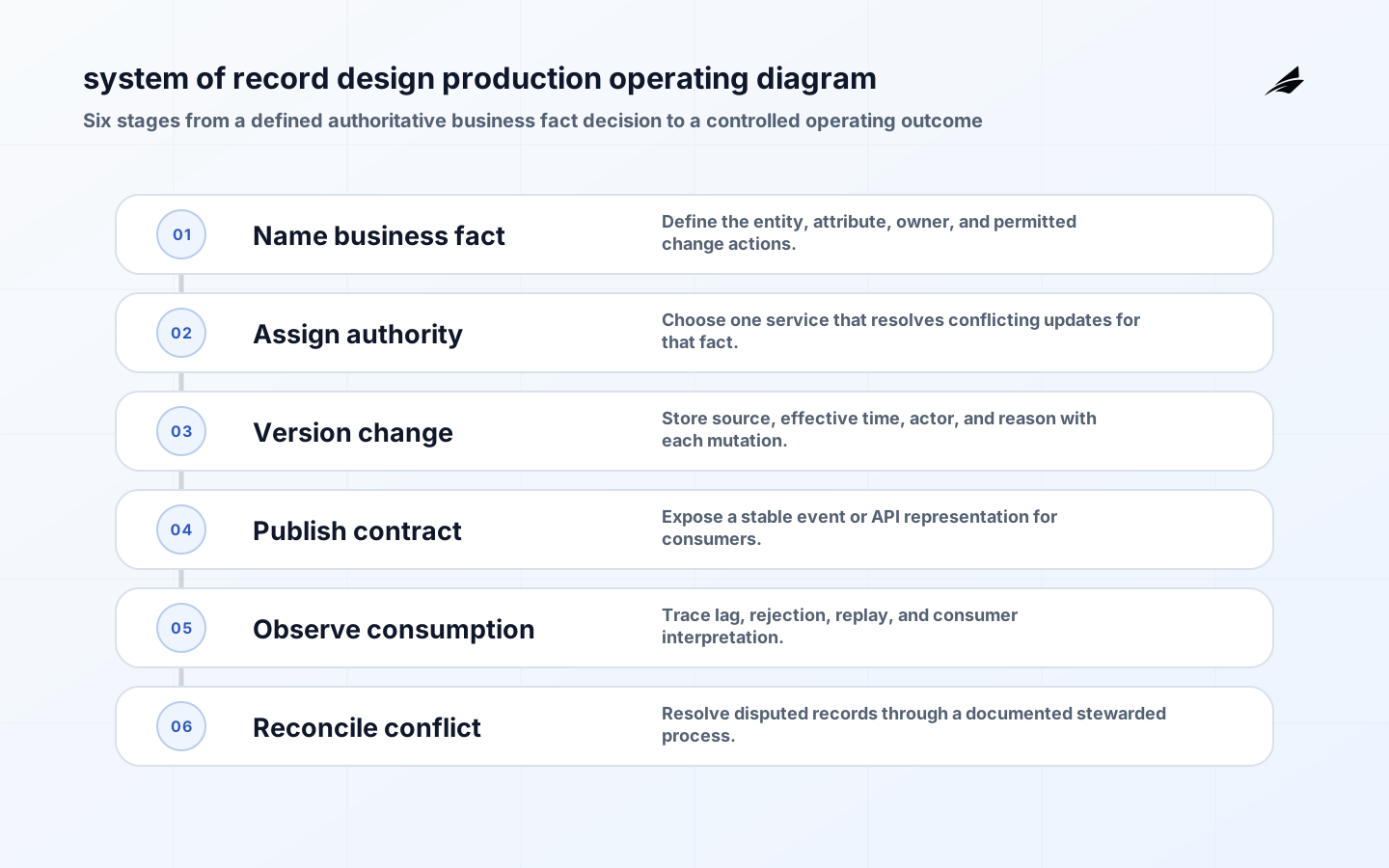
System of record design changes character the moment it becomes a production service. Before launch, a team can describe an ideal path on a whiteboard. After launch, engineering teams, data stewards, and enterprise architects must make a defensible authoritative business fact decision whenever data arrives late, a dependency is unavailable, or a person asks why a decision was made. The production question is therefore not whether the interface works. It is whether the system can make business-record actions such as creating, amending, merging, retiring, publishing, or reconciling predictable, explainable, and recoverable under ordinary pressure. This guide treats the release as an operating design problem: establish authority, retain the evidence behind state, protect consequential actions, and give people a practical way to correct a wrong outcome.
Define the authoritative business fact decision
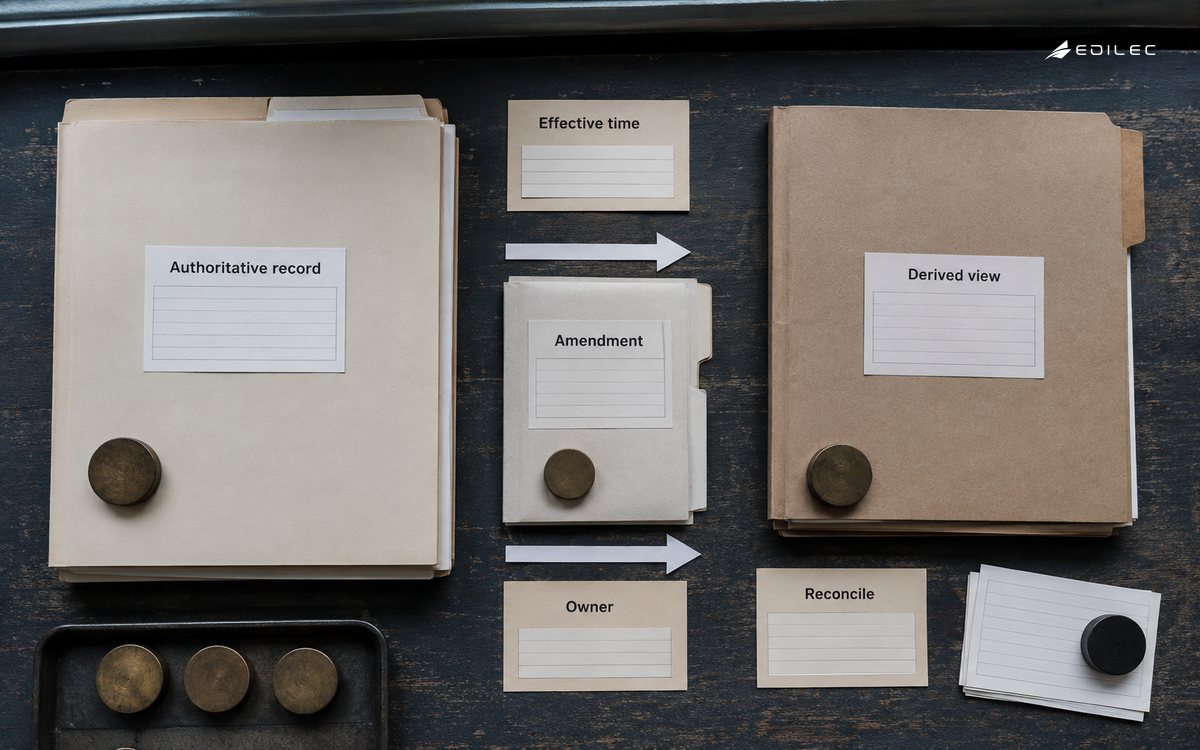
Begin by writing the decision in one sentence: whether the service may create, amend, merge, retire, publish, or reconcile a business record for a named subject at a particular time. That sentence exposes missing boundaries quickly. The system needs a durable identifier for the subject, an effective time rather than only a processing time, a named owner for the decision, and a clear result when facts conflict. For system of record design, the important records are entity identifier, source owner, version, effective time, change reason, quality state, and downstream use. Do not ask a dashboard, browser cache, or inbox thread to settle a dispute. One named domain service for each fact, with other systems consuming a defined representation rather than independently editing it should be explicit, and any downstream copy should say how it was derived, when it was last synchronized, and what it is permitted to change.
| Decision element | Production question | Evidence to retain |
|---|---|---|
| Business outcome | What result must system of record design make dependable? | Affected subject, expected action, and accountable owner |
| Authoritative fact | Which system resolves a conflict about authoritative business fact decision? | one named domain service for each fact, with other systems consuming a defined representation rather than independently editing it |
| State transition | What permits the service to create, amend, merge, retire, publish, or reconcile a business record? | Prior state, event or approval, rule version, actor, and effective time |
| Recovery route | Who corrects an incorrect result after launch? | Named queue, permitted action, approval evidence, and closure reason |
Model records, state, and time
A production model is less about collecting every field than about preserving the facts needed to explain a decision. Treat identifiers, ownership, source, effective time, and change reason as part of the domain contract. A caller may retry a request; an upstream service may send an older event after a newer one; a human may make a correction that is valid only for a limited period. System of record design should therefore distinguish an observed event from the current business state, reject or park ambiguous updates, and make reconciliation a normal operation rather than an incident-only activity. This protects the team from silent overwrites and gives support staff something better than a narrative reconstruction.
The references behind this approach are practical rather than vendor-specific. NIST SP 800-53 Rev. 5: Security and Privacy Controls, NIST SP 800-218: Secure Software Development Framework, OWASP Logging Cheat Sheet, OpenTelemetry Documentation provide useful checks for access controls, secure delivery, logging, recovery, or telemetry. Apply them to the actual decision boundary: decide which event facts are trusted, validate authority where the consequential action occurs, log a safe explanation without copying sensitive content, and test behavior when a dependency or audit destination is unavailable. Guidance does not replace local policy, contract terms, or legal obligations, but it gives a disciplined vocabulary for turning those obligations into reviewable system behavior.
Set boundaries and integration contracts
System of record design becomes fragile when master-data services, event streams, APIs, reporting stores, identity, and operational applications exchange loose status labels without agreeing on ownership and failure behavior. Every integration should state the command or event name, stable identifiers, schema version, permitted state transitions, ordering expectation, idempotency rule, acknowledgement, and retry limit. Design for the specific risk of two teams believing they own the same attribute, or consumers acting on a late event without knowing its effective order. A message accepted by a queue is not proof that the business change occurred; a remote timeout is not proof that it did not. Preserve a correlation identifier through the path, expose a queryable outcome, and let the caller distinguish pending work from a final result. That discipline also prevents a later connector change from quietly rewriting a business rule.
| Integration concern | Rule to choose before launch | Operational signal |
|---|---|---|
| Identity and scope | Derive subject and permission scope from trusted server context. | Denied attempts, scope mismatches, and emergency access use |
| Delivery and replay | Use a stable operation key and make duplicate delivery harmless. | Duplicate detections, retry age, and unknown outcome count |
| Conflict handling | Order updates by a documented business rule, not arrival order alone. | Stale-event rejections, merge conflicts, and reconciliation backlog |
| Dependency loss | Return a visible pending or restricted state with a named owner. | Timeouts, queue age, fallback use, and recovery duration |
Prepare a controlled production release
Release readiness is proven with representative outcomes, not a successful happy-path demo. Publish an ownership map before redirecting writes, run read-only comparison feeds, and migrate one domain boundary after evidence shows conflict handling works. Build a test set containing normal work, duplicate submission, stale data, revoked authority, changed policy, partial dependency failure, and a correction made by an authorized operator. For each case, record the expected user-facing result and the trace, event, or audit record that proves it. Put a kill switch or scoped disable route beside automation that can create commitments or expose data. A rollback is useful only when the team knows which records require compensation, which external actions cannot be undone, and who will communicate a temporary manual process.
Operate the service as a decision system
Once live, examine whether the system is producing trustworthy decisions rather than merely processing traffic. For system of record design, track conflicting updates, consumer lag, record merge rate, data-quality exceptions, source attribution, and reconciliation completion. Pair aggregate measures with sampled case reviews: follow one completed outcome across every handoff, and inspect one failure or exception until the owner can explain the current state. Correlated traces, metrics, and logs can shorten that investigation, but telemetry must respect data classification and access rules. Run a recurring reconciliation between authoritative records and downstream effects. The goal is not zero exceptions; it is a small, visible, owned set of exceptions whose resolution improves the system instead of teaching people to bypass it.
Key takeaways
- Define authoritative business fact decision before choosing fields, screens, or integration tooling.
- Keep one named domain service for each fact, with other systems consuming a defined representation rather than independently editing it visible to users, support, and downstream consumers.
- Record the source, effective time, rule version, and actor for consequential state changes.
- Make retries, stale events, and partial failure explicit parts of the system of record design contract.
- Release in a bounded scope with evidence-based expansion and a real recovery route.
- Use conflicting updates, consumer lag, record merge rate, data-quality exceptions, source attribution, and reconciliation completion to improve the operation after launch rather than relying on anecdote.
Frequently asked questions
What is the first production decision for system of record design?
Set the authoritative source and action boundary. A production team must know which record settles a dispute about authoritative business fact decision, which service performs the consequential action, and what happens when either source is unavailable. That answer should be understandable without reading application code.
What history should this team migrate at launch?
Migrate the identifiers, current authoritative values, and provenance needed for active consumers to resolve business facts. Preserve version and effective-time semantics. Legacy values that lack reliable lineage should be marked as historical reference rather than quietly promoted to the new source of truth.
Which exceptional cases can be automated safely?
Automate a record exception when merge authority and the conflict rule are unambiguous. A deterministic formatting correction can run automatically; disputed ownership, identity merges, or retroactive effective-date changes should go to a data steward with the original evidence.
Which adjacent systems deserve early design review?
Start with the systems that create identity, authority, financial or contractual consequence, and reporting evidence. For this topic, useful related reading includes system of record design guide, master data management guide, ERP integration design decisions. Those guides help teams align the release with adjacent ownership boundaries instead of discovering them during an incident.
Conclusion
The shift to production asks system of record design to withstand real ambiguity: incomplete facts, concurrent changes, human correction, and service failure. A useful implementation does not promise that every case will be automatic. It makes the normal path reliable, makes uncertainty visible, and gives an accountable person the information and authority to resolve the remainder. When the system preserves evidence, enforces the right boundary, and reconciles its effects, it becomes a dependable part of operations rather than another place to re-enter the same work.