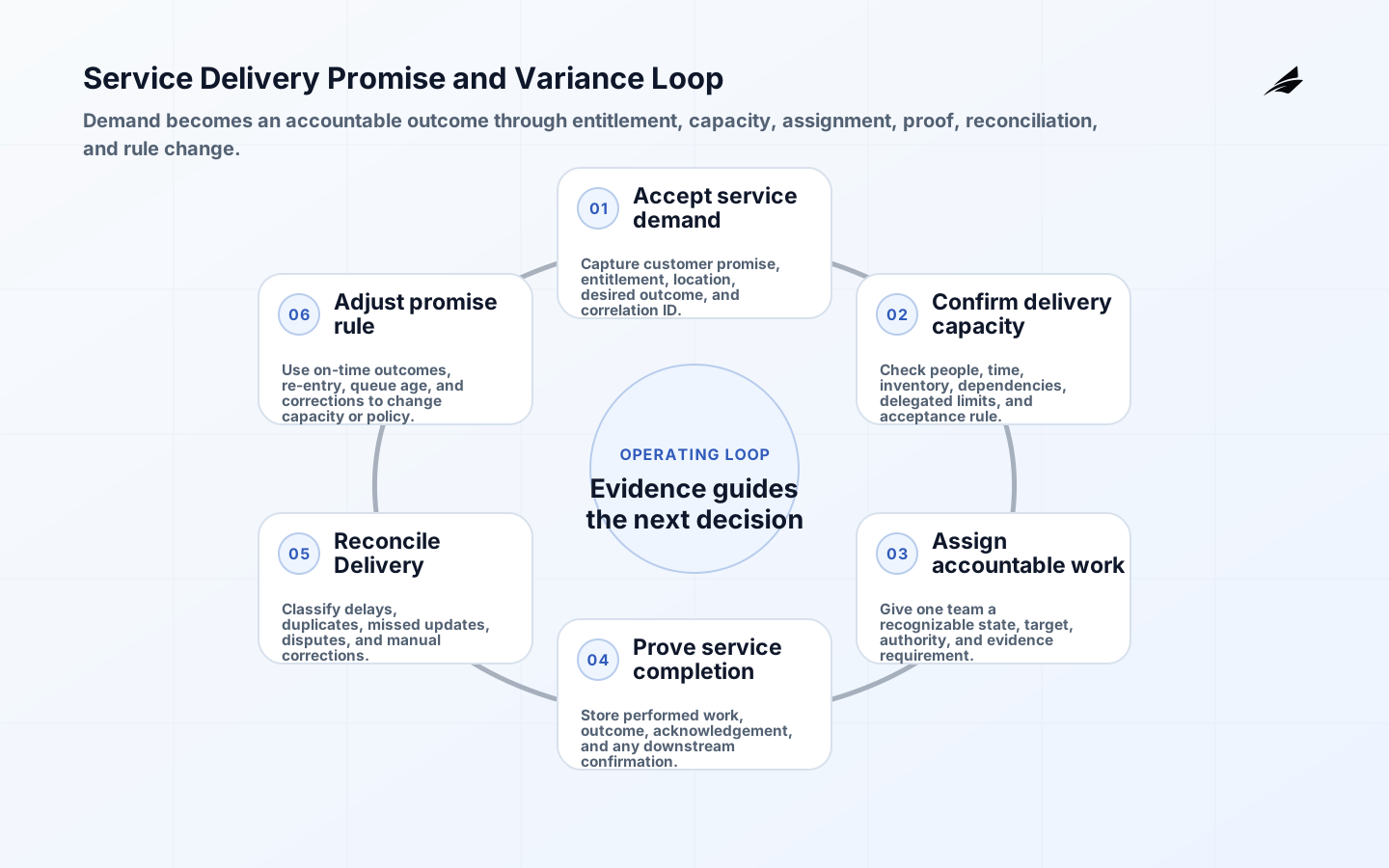
Service delivery systems are not primarily a software selection question. It is a way to make the acceptance, assignment, completion, and confirmation of a promised service visible, repeatable, and recoverable. The useful unit of design is the real decision: what arrives, what authority applies, which record is trusted, and how a person can correct the result. That framing exposes the work that product demonstrations often hide: ownership, evidence, awkward cases, and the handoffs between teams. For founders and delivery managers, the first deliverable should be a bounded operating path rather than a catalogue of features. The NIST Cybersecurity Framework 2.0 is a helpful governance reference because it treats risk management as an organizational activity, while the W3C PROV Data Model supplies a practical language for linking an outcome to the entities, activities, and responsible agents that produced it. The Plain-language Guide to Service Delivery Systems offers a useful adjacent lens when mapping the boundary.
Frame the service delivery systems decision
Begin by following a service request from arrival to an accountable outcome. Write the decision in one sentence, name service delivery manager as the business owner, and list the records that must be present: customer promise, entitlement, location, capacity, assignment, work record, and outcome. This is deliberately narrower than a transformation programme. A boundary makes assumptions inspectable. It also reveals where the team has confused a copied value with the authority that can change it. Record what is in scope, what is merely referenced, and what should stop for review. For every stop, define a named queue, target response, and escalation route. A case that cannot proceed should not become an email thread with missing context. The goal is to let a new operator explain the state, owner, next action, and reason without reconstructing the story from several applications.
| Decision element | Question to settle | Evidence to keep |
|---|---|---|
| Accountability | Who may decide whether a promised service can be accepted, assigned, completed, and confirmed? | Named service delivery manager, delegated limits, escalation. |
| Authoritative facts | Which customer promise, entitlement, location, capacity, assignment, work record, and outcome establish the outcome? | Source, version, effective time, and correlation ID. |
| Exception boundary | When must normal processing stop? | Rule result, impact, owner, and recovery decision. |
| Completion | What proves the work is complete? | Outcome, acknowledgement, and correction route. |
Model the work before choosing screens
A durable service delivery systems model separates a request, a decision, and an execution. The request carries facts supplied by a user or upstream system. The decision applies current policy and authority. Execution changes an operational record or creates a downstream obligation. Keeping those moments distinct prevents a common failure: an interface appears to approve something, while the actual system of record has rejected, delayed, or changed it. Give each transition a stable identifier and idempotency rule so a retry cannot create a second commitment or silently overwrite a correction. Capture the policy or workflow version used at the time. That detail matters during dispute resolution because today’s rule may not explain yesterday’s outcome. The Plain-language Guide to Workflow Exceptions is worth reading alongside this model when the path spans several teams or services.
- Describe the normal route with real examples, then add late, incomplete, duplicate, and disputed inputs.
- Make the actor, authorization, state transition, and resulting evidence explicit at every consequential step.
- Use business states that operators recognize; do not expose implementation status as the only explanation.
- Define which actions are reversible and who may approve a reversal.
- Keep manual intervention inside the same record history rather than in a private spreadsheet.
Make data and integration contracts explicit
Integration is where an apparently sound service delivery systems workflow tends to become ambiguous. Each exchange needs a purpose, producer, consumer, schema, acknowledgement, retry behaviour, and owner. The consumer should be able to distinguish a new event from a replay, and the producer should know whether a rejection means repair, review, or a safe retry. Retain the source identifiers alongside internal identifiers; replacing them makes later reconciliation unnecessarily hard. Use effective time for facts whose business meaning changes, and processing time for when the platform learned them. The distinction helps operators investigate a late update without pretending it was true earlier. The provenance concepts in W3C PROV are especially useful here: record what generated an assertion, which activity changed it, and which agent was responsible.
| Failure pattern | Practical control | Signal to review |
|---|---|---|
| Replay creates a second result | Stable event key and idempotent handler. | Duplicate outcome count after retries. |
| Two systems disagree | Attribute-level authority and effective-time rule. | Conflicts awaiting reconciliation. |
| Consumer misses an update | Acknowledgement plus scheduled population reconciliation. | Unapplied events by age. |
| Manual correction disappears | Traceable correction action with before-and-after values. | Corrections without a recorded reason. |
Control access and preserve evidence
Authorization has to be evaluated for the specific record and action, not inferred from a page being visible. The OWASP Authorization Cheat Sheet recommends deny-by-default, server-side enforcement, and checks that account for the object being accessed. Apply that guidance to service delivery systems: scope permissions by relevant organization, role, value, location, and time, then test denied paths as carefully as allowed paths. Separate preparation, approval, and release where combining them would defeat a material control. Audit trails should answer who acted, under which authority, on which version of the record, and what result followed. Avoid collecting sensitive data merely because it might be useful later. Design support views that reveal enough to resolve an issue without broadly exposing content, credentials, or unrelated cases.
Release a bounded path and rehearse recovery
Release the smallest service delivery systems path that reaches a real outcome and includes difficult examples. Test a normal request, missing data, a duplicate, an expired authority, an upstream outage, and a correction after downstream processing. Before expanding, reconcile the population across connected systems and agree what evidence proves the result is complete. The control families in NIST SP 800-53 are useful prompts for access control, audit, contingency planning, and system integrity; they are not a substitute for deciding how this particular operation must behave. Publish a support contact, operating hours, rollback or compensation procedure, and a threshold that pauses rollout. A reversible pilot teaches more than a broad launch whose errors have no clear owner.
- Run representative data through the full path before cutover, including items that must be rejected.
- Exercise retry, reversal, and escalation procedures with the people who will perform them.
- Reconcile source, target, and exception populations at a stated cadence.
- Give support staff a record-level explanation, not only a technical error code.
- Review permissions and delegated authority when roles, teams, or contracts change.
Measure operating results, not activity
The first metric should illuminate whether the path for accepting, assigning, completing, and confirming a promised service is becoming more dependable. Track on-time completion against the customer promise, alongside the share of work completed without manual re-entry, the age of unresolved exceptions, successful reconciliation rate, reversal frequency, and user-reported workarounds. Do not treat a lower exception count as automatic success: it may mean people stopped recording exceptions. Sample outcomes with frontline users and inspect the actual records behind a change in trend. Make a short weekly review routine: identify the oldest high-impact items, inspect a small set of reversals, decide who owns recurrent causes, and publish the change made. This turns data into operational learning rather than a decorative dashboard. System of Record Design: Explained from First Principles can help teams keep ownership boundaries clear as the workflow grows.
Key takeaways
- Start service delivery systems with one consequential decision and a named business owner.
- Specify authority, states, evidence, and recovery before expanding integrations or interfaces.
- Use stable identifiers, acknowledgements, and reconciliation to make handoffs explainable.
- Apply least privilege and record-level authorization to actions with real operational impact.
- Judge progress by correction speed and dependable outcomes, not by feature count or volume processed.
Frequently asked questions
Where should a service delivery systems initiative start?
Start where missed handoffs, unacknowledged work, and completion claims without evidence are already creating measurable rework, risk, or customer confusion. Choose a path with a reachable owner and enough volume to observe normal and abnormal cases. The first release should improve one decision and preserve the evidence needed to prove that it did; it does not need to replace every surrounding system.
Does service delivery systems require a single platform?
Not necessarily. Service delivery systems can coordinate existing services when the team explicitly assigns authority, defines exchange contracts, and gives operators a correction path. Consolidation may eventually reduce a specific cost or handoff, but moving records before resolving ownership merely transfers the dispute. Choose the operating model first, then select tools that make its controls observable.
Conclusion
Service delivery systems earns trust when it makes a consequential decision easier to understand, execute, and correct. Keep the first scope narrow, give every transition an owner and evidence, test recovery before scale, and use measures that show whether people can finish work with fewer hidden workarounds. That is the practical route from a promising system diagram to an operation that survives ordinary change.