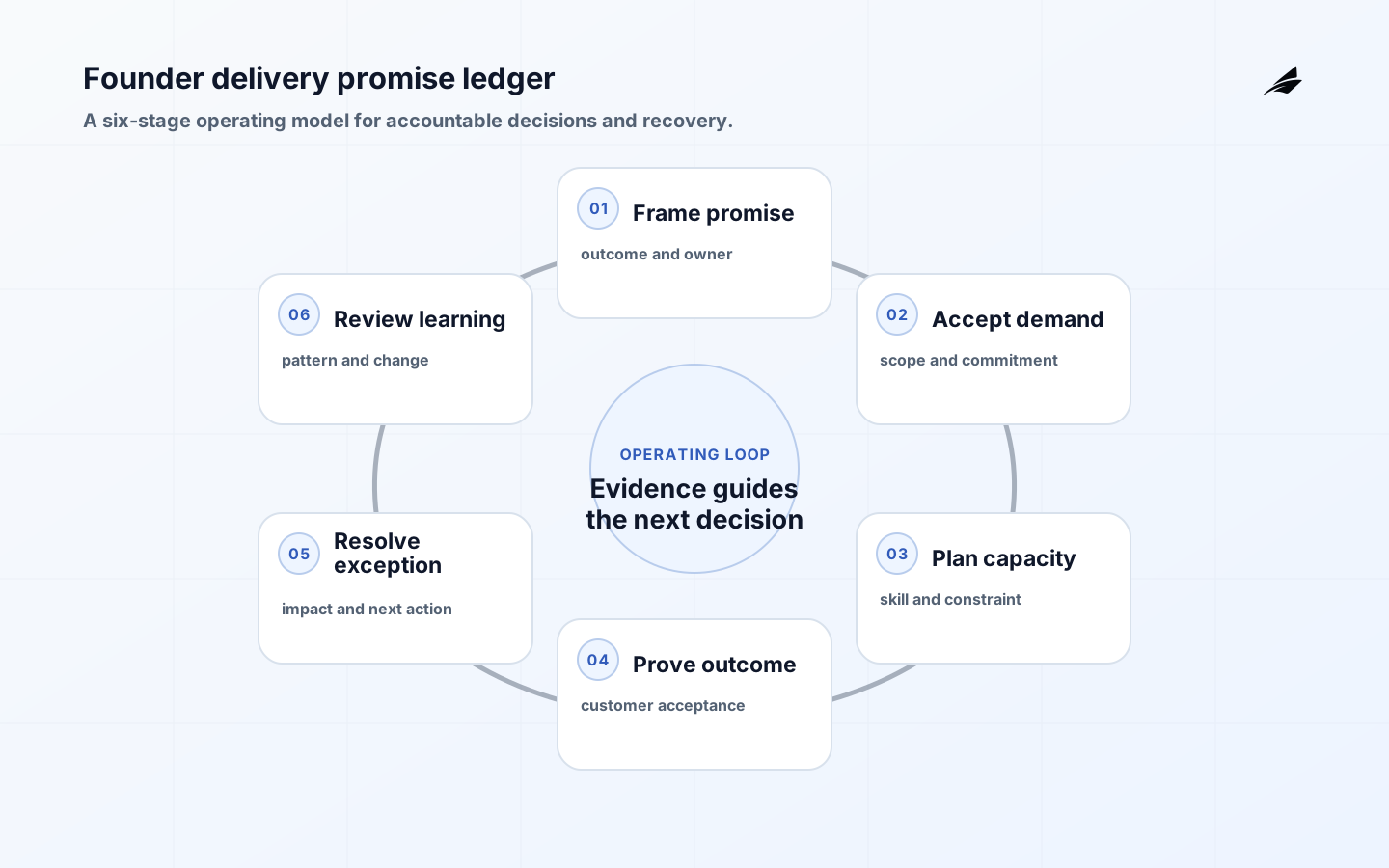
Service delivery systems turn a commercial promise into repeatable work. Whether the service is implementation, maintenance, onboarding, field work, or managed operations, the system has to make the request, commitment, capacity, evidence, and outcome visible to the people responsible for them. Founders often see delivery as a people problem until volume reveals that the same ambiguity is being resolved repeatedly by experienced staff.
Define the service promise precisely
Start with the unit of value that a customer receives, not with internal departments. A service might promise a configured workspace, a repaired device, a completed inspection, or a monthly operational report. Name the entry criteria, expected outcome, exclusions, and completion evidence. That definition is what lets sales set expectations, operations plan capacity, and finance know when a milestone can be recognized or invoiced.
Separate a standard path from work that needs professional judgment. Standard work benefits from checklists and automation; judgment work needs a case owner, decision log, and escalation route. Trying to force both into an identical sequence makes the standard path slow and the complex path invisible. The useful design question is where a trained person must interpret evidence, not where a screen can collect another field.
| Service stage | Record to create | Proof of completion |
|---|---|---|
| Intake | Request, customer scope, urgency | Eligibility and requested outcome confirmed |
| Planning | Work package, owner, target date | Capacity and dependencies accepted |
| Execution | Task events and attachments | Required steps or deliverables recorded |
| Acceptance | Customer or internal verification | Outcome accepted, rejected, or placed in recovery |
Service delivery architecture
Use a durable work record as the spine of the system. It should link customer, entitlement or contract, requested outcome, owner, state transitions, and the external records created along the way. A ticket can be one implementation, but it is not sufficient if it cannot represent planned work, multiple visits, customer acceptance, or a managed exception. Keep operational events append-only where possible so a changed due date does not erase the original commitment. NIST SP 800-53 provides a useful control catalogue for ownership, access, and change evidence.
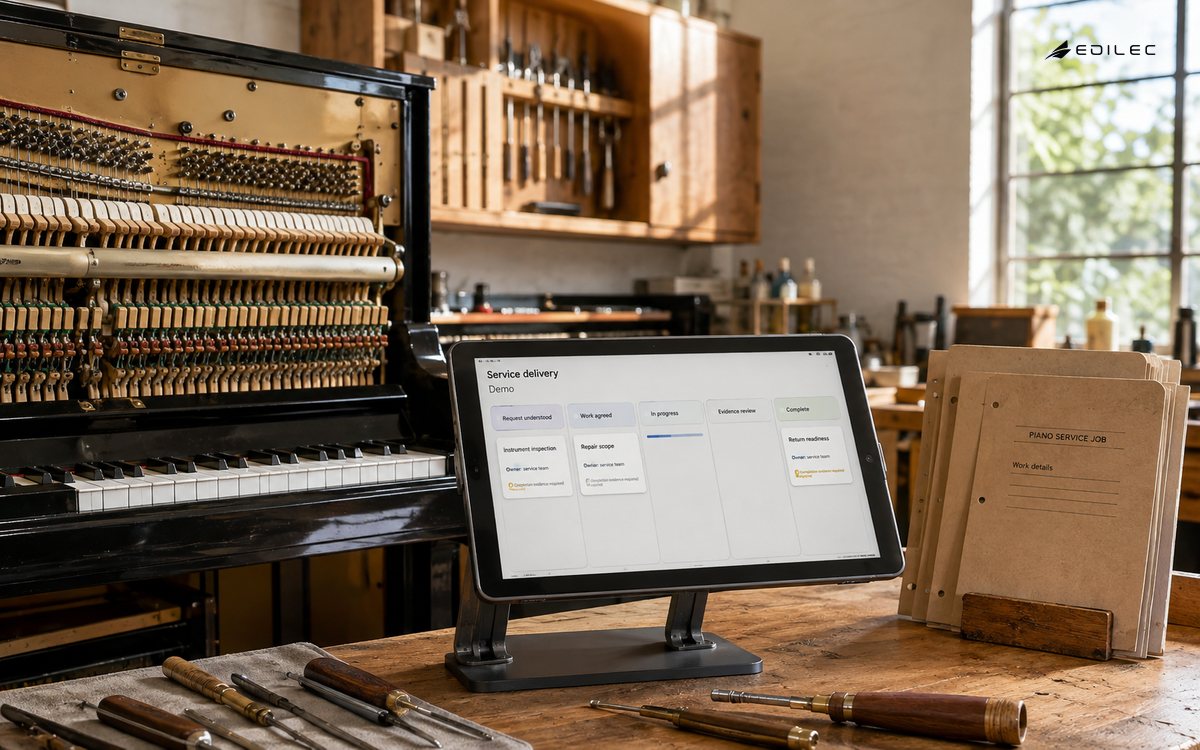
Integrate around the moments that change responsibility: work accepted, appointment confirmed, deliverable submitted, outcome verified, and service closed. Each event needs an identifier, timestamp, actor, and retry-safe consumer. Customer-facing updates can be delivered through customer portals, but the portal should report the delivery system's truthful state rather than inventing a parallel status model.
Plan capacity without hiding demand
Do not let a calendar be the only capacity model. Estimate the work type, required skill, location or time-zone constraint, and dependency before assigning an owner. Then compare promised work with available capacity over a planning horizon. A queue that looks stable because work is unassigned is not stable; it is simply concealing demand from the people who need to make a trade-off.
Define service targets as customer-relevant thresholds. A response target is different from a restoration target, and an installation appointment is different from a completed configuration. Use percentiles and aged backlog rather than an average that can conceal long waits. Where a target cannot be met, communicate the changed commitment and the reason rather than allowing the due date to drift silently. Google SRE Workbook is a practical reference for service targets, reliability, and review routines.
| Signal | What it reveals | Likely action |
|---|---|---|
| Aged work by waiting reason | External dependency or missing ownership | Escalate the blocker or improve intake |
| Rework rate | Poor acceptance criteria or training gap | Review samples and update the work package |
| On-time completion percentile | Reliability of the promise | Rebalance capacity or narrow the offer |
| Handoffs per work item | Fragmented responsibility | Clarify ownership or combine steps |
Build recovery into the normal flow
Every service needs a recovery state that is visible to the customer and internally accountable. Examples include a failed visit, missing customer access, an unavailable part, or an outcome that fails acceptance. Capture the reason, customer impact, next owner, and next review time. A closure code alone is not a recovery plan, and reopening the original request without context loses the evidence needed to prevent a repeat. OWASP Logging Cheat Sheet helps make recovery events useful for investigation and correction.
Run a weekly review of a small set of late, reopened, and escalated work items. Look for patterns in the promise, not only in individual performance. Repeated wait states may reveal a missing integration; repeated changes may reveal a product configuration problem; repeated manual coordination may justify an automation. This is where a delivery system becomes a learning system.
Implement one service line at a time
Choose a service line with a stable demand pattern and a motivated operating owner. Observe its current work for a week, define only the fields needed for the first decision, and migrate open work carefully. Pilot with real customer cases and compare outcomes to the previous process. A broad platform rollout before the service model is agreed will make every configuration argument feel urgent.
- Name a service owner who can change the operating rule, not only administer the tool.
- Keep a short decision record for each state transition and integration boundary.
- Test unavailable dependencies and reassignment before declaring the path ready.
- Link recurring service outcomes to enterprise reporting for management review.
Service Delivery Systems for Enterprise Systems: Key takeaways
- Define the service outcome and completion evidence before automating its steps.
- Use one durable work record with visible ownership and waiting states.
- Measure reliability and rework alongside speed.
- Treat recovery cases as input to service design, not administrative noise.
Service Delivery Systems for Enterprise Systems: Frequently asked questions
Is a ticketing tool a service delivery system? It can be part of one, but only if its data model supports the service promise, ownership, scheduling, evidence, and recovery that the business needs. A generic queue is not a substitute for an operating model.
Who owns service targets? The commercial and operational owners should agree on them. Operations can describe capacity and failure modes, while the business decides what level of reliability it is prepared to fund and promise.
When should work be closed? Close when the defined outcome has been verified or a transparent recovery decision has been made. Closing merely to improve a dashboard moves the unresolved work somewhere less visible.
Assurance review — for founder delivery
For service delivery, compare the planned and actual sequence for a handful of completed and reopened engagements. Look for where a customer was waiting without a visible owner, where a technician lacked a required fact, and where acceptance criteria were interpreted differently. Those observations produce better changes than a generic demand forecast. They can lead to a clearer intake question, a realistic target, a better work package, or a deliberate recovery state.
The assurance review should produce a small, owned change rather than a broad redesign; delivery owners record the commitment. For service delivery systems, write down the observed condition, the decision it affected, the owner who will correct it, and the signal that will show whether the correction worked. Revisit the same class of work after the change. This closes the loop between policy, system behavior, and the people who depend on the outcome; delivery owners record the commitment. NIST Cybersecurity Framework 2.0 offers a current lens for governing service risk and improvement.
Service delivery improves when the organization distinguishes work that is truly complete from work that has merely left one queue. Make verification proportional to the service: a photo or serial number may confirm installation, a customer acknowledgement may confirm a configuration, and a manager review may confirm a regulatory deliverable. Record that evidence where the next team can use it. Also review the economics of rework and delays by service type. A service that appears profitable at booking can become expensive when avoidable visits, missing prerequisites, and unclear acceptance cause repeated coordination across teams.
Finally, make the review of service delivery systems a normal operating meeting rather than an annual clean-up. Bring a sample of recent work, one aged item, one recovery case, and one decision that depended on a shared record; delivery owners record the commitment. Ask whether the current owner, evidence, and system state would let a new colleague understand what happened and act safely; delivery owners record the commitment. Record only the changes that have a named owner and a testable signal; delivery owners record the commitment. This small cadence is how an enterprise system stays aligned with changing customers, policies, and teams without relying on heroic knowledge held by a few people; delivery owners record the commitment.
Keep this review evidence with the service delivery systems record: the observed case, the owner, the chosen correction, and the date it will be checked again. That modest history prevents the same issue from being rediscovered when staff or systems change; delivery owners record the commitment.
Service Delivery Systems for Enterprise Systems: Conclusion
A service delivery system is a way to make commitments credible at scale. It gives each request a path, an owner, an evidence trail, and a recovery option. Build it around the actual service a customer receives, then use its operating data to improve the promise rather than merely report activity.
Service Delivery Systems for Enterprise Systems: Service Delivery Systems for Enterprise Systems operating checklist; delivery owners record the commitment.
A dependable service delivery systems design makes the decision boundary visible. Define the user, the unit of work, the allowed action, the evidence required, the time boundary, and the owner who can correct a result; delivery owners record the commitment. Apply the official controls already named in this article: provenance should connect entities, activities, and responsible agents; security controls should protect the action that matters; observability should describe a customer-relevant outcome rather than only a technical event; delivery owners record the commitment. In practice, this means a late source, rejected request, disputed invoice, blocked service, or reconnecting device becomes an owned state with a next review, not an unexplained red badge; delivery owners record the commitment. Use one representative path as the release test. For a data path, reconcile a sample against the source. For a portal, prove tenant isolation and safe correction. For a workflow, replay a duplicate and a dependency failure. For billing, reproduce the same charge from retained inputs. For MQTT, exercise expiry, reconnect, authorization, and downstream acknowledgement. The test should produce evidence that an operator can inspect without asking the original implementer; delivery owners record the commitment. Read the related Edilec guides related guide, workflow exceptions, and production operations; delivery owners record the commitment. | Review question | Evidence to retain | Decision when absent | |---|---|---| | What was requested? | scope, actor, time | clarify or reject | | What changed? | event, version, owner | investigate or replay | | What is trusted? | promise, owner, completion proof | publish with caveat or hold | | How is it corrected? | before, after, reason | approve, reverse, escalate | | What improves next? | cause, trend, owner | schedule a bounded change | ### FAQ What belongs in the first release? One complete path with its highest-cost exception. Who owns the result? The person accountable for the business meaning, supported by a technical owner; delivery owners record the commitment. When should scope expand? After normal work, failure recovery, access review, and correction are all measurable; delivery owners record the commitment. ### Conclusion The durable form of service delivery systems is an operating capability: explicit promise, controlled action, inspectable evidence, and a review loop. Start narrow, test the uncomfortable cases, and scale only when the evidence remains understandable; delivery owners record the commitment.