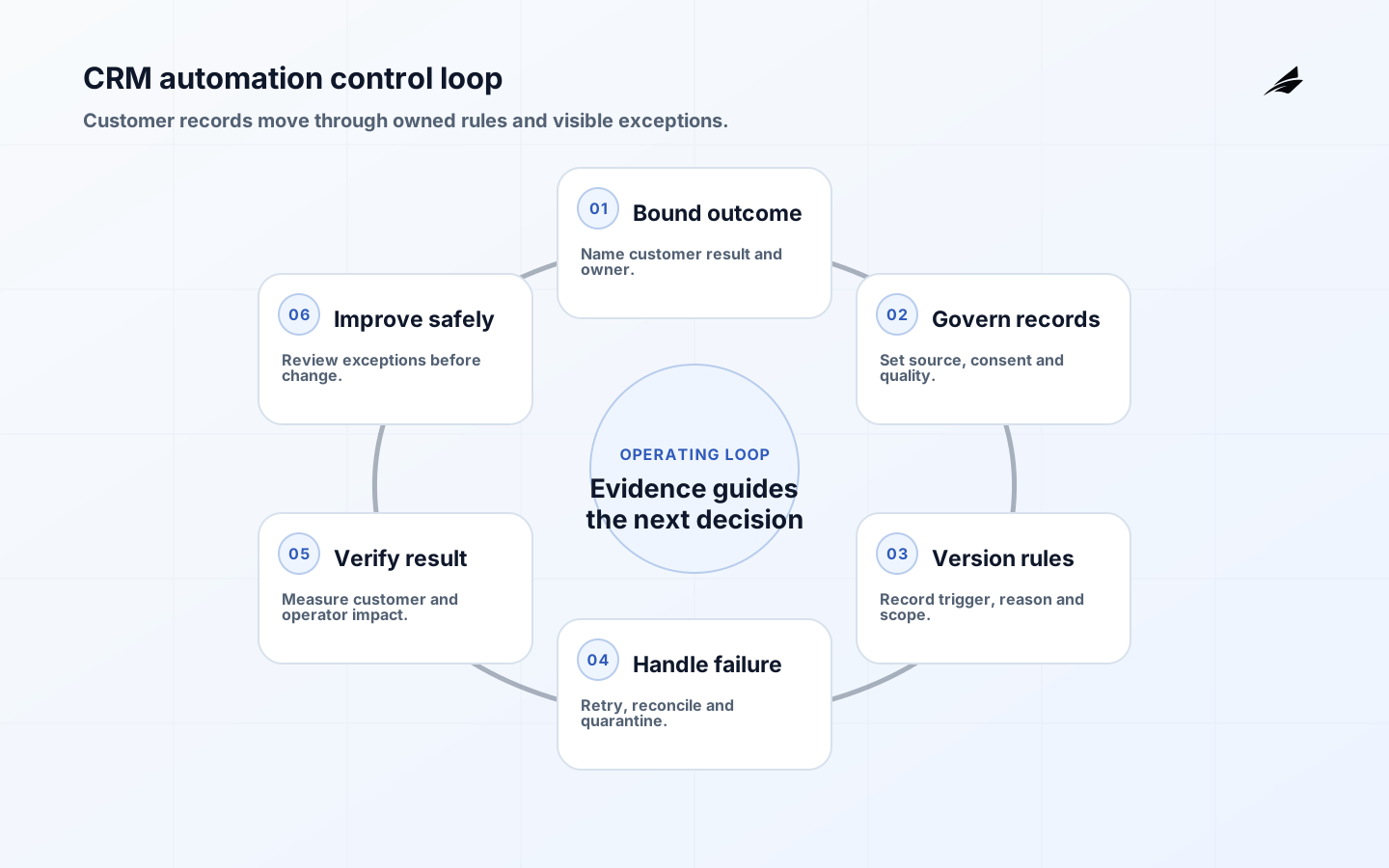
CRM automation should remove avoidable effort without weakening the customer record or hiding exceptions. Start with one customer outcome, the authoritative fields that support it, and a named owner for every automated decision. This CRM automation checklist works alongside Edilec’s CRM architecture guide, operations-leader decision guide, and production operations guide.
Frame the CRM automation decision
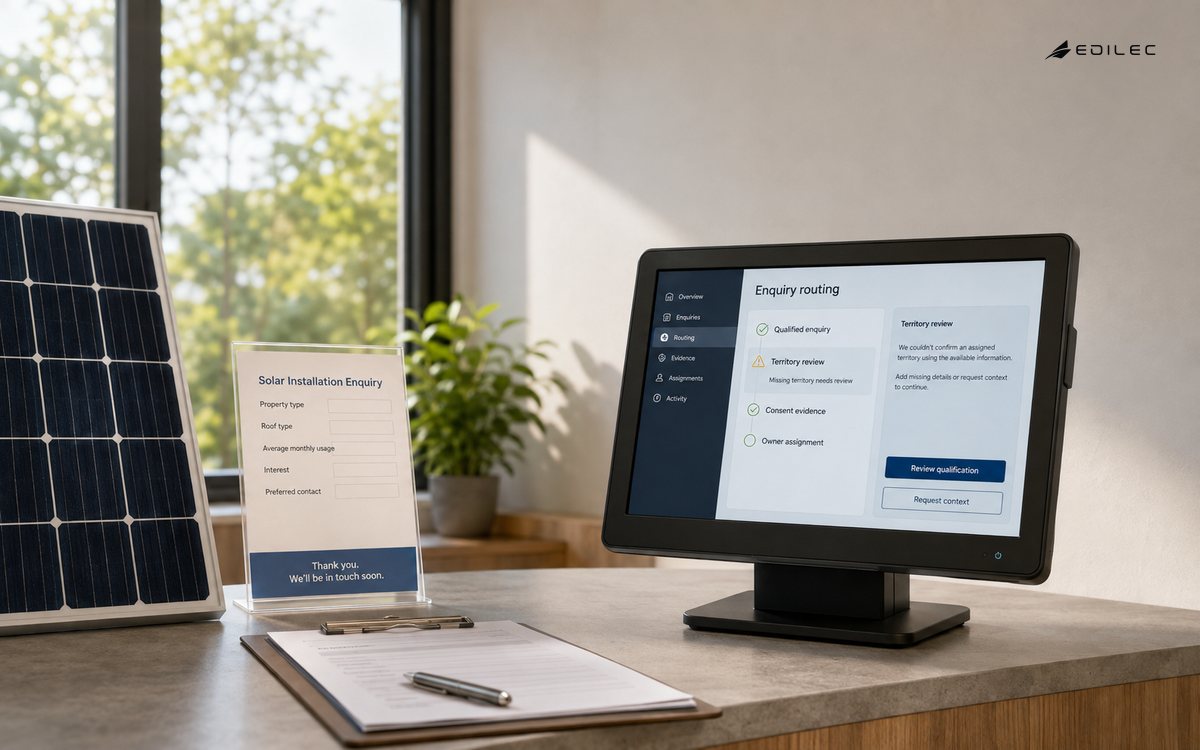
Anchor the automation in a customer outcome that can be checked. For example: when a qualified enquiry is accepted, assign it once to the correct territory owner and record when follow-up becomes due. Name the CRM field or event that proves qualification, the team accountable for the routing policy, and the application allowed to change ownership. Also state the time limit and what happens when territory, consent, or account data is missing. This turns a vague request to automate lead management into a decision contract that sales operations, marketing, and engineering can test together. NIST’s definition of data governance is useful here because it places authority around enterprise data assets, not merely around software access. Record who may correct the source, who may approve an exception, and which downstream tools receive only a copy. The CRM automation engineering notes show how that ownership model carries into integration design.
Define records, states, and boundaries
Model each CRM object according to the business promise it represents. A lead can be unreviewed, qualified, disqualified, converted, or reopened; an opportunity can move stages only when the required customer evidence exists; a communication preference needs source, purpose, effective time, and withdrawal history. Define these transitions before writing automation rules, including whether an amendment replaces a value or creates a new dated fact. Then decide which application is authoritative for account identity, commercial ownership, consent, and fulfilment status. Other systems should receive the identifiers and context needed for their task without acquiring an undocumented right to overwrite the master record. Every automation should therefore name its trigger, eligible population, suppression tests, intended side effect, and reversal method. The NIST Data Governance and Management Profile connects useful data management with privacy and cybersecurity risk; applying that idea to CRM means treating record provenance and permitted use as part of the workflow, not cleanup after integration.
| Design question | Good operational answer | Evidence to retain |
|---|---|---|
| What starts work? | A named business event with a source and effective time | Source reference and correlation ID |
| Who may decide? | A current role or assigned owner, not an assumed inbox | Authority or assignment record |
| What can fail? | A defined rejection, retry, and escalation path | Error reason and handoff history |
| How is it corrected? | A controlled reversal or amendment, not a silent overwrite | Old value, new value, reason, and actor |
Design the exchange and exception path
Specify the exchange as an event contract rather than a sequence of screenshots. A useful contract identifies the originating record and revision, event time, customer or account key, permitted purpose, rule version, and idempotency key. The receiver must acknowledge whether it accepted, rejected, or had already processed the event. A retry may repeat delivery, so email sends, owner changes, and task creation need duplicate protection at the action boundary. Route validation failures separately from temporary transport failures: a malformed country code requires source correction, while a timed-out destination may be safe to retry. For identity uncertainty, quarantine the action instead of merging customers on a weak match. Carry one correlation identifier through the CRM, integration layer, and destination so an operator can reconstruct the journey without comparing clocks. The system-of-record design guidance is especially relevant when a marketing, billing, or support platform wants to write back a fact whose authority belongs elsewhere.
Control access and change
Match CRM controls to the side effect. A rule that adds an internal reminder can tolerate lighter review than one that changes a sales stage, transfers an account, discloses personal data, or sends a customer message. Run integrations under service identities limited to the required objects and operations; restrict exports, bulk edits, and impersonation separately. Store automation definitions in a versioned change process with a tested disable switch and a way to identify records touched by each release. The NIST Cybersecurity Framework provides a sound structure for governing, protecting, detecting, responding to, and recovering from these changes. For every production update, retain the business purpose, rule diff, affected cohort estimate, sample results, reviewer, deployment time, and rollback or correction query. Use synthetic or minimized test data, and keep customer values out of routine logs and alerts. These measures let the team contain a faulty campaign or reassignment rule without granting broad access during the incident.
| Signal | Likely interpretation | First accountable response |
|---|---|---|
| Records wait past their target | An owner, validation, or downstream dependency is blocked | Inspect the oldest items and assign a named resolver |
| Manual corrections rise | A rule, master record, or upstream process is drifting | Sample corrections and fix the shared cause |
| Duplicates or repeats appear | Retries lack a stable business key or matching rule | Pause unsafe replay and reconcile the affected population |
| Users work around the system | The path is slow, unclear, or missing an exception state | Observe the real task before adding another form |
Govern Crm Automation
Give CRM automation a standing owner and a short operating cadence. Revenue operations should own the meaning of stages, routing, and suppression policy; data stewardship should resolve identity and authoritative-field disputes; engineering should own delivery, observability, and safe recovery; frontline representatives should confirm that the resulting task is usable. Review failed and overridden records weekly during launch, then at a frequency justified by volume and consequence. Rehearse a concrete incident such as a territory upload that reassigns active opportunities and triggers duplicate outreach. The team should be able to stop the rule, find the affected cohort, preserve customer history, restore ownership, notify account teams, and decide whether customers need a correction. CISA’s incident response planning guidance supports the underlying practice of defining roles and communications before pressure arrives. Here, that practice becomes a CRM-specific playbook rather than a generic escalation document.
Release in small, observable slices
Pilot one rule on a cohort that can be reconciled record by record—for example, complete inbound enquiries from a single region routed during staffed hours. Capture the previous assignment time, touches, correction rate, and abandoned records before enabling automation. In shadow mode, calculate the proposed owner without changing the record; compare that answer with current operations and investigate disagreements. The live pilot should cap the number of actions per run, exclude records with uncertain consent or identity, and leave an immediately usable manual route. Reconcile eligible source events against assignments, tasks, and messages every day. Explicit pause conditions should cover duplicate communications, unexpected stage movement, high unmatched-account volume, or a spike in manual reversals. Expanding by region, source, or action type only after these checks protects against a bulk update becoming an uncontrolled fan-out. It also exposes local territory rules and late customer corrections before the automation reaches harder-to-repair commercial work.
Measure useful operation
Use measures that connect an eligible CRM event to its intended customer-operation result. Reconcile qualified records with assignments completed once, measure time to first usable action, and track suppressions by reason, unmatched identities, duplicate side effects, stale-owner reversals, and records stranded between systems. Segment by acquisition source, region, rule version, and destination because a healthy overall rate can hide one broken connector or policy branch. A fast alert might fire when acknowledgements stop or duplicate keys rise; diagnosis then needs event payload metadata, mapping version, and destination response. That separation follows Google SRE monitoring guidance on actionable signals versus diagnostic detail. Give each threshold a revenue-operations and technical receiver, plus a documented containment step. In monthly case reviews, sample successful actions as well as exceptions to detect formally valid but commercially wrong outcomes. The production operations guide extends this approach into recurring ownership and change routines.
Worked example: lead routing without silent loss
Suppose a regional sales organization wants to route inbound leads automatically. Define the entry event as a validated lead creation, not any form submission. Normalize country, product interest, customer status, and consent; reject or quarantine records that cannot be matched safely. The CRM remains authoritative for lead state, while territory and product rules come from owned reference tables. The automation records the rule version, route decision, timestamp, and reason so sales operations can reconstruct what happened.
Run the first release in shadow mode. Compare the proposed owner with the assignment a coordinator would have made, then investigate disagreement by reason: incomplete data, stale territory, duplicate account, capacity rule, or genuine judgment. When live, set an acknowledgement timer and return unaccepted leads to a visible queue. Measure time to first action, misroutes, duplicates, unowned records, manual corrections, opt-out breaches, and downstream conversion. A higher routing count is not success if customer context or accountability deteriorates.
Key takeaways
- Begin CRM automation with one consequential decision and a named revenue operations owner.
- Define lifecycle states, authority, effective time, and correction before automating handoffs.
- Use stable references and an explicit exception path across every consequential exchange.
- Protect sensitive data and high-impact changes with proportionate access, review, and audit records.
- Release with reconciliation and real failure cases, then use operating evidence to improve the path.
Frequently asked questions
What is the first practical step for CRM automation?
Choose one recurring CRM automation event that currently causes rework or uncertainty, name its accountable owner, and map its source, states, consumers, deadline, and correction route. That produces a testable boundary for CRM automation without requiring an enterprise-wide redesign.
When is automation ready?
Automation in CRM automation is ready when the team can explain the normal result, duplicate behavior, rejection route, correction method, and who is allowed to change the rule. Test those cases with representative CRM automation records before relying on volume or a dashboard as evidence of readiness.
Conclusion
Reliable CRM automation begins with an authoritative customer event and ends with a verifiable business action. Define object lifecycles, permitted writers, duplicate behavior, suppression rules, and correction ownership before adding more journeys. When the team can reconcile every eligible record, stop a faulty rule, and explain an assignment or message from retained evidence, automation is reducing coordination without sacrificing customer context.