How It Managers Should Think About Data Quality
Data quality is useful only when it makes whether a team can use a report for a stated operational or financial decision easier to answer. For IT managers, that shifts attention away from a tool purchase or dashboard request and toward a decision contract: who will act, what evidence is needed, when the answer is current, and what must happen when it is not. Begin with one named decision, a stated reporting cut-off, and a visible owner. The purpose is not to collect every possible field; it is to make a consequential question answerable with a result whose limits are understood. For this data handoff, name the accountable owner, supporting evidence, exception route, and next measurable check.
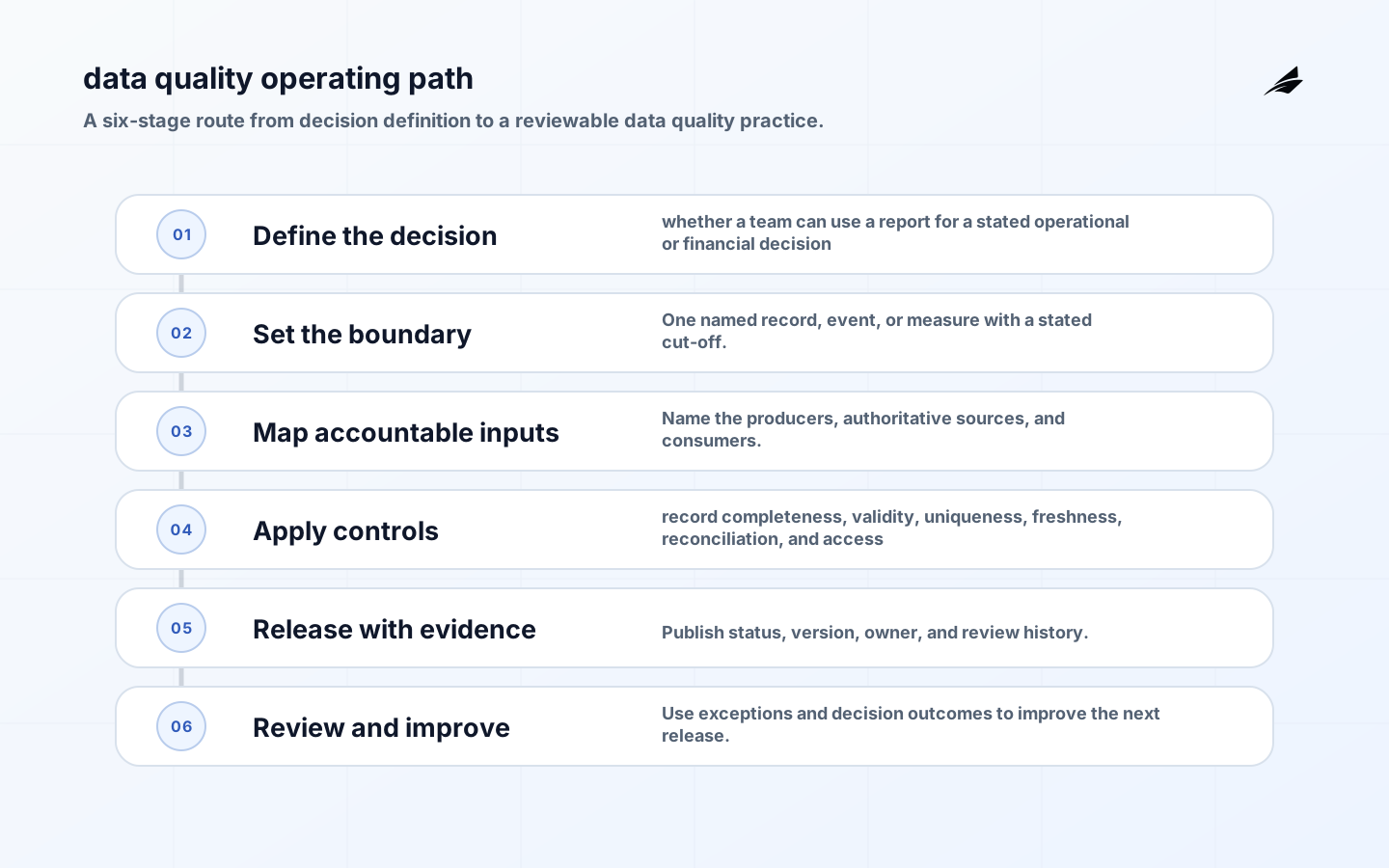
Define the data quality decision
Write the decision in plain language before designing the data product. In this case, record whether a team can use a report for a stated operational or financial decision. A reader should be able to describe what action changes when the result changes. This keeps a request for better data from becoming an unbounded integration project. Name the cadence, decision forum, and tolerance for uncertainty. A daily intervention needs a different freshness expectation than a monthly review. The W3C PROV overview provides useful concepts for keeping the entities, activities, and responsible agents behind an output explainable. Within this data handoff, name the accountable owner, supporting evidence, exception route, and next measurable check.

| Decision element | What to record | Why it matters |
|---|---|---|
| Action | whether a team can use a report for a stated operational or financial decision | Prevents passive reporting from becoming the goal |
| Boundary | One record or event at a named cut-off | Makes results comparable across runs |
| Owner | Decision owner, source owner, and product steward | Creates a route for repair and approval |
| Failure state | Delayed, incomplete, or corrected | Tells readers when an output needs an exception |
Set a usable data quality boundary
For IT managers working on data quality, this information boundary should connect business rules, system state, operating evidence, accountable ownership, and recovery to evidence an accountable owner can inspect. A small boundary is not a compromise in rigor; it is how a team proves meaning before multiplying dependencies. Specify the grain, reporting clock, included population, authoritative source for each material attribute, and the treatment of late data. Keep manual adjustments visible rather than merging them silently into a final total. This gives reviewers a practical way to compare a result with its inputs. It also exposes disagreements that technology cannot settle, such as whether a cancellation belongs to the original period or whether a telemetry event represents customer impact. In this planning review, move beyond the information boundary only after the owner can show the accepted result, the exception path, and the signal for another review.
- State the grain, inclusion rule, and reporting cut-off.
- Name the producer, owner, and refresh expectation for each critical input.
- Record exclusions and the point at which a correction becomes a restatement.
- Show readers a plain status when a result is delayed, incomplete, or under review.
Design controls for data quality risk
Controls should be chosen because they address a credible failure, not because a checklist is available. For data quality, focus on record completeness, validity, uniqueness, freshness, reconciliation, and access. Automated checks establish expected relationships, but they do not replace ownership or judgment about whether a result is safe to use. dbt documentation on data tests offers a practical model for assertions evaluated during a transformation workflow. Pair test results with review of material changes: volume shifts, missing partitions, altered definitions, and unexplained reconciliation differences. Before releasing this data handoff, name the accountable owner, supporting evidence, exception route, and next measurable check.
| Control | Evidence to keep | Response on failure |
|---|---|---|
| Input readiness | Arrival time, schema version, row or event counts | Mark impacted outputs as pending or scoped |
| Business rule | Test result and accountable rule owner | Investigate records rather than accepting a plausible total |
| Change control | Version, approver, and release time | Compare with the prior approved release |
| Access and use | Role assignment plus export or query history | Restrict use while a permission or exposure issue is assessed |
Design the reader experience for data quality
In data quality, IT managers should make the relationship between business rules, system state, operating evidence, accountable ownership, and recovery explicit and reviewable. Readers need more than a number. Provide the period, population, last successful refresh, material limitations, and a path to the accountable owner. A drill-through, reconciliation note, or retained sample should answer the next reasonable question without creating a parallel spreadsheet. Define status language before an incident occurs: ready, delayed, partially available, corrected, and retired are more useful than a silent gap. Separate observations from recommendations. The product can present evidence, while the named decision maker remains responsible for the action. This planning review should close the information boundary only when the result, unresolved exception, and next review condition are recorded.
Release data quality with evidence
A dependable data quality design makes business rules, system state, operating evidence, accountable ownership, and recovery visible to the owner responsible for this information boundary. Make the first release intentionally narrow: one reader group, one repeatable decision, and a traceable path from input to output. Put definitions, code or configuration, tests, and publication steps under a reviewable change process. Exercise unhappy paths before release: late input, identifier change, missing partition, changed policy, or unavailable owner. Decide who can pause publication, who approves a correction, and how readers will learn about an affected period. Retain enough run and version information for a new owner to understand why the current result differs from the prior one. The next step in this planning review is justified when the team can trace the accepted outcome, the fallback route, and the owner of follow-up.
Operate data quality with visible exceptions
This information boundary for data quality is strongest when business rules, system state, operating evidence, accountable ownership, and recovery can be reviewed as one operating record. Review both technical signals and decision outcomes after launch. Watch input readiness, control failures, correction volume, reader questions, and decisions that had to be reversed. An exception queue should distinguish a defect from an unresolved policy choice and from a simple delay, giving owners a meaningful route to act. Google's SRE guidance on monitoring supports a useful principle: signals matter when they enable a response, not when they merely create more noise. Keep the exception state in the product so readers encounter uncertainty before acting. Acceptance in this planning review requires a visible outcome, a bounded exception path, and a measurable reason to revisit the decision.
Scale data quality without losing meaning
IT managers can keep data quality accountable by recording how business rules, system state, operating evidence, accountable ownership, and recovery shape this information boundary. Scale in the order of decision value. Add an input, audience, or automation step when it changes an action, removes a recurring manual check, or materially improves a control. Measure operating cost in owner time, compute, storage, review effort, and recovery work, not only subscription fees. Revisit access, retention, and accountability as the footprint grows. NIST Cybersecurity Framework 2.0 is a useful cross-functional reference because governance and protection remain part of the design even when analysis is automated. For this planning review, the responsible owner should be able to explain what passed, what remains exceptional, and which signal reopens review.
Run a data quality decision review
A scheduled data quality review should examine a small set of real decisions, not only a technical scorecard. Ask which result changed an action, whether the reader understood its cut-off and limitations, and whether any exception arrived too late to matter. Compare the published output with the underlying records that drove the decision, then record where the explanation was difficult, where a source owner had to intervene, and where a definition created avoidable debate. This feedback is more useful than a generic maturity rating because it connects operational cost to decision value. For data quality, the review should also identify one control to keep, one ambiguity to resolve, and one manual step that can be removed only after its purpose is understood. Close the review with a named owner, an expected date, and a visible status. That creates a practical learning loop while preserving the judgment that automation cannot supply.
Data quality takeaways
- Data quality should answer whether a team can use a report for a stated operational or financial decision.
- Make grain, cut-off, owners, and exclusions explicit before adding sources.
- Use controls to expose uncertainty early and retain release evidence.
- Show exceptions where readers will see them, not in a private follow-up.
- Scale only after readers can explain the result, its limits, and its correction route.
Data quality FAQ
For data quality, the evidence behind this information boundary should cover business rules, system state, operating evidence, accountable ownership, and recovery. What is the fastest useful first step? Define the decision, boundary, owner, refresh expectation, and one failure condition in a shared record. How do we know a result is ready? Declared inputs arrived, required controls passed, and any unresolved limitation is visible to the reader. Who owns a cross-functional result? The decision owner owns its use; producers own inputs; and the product steward coordinates definitions and release evidence. What happens when a number changes? Preserve the prior version, identify the changed input, logic, or policy, state the impacted period and audience, and record the correction rather than quietly overwriting history. Do not widen the scope from this planning review until the evidence supports the result, the recovery route, and the next operating check.
Conclusion: make data quality answerable
Data quality earns trust when it helps IT managers determine whether a team can use a report for a stated operational or financial decision with appropriate evidence and visible limits. Start with a bounded product, connect controls to real failure modes, release with traceable evidence and treat exceptions as part of the reader experience. That discipline keeps the work useful as the organization adds sources, automation and new decision makers. When explaining this data handoff, name the accountable owner, supporting evidence, exception route, and next measurable check.