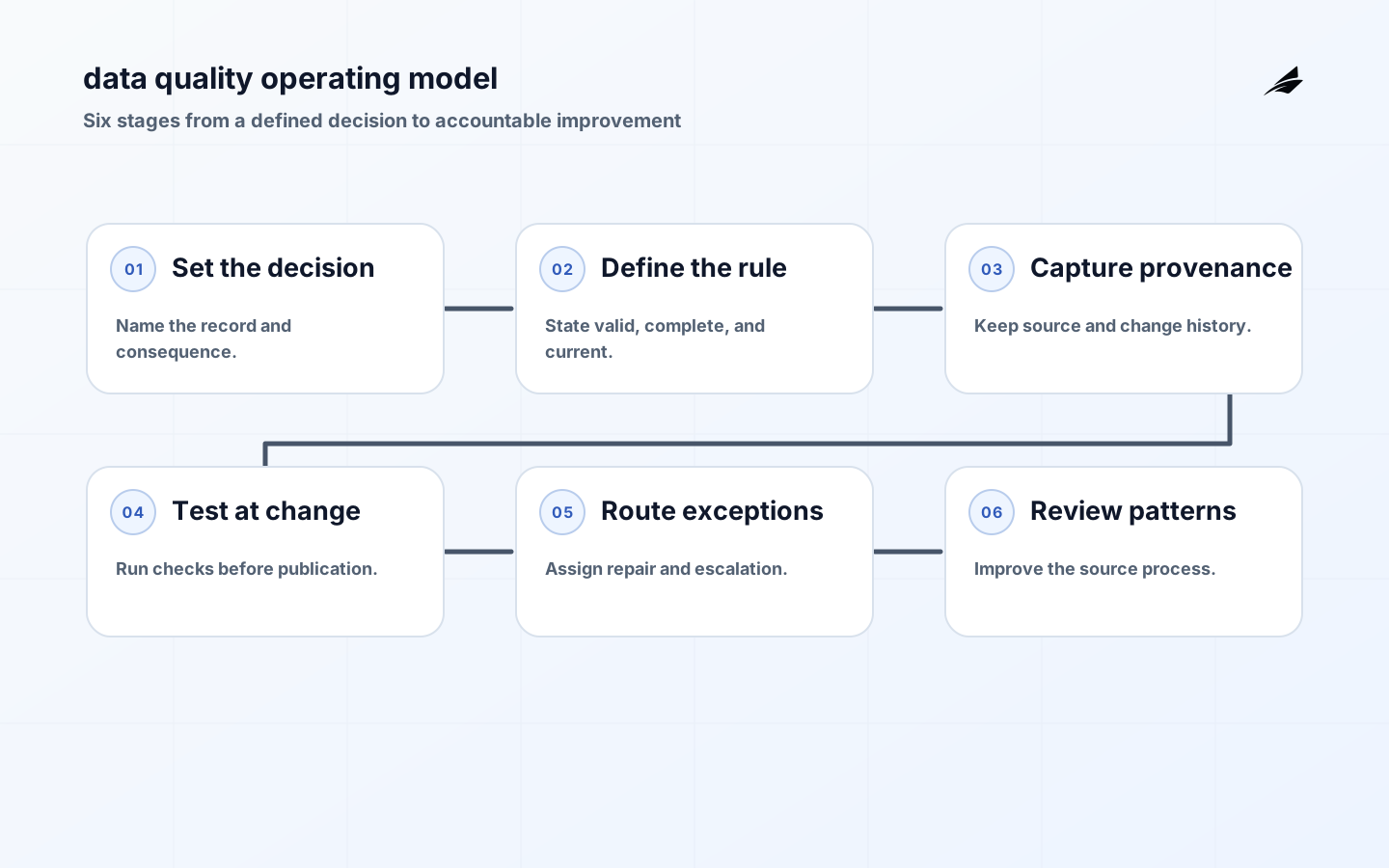
Data Quality Checklist for Reliable Digital Operations is useful when it helps operations leaders decide whether a record is fit for a named operational decision. The first question is not which dashboard, pipeline, or platform to buy. It is whether the team can state the decision, the person accountable for it, the evidence that may influence it, and the safe response when that evidence is incomplete. Data Quality is therefore an operating practice: it joins a business question to records, controls, and follow-up work. The UK Government Data Quality Framework makes the practical point that quality has to be managed in context, not declared once at ingestion. Useful adjacent reading includes event analytics checklist for reliable digital operations, customer analytics checklist for reliable digital operations, the plain-language guide to dbt models.
Start with the data quality decision
Write the decision as a sentence that can be tested: “Can this team use this evidence to decide whether a record is fit for a named operational decision?” For data quality, the expected outcome is a trusted customer, supplier, or operational record at the moment a team must act. That wording rules out a vague project charter and forces useful choices about users, timing, authority, and consequence. Identify which cases are ordinary, which require a human review, and which should be stopped. A good boundary also prevents a later metric from being mistaken for an instruction. The W3C PROV data model is valuable here because it distinguishes entities, activities, and agents: a report should not hide which process and responsible role shaped it.
| Decision element | Question to settle | Evidence to retain |
|---|---|---|
| Decision owner | Who may act on data quality evidence? | Named role, review cadence, and escalation route. |
| Outcome boundary | What counts as a useful data quality result? | Acceptance criteria and excluded cases. |
| Authority | Which source or approval resolves a conflict? | Source hierarchy and effective date. |
| Failure response | What happens when evidence is late, disputed, or unavailable? | User message, queue owner, and manual path. |
Make the evidence contract explicit
The evidence contract for data quality should name the business definition, source system, owner, allowed values, completeness rule, freshness expectation, and remediation path. Keep this information close to the dataset, event, metric, or report rather than distributing it across tickets and personal memory. A person reviewing an unexpected value needs enough context to tell whether the defect began in collection, transformation, definition, access, or presentation. Data Quality becomes reliable when its records can answer “what is this?”, “who owns it?”, “when was it valid?”, and “what changed?” without reconstructing the story from several systems. Data Catalog Vocabulary version 3 provides a useful standards-based lens for describing assets and their context; use it to support an operational register, not just a catalog that no one consults.
- Give every critical data quality asset a business owner and a technical contact.
- State the authoritative source before creating a derived view or convenience copy.
- Record the time basis: event time, reporting period, refresh time, or effective date as appropriate.
- Version definitions and schemas so reviewers can explain a change in behavior.
- Keep access classification and permitted use beside the asset metadata.
- Define a repair path that preserves the original evidence and the reason for correction.
Design for inspection and change
Profile data at entry, preserve the source identifier through transformations, publish tests beside models, and send failed records to an owned queue rather than silently coercing them. The important design test is whether a maintainer can answer the impact question before making a change: which decisions, reports, consumers, or controls depend on this asset? Build with stable identifiers and observable handoffs. Avoid letting a presentation layer silently define business meaning; that logic belongs where it can be reviewed, tested, and reused. PROV data model supports a useful discipline: preserve the relationships between the input, the activity that changed it, and the published output. That relationship is what turns a plausible number into an inspectable one.
| Layer | Responsibility | Practical verification |
|---|---|---|
| Source and intake | Capture the record and its original context. | Compare a sample with the system of record and inspect rejected inputs. |
| Transformation | Apply documented rules and preserve identifiers. | Replay a known case and confirm the expected output and lineage. |
| Publication | Expose approved information to the intended audience. | Check freshness, access, definition, and visible limitations. |
| Operation | Detect change, assign response, and learn from exceptions. | Trace one normal case and one failed case from source to resolution. |
Put controls where consequences occur
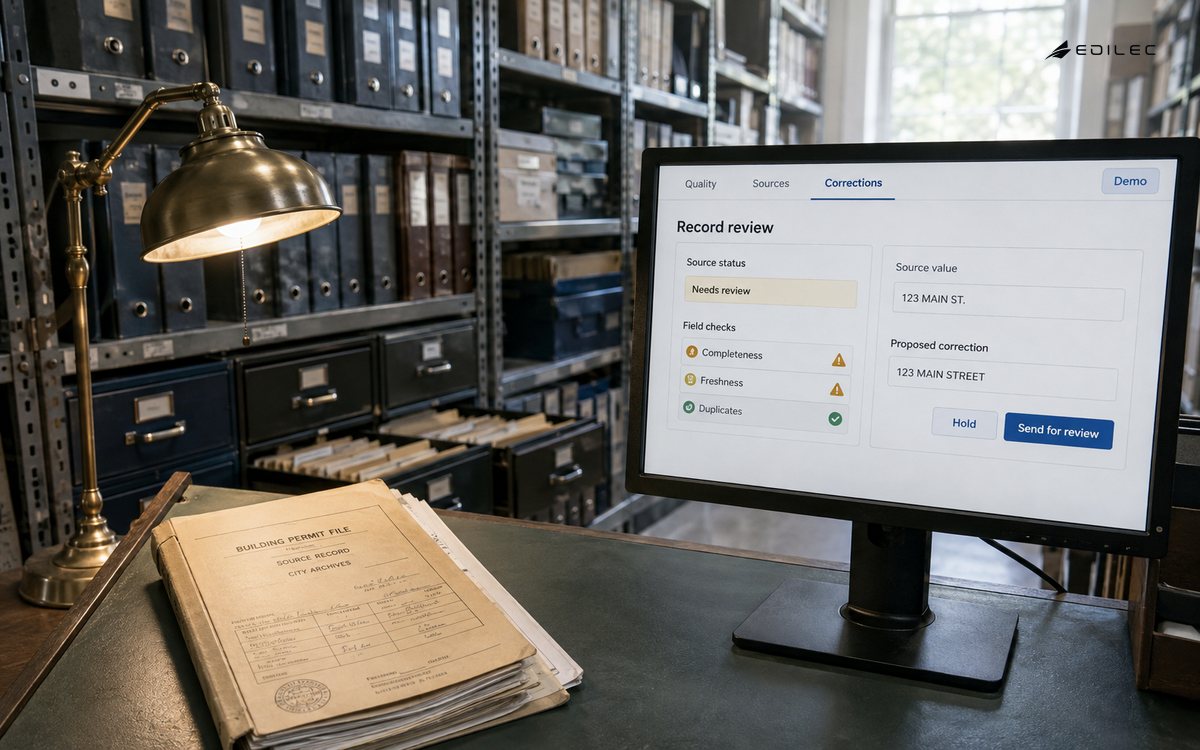
Controls for data quality belong at the moments where a wrong or unauthorized result can change work. Make a rejected or quarantined record observable; a correction without provenance can improve a screen while making later reconciliation harder. Apply deterministic checks to identities, schema shape, permitted destinations, thresholds, and approval state. Keep exceptions visible: suppressing them may produce a cleaner trend while allowing the underlying process to decay. The final control is a usable recovery route. Operators should know who can pause publication, who investigates the source, and how a user completes the task while the normal path is unavailable. OpenTelemetry specification is a useful reference for treating instrumentation and operational evidence as part of the system rather than a post-release add-on.
Measure data quality as operational quality
Measure data quality with a small set of signals that can change a decision. Useful measures include rule pass rate by critical field, freshness against the stated service target, duplicate rate, exception age, and the share of decisions delayed for data repair. Do not collapse these into one score too early: a fast system can publish the wrong period, and a complete dataset can still be unusable if the owner cannot explain its definition. Establish a baseline from real historical cases, retain examples of both ordinary and uncomfortable conditions, and review disagreements with the process owner. Measure the quality of the recovery path as carefully as the happy path. A release comparison should identify what changed in the source, configuration, definition, or workflow before it claims improvement.
- Use a documented baseline rather than an anecdotal “before” state.
- Segment measures by source, user group, or workflow when aggregation would conceal a failure.
- Track the age and disposition of exceptions, not only their count.
- Sample results with the people who rely on the decision, including cases that appear successful.
- Treat unexplained movement as an investigation prompt, not as proof of improvement.
Release in a reversible sequence
Begin with one high-consequence dataset and one decision, then compare the new checks with the existing manual reconciliation. Run the new path beside the established process long enough to compare outcomes, not just technical completion. Decide beforehand which evidence lets the team expand, hold, or roll back. A release should include access review, a support contact, a visible limitation, and a way to preserve cases completed during an incident. Narrow scope is useful because it limits the consequence of an incorrect assumption while producing concrete evidence about users, data, and controls. Broaden the boundary only after the team can explain the observed failures and their remedies.
Keep the practice alive after launch
After launch, review repeated exceptions with the source owner, distinguish process errors from integration defects, and version rule changes with their rationale. A short operating review works best when it combines system signals with examples from actual decisions. Ask whether the current owner, definition, source, and threshold still match the work. Record material changes and their approval so a future reviewer can distinguish normal evolution from an unexplained break. This keeps data quality from becoming a static artifact: the workflow remains understandable even when source systems, roles, and business priorities change.
Key takeaways
- Data Quality should begin with a named decision and accountable owner.
- An evidence contract makes definitions, time, provenance, and permitted use reviewable.
- Place validation and access controls before an incorrect result can influence work.
- Use several operating signals so speed, completeness, and trust are not confused.
- Expand only when a bounded release has shown useful outcomes and controlled recovery.
Data Quality FAQ
What is the smallest useful first scope? Choose one decision with a known owner, a defined user group, a manageable source boundary, and a manual fallback. The goal is not to prove that data quality can cover every use case; it is to learn whether the evidence and controls support one consequential piece of work.
How often should definitions and controls be reviewed? Review data-quality rules after a critical source changes, a persistent exception emerges, a field gains a new operational use, or the accountable owner changes. Scheduled sampling catches gradual drift; a post-incident review catches the specific assumption that failed.
Which problem deserves attention first? Prioritize a data-quality failure that can misstate a critical record, delay a safety or service decision, or conceal the original value. A formatting inconsistency can wait when ownership, validity, freshness, or correction provenance is in doubt.
Conclusion
Data Quality is dependable when it gives a team more than a number or a record. It gives them a bounded decision, inspectable evidence, controls at the point of consequence, measures that reveal failure, and a recovery path with a real owner. Keep asking the central question: can this system support whether a record is fit for a named operational decision without hiding its source, meaning, time basis, or limitation? When the answer is supported by observed operation rather than optimistic presentation, the team has a credible foundation for expansion.