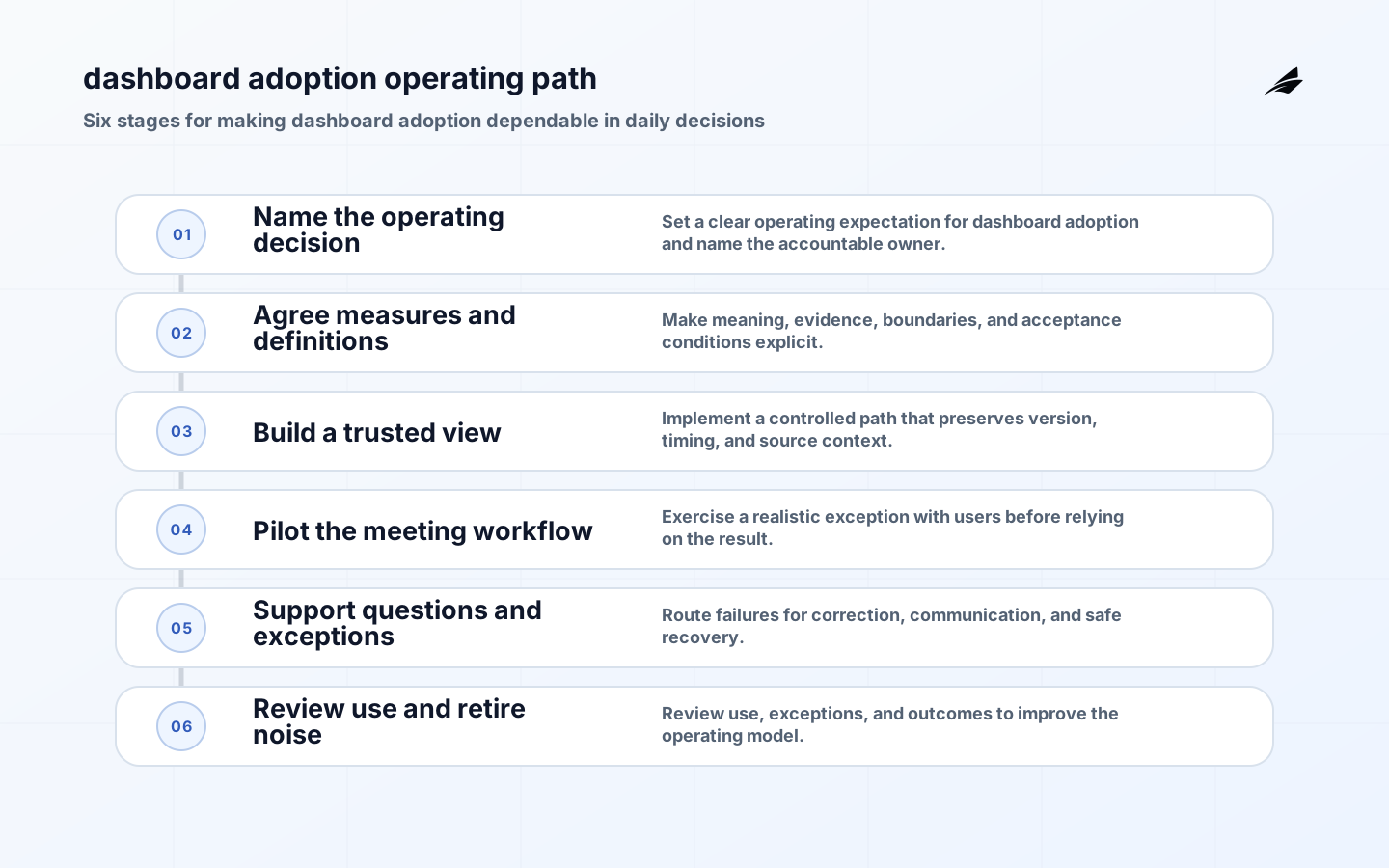
Dashboard adoption decisions before the first build
Dashboard adoption is not the act of installing a tool or publishing a technical asset. For IT managers, it is the discipline of making a particular decision dependable at a known moment, with evidence a colleague can inspect. The value is a weekly operating decision rather than a prettier status report. Start by writing down the decision, who takes it, what changes it, and what happens when available evidence is incomplete; dashboard review context remains explicit. A regional operations manager opens the service dashboard before a Monday allocation meeting. If the overdue-work tile is stale, the meeting should not silently use it; the page needs to show its reporting cutoff, data owner, and next action. That practical boundary keeps the work focused on behavior and consequences rather than a long inventory of features; dashboard review context remains explicit.
Name the first user outcome after the first production signal
Before committing a team, describe the recurring decision in one sentence: “At this cadence, this person decides this action using these measures.” Then collect real cases, including an uncomfortable exception; dashboard review context remains explicit. For dashboard adoption, the useful scope is often narrower than the requested platform: one planning meeting, operational handoff, or governed dataset. The deliverable is a decision brief naming the meeting, owner, measures, refresh promise, and threshold actions. A named owner must accept the definition, request a change, and decide whether an exception blocks the result or merely qualifies it; dashboard review context remains explicit. That makes accountability testable before implementation expands.
| Question | Decision to make | Evidence to keep |
|---|---|---|
| Who acts? | Name the accountable user and decision. | Decision statement and cadence. |
| What must be true? | Specify records, definitions, and uncertainty. | Examples, source IDs, acceptance criteria. |
| When does dashboard adoption create enough value to justify its operating cost? | Set a business freshness or response expectation. | Timestamp, cutoff policy, exception state. |
| Who responds? | Assign correction and communication ownership. | Escalation route and incident record. |
Set the operating promise and boundary before wider adoption
A useful definition prevents technology from becoming a vague cure for every reporting problem; dashboard review context remains explicit. Dashboard adoption should make one kind of evidence easier to produce, understand, reuse, or act on; it does not remove judgment about policy, incentives, or changing business conditions. The important work is semantic: what does an identifier represent, which time applies, which exclusions are intended, and which audience can see the result; dashboard review context remains explicit. Put those answers where a reviewer can find them. Ambiguity in Dashboard Adoption Decisions That Matter before the First Build is reduced by clarifying the decision, evidence, and owner rather than adding another surface.
The caution is concrete: a widely viewed page whose important metric is interpreted differently by finance and operations. Treat that as a design test. Ask a domain expert to walk through the example, then make expected handling executable where feasible and visible where automation would be unsafe; dashboard review context remains explicit. W3C PROV explains why provenance matters, while the W3C Data Quality Vocabulary frames quality characteristics in context; dashboard review context remains explicit. Both are useful anchors when a team must explain what it knows and why; dashboard review context remains explicit.
Design context a reviewer can verify

The architecture should make claims traceable. For this topic, that means a governed semantic model, certified measures, role-aware access, refresh state, and telemetry for report failures and use. Keep authoritative evidence separate from presentation, and retain the version, time, and owner behind consequential outputs; dashboard review context remains explicit. Design each boundary for a real operating question: can the team identify a missing input, distinguish delayed from absent data, understand a change's blast radius, and recover without inventing a second source of truth; dashboard review context remains explicit. A simple path that is observable and recoverable is more valuable than an elaborate design that only works in the happy case; dashboard review context remains explicit.
| Layer | Responsibility | Failure signal |
|---|---|---|
| Evidence | Preserve source identity, time, and relevant context. | Missing keys, unusual volume, unavailable source. |
| Controlled logic | Apply approved rules with versioned change history. | Test failure, reconciliation gap, incompatible change. |
| Published result | Expose scope, freshness, limitations, and definition route. | Stale output, unexplained shift, access mismatch. |
| Operations | Monitor, communicate, repair, and learn. | Unowned alert, repeated workaround, slow recovery. |
Release the smallest useful view
A first release should prove the decision path, not standardize every adjacent workflow; dashboard review context remains explicit. Build from representative data and real users; include the unhappy path before calling work complete; dashboard review context remains explicit. Exercise an input delay, a definition change, a permission problem, and unexpected volume; dashboard review context remains explicit. Review the result with the decision owner, not only implementers. For dashboard adoption, release criteria include a working explanation, a support owner, and evidence that the result can be checked against a known case. This is how capability becomes repeatable rather than dependent on one expert; dashboard review context remains explicit.
- Write the minimum contract and decision statement for dashboard adoption before building broad surfaces.
- Choose one owner for meaning and one technical owner for operation.
- Show freshness, version, or exception state wherever a user may act.
- Reconcile known cases with people closest to the source process.
- Rehearse correction, rollback, or replay before the first important cycle.
Review dashboard adoption by the decisions it changes
After launch, measure effective use: viewers can locate the definition, identify the reporting period, and explain the action they took. These are not universal targets; their purpose is to make trade-offs discussable and surface whether the service remains fit for its decision; dashboard review context remains explicit. Review recent examples on a cadence: a normal run, an exception, a change request, and a user question; dashboard review context remains explicit. Record what was learned, who owns the next action, and whether the definition, control, or training needs revision; dashboard review context remains explicit. This closes the loop between what the team designed and how work actually happens, without pretending a successful deployment ends operational responsibility; dashboard review context remains explicit.
In a dashboard adoption review, compare the meeting decision with the dashboard state. Ask which tile changed the decision, which tile was ignored, and whether a user left the page to find a number elsewhere. That conversation reveals whether the design is earning trust. It also distinguishes a necessary drill-through from a missing definition. Remove low-value views deliberately; a smaller set of reliable decision pages is easier to support and keeps attention on the few measures that really guide work.
A mature dashboard adoption practice should make routine change safer as well as make today’s result useful. Review the boundaries in the architecture when a source, owner, policy, or business question changes, and record which published outputs depend on the old assumption; dashboard review context remains explicit. The design risk remains: a widely viewed page whose important metric is interpreted differently by finance and operations. This gives the team a concrete scenario for release review, support training, and recovery rehearsal; dashboard review context remains explicit. Operational decisions become more dependable when people can see the limitation before it becomes an incident, rather than reconstructing intent from a result after it has already been used; dashboard review context remains explicit.
One practical test for dashboard adoption is decision reversibility. Before relying on a result, ask what evidence a reviewer would need to challenge it, correct it, or explain a different outcome tomorrow; dashboard review context remains explicit. Preserve that evidence with the output: the relevant period, scope, definition version, source state, and accountable owner; dashboard review context remains explicit. Dashboard adoption does not need to make every decision automatic. It needs to make appropriate human judgment faster and better informed, especially when the facts are incomplete or an exception has material consequences; dashboard review context remains explicit.
Dashboard adoption takeaways for service teams
- Dashboard adoption succeeds when it supports a named decision and accountable user.
- Definitions, time boundaries, and exceptions are product behavior, not after-the-fact paperwork; dashboard review context remains explicit.
- The first build should preserve evidence and make recovery possible before it reaches every audience; dashboard review context remains explicit.
- Usage matters, but effective use means people can explain the result and act appropriately; dashboard review context remains explicit.
- Reviewing real failures is the quickest way to improve ownership, controls, and scope; dashboard review context remains explicit.
Use this article's decision boundary as an operating contract. Name the user or operator, trusted inputs, the owner who can act, the response window, and the safe state when evidence is late or wrong; dashboard review context remains explicit. Before widening scope, capture a baseline and test one normal path plus one credible exception; dashboard review context remains explicit. Record the version, approval, observed signal, and recovery result in the same review record; dashboard review context remains explicit. This makes a failure interpretable: the team can tell whether the rule, data, permission, or handoff caused the outcome; dashboard review context remains explicit. Keep controls close to the consequence, explanations close to the next decision, and the pilot small enough to reverse; dashboard review context remains explicit. At review, remove checks that create work without changing behaviour and add only the smallest next hypothesis; dashboard review context remains explicit. The result is a capability that can survive turnover, explain exceptions, and improve from production evidence rather than confidence alone; dashboard review context remains explicit. For dashboard adoption, prove value where a reader acts. Use the W3C accessibility guidelines for usable presentation and Snowflake's access-control overview to verify visibility.
Dashboard adoption FAQ for service teams
Do we need a large platform first for dashboard adoption? No. Begin with the smallest decision needing dependable evidence and make its path observable; dashboard review context remains explicit. Who owns it? The business owner protects decision meaning, while the technical owner maintains the governed data path. How do we know it is ready? Use named meeting scenarios, expose freshness and limitations, assign support, and observe a real decision. What should change first after launch? Resolve unclear definitions, unmanaged exceptions, and missing evidence before publishing another view.
Conclusion
Dashboard adoption is worth building when it makes an important decision more explainable, timely, and recoverable. Keep the first commitment concrete: one decision, one owner, constrained evidence, and a review loop containing real exceptions. related data guide, related data guide, related data guide provide adjacent data practices that strengthen this work. For technical grounding, consult Microsoft Fabric adoption roadmap, Power BI solution planning, W3C Data Quality Vocabulary, W3C PROV data model. These authoritative references do not replace local judgment, but they help teams make definitions, lineage, controls, and operating responsibilities explicit; dashboard review context remains explicit.
For Dashboard Adoption Decisions That Matter before the First Build, the durable implementation is a sequence of bounded decisions. State the operating context, identify the evidence that can change the decision, name the owner who can act, and record the condition that triggers review; dashboard review context remains explicit. This keeps the guidance useful after launch: a team can compare intended outcomes with observed behavior, explain exceptions without normalizing them, and choose the next smallest corrective action; dashboard review context remains explicit. For Dashboard Adoption Decisions That Matter before the First Build, the useful record preserves the evidence that lets the owner choose the next safe action.
A production decision about dashboard adoption should be tested against a concrete operating scenario, not only a design diagram; dashboard review context remains explicit. Use the article's concern—Dashboard Adoption Decisions That Matter before the First Build; Start with the decision and the user; Define what dashboard adoption does and does not promise; Architecture for accountable dashboard adoption—to name the input, the responsible owner, the expected signal, and the point at which the team stops or reverses the change. Evidence should include both the normal path and the first credible exception: late data, an unavailable dependency, an unexpected permission, a changed schema, a noisy alert, or a customer-visible delay; dashboard review context remains explicit. Record the observed condition and the decision made so a later reviewer can tell whether the control worked or merely appeared to work; dashboard review context remains explicit. The dashboard record should stay tied to the adoption workflow and its reader-specific acceptance evidence.
The W3C Data Quality Vocabulary gives this dashboard review a precise language for dimensions and observations; use the W3C Data Quality Vocabulary when documenting what the view can and cannot claim.