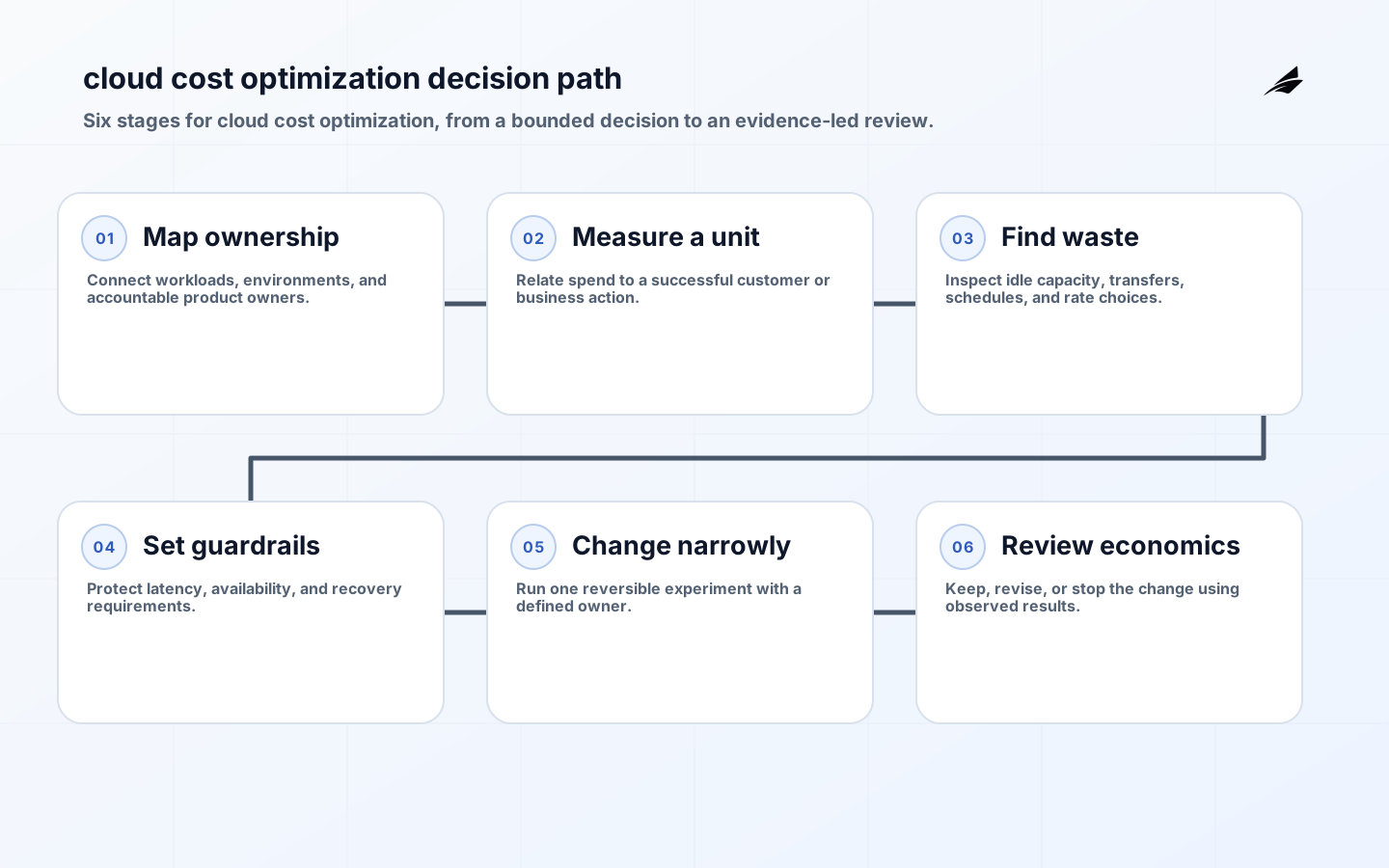
How Product Teams Should Think About Cloud Cost Optimization is not a tooling decision in disguise. For product teams, cloud cost optimization is a way to make a concrete operating choice: which customer-facing capability is worth funding at its current usage and reliability level. The useful starting point is a narrow boundary, a named owner, and evidence that another person can inspect. AWS Well-Architected Cost Optimization Pillar and FinOps Framework provide the technical framing; this article translates that framing into decisions a team can make during planning, release review, and incident follow-up. A mature practice does not eliminate uncertainty. It makes assumptions visible, limits the consequence of a wrong assumption, and leaves an understandable record of why the next action was taken.
Key takeaways
- Treat cloud cost optimization as a product cost model, not as a one-time configuration exercise.
- Set the boundary around allocation, demand shape, unit cost, capacity and commercial commitments before selecting a product or automation.
- Keep evidence that covers tag coverage, cost per successful customer action, utilization, latency and error-rate trends; a claim without context is hard to operate.
- Choose a small reversible first change and make the stop rule explicit before acting.
- Pair technical health with a user or business outcome, because neither alone explains the decision.
- Give exceptions an owner, an expiry, and a review rather than allowing silent workarounds.
- Use post-change evidence to decide whether to extend, revise, or retire the approach.
Set the cloud cost optimization decision boundary
A useful boundary says what is included, who can act, and what result matters. For cloud cost optimization, include allocation, demand shape, unit cost, capacity and commercial commitments. Do not write a boundary as a slogan such as “improve reliability” or “reduce risk.” Instead, name the workflow, affected environment, accountable role, dependencies, and the decision that can be reversed. Tag coverage, cost per successful customer action, utilization, latency and error-rate trends are examples of evidence worth retaining. Distinguish facts from interpretations: an alert, an invoice line, or a deployment marker may indicate a change, while a correlated trace or tested recovery may establish what happened. This level of precision prevents a local improvement from becoming an unowned system-wide intervention.
| Decision area | Question to settle | Evidence to retain |
|---|---|---|
| Outcome | Which customer or operational outcome does cloud cost optimization protect? | A measurable journey, baseline, and accountable owner. |
| Scope | Which services, environments, and dependencies are included? | A written boundary covering allocation, demand shape, unit cost, capacity and commercial commitments. |
| Authority | Who may proceed, pause, or accept an exception? | Named roles, escalation route, and decision timestamp. |
| Verification | What observation makes the change acceptable? | tag coverage, cost per successful customer action, utilization, latency and error-rate trends. |
Cloud cost optimization architecture and controls
Architecture choices should follow the boundary rather than precede it. In this case, separate shared-platform charges from workload charges; then connect each workload to a measurable product unit such as an order, active account, file processed, or API request. That design has consequences for ownership: identify the control point, its failure mode, and the person who can safely change it. Prefer explicit interfaces and versioned records over assumptions held in meetings or tickets. A control is useful only when it can be exercised under ordinary operating pressure. Google Cloud cost optimization framework is a helpful reference for adapting technical mechanisms to the consequence of the workload. The goal is proportionate control: enough structure to detect and recover from harm, without creating a process that people bypass because it cannot support normal delivery.
| Control | Purpose | Practical test |
|---|---|---|
| Clear ownership | Avoid decisions that are technically possible but operationally orphaned. | A responder can identify the decision maker without searching chat history. |
| Observable state | Connect action to an outcome rather than relying on confidence. | The team can inspect tag coverage, cost per successful customer action, utilization, latency and error-rate trends. |
| Reversible action | Limit the cost of a mistaken assumption. | The recovery procedure is documented and has been exercised. |
| Time-bound exception | Allow justified deviation without normalizing it. | The exception has an owner, expiry, and follow-up review. |
Implement cloud cost optimization in a bounded sequence
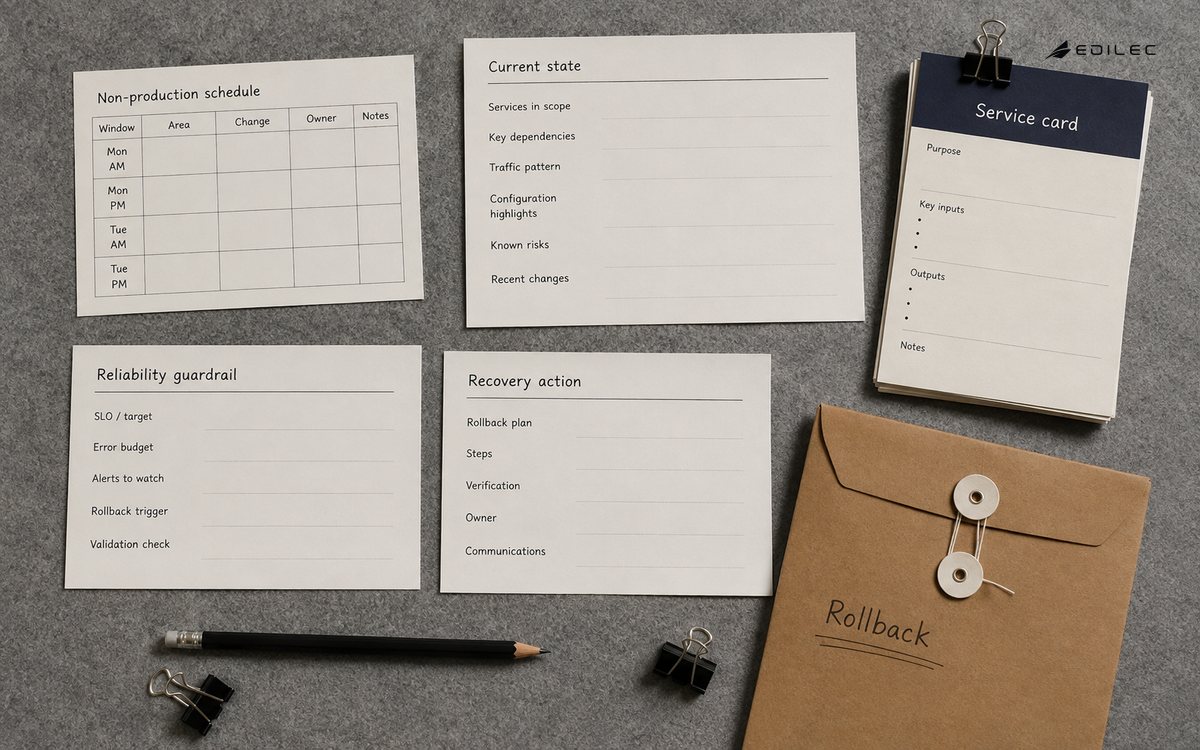
Begin with the smallest path that can prove or disprove an important assumption. For cloud cost optimization, begin with non-production schedules, unattached storage, oversized steady services, data-transfer paths, and autoscaling floors before considering reservations or architectural changes. Capture the pre-change state, expected benefit, guardrail, decision owner, and recovery action before changing production behavior. Keep automation narrow until the signals are trustworthy; a human checkpoint is appropriate when the consequence is high or the evidence is ambiguous. Use a repeatable release or change record, but do not mistake the record for the control itself. The record should let an operator reconstruct what was changed, which input was trusted, and why the team continued or stopped. That makes the next iteration faster and less dependent on memory.
Operating signals for cloud cost optimization
Review allocated-spend coverage, cost per successful action, idle-resource age, request volume, p95 latency and error budget consumption together, with a concrete case in front of the people who own the work. A single metric is usually too easy to optimize at someone else’s expense. Pair a leading signal, such as a denied policy action or a routing anomaly, with an outcome signal such as journey completion, delay, or customer support demand. Choose an observation window that matches the mechanism: a request path can show harm within minutes, while retention, rotation, or a commercial commitment may require days or weeks. The review should answer three questions: what changed, which signal moved, and whether the existing decision rule still fits the observed system.
Failure modes that weaken cloud cost optimization
The dangerous failure is often a plausible-looking result without enough context to challenge it. For cloud cost optimization, common examples include treating a temporary usage dip as a commitment signal, deleting resources without proving their dependency path, and celebrating lower spend while customer latency or support work rises. Counter these risks by preserving identifiers, decision records, and the source of important inputs. Treat exceptions as operational data. A temporary bypass may be correct during an incident, but it needs a named authority and a point at which normal safeguards are restored. When the same exception returns, investigate the interface, documentation, alert, or capability that made the workaround attractive. Repeated exceptions are design feedback, not proof that the team needs more informal heroics.
A worked cloud cost optimization example
A document-processing feature has high weekday traffic and nearly no weekend use. The team first labels its queue, workers and storage; measures completed documents rather than requests; and schedules its test workers. It leaves the production minimum untouched until it can show that queue age and completion time remain within the agreed range. The useful outcome is not merely a smaller invoice: the product owner can explain what changed, why it is reversible, and which service signals would cancel the experiment.
Ownership, review, and escalation
The owner of cloud cost optimization does not need to perform every technical action. They are accountable for the decision record: why the boundary exists, which evidence is authoritative, who may change the control, and how recovery or exceptions work. Engineers should keep the implementation and observability usable; operations should make the path executable under pressure; security, finance, or product leaders should participate when the consequence crosses their boundary. A short review cadence is enough when it uses real evidence. Escalate when the stop rule is crossed, a dependency invalidates the assumption, or the team cannot explain the current state from the record alone.
An adoption sequence for cloud cost optimization
Start cloud cost optimization with one representative path and one accountable person who can decide whether it is ready to expand. Capture the baseline, assumption, guardrail, and recovery action. Run the change at limited scope, inspect both technical and user-facing evidence, and make one precise improvement before widening adoption. This deliberately modest sequence reveals unclear dependencies and authority while the consequence is small. It also produces a real operating record that new team members can follow. Azure Well-Architected cost optimization offers further technical detail; use it to deepen a decision that your evidence has already made relevant, not to substitute a generic checklist for local understanding.
Frequently asked questions
Does cloud cost optimization require a new platform? Not necessarily. Start with the evidence, interface, and control that the first bounded path needs; an existing pipeline, policy engine, secret store, dashboard, or runbook may be sufficient. When should the practice expand? Expand only when the initial path protects the intended outcome, exceptions are owned, and recovery has been exercised. How often should it be reviewed? Match the review to the rate of change and consequence, then revisit the cadence when the evidence shows it is too slow or too noisy. The aim is a durable operating decision, not ceremonial compliance.
Conclusion
Cloud cost optimization becomes dependable when it converts a recurring technical choice into a visible routine: define the boundary, apply proportionate controls, observe the outcome, recover deliberately, and improve from real exceptions. For product teams, the next step is one owned path with a measurable result. Let evidence, rather than enthusiasm for a tool or pattern, decide what scales.