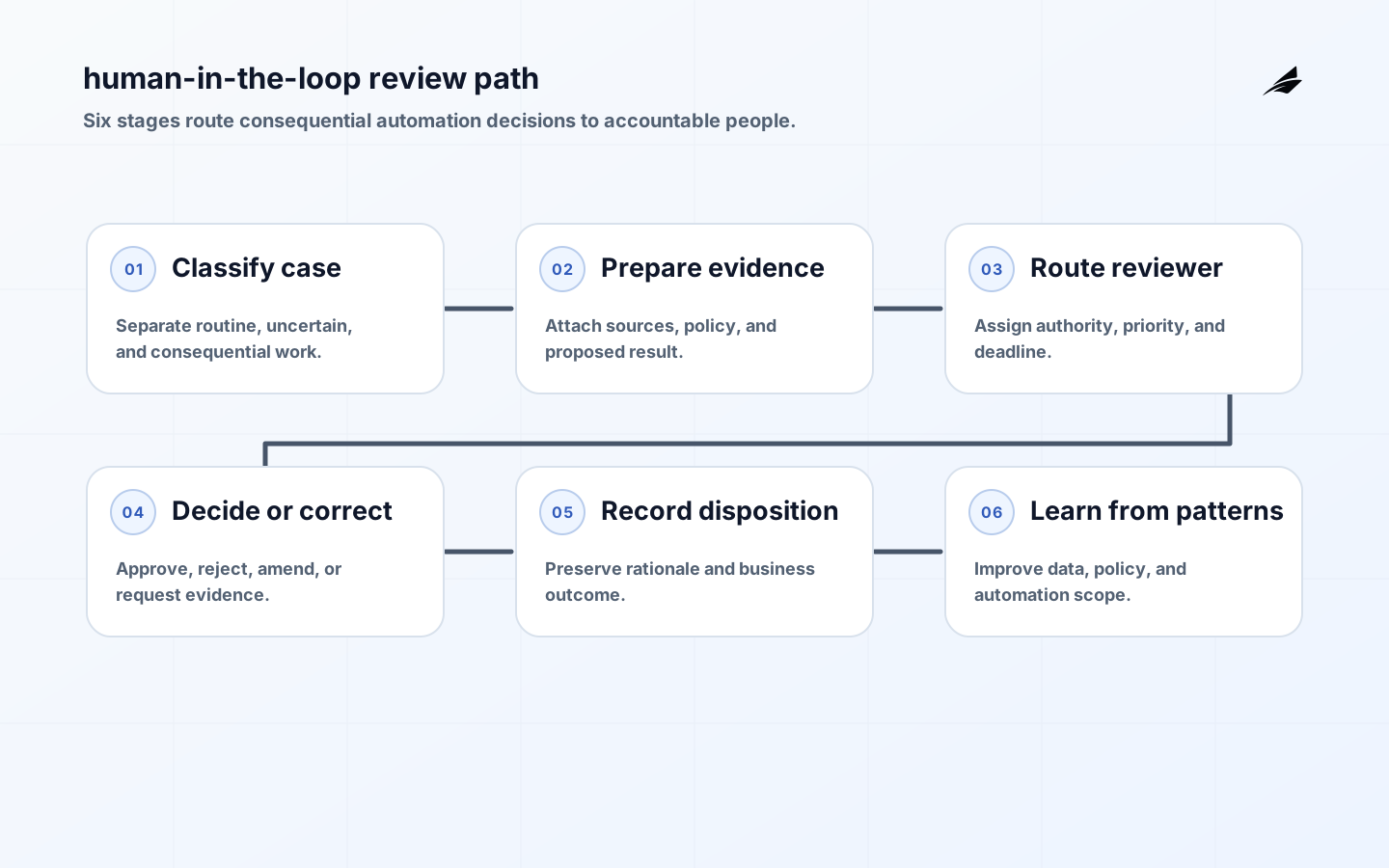
Human-in-the-loop automation is not a ceremonial approval button placed at the end of an AI workflow. It is a designed handoff in which a person receives the context, authority, and time needed to make a better decision than the system should make alone. The useful pattern is selective review: automate preparation and routine handling, then route uncertainty, exceptions, or consequential choices to the right role. A review queue that contains no evidence, no priority, and no clear action merely converts model uncertainty into operational delay. This guide focuses on the review design that makes automation more accountable. AI workflow approvals provides related guidance on permission and decision routing.
Choose the human decision boundary
Begin by separating assistance from authority. An AI system can extract fields from an invoice, summarize a case history, or propose a routing decision; a finance lead may still need to approve an unusual supplier, a high-value payment, or a policy exception. Define the outcome that automation can complete, the conditions that demand review, the reviewer role, and the maximum delay the work can tolerate. The NIST AI Risk Management Framework encourages organizations to govern and measure risks in context. That makes review thresholds a business and operating decision, not a generic confidence score.

| Case type | System role | Human role |
|---|---|---|
| Routine, low consequence | Prepare and complete within policy. | Sample for quality. |
| Missing evidence | Identify the gap and pause. | Request or select additional evidence. |
| Policy exception | Prepare a recommendation. | Approve, reject, or delegate. |
| High consequence | Summarize and route only. | Make the accountable decision. |
Give reviewers the context to decide
A useful review item explains why it arrived, what evidence the system used, what policy or threshold applied, which alternatives were considered, and what will happen after approval. Show source references and freshness rather than a bare confidence score. Let reviewers correct structured fields, choose a reason for rejection, request more information, or return the case to a known manual route. Avoid asking them to reconstruct the original request in a separate system. The human-AI interaction guidance from Microsoft Research is a useful reminder that expectation-setting, feedback, and graceful failure are parts of the interaction, not optional extras.
- Show the source record, policy version, and reason the case was routed.
- Use priority based on consequence and service deadline, not model confidence alone.
- Make correction fields structured enough to support analysis and reprocessing.
- Preserve the final human disposition as evidence for the affected business record.
Route cases by consequence and capacity
Design routing rules around the cost of a wrong decision and the availability of reviewers. A low-value, complete request may flow through automatically while a novel customer commitment waits for a trained owner. Queue health matters: a review path that exceeds its service window needs escalation or a controlled fallback, not a growing list of silent work. Use load balancing only when reviewers have comparable authority and training. For cross-functional exceptions, assign one accountable decision maker and make consultation visible rather than sending the case to a vague shared inbox.
| Signal | Routing rule | Recovery action |
|---|---|---|
| Incomplete source record | Send to data owner. | Hold outcome until evidence arrives. |
| Threshold exceeded | Send to authorized approver. | Escalate after service deadline. |
| Reviewer disagreement | Route to policy owner. | Record rationale and precedent. |
| Queue overload | Pause intake or reduce automation scope. | Use documented manual fallback. |
Learn from overrides without training blindly
Reviewer decisions are valuable feedback, but they are not automatically ground truth. A rejection may reveal a bad proposal, an unclear policy, missing context, or reviewer inconsistency. Store the input version, proposal, evidence, reviewer role, correction, reason, and final outcome. Review patterns with the process owner before using them to tune a model or modify an automated rule. Track override rate by case type, reviewer agreement, queue age, reopened cases, and downstream error rate. Those measures show whether automation is reducing cognitive work or simply moving it to a later stage.
- Audit a sample of approved and rejected cases for policy consistency.
- Separate data-quality defects from model-quality defects and training needs.
- Re-test changes against historical exceptions before increasing automatic completion.
- Let reviewers flag a harmful pattern even when they can resolve an individual case.
Introduce review in controlled increments
Pilot human-in-the-loop automation with one workflow where manual outcomes and deadlines are already understood. Shadow the process first: let the system propose, compare it with the existing decision, and study where evidence or routing fails. Then allow limited automation for the safest category while retaining a clear manual path. The NCSC secure AI guidance supports planning maintenance and monitoring early. Expand only when reviewers can maintain their service level and the measured outcome is at least as reliable as the previous process.
Design review for speed and accountability
The quality of the review screen changes the quality of the decision. Put the recommended disposition, the primary evidence, the policy rule, and the available actions in one place. Make the most important difference from the normal path visible: an unusual amount, a conflicting source, a missing document, or a new customer condition. Use plain-language labels for what approval will do and who receives the result. A reviewer should not have to open five systems to learn whether they are authorized to approve the case. At the same time, avoid collapsing evidence into a single unexplained score. The person needs enough source detail to catch a confident but incomplete proposal, especially when a workflow has a long tail of rare, costly exceptions.
Plan for reviewer absence, disagreement, and fatigue. Define delegated authority, escalation windows, and a safe disposition when no qualified reviewer is available. For recurring disagreement, record the policy question separately from the individual case so the team can clarify guidance rather than repeatedly litigating the same edge case. Sample time-to-decision alongside error measures: a fast queue can be unhealthy if reviewers are approving without reading evidence, while a slow queue may indicate that automated preparation is insufficient. Train reviewers on the limits of the system and show them how to report a bad pattern. Human-in-the-loop automation earns trust when the human role is respected as an operational function with capacity, expertise, and feedback, not treated as an invisible safety net.
Human-in-the-loop implementation checklist
- Define the consequence, uncertainty, and policy conditions that route a case to human review.
- Name the reviewer role, delegated authority, service deadline, and escalation owner for each route.
- Show the original request, relevant evidence, policy rule, and proposed outcome in the review view.
- Make approval, rejection, correction, delegation, and request-for-information distinct documented dispositions.
- Prioritize queues by consequence and deadline rather than model confidence alone.
- Preserve reviewer changes and rationale beside the resulting business record and workflow state.
- Test how the queue behaves when evidence is missing, a reviewer is unavailable, or reviewers disagree.
- Measure queue age, rework, agreement, override, downstream error, and manual fallback rates.
- Separate model errors, source defects, policy ambiguity, and reviewer training gaps during analysis.
- Provide reviewers with a direct way to report a dangerous recurring pattern, not only an individual error.
- Pilot in shadow mode against an understood manual process before allowing any automatic completion.
- Set limits that reduce intake or escalate capacity before overdue reviews become normal work.
- Audit a sample of approved cases as well as rejected cases for consistency and hidden harm.
- Version routing rules and review instructions when policy, source data, or process ownership changes.
- Practice handoff to a known manual path so automation failure does not strand an accountable case.
Before production, rehearse one full review cycle with realistic evidence and a real deadline. Ask a reviewer to approve, correct, reject, and escalate different cases, then observe what the next system and the case owner receive. This exercise often exposes small but consequential gaps: a correction that is not carried forward, a queue without a backup owner, a rejection that leaves the requester uninformed, or a policy reference that cannot be opened. Capture these findings as workflow requirements, not training notes for the reviewer. The automation is ready to assist only when the human decision can be completed, explained, and recovered within the service window.
Review metrics should be visible to the people who set automation scope. They reveal when a seemingly efficient release is consuming unmeasured expert attention or creating a new exception backlog.
Key takeaways
- Route humans to uncertainty and consequence, not every automated output.
- Give each reviewer evidence, authority, priority, and clear dispositions.
- Measure queue health and override patterns alongside model quality.
- Use feedback to improve policy, data, and workflow before changing automation authority.
Human-in-the-loop automation FAQ
When should a person review every case? Use universal review when the action is highly consequential, regulations require it, or the workflow has not yet earned evidence for partial automation. Even then, automate evidence preparation and record keeping where useful.
Is confidence a sufficient routing signal? No. Confidence may be poorly calibrated and says little about business consequence, source completeness, or policy exceptions. Combine it with explicit rules and observed outcome data.
How do reviewers avoid becoming a bottleneck? Keep the initial scope narrow, prioritize by deadline and consequence, provide complete context, and monitor queue age. When capacity is insufficient, reduce the automated intake rather than normalizing overdue reviews.
Conclusion
Human-in-the-loop automation works when the human role is concrete. The system prepares, detects uncertainty, and preserves evidence; the accountable person decides, corrects, or escalates; the team learns from the result. That arrangement gives growing teams a path to greater automation without pretending that every consequential judgment can be delegated.