AI workflow approvals decisions should start with a work problem, not a platform demo. Consider an expense team assembling an approval packet for an employee reimbursement request. The team does not need a general AI promise; it needs a bounded way to use evidence, preserve accountability, and recover when the system is uncertain. AI workflow approvals place an accountable human decision between an AI-generated recommendation and a consequential action. A real approval includes defined authority, sufficient evidence, a recorded choice, and a route for exceptions. This guide focuses on the choices that make a first build useful to product teams: scope, records, independent controls, release evidence, and ownership. The production guide is useful context for the operating changes that follow a successful first release.
Set the decision boundary for AI workflow approvals
Write one operating statement before selecting a vendor or model. The user is a named role working on an expense team assembling an approval packet for an employee reimbursement request. Permitted inputs are an expense claim, receipts, policy rules, employee identity, cost-center data, and delegated authority. The permitted result is a reviewable approval packet that can be approved, rejected, returned for information, or escalated. The excluded result is to auto-approve an exception, overwrite policy, or submit payment without an accountable decision. This is not paperwork for its own sake: it gives designers a testable answer to what the workflow may do, what a reviewer should see, and when it must stop. The NIST AI Risk Management Framework is helpful because its govern, map, measure, and manage functions keep risk connected to an operating context rather than treating a model as the entire system.

| Boundary question | Decision for this first build | Evidence to retain |
|---|---|---|
| User and purpose | A named role handling an expense team assembling an approval packet for an employee reimbursement request. | Role, process owner, and task description. |
| Authoritative inputs | an expense claim, receipts, policy rules, employee identity, cost-center data, and delegated authority | Record identifier, owner, version, and access decision. |
| Permitted output | a reviewable approval packet that can be approved, rejected, returned for information, or escalated | Result, evidence, configuration version, and reviewer disposition. |
| Prohibited outcome | auto-approve an exception, overwrite policy, or submit payment without an accountable decision | Blocked request, escalation route, and audit event. |
Design the AI workflow approvals workflow around evidence
The first architecture should be small enough to inspect end to end. Draw where a request begins, which component can see each record, where a claim or proposal is produced, and which service can cause a side effect. Distinguish authoritative records from convenience context. A busy reviewer should be able to verify a consequential statement without reconstructing the system from logs or relying on a fluent explanation. The AI governance guide is useful adjacent reading when the team needs to assign responsibility across business and engineering roles. For AI workflow approvals, make the evidence path explicit in the interface, not merely available to an administrator.
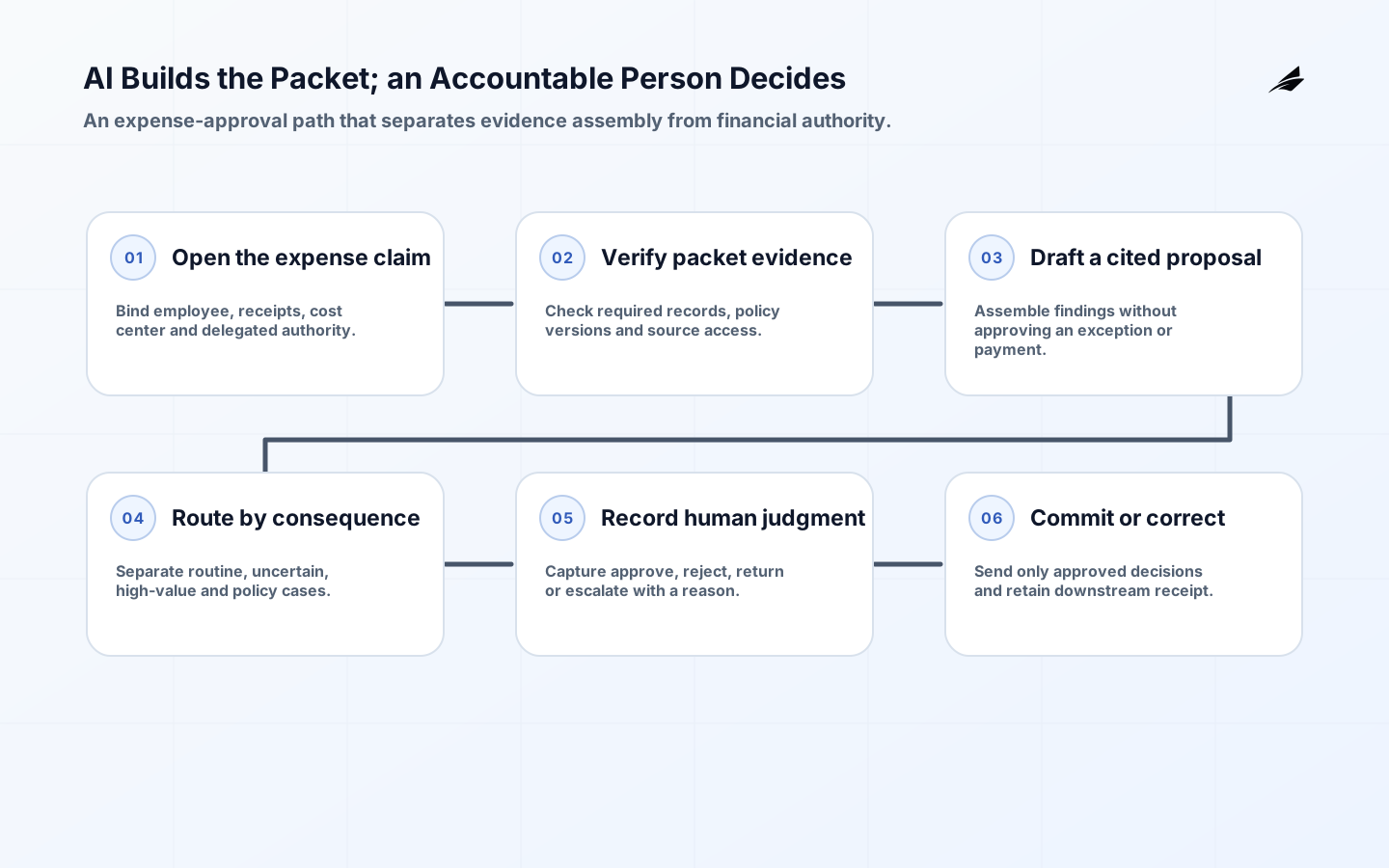
- Name the exact decision, delegation rule, and evidence required before recommendation.
- Route routine, uncertain, high-value, and exception cases through distinct paths.
- Record approve, reject, request information, and escalate with identity and reason.
- Send only an approved decision and reference to a downstream system.
Place controls where AI workflow approvals can fail
The key risk is concrete: a superficial confirmation can make automation look governed while a reviewer lacks evidence, authority, or time. Do not expect an instruction alone to contain it. Separate the component that proposes language or an action from the controls that enforce identity, access, schemas, business rules, and rate limits. Treat documents, tickets, retrieved text, and integration responses as data rather than authority. OWASP identifies prompt injection, insecure output handling, sensitive-information disclosure, and excessive agency as material risks in LLM applications. An independent check at the application boundary, plus a visible escalation route, protects the work when the system cannot establish safety or sufficiency.
Release AI workflow approvals in observable increments
Begin with a path that has enough real volume to learn from but limited impact when it is wrong. Baseline the manual process, run representative historical cases, then release to a constrained audience or queue. Retain the configuration version, allowed inputs, result, evidence reference, reviewer choice, and correction. That record turns a vague complaint into an investigation: was the issue a source record, a workflow rule, a configuration change, or a misunderstood boundary? The UK National Cyber Security Centre's secure-AI guidance is a useful reminder that deployment and operation deserve the same design attention as development. For AI workflow approvals, define the trial cohort and the exact evidence that decides whether the next cohort is justified.
| Release stage | What to prove | Hold or expand decision |
|---|---|---|
| Offline review | Representative AI workflow approvals cases meet evidence and exclusion rules. | Hold when a material failure lacks a clear control or owner. |
| Limited live use | Real users can review results, find evidence, and close exceptions without workarounds. | Expand only when quality, support, and access thresholds are met. |
| Controlled rollout | Signals remain stable across relevant users, record conditions, and request types. | Pause when a material metric worsens or a new risk appears. |
| Routine operation | Owners can investigate, recover, and approve changes. | Reassess when scope, data, action authority, or architecture changes. |
Measure outcomes, not just activity
A useful measurement plan asks whether the workflow helped the intended role and remained within its boundary. For AI workflow approvals, inspect override rate, exception-routing accuracy, reviewer time with evidence, late correction rate, and missing records. Report results by meaningful slices such as user role, record type, request complexity, language, or policy path. A single average can hide the cases that need review. Pair quantitative signals with sampled evidence review: the question is not only whether a response arrived quickly, but whether an authorized person could understand its basis and act appropriately. The Security and Privacy Controls for Information Systems and Organizations provides primary technical context for this design.
For AI workflow approvals, look for approval friction that signals missing evidence rather than simply trying to reduce reviewer time. Repeated requests for the same receipt, policy interpretation, or manager confirmation indicate that the packet is incomplete or routed too early. Track which fields reviewers correct and whether overrides cluster around a threshold or document type. The answer may be a better evidence collector, a different route, or a policy clarification, not a broader automation permission. Approval quality is preserved when the system helps the reviewer make a real decision quickly.
Make operating ownership explicit
Before broad launch, assign a business process owner, product owner, platform owner, data or knowledge owner, and security reviewer. Each needs a practical decision right: who may change configuration, approve a new record source, adjust thresholds, investigate an incident, and disable the path. Define recovery in advance: it may be a return to the manual process, read-only mode, previous configuration, or revoked connection. Rehearse recovery with the people who will use it, because an alert is not a recovery plan. Keep the manual route usable until the controlled workflow has demonstrated the stated threshold. In a AI workflow approvals workflow, that allocation prevents a configuration change from silently becoming a business-policy change.
Key AI workflow approvals takeaways
- AI workflow approvals are valuable when they improve one defined work decision, not when they merely appear generally capable.
- Authoritative records, access rules, and a visible abstention path matter as much as the model or integration.
- Keep authorization, validation, and consequential business controls outside the component that generates language or proposals.
- Release with representative cases and clear stop conditions, then inspect the failures that matter by slice.
- Give named owners the evidence and authority to investigate, recover, and approve a scope change.
AI workflow approvals FAQ
What is the first decision to make about AI workflow approvals?
Name one user, one task, the authoritative records, the allowed output, and the action that remains outside the system. That boundary keeps early work focused and supplies criteria for testing. It is more useful than starting with a feature list because it connects AI workflow approvals to an accountable operational result.
When should a person review the result?
Require review when the result can create a financial commitment, change access, alter a customer promise, resolve a policy exception, or lacks sufficient evidence. For lower-impact assistance, make evidence and uncertainty easy to inspect so a person can decide whether review is needed. Review is meaningful only when the reviewer has authority, time, and a real alternative to accepting the result. The review point for AI workflow approvals should appear before the irreversible step, not after a record or commitment is changed.
How do we know the first build is ready to expand?
Expand only after representative cases show expected evidence quality, permissions, exception handling, and recovery behavior. Confirm that users can correct the workflow without workarounds and that owners can explain a failure using retained records. A stable small release teaches more than a broad launch that leaves no clean way to distinguish data, policy, and system failures. For AI workflow approvals, expansion should also demonstrate that the relevant source or integration owners can investigate an exception promptly.
Conclusion: build AI workflow approvals around a decision
The first AI workflow approvals build should make a modest promise and keep it well. Define the work decision, preserve authoritative evidence, enforce controls independently, and give people a route to review, correct, and recover. This does not slow useful experimentation; it makes learning legible. Once the team can show why a result was produced, who could act on it, and what happens when it fails, it has a foundation for expanding the workflow with care. That discipline is especially valuable for AI workflow approvals, where an appealing demonstration can hide an untested dependency.