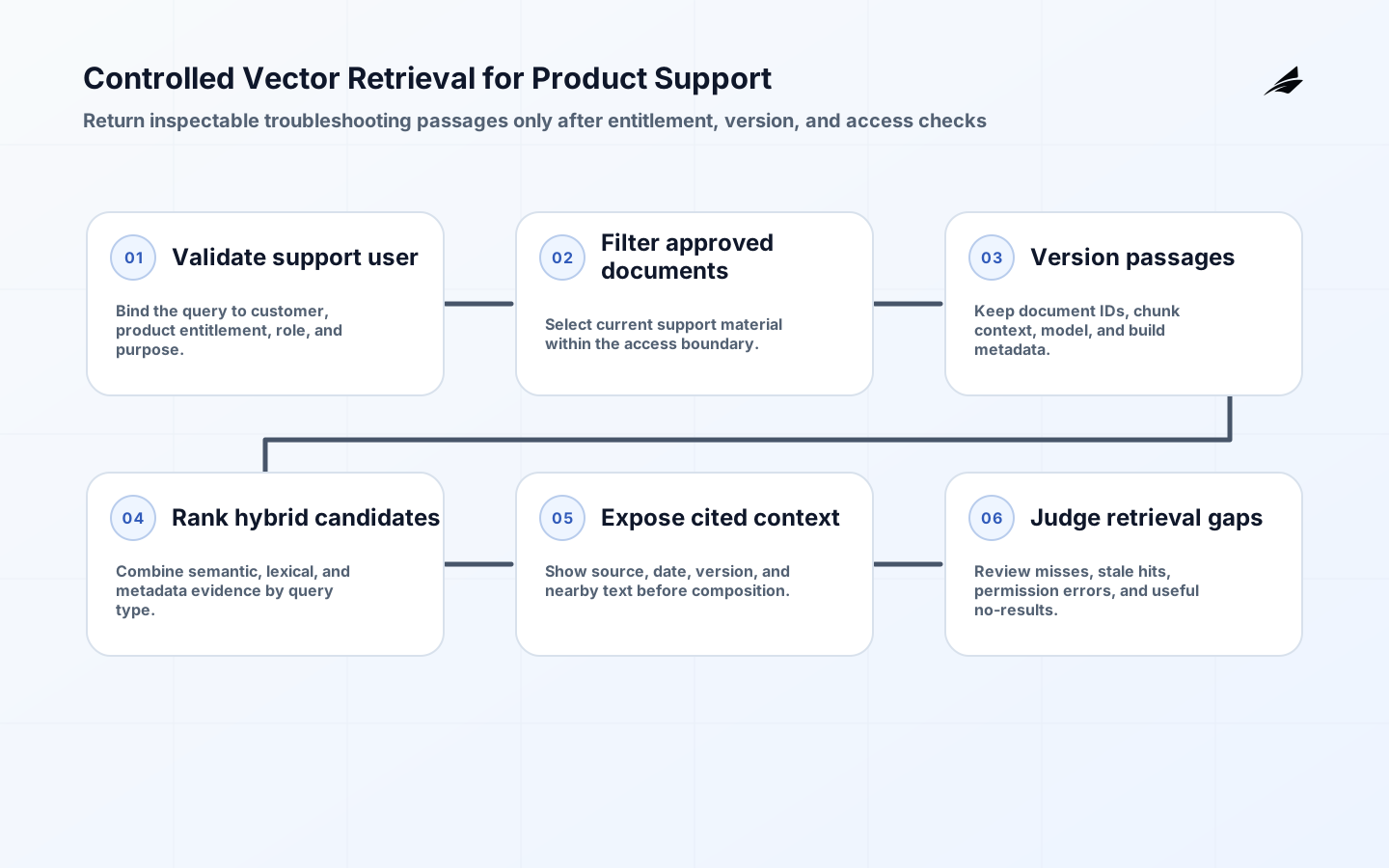
Vector search becomes a different engineering problem when it moves from a demo into a live workflow. In a prototype, a helpful answer can look like success even when a builder quietly compensates for incomplete records, permissive access, or a missing exception path. For product teams, the practical test is whether the service can support a product-support portal locating the most relevant troubleshooting passages for an authenticated customer on an ordinary working day, while still making uncertainty and accountability visible. The surrounding system needs to know which evidence is allowed, which person owns the decision, and what happens when the record is absent or contradictory. RAG systems guide provides useful adjacent context, but a production decision begins with the specific job in front of the team.
Set the production boundary for vector search
Start with a concise operating statement rather than a model choice. Here, the authoritative material is versioned support documents, product entitlement, document metadata, and search-quality judgments. The permitted outcome is to return inspectable results that preserve source, version, and access context before any answer is composed. That statement is deliberately narrow: it establishes what the service is for and supplies an observable basis for review. Equally important is the excluded outcome: the service must not rank a withdrawn article, let similarity bypass entitlement, or treat an exact product code as a purely semantic query. A boundary must cover the user, purpose, inputs, allowed output, prohibited side effect, and recovery route. The NIST AI Risk Management Framework is useful here because its govern, map, measure, and manage functions keep risk connected to a real operating context instead of treating the model as the whole system.

| Boundary question | Decision for this workflow | Evidence to retain |
|---|---|---|
| Who is helped? | An accountable user handling a product-support portal locating the most relevant troubleshooting passages for an authenticated customer. | Role, purpose, and workflow owner. |
| What is authoritative? | versioned support documents, product entitlement, document metadata, and search-quality judgments | Source identifier, version, and access decision. |
| What may happen? | return inspectable results that preserve source, version, and access context before any answer is composed | Output, trace, and reviewer disposition. |
| What must not happen? | rank a withdrawn article, let similarity bypass entitlement, or treat an exact product code as a purely semantic query | Enforcement rule and escalation record. |
Map evidence and authority before building
The workflow map should follow facts, not screens. Trace where the request enters, which system creates or changes each important fact, which source may resolve a conflict, and where a person has authority to act. In this case, versioned support documents, product entitlement, document metadata, and search-quality judgments should not become one undifferentiated context window. Give each source an owner, a freshness expectation, a permission rule, and a stable reference that survives re-indexing or model changes. Record the distinction between a source that is relevant and a source that is sufficient for the decision. The NIST Generative AI Profile identifies concerns including confabulation, data privacy, information integrity, and human-AI configuration; a source map makes those concerns testable in the actual work.
- Name the source owner and update expectation for every record that can influence vector search.
- Preserve the identifier, effective date, and surrounding context a reviewer needs to check a consequential claim.
- Define a route for missing, conflicting, expired, or access-restricted evidence instead of letting the system infer a default.
- Keep the established manual route available until the new route has met its stated operating threshold.
Place independent controls at state changes
Vector search should be able to prepare or retrieve; it should not become the final authority by accident. Put enforcement where the workflow exposes data, creates a record, calls a tool, changes a queue, or communicates externally. An application can check identity, tenant, purpose, field-level scope, schema, business policy, budget, and approval state independently of generated language. That design matters when untrusted material appears in a document, message, or retrieved passage. The OWASP guidance for LLM applications usefully frames prompt injection, sensitive-information disclosure, improper output handling, and excessive agency as system risks. A prompt may influence a proposal; it should not be the enforcement mechanism for a material action.
| Control point | Failure it addresses | Practical check |
|---|---|---|
| Identity and purpose | A plausible request exceeds its authorized use. | Test role, tenant, purpose, and session changes. |
| Source and context | Weak, stale, or unowned evidence shapes the result. | Sample lineage, authority, and freshness on judged cases. |
| Action boundary | A suggestion turns into an unapproved side effect. | Validate policy and tool scope on the server. |
| Recovery path | A defect persists because nobody can stop or investigate it. | Exercise pause, fallback, notification, and restoration. |
Evaluate decisions rather than demonstrations
Build an evaluation set from privacy-reviewed examples of the real task. It should include routine work, ambiguous requests, incomplete records, changed permissions, adversarial or malformed inputs, and cases that must be declined or escalated. For vector search, the result is not a single quality score. Measure task success by query type, permission-filter accuracy, freshness lag, and zero-result quality, then inspect the evidence behind those signals. Segment results by a meaningful condition such as request type, user role, source family, language, consequence, or integration state. A strong average can conceal a serious failure in a low-volume slice. Use reviewers who understand the decision to mark outcomes as accepted, corrected, rejected, or escalated, and convert verified failures into versioned regression cases.
Release in increments that teach the team
A narrow release is not merely a risk reduction exercise; it is how the team learns which parts of the operating design are real. Baseline the current route, choose a limited audience or queue, and decide in advance what would cause a pause, rollback, or expansion. Capture the configuration version, inputs actually used, returned evidence, action policy, reviewer decision, and correction. That trace lets the team distinguish a change in data from a change in model behavior or user practice. The UK Guidelines for secure AI system development reinforces the lifecycle point: security work needs attention through design, development, deployment, and operation, not a single gate before launch. For vector-index versioning and hybrid ranking, the limited release should also expose the first operational assumption that needs an owner.
| Release stage | Question to answer | Decision signal |
|---|---|---|
| Offline review | Does the workflow handle representative and negative cases? | Hold when a material failure lacks an enforceable control. |
| Limited live use | Can users understand evidence and exceptions under real time pressure? | Expand only when quality and support thresholds hold. |
| Controlled rollout | Do signals remain stable across relevant slices? | Pause when a material metric worsens or a new risk appears. |
| Routine operation | Can owners investigate and recover without informal knowledge? | Reassess after each material scope or dependency change. |
Operate vector search as a changing service
The real production work begins after a launch. Assign named owners for source changes, access review, evaluation refresh, incident response, and capacity decisions. A material an embedding model, chunk size, index build, hybrid-ranking weight, metadata schema, or access filter should trigger proportionate re-evaluation because prior evidence may no longer represent current behavior. Review traces and samples with numbers: numerical trends tell the team where to look, but the trace explains why an outcome occurred. Keep operational data limited to what investigation needs, apply retention rules, and protect it as business-sensitive material. The specialist reference, FAISS: A Library for Efficient Similarity Search, is helpful technical background, but it does not replace task-specific evidence about this workflow.
- Review task success by query type, permission-filter accuracy, freshness lag, and zero-result quality on a fixed cadence with the workflow owner and technical owner.
- Version every material an embedding model, chunk size, index build, hybrid-ranking weight, metadata schema, or access filter and attach it to the evaluation result used for release.
- Make pause, manual fallback, customer or user communication, and correction responsibilities explicit before an incident.
- Use confirmed corrections to improve the source, rule, evaluation set, or interface rather than only the prompt.
Key takeaways
- Vector search is ready for production only when its purpose, authority, and prohibited actions are explicit.
- Evidence needs provenance, freshness, and access context that an accountable person can inspect.
- Independent policy enforcement belongs at data and action boundaries, not only in generated instructions.
- Representative evaluation, including no-answer and escalation cases, is more informative than a polished demo.
- Release and operations should make it possible to pause, investigate, correct, and re-evaluate the service.
Frequently asked questions about vector search
What is the first production step for vector search?
Choose one repeatable decision with a named owner, then specify the requester, authoritative record, permitted output, excluded action, and recovery route. For this case, that means grounding a product-support portal locating the most relevant troubleshooting passages for an authenticated customer in versioned support documents, product entitlement, document metadata, and search-quality judgments. The first release does not need broad capability; it needs enough evidence to show that the bounded workflow is useful and controllable.
Does human review make vector search safe?
Review helps only when the reviewer has authority, time, relevant evidence, and a meaningful choice. A person who sees only a fluent recommendation or is measured only on speed can become a rubber stamp. Give reviewers the original record, the system's rationale, uncertainty, and clear options to edit, reject, escalate, or stop the route. Capture the result so it improves the next evaluation set. For vector-index versioning and hybrid ranking, review instructions should name the exact evidence that permits a decision.
When should the team re-evaluate vector search?
Re-evaluate after any material an embedding model, chunk size, index build, hybrid-ranking weight, metadata schema, or access filter, after a sustained change in task success by query type, permission-filter accuracy, freshness lag, and zero-result quality, and after a serious correction or incident. Also revisit the evidence when the user population, business policy, data classification, or action authority changes. The goal is not constant testing for its own sake; it is to keep the release evidence aligned with the service people are actually using.
Conclusion
The production question for vector search is not whether it can produce an impressive result. It is whether the surrounding service can use that result responsibly, explain it to the accountable person, and recover when reality is untidy. Begin with the bounded decision around a product-support portal locating the most relevant troubleshooting passages for an authenticated customer; preserve evidence and independent controls; evaluate the failures that matter; and give people clear authority to stop or correct the workflow. That is how a promising AI capability earns a durable place in operations.