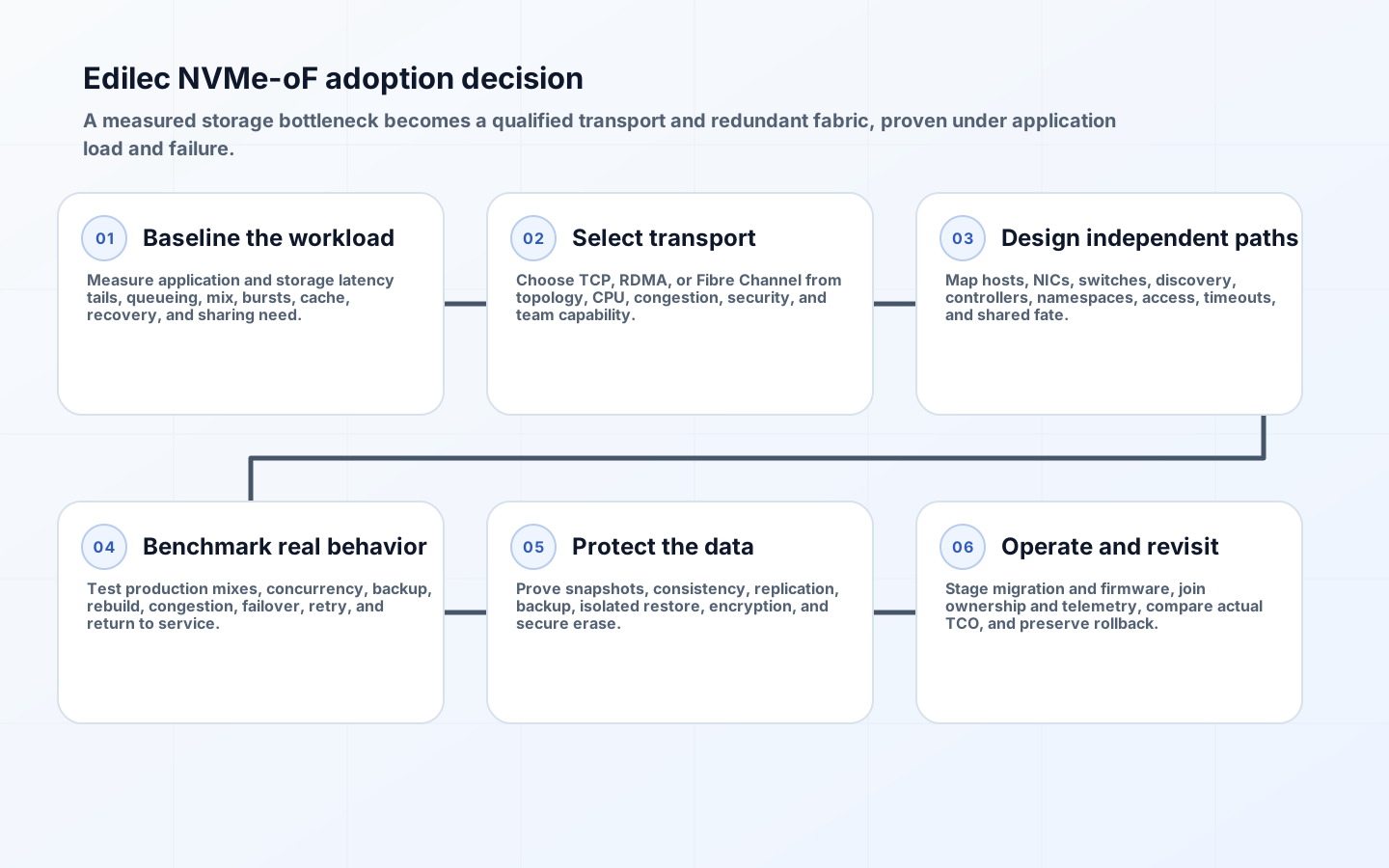
NVMe over Fabrics extends NVMe commands across a network so hosts can access shared namespaces without presenting storage through a legacy SCSI command path. It can improve consolidation, utilization, and latency for suitable databases, analytics, virtualization, and AI pipelines, but it also makes network behavior part of storage service. Faster media alone does not justify a fabric migration; application tail latency, queueing, availability, and operating cost must improve.
The current NVM Express specification set is modular. The NVM Express specifications page lists NVMe 2.3 material, including Base, command-set, NVMe over PCIe, RDMA, TCP, management, and boot specifications. The older standalone NVMe-oF document is historical; generic fabric operation moved into the Base specification. Architecture reviews should cite the transport and revision actually implemented by hosts and targets.
Establish the workload and latency baseline
Measure IOPS, throughput, block size, read/write mix, queue depth, locality, burst duration, cache hit rate, bandwidth per host, and median, p95, p99, and maximum latency at the application, filesystem, volume, host, network, and array. Correlate with CPU wait, database stalls, compaction, checkpoint, backup, and recovery. Test representative peak and failure periods. An average microsecond improvement may be irrelevant if application tail latency comes from locks, log serialization, or remote replication.
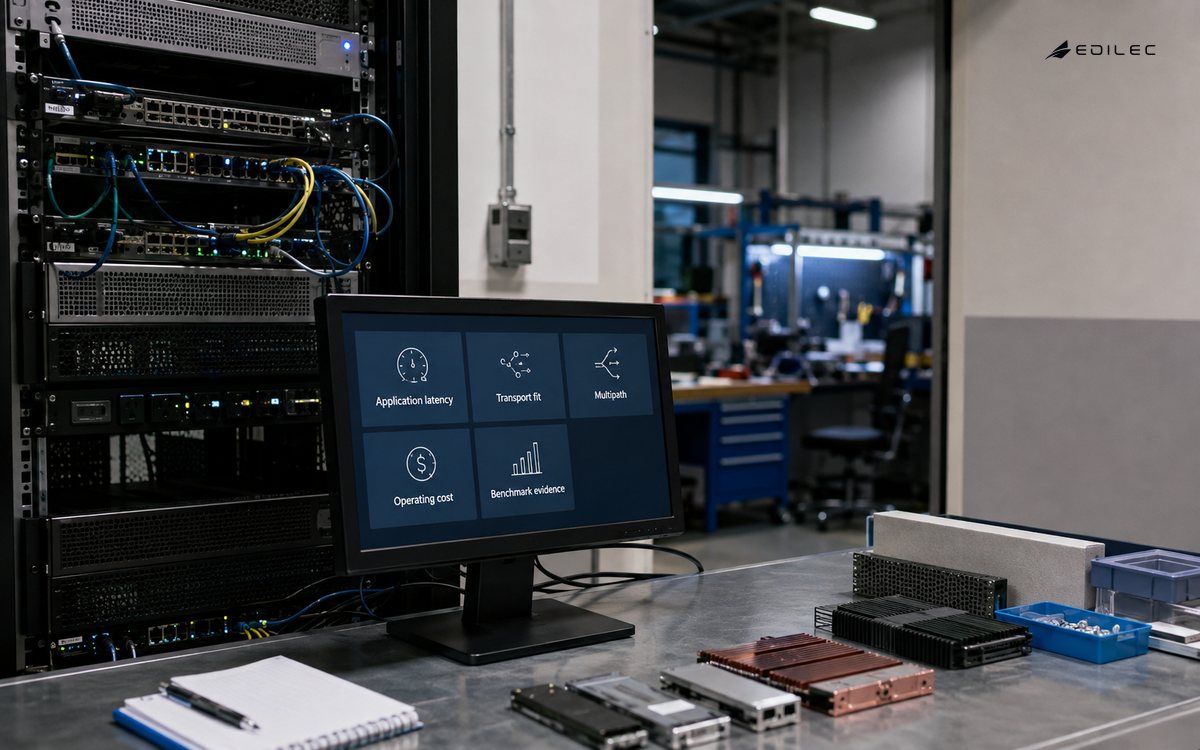
Define objectives for normal service and degraded paths: latency distribution, bandwidth, recovery point, recovery time, host count, namespace count, growth, maintenance, and failure-domain independence. Identify why sharing is needed: disaggregated capacity, live mobility, centralized data services, faster replacement, or eliminating stranded local drives. Local NVMe remains simpler and may be faster; NVMe-oF must earn the added network and target layers.
| Signal | NVMe-oF may fit | Caution | Proof needed |
|---|---|---|---|
| Latency sensitivity | Storage wait materially limits an optimized workload | Application bottleneck is elsewhere | Application trace plus storage latency distribution |
| Capacity utilization | Local NVMe is stranded across hosts | Data is tightly local and easy to rebuild | Fleet capacity and growth model |
| Sharing/mobility | Hosts need common namespaces or rapid reassignment | Application already replicates efficiently | Failover and fencing test |
| Throughput | Parallel sustained demand exceeds current path | Peak benchmark is rare | Production-shaped read/write mix |
| Operations | Network and storage teams can own joint SLOs | Troubleshooting boundaries are fragmented | Incident drill and telemetry coverage |
Choose TCP, RDMA, or Fibre Channel by operating context
NVMe/TCP maps queues, capsules, and data onto standard TCP/IP. NVM Express explains that the NVMe over TCP transport can use ubiquitous Ethernet and traditional adapters, with optional data digests and TLS support in current specifications. It often offers the easiest adoption path because teams can use familiar IP routing and observability, though host CPU, software stack, congestion, and NIC offload still affect latency.
NVMe/RDMA can reduce CPU involvement and data movement through RoCE, iWARP, or InfiniBand, but the network must support the chosen RDMA provider and operations model. RoCE designs may require careful loss and congestion engineering; assumptions about a universally lossless Ethernet are dangerous. Fibre Channel can preserve an established storage-fabric operating model. The official NVMe over RDMA transport page documents the current transport specification. Choose for performance, availability, topology, team capability, and failure behavior, not protocol fashion.
Design the fabric, multipathing, and failure domains
Map host initiators, NICs, switches, target ports, controllers, namespaces, discovery services, management, and replication. Provide independent paths that do not share a hidden switch, power feed, line card, or target controller. Configure host multipathing and asymmetric namespace access according to platform and array guidance. Test path loss during sustained writes, controller failover, switch maintenance, target reboot, discovery outage, stale path, and network partition. Verify timeout values across application, OS, NVMe stack, network, and target.
For IP fabrics, design addressing, routing, MTU, QoS, congestion control, ECMP behavior, ACLs, and telemetry as one storage service. Jumbo frames can reduce overhead but create severe faults when inconsistent; prove end to end. Isolate administrative access, authenticate hosts and targets, protect discovery, rotate credentials, and evaluate transport security against performance and threat requirements. Namespace access control and data-at-rest protection remain necessary even on a dedicated network.
| Area | Normal proof | Failure proof | Decision gate |
|---|---|---|---|
| Host stack | Supported OS, driver, multipath, queue configuration | Reboot, driver error, stale path recovery | No unsupported tuning dependency |
| Network | Latency, loss, utilization, congestion telemetry | Link, switch, route, MTU, and congestion faults | Tail objective maintained or bounded failover |
| Target | Controller, cache, namespace, data protection | Controller loss, firmware update, capacity pressure | Durability and availability objective met |
| Application | Production-shaped workload and recovery | Timeout, retry, failover, restart, restore | Correctness with acceptable tail latency |
| Operations | Unified dashboards, ownership, change process | Cross-team incident drill | Fault isolated within response objective |
Benchmark application outcomes and degraded behavior
Use the exact servers, NUMA placement, NICs, switches, optics, target software, firmware, filesystem, volume settings, and application pattern planned for production. Warm and cold caches deliberately. Report latency histograms by block size, queue depth, read/write mix, and host count. Add background replication, rebuild, backup, and noisy-neighbor workloads. A synthetic maximum-IOPS number at deep queue depth can hide poor latency at the queue depths an application actually uses.
Benchmark failover and recovery, not only steady state. Measure I/O pause, errors surfaced to applications, retry storms, path rebalance, data consistency, rebuild effect, and return to preferred path. Run soak tests for memory leaks, connection churn, and performance drift. Compare against optimized current storage and local NVMe with application replication. Require statistically meaningful repeated runs and retain configuration as code so results can be reproduced after firmware changes.
Model TCO and roll out as a storage service
Include targets, media, NICs or HBAs, switches, optics, cabling, ports, licenses, support, rack power, cooling, capacity reserve, replication, backup, telemetry, engineering, training, migration, and downtime. Credit avoided local drives, improved utilization, faster host replacement, and operational consolidation only with measured evidence. Model expansion and failure spares. RDMA may need specialized adapters and skills; TCP may consume more host CPU or require acceleration. Price the whole path.
Start with a bounded workload whose baseline and recovery are understood. Establish host and target qualification matrices, staged firmware rules, change windows, rollback, capacity thresholds, and joint network-storage on-call ownership. Migrate a replica or noncritical shard first, validate application behavior, then expand by failure domain. Continuously monitor application latency, NVMe command errors, queue depth, retransmission or RDMA counters, congestion, path state, target latency, media health, and capacity.
Key takeaways
- Prove storage is a material application bottleneck and define tail-latency and recovery objectives.
- Choose TCP, RDMA, or Fibre Channel from existing network capability, failure behavior, and operating skill.
- Design independent paths and align timeouts, discovery, multipathing, access control, and telemetry end to end.
- Benchmark production-shaped workloads during congestion, failover, rebuild, backup, and recovery.
- Compare lifecycle path cost and operational value with optimized current storage and local NVMe alternatives.
FAQ
Is NVMe/TCP too slow for low-latency storage?
Not inherently. It can provide excellent performance on standard IP networks, but CPU, NIC offload, congestion, topology, target, and workload determine results. Benchmark tail latency and degraded paths on the intended stack.
Does NVMe/RDMA require a lossless network?
Requirements depend on the RDMA provider. RoCE deployments commonly engineer priority flow and congestion behavior carefully, while iWARP uses TCP and InfiniBand has its own fabric. Follow implementation guidance and test faults rather than applying one blanket rule.
Should every database use NVMe over Fabrics?
No. Some databases benefit from low-latency shared storage; others perform well with local NVMe and application replication or remain limited by CPU and coordination. Use application traces, availability design, and TCO to decide.
Prepare data protection, upgrades, and joint operations
Clarify which layer provides snapshots, clones, replication, consistency groups, encryption, secure erase, backup integration, and ransomware recovery. A namespace is not a backup. Application-consistent protection may require database quiescence or log coordination, while crash-consistent snapshots have different recovery guarantees. Test restore to isolated hosts and verify identity, discovery, access controls, and application correctness. Measure restore throughput when the fabric is also serving production, because a fast target can still saturate shared links.
Qualify firmware and software across target controllers, drives, NICs, switches, host kernels, drivers, and multipath tools. Stage changes through a representative noncritical workload and preserve compatibility matrices and rollback. During target maintenance, verify path movement before removing redundancy. During network maintenance, coordinate with storage ownership so routing or QoS changes are assessed as storage changes. Keep configuration and cabling records accurate enough to reveal shared fate.
Create one service review joining application, compute, network, storage, backup, and security teams. Use common incident timestamps and trace identifiers where available. Alerts should distinguish host queueing, network congestion, path failure, target processing, media health, replication lag, and application retries. Define who leads incidents and who can fence a host or namespace. A low-latency architecture that requires several teams to debate ownership during every fault will not meet its availability objective.
Recheck the business case after production stabilization. Compare actual utilization, host CPU, tail latency, incident effort, capacity growth, and migration savings with the approved model. Retire tuning that lacks evidence and preserve benchmark fixtures for future target, NIC, switch, and software changes.
Conclusion
NVMe-oF is justified when disaggregated shared storage improves a measured workload and the organization can operate the network as part of the storage service. Transport fit, independent paths, failure testing, and full-path economics matter more than an isolated benchmark number.