The identity-aware proxy vs VPN choice should be made per application and workflow, not as a slogan about replacing networks. A VPN gives a device a protected path into a network or network segment. An identity-aware proxy places an application-facing enforcement point between the user and a published service, usually authenticating identity and evaluating context before forwarding each connection or request. These boundaries expose different things and support different protocols.
An application proxy can reduce reachable network surface and produce application-specific policy, but it cannot automatically carry every database tool, thick client, UDP protocol or administrator workflow. A VPN remains useful for bounded legacy and infrastructure access when segmented carefully. Use Edilec's zero trust for business applications as the resource-policy foundation; this comparison determines where remote traffic first meets that policy.
Compare what each access edge exposes
NIST Zero Trust Architecture rejects implicit trust based only on network location and emphasizes protecting resources through explicit decisions. An identity-aware proxy naturally presents one published application at a time and can hide its origin from direct internet reach. A VPN often places the client on a routed address space, after which firewalls, segmentation and application authorization must constrain reachable services. Neither approach removes the application's responsibility to authorize actions.
Draw origin, proxy or concentrator, identity provider, device signal, DNS, client and management plane. Document whether traffic can bypass the edge through a public origin, private peering or alternate hostname. For VPN, list routes and lateral destinations rather than saying internal network. For proxy, list supported protocols and websocket, upload, callback or client-certificate needs. The useful diagram shows actual enforcement and bypass paths, not vendor product boxes.
| Decision factor | Identity-aware proxy | VPN | Selection implication |
|---|---|---|---|
| Published unit | Application or service | Network routes or segments | Prefer proxy for isolated web apps |
| Client software | Browser or app connector | VPN client and route stack | Assess support and management burden |
| Protocol breadth | Often HTTP-focused; product-dependent | Broad IP connectivity | Retain VPN for unsupported legacy protocols |
| Policy context | Identity and device at app edge | Identity/device at tunnel plus downstream controls | Do not confuse tunnel with object authorization |
| Blast radius | Origin and app scope can stay hidden | Misrouting may expose adjacent services | Validate segmentation and bypass resistance |
Inventory protocol and application compatibility
Classify each target as browser SaaS, internal web, SSH, RDP, database, file share, voice, custom TCP/UDP, service API or device-management channel. Record authentication model, latency sensitivity, source-IP dependence, certificate behavior, DNS assumptions and bandwidth. Identity-aware proxies vary considerably; verify the chosen product's transport rather than assuming the category supports everything. A web front end may proxy cleanly while its desktop synchronization client fails.
For legacy applications, an application connector or protocol gateway can bridge access without exposing a full network, but that adapter becomes critical infrastructure. NIST SP 800-46 Rev. 2 provides remote-access and telework security guidance that remains useful when evaluating VPN and remote administration paths. Test file locking, long sessions, reconnect, large transfer, printing and administrative consoles. A VPN can be the conservative temporary route when gateway translation would alter behavior. Constrain it to application-specific subnets and ports, and keep migration work visible rather than treating broad access as permanent compatibility.
Evaluate identity and device policy on every path
Both architectures should use centralized identity, phishing-resistant authentication for higher risk, managed-device signals and short-lived policy context. The proxy can often re-evaluate at connection or request boundaries. A VPN may evaluate at tunnel establishment, so long-lived tunnels need reauthentication, posture refresh and rapid termination. Verify what happens when an account is disabled or a device becomes noncompliant; a console indicator is not proof that existing access stopped.
Keep identity-provider groups small and map them to named applications or segments. Resource applications continue to apply roles and object rules. Device posture should be decision-useful and privacy-bounded: operating-system support, disk protection, endpoint protection and certificate health may matter; unrelated personal telemetry does not. Define a recovery path for a broken managed device that does not grant unrestricted access from an unmanaged one.
Compare availability and user experience honestly
A proxy adds identity, policy and forwarding dependencies to each published application. A VPN adds client, tunnel, route, DNS and concentrator dependencies, often affecting all remote applications at once. Model regional failure, identity-provider outage, certificate expiry and control-plane misconfiguration. Provide tested emergency access for critical operations with equivalent logging and narrow scope. A broad bypass URL or split-tunnel exception is not a recovery design.
Measure sign-in completion, connection latency, reconnect success, support contacts and task completion by application. Proxy access can remove the ritual of starting a tunnel for browser apps, while a VPN may offer a smoother experience for a suite of tightly coupled legacy tools. User experience affects security because repeated friction encourages local copies, credential sharing and unauthorized remote-control products. Include accessibility and contractor onboarding in the pilot.
| Migration cohort | Preferred starting edge | Required proof | Fallback |
|---|---|---|---|
| Modern internal web app | Identity-aware proxy | Origin hidden; identity and posture enforced | Time-limited segmented VPN |
| Database administrator | Protocol-aware ZTNA or narrow VPN | Target-only routes and strong admin auth | Hardened jump host |
| Legacy thick-client suite | Segmented VPN initially | Route, DNS and lateral-access tests | Application gateway pilot |
| External contractor portal | Identity-aware proxy | Federation, device rule and expiry | Managed virtual desktop |
| Incident responder | Both may be needed | Break-glass and evidence survive outage | Separate emergency path |
Migrate by application and preserve observability
Create a catalog with owner, protocol, user population, sensitivity, current routes, proxy readiness, dependencies and retirement criterion. Move low-complexity web applications first, monitor denied and bypass traffic, then remove their VPN routes. Avoid running both edges indefinitely; dual paths make policy drift and incident reconstruction harder. A dated exception should name the incompatibility and the engineering action needed to resolve it.
Join identity decision, device posture, edge connection and application authorization in protected telemetry. For a proxy, record published app, policy, origin route and result. For a VPN, record assigned address, route policy, tunnel state and target flow where privacy and law permit. Edilec's audit log guide helps keep events attributable without capturing payload content.
Use the six-stage Edilec access-edge route
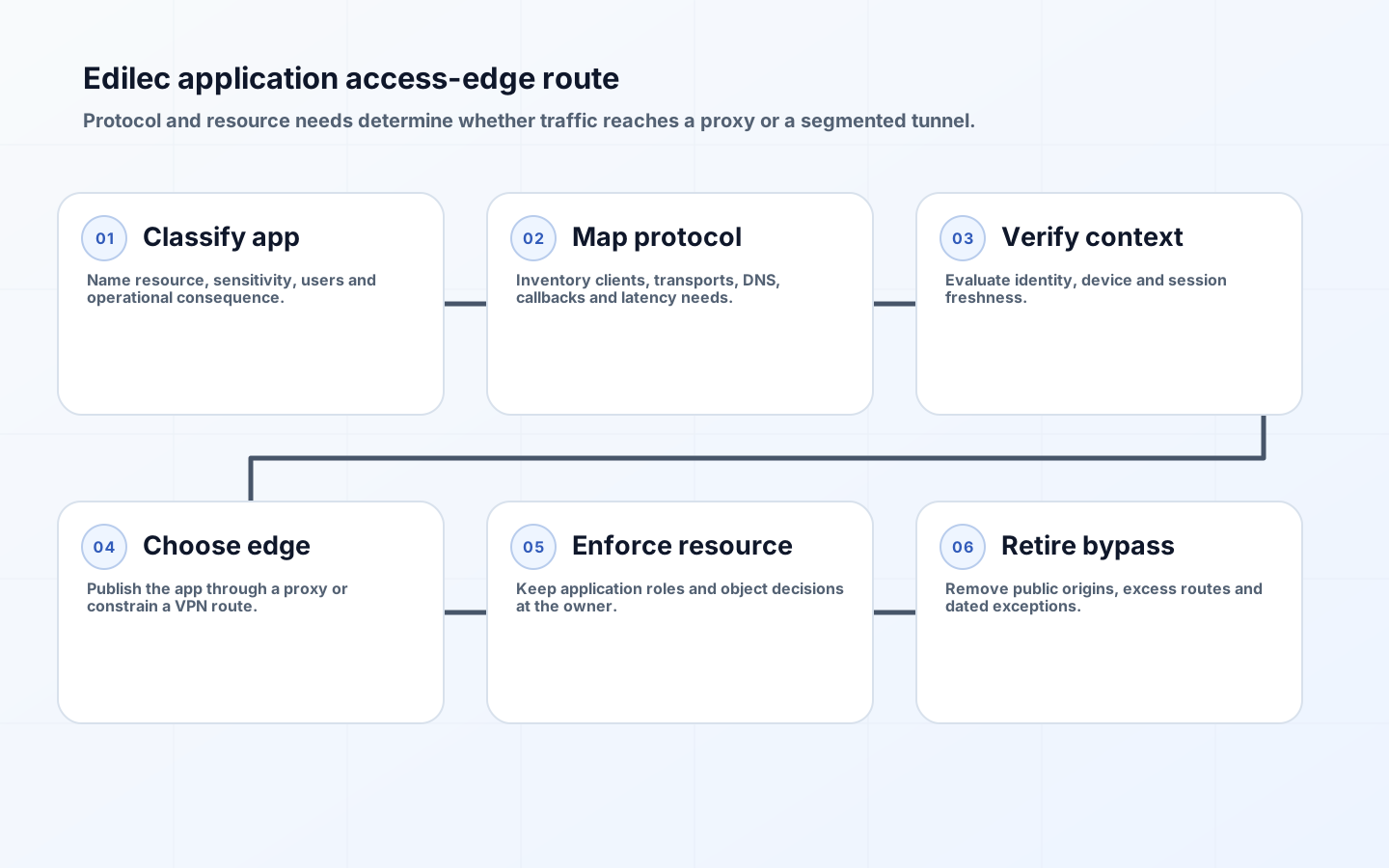
The Edilec route classifies the application, maps protocol dependencies, verifies user and device, selects proxy or segmented tunnel, enforces at the resource and retires bypass paths. Use the six stages for each catalog entry. Different applications can reach different conclusions without weakening the program; consistency comes from the decision method and evidence, not one universal transport.
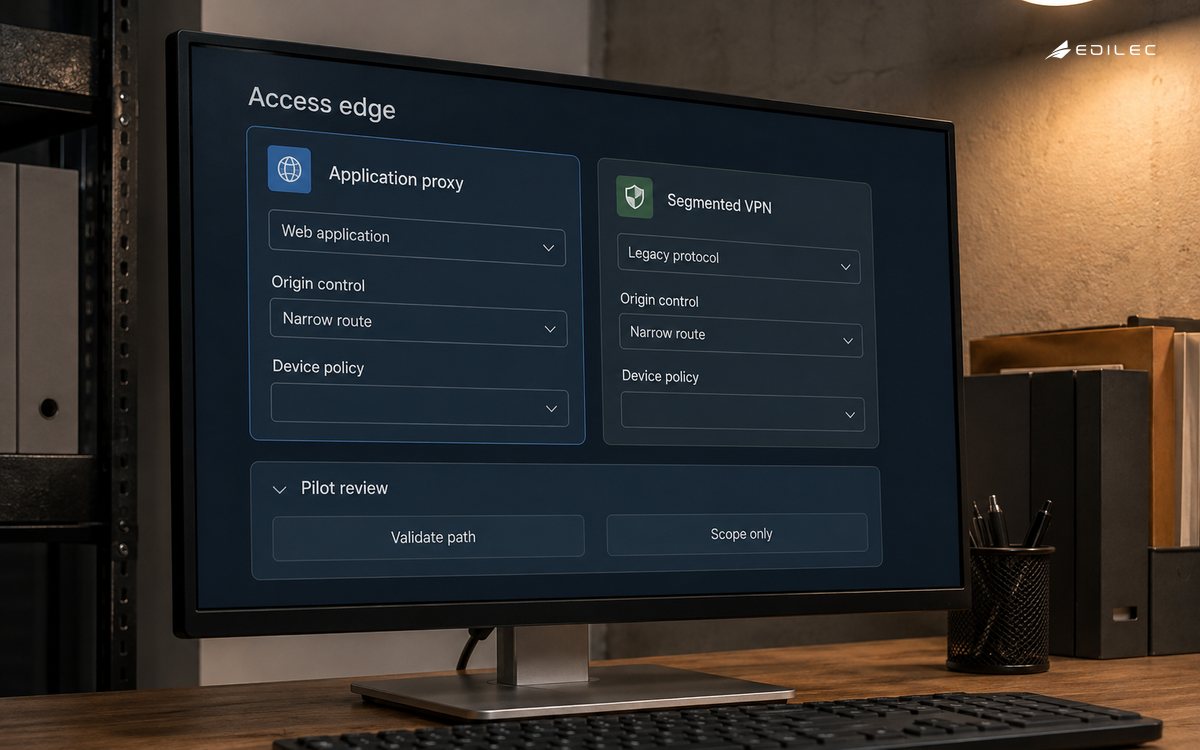
Pilot with realistic users from home, office and restricted networks. Test account disablement, device downgrade, expired certificate, proxy outage, VPN route error, long session and origin bypass. Confirm help-desk diagnostics and emergency recovery. NIST SP 800-207A is especially relevant when the protected applications are cloud-native and enforcement spans gateways, sidecars and application identity infrastructure. The CISA Zero Trust Maturity Model can help organize broader identity, device, network, application and data improvements around the access-edge change.
Evaluate access-edge products against the operating model
Compare products with the application catalog rather than a generic feature matrix. Require supported protocol evidence, maximum session behavior, posture refresh timing, identity-provider failure behavior, origin connector lifecycle, regional routing, policy export, event APIs and administrator separation. Price the complete service: licenses, connectors, private points of presence, certificate management, logging volume, support tier and migration labor. A low per-user price can be misleading when every unsupported application requires a separate gateway.
Ask how tenant isolation and provider administration work. The access edge can observe sensitive destinations and identity context, so vendor support paths, update controls, data locations and incident notification matter. Test configuration export and exit. If policies, connector identities or application definitions cannot be migrated, the edge becomes a concentrated switching cost. Keep origin access controls portable enough to survive a vendor transition without temporarily publishing applications to the internet.
Operationally, decide who owns an application publication, who approves policy, who manages device rules and who can create bypasses. Separate these permissions where risk warrants it. Review unused applications, stale contractors, dormant connectors and permissive route groups. Include edge configuration in disaster recovery and test restoration in a clean environment. A service that protects every remote application deserves the same change discipline and independent monitoring as an identity provider or network core.
Key takeaways
- Choose an access edge per application after inventorying protocol and client dependencies.
- Use a proxy to reduce network exposure for compatible applications; use a segmented VPN where network protocols remain necessary.
- Re-evaluate identity and device state during long-lived access, not only at initial connection.
- Keep application authorization in place and remove origins or routes that bypass the selected edge.
- Migrate by cohort with measured user experience, recovery tests and dated retirement criteria.
Frequently asked questions
Can an identity-aware proxy replace every VPN?
Usually not immediately. Browser applications are strong candidates, while custom network protocols and infrastructure administration may require protocol-aware access or a narrow VPN. The long-term architecture can combine edges without giving either broad implicit trust.
Can a VPN be part of zero trust?
Yes, if it provides a narrow protected transport and every request remains subject to identity, device, segmentation and resource authorization. A tunnel must not make all internal destinations trusted. Routes and downstream permissions should be explicit.
Should the proxied application's origin remain public?
Generally restrict the origin to the proxy or another authenticated service path. Otherwise users or attackers may bypass edge policy. Test alternate DNS names, provider addresses and direct APIs before declaring the origin protected.
Conclusion
Identity-aware proxies and VPNs solve different access problems. A proxy is an application-level boundary that can sharply reduce exposed network surface. A VPN is a network transport that supports broader protocols but needs segmentation and downstream authorization. Treating one as universally secure hides the actual resource path.
Build the application inventory, move a compatible cohort and remove its alternate path after verification. Align edge decisions with Edilec's zero trust field guide so identity, device and resource policy remain coherent. The result is a smaller, explainable access surface instead of a renamed perimeter.