A FAPI 2.0 implementation is appropriate when compromise of an authorization response, access token or transaction context could produce material harm and participating systems need an interoperable high-security profile. FAPI is not a replacement name for OAuth and it is not limited to banks. It is a coordinated set of requirements that removes optionality, combines modern OAuth controls and defines how clients, authorization servers and resource servers must behave together.
Teams should adopt it because a documented risk and ecosystem contract justify the operational cost, not because a product offers a FAPI checkbox. Start with Edilec's OAuth security architecture guide for flow fundamentals. This guide addresses the next decision: whether high-value APIs need the stricter profile, how to map its components into a deployment, and how to prove interoperability before customers depend on it.
Scope FAPI 2.0 to high-value authorization journeys
The FAPI 2.0 Security Profile defines an API security profile based on OAuth 2.0 Authorization Code flow. Inventory journeys, not just endpoints: consent, redirect, token issuance, refresh, API use, revocation and error handling. Classify the consequence of redirect manipulation, authorization-code interception, token replay, client impersonation and message alteration. Include privacy impact because transaction and account details may be sensitive even when no transfer succeeds.
Choose a complete trust domain for the first implementation. Name client types, authorization-server issuer, resource-server audiences, approved redirect URIs, supported sender constraint and key authorities. A partial deployment where the authorization server claims FAPI behavior but a gateway accepts ordinary bearer tokens creates misleading assurance. Keep lower-risk OAuth clients in a separate registration and policy profile so compatibility exceptions cannot silently weaken the high-value path.
| Journey risk | FAPI control contribution | Owner | Acceptance evidence |
|---|---|---|---|
| Authorization request is altered | Pushed authorization request creates server-held request context | Client and authorization server | Tampered browser parameters do not change approved request |
| Code is intercepted | PKCE binds redemption to initiating client instance | Client and token endpoint | Wrong verifier is rejected |
| Token is replayed | DPoP or mTLS constrains token to sender key | Authorization and resource servers | Copied token fails without key |
| Authorization response is substituted | Issuer identification and signed response option support validation | Client | Wrong issuer or signature is rejected |
| Client credentials are abused | Asymmetric client authentication reduces shared-secret exposure | Client registry and token endpoint | Unregistered key cannot authenticate |
Use PAR to protect authorization request integrity
RFC 9126 lets a client send an authorization request directly to the authorization server's pushed authorization request endpoint. After authenticating and validating the request, the server returns a request_uri; the browser-facing authorization request references that value. This reduces exposure of request parameters in the browser and gives the server an early opportunity to reject invalid redirect, scope, response and policy combinations.
PAR does not authorize the transaction before the user authenticates or consents. Treat the pushed object as short-lived, one-client context and prevent reuse outside the intended flow. Correlate PAR, authorization and token events without logging full request objects that contain sensitive claims. Capacity-plan the endpoint because every authorization starts there, and expose errors that distinguish client configuration from temporary service failure without revealing policy internals.
Lock down the FAPI client and server contract
Register exact redirect URIs, approved grant behavior, client authentication keys, response modes and sender-constraining method. Use asymmetric client authentication rather than a long-lived shared secret. Apply PKCE with the required secure challenge method and bind each authorization response to the initiating browser transaction. The client validates issuer and state before accepting a response. Authorization-server metadata and client registration should be versioned configuration, not assumptions embedded independently in several codebases.
At the token endpoint, validate client authentication, authorization code, redirect URI, PKCE verifier and any sender key relationship as one transaction. Issue an audience-specific, short-lived access token and govern refresh-token rotation and reuse detection. At the resource server, validate issuer, audience, expiry, scope and sender constraint, then enforce object-level authorization. The secure API access control guide covers that final domain decision.
Design key, certificate and metadata operations
High-assurance message and client authentication depends on key lifecycle. Assign owners for signing keys, DPoP keys or mTLS certificates, trust stores and metadata publication. Define generation boundary, algorithm policy, hardware protection where warranted, activation, overlap, retirement and compromise response. A rotation must not create an interval where every old and new key is accepted indefinitely. Cache key sets with bounded freshness and retain enough history to validate events still within their legitimate lifetime.
Separate client keys from authorization-server keys and production from non-production trust. Automate expiry alerts and rehearse emergency rollover with representative clients. Metadata changes need staged publication and consumer observation before removal. If a gateway performs proof validation, document how validated identity reaches the application and prevent external callers from injecting equivalent headers. The security profile applies across termination points, even when one vendor product presents them as a single logical service.
| Release gate | Positive test | Hostile test | Operational proof |
|---|---|---|---|
| Client registration | Approved redirect and key complete flow | Unregistered redirect and key fail | Versioned registration record |
| PAR | Valid request URI starts authorization | Modified or expired request URI fails | PAR latency and error metrics |
| Token endpoint | PKCE and client proof issue bound token | Wrong verifier or proof fails | Correlated token decision |
| Resource API | Bound token reaches permitted object | Copied token or wrong audience fails | Resource policy result |
| Rotation | New key works during planned overlap | Retired key fails after deadline | Rotation event and rollback limit |
Test conformance and business interoperability
Use the OpenID Foundation's FAPI specification and certification resources to align with the final profile and available conformance tooling. Conformance is valuable because subtle optionality and negative cases are difficult to cover with a happy-path integration test. It does not certify the surrounding product's business authorization, fraud controls, key custody, availability or privacy handling. Maintain separate tests for those responsibilities.
Run cross-vendor tests with the actual clients, gateways and resource servers that will ship. Exercise canceled consent, duplicate redirects, expired PAR references, code replay, wrong issuer, invalid signature, refresh reuse, sender-proof mismatch and key rollover. Confirm that customer-facing errors are recoverable and that support can locate the relevant event without seeing tokens. A compliant component can still participate in an inoperable journey if timeout and recovery contracts disagree.
Use the six-stage Edilec FAPI assurance path
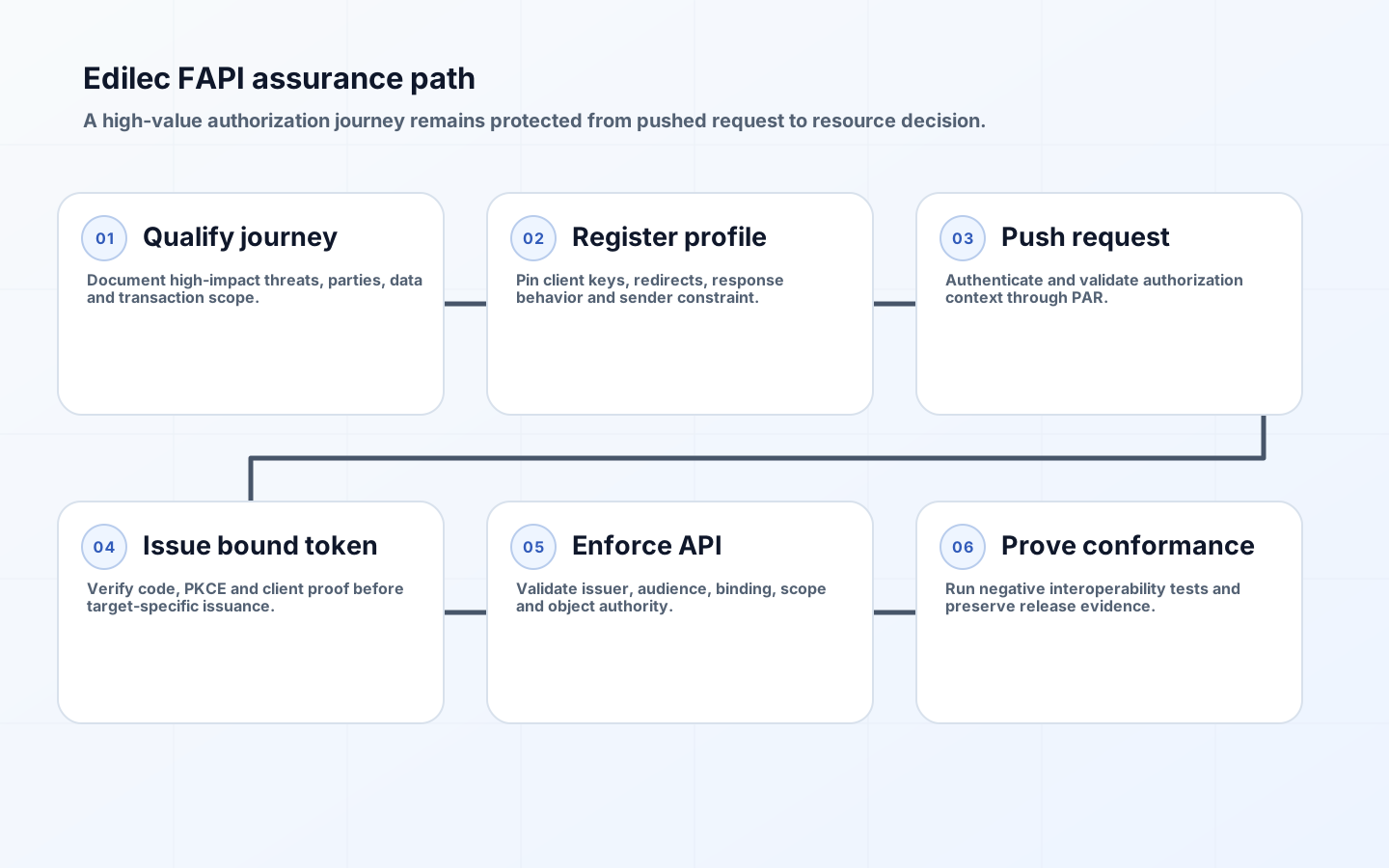
The Edilec path moves from risk qualification to profile registration, protected authorization request, bound token issuance, resource enforcement and conformance evidence. Use it as a release map with named owners rather than a network drawing. Each stage should have configuration under change control, a negative test and an operator signal. That turns the FAPI 2.0 implementation into a verifiable journey instead of a list of enabled protocol features.

Migrate by cohort. Establish a separate FAPI issuer or clearly isolated policy where practical, onboard one capable client, run parallel observability, then require the profile for selected high-value scopes. Do not downgrade automatically when PAR, proof or signing fails. A controlled failure is safer than silently falling back to bearer behavior. Track blocked legacy clients and retire explicit exceptions on dated plans approved by accountable risk owners.
Prove production readiness beyond protocol conformance
Create a service map for the authorization journey with owners and objectives for PAR, authentication, consent, token, key publication, proof validation and resource APIs. Define capacity and abuse controls independently for each endpoint. Attack traffic against PAR should not exhaust interactive login, and expensive signature checks need bounded input sizes and rate policy. Protect administrative configuration with strong change approval because a malicious redirect, client key or trust entry can bypass otherwise correct runtime validation.
Prepare an incident playbook for leaked client key, authorization-server signing key, sender key and refresh token. Each case has a different containment action and customer impact. Preserve safe event evidence, rotate affected material, invalidate relevant tokens, notify relying parties through authenticated channels and verify restored clients before broad reactivation. Rehearse the sequence during migration. High-assurance protocol behavior is incomplete if a key incident forces teams to disable validation or accept unbounded overlap to restore service.
Key takeaways
- Adopt FAPI for a defined high-impact authorization ecosystem, not as a generic OAuth marketing label.
- Implement PAR, PKCE, asymmetric client authentication and sender constraint as one coordinated profile.
- Make every proxy, token endpoint and resource server preserve the profile's security properties.
- Use conformance tests for protocol behavior and separate tests for business authorization, operations and privacy.
- Migrate clients by controlled cohort and never silently downgrade a failed FAPI journey to bearer OAuth.
Frequently asked questions
Is FAPI 2.0 only for financial services?
No. Its origin and name reflect financial-grade risk, but the profile can fit healthcare, government, identity administration or any ecosystem with high-value API authorization. Regulatory and partner requirements still determine whether a particular deployment must use it.
Is following OAuth security best practice enough?
RFC 9700 is essential baseline guidance. FAPI goes further by selecting a stricter interoperable profile and defining combinations for parties that must connect reliably. A closed first-party system may address risk without FAPI, but it should not claim FAPI conformance.
Does certification prove the whole product is secure?
No. Certification or conformance testing covers specified protocol behavior for a deployment profile. Secure key custody, endpoint authorization, customer configuration, fraud detection, resilience and incident response remain product and operator responsibilities.
Conclusion
FAPI 2.0 is valuable because it makes a high-security OAuth ecosystem more specific. It protects authorization request handling, narrows client behavior, requires strong client authentication and token binding choices, and gives independent implementations a shared test target. Those benefits arrive only when the complete path follows the profile.
Qualify one high-value journey, assign control owners and prove every negative case through the production edge. Connect operational records to Edilec's audit log guide and keep normal OAuth inventory disciplined. A successful rollout gives partners predictable interoperability and gives operators evidence they can act on when an authorization journey fails.