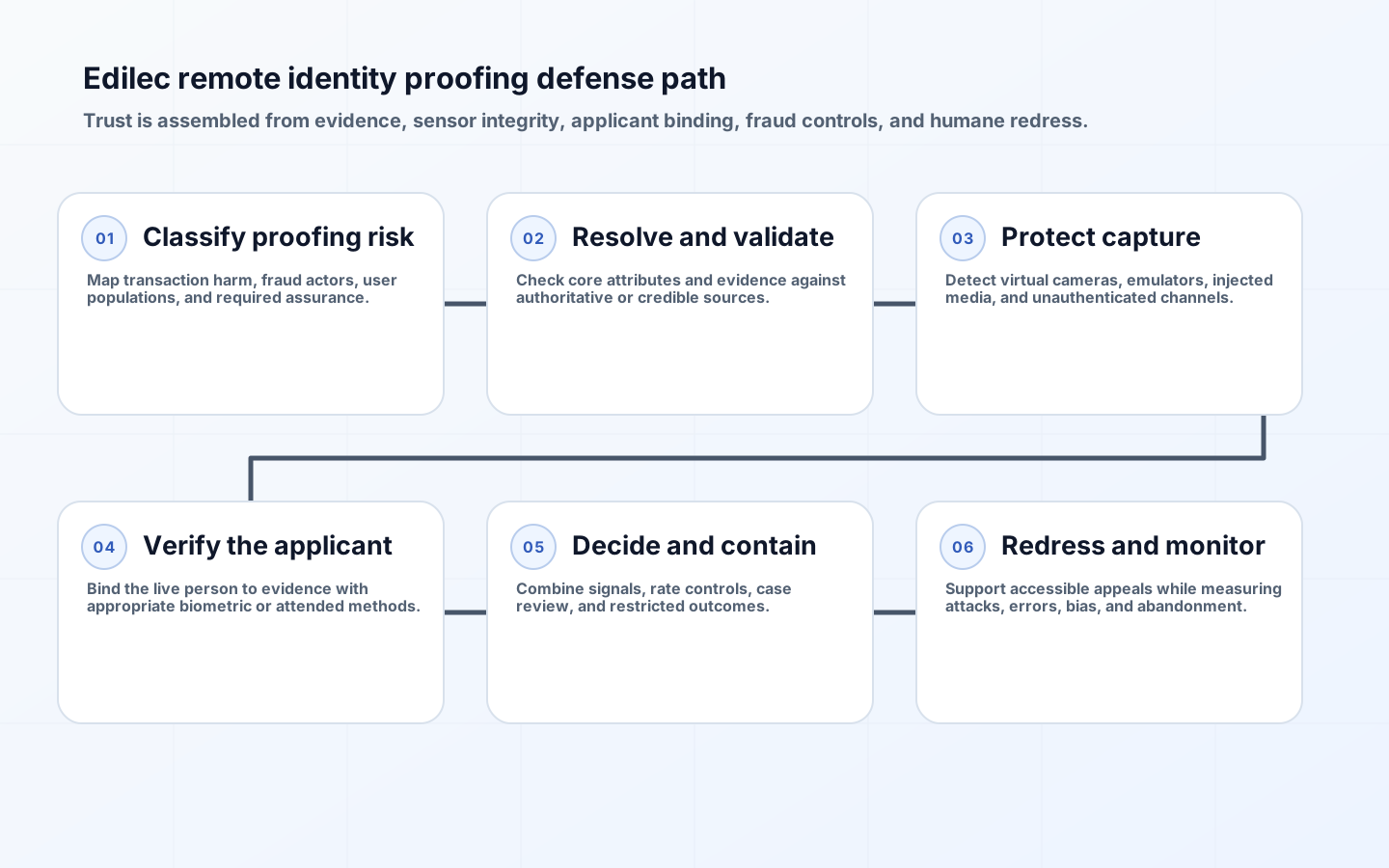
Remote identity proofing controls establish confidence that an applicant is associated with a claimed real-world identity when enrollment does not occur face to face. Deepfakes and digital injection raise the quality and scale of impersonation, but they do not erase the older problems of stolen evidence, synthetic identities, compromised personal information, coercion, mule enrollment, and corrupt recovery channels. A defensible service layers evidence validation, capture integrity, applicant verification, fraud analysis, rate controls, human review, privacy, and redress instead of betting the decision on one liveness score.
NIST SP 800-63A-4 explicitly addresses digital injection prevention and forged media detection. It describes injection as forged or modified media inserted between capture and comparison, notes that biometric comparison alone does not stop the attack, and requires controls that increase confidence media came from a genuine sensor. This is a systems problem: the capture application, device, network channel, validation service, proofing agent, case system, and downstream authenticator binding all participate in the trust decision.
Scope the proofing decision and fraud model
Define the transactions enabled by a successfully proofed account and the harms of issuing one to an imposter. Separate low-value profile access from payment, health, government benefit, regulated account opening, employee administration, and bulk-data privileges. Use the NIST risk-management method to identify user groups, impacted entities, fraud scale, and initial assurance direction. Proofing intensity should follow actual harm; collecting more identity evidence than the service needs creates privacy exposure without necessarily improving resistance.
Build attack stories for stolen genuine documents, altered documents, synthetic records, replayed capture, virtual cameras, emulators, device farms, deepfake video, face swaps, coerced applicants, compromised source databases, insider overrides, and repeated low-rate attempts. Note which attacker controls the endpoint and which controls only submitted data. Then assign each attack to preventive, detective, containment, and recovery controls. The threat-modeling guide helps keep assumptions and trust boundaries explicit.
Resolve identity and validate evidence
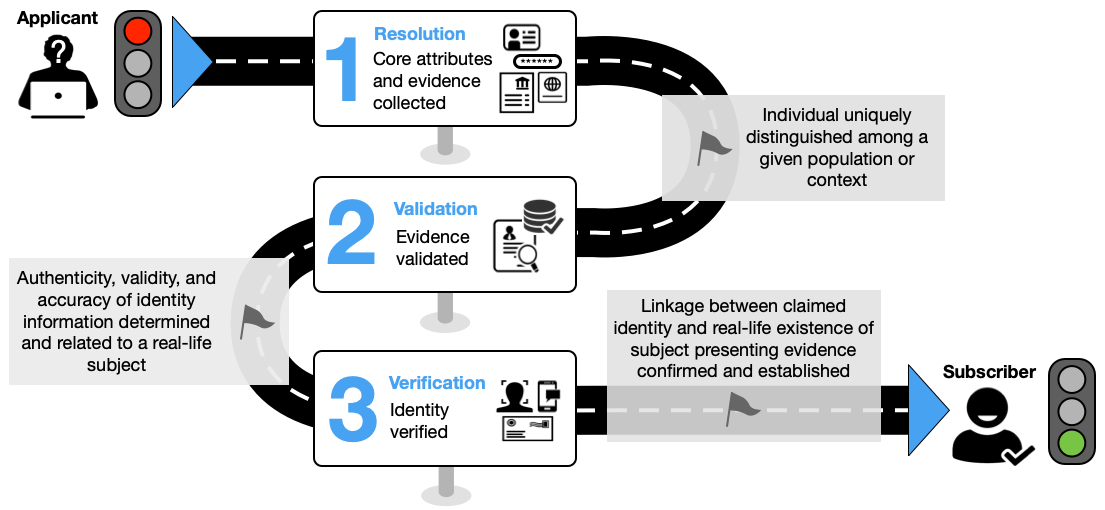
Resolution collects the minimum core attributes needed to distinguish the claimed identity. Validation determines whether evidence and attributes are genuine, accurate, and associated with authoritative or credible sources. Verification then binds the applicant to that identity. Preserve these distinctions in architecture and logs. A document image that passes visual checks is not proof the applicant owns it; a database match is not proof the live applicant is the record subject. Use multiple evidence pathways appropriate to the selected IAL and population.
For document validation, inspect security features and data consistency, query authoritative or credible records where permitted, check status and expiry, and detect repeated evidence across accounts. Protect source queries and responses from tampering. Define what happens when a source is unavailable or returns conflicting data; do not silently treat missing checks as passes. Minimize retained images and extracted attributes, document purpose and deletion, encrypt sensitive artifacts, and restrict access. Fraud analysts often need derived signals and provenance, not perpetual access to raw identity evidence.
Defend the remote capture channel
Use authenticated protected channels and application integrity controls. Detect virtual cameras, emulators, rooted or jailbroken devices, automation frameworks, impossible sensor combinations, stream substitution, and replay where feasible. Device attestation and sensor authentication can increase confidence but have coverage and privacy limits, so record their strength and absence explicitly. Bind captured artifacts to a transaction nonce, session, device context, and sequence; reject reuse. Server-side policy must remain authoritative because an attacker may control the client.
| Attack surface | Control objective | Example controls | Residual risk response |
|---|---|---|---|
| Identity evidence | Detect falsification, theft, and invalid status | Source validation, security features, duplicate analysis | Request alternative evidence or review |
| Capture endpoint | Increase confidence in genuine sensor output | Attestation, virtual-camera detection, application integrity | Raise risk or require attended route |
| Media stream | Detect replay, injection, and manipulation | Nonce binding, PAD, active cues, forensic signals | Block, retain decision evidence, investigate cluster |
| Applicant binding | Associate live person with validated identity | Biometric or trained visual comparison | Second method or supervised review |
| Fraud orchestration | Limit scalable and coordinated attempts | Velocity, graph, device, evidence and network signals | Contain linked cases and tune controls |
| Human review | Resist social engineering and override abuse | Training, dual control, case evidence, audit | Escalate and quality-review decisions |
Presentation attack detection, document-presence checks, randomized human cues, and passive forged-media analysis add friction for attackers but must not be described as guarantees. NIST requires remote attended proofing agents to be trained for manipulation indicators and calls for random human-in-the-loop cues in relevant scenarios. Evaluate controls against current attack tools using a controlled lab and independent test material. Do not train or tune on production applicant data without a documented lawful purpose, consent where required, security safeguards, and retention limits.
Verify the applicant and make a fraud decision
Applicant verification may compare a live biometric sample with a portrait in validated evidence or use an attended visual process, depending on assurance pathway. Set quality thresholds, retry limits, and failure handling before launch. A match score is one input, not a declaration of identity. Combine evidence strength, source results, capture integrity, presentation-attack signals, device and network context, duplicate relationships, velocity, and known fraud indicators under a versioned decision policy. Record which evidence caused approval, denial, or review.
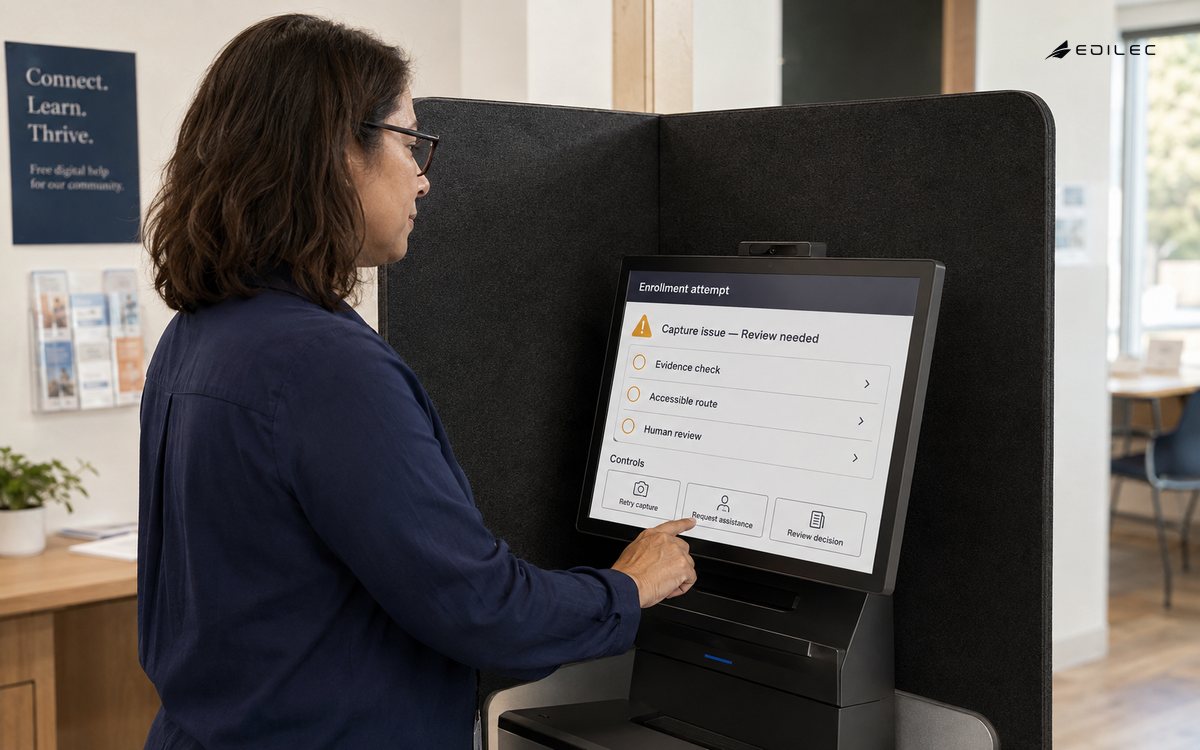
Human review needs defined authority and uncertainty handling. Show reviewers relevant, explainable signals and source provenance; avoid dumping every available personal attribute into a case. Separate review from policy override for high-risk approvals, rotate assignments where insider collusion matters, and sample decisions for quality. Provide reviewers a route to flag new attack patterns. When confidence is insufficient, choose a stronger alternative pathway, limited account, delayed decision, or denial with redress rather than lowering the threshold invisibly.
Bind authenticators and notify the subject
Successful proofing must flow into secure enrollment. Bind the initial authenticator through a protected ceremony tied to the proofing transaction, subject identifier, assurance outcome, and policy version. Prefer phishing-resistant options where risk warrants them; the WebAuthn standard supplies a verifier-bound public-key mechanism. Do not deliver a reusable bootstrap secret through a channel that was not established during proofing. Expire enrollment links quickly, prevent replay, and reconcile partially completed cases.
Send a notice to a validated address or channel independent of the active session, describing the enrollment and a route to dispute it. A disputed enrollment should trigger containment of authenticators and sessions, preservation of relevant evidence, and investigation of linked attempts. Align later recovery with the original assurance; a robust IAL2 enrollment followed by knowledge-question recovery has little durable value. The broader authentication flow guide can help join proofing, binding, session, and recovery states.
Design privacy, accessibility, and redress
Publish what evidence and biometrics are collected, why, which processors receive them, how long they remain, and how a person can correct records or challenge a decision. Minimize centralized biometric templates and raw media; secure unavoidable retention with narrow roles, encryption, monitoring, and deletion verification. Test performance across skin tones, ages, disabilities, document types, device quality, bandwidth, and language. Aggregate accuracy can hide systematic barriers. Offer equivalent alternative pathways rather than pushing excluded users into weak exceptions.
Redress must be reachable without repeating the exact failed mechanism. Give applicants a case identifier, understandable reason category where safe, expected timeline, evidence-submission route, and human escalation. Protect appeals from attackers trying to learn detection details, yet provide enough transparency for correction. Monitor abandonment, repeated failures, appeal overturns, and time to resolution by pathway and population. A secure proofing system that wrongly excludes legitimate users at scale is not meeting its service objective.
Test the complete proofing system
| Test family | Scenario | Evidence | Release criterion |
|---|---|---|---|
| Injection | Virtual camera supplies replayed or generated applicant media | Client, server, media and decision traces | Blocked or escalated according to policy |
| Evidence theft | Genuine document is presented by wrong person | Validation and applicant-binding results | Document validity alone cannot approve |
| Scale | Device farm submits varied identities slowly | Entity graph and rate-control events | Linked activity is detectable and containable |
| Availability | Authoritative source or biometric vendor fails | Fallback transitions and operator actions | No silent pass; safe alternative exists |
| Human process | Reviewer receives urgent social-engineering request | Case actions and override approvals | Required separation and escalation hold |
| Legitimate access | Low-bandwidth or accessibility-constrained user applies | Completion, errors, redress outcome | Equivalent secure pathway succeeds |
Continuously track attack detection, false acceptance, false rejection, manual review, override, source failure, biometric quality, abandonment, appeal, confirmed fraud, and time to containment. Version models and policies, validate updates before deployment, and retain enough lineage to reproduce material decisions. Monitor drift in document populations and attack techniques. Audit logs should support investigation without becoming an uncontrolled identity warehouse; the audit-log architecture guide offers design principles for decision-grade evidence.
Remote identity proofing controls takeaways
- Base proofing intensity on enabled transactions and concrete harms.
- Keep resolution, evidence validation, applicant verification, and fraud decision distinct.
- Protect the capture path against injected and forged media; biometric comparison alone is insufficient.
- Combine independent signals under a versioned policy with bounded human review.
- Join successful proofing to secure authenticator binding and independent notification.
- Measure fraud, error, access, privacy, redress, and population outcomes continuously.
Remote identity proofing FAQ
Does liveness detection stop deepfakes? No single liveness or presentation-attack control stops every injection and forged-media technique. It should be one layer alongside sensor confidence, transaction binding, evidence validation, applicant verification, fraud analysis, and review.
Must remote proofing use biometrics? The selected assurance pathway and service risk determine requirements. Where biometrics are used, teams must address consent, performance, presentation attacks, retention, security, accessibility, and alternatives.
Should suspicious applicants be permanently blocked? Not automatically. Contain the attempt and linked risk, but provide proportionate redress because technical failures and false positives occur. Permanent decisions need authorized policy and reviewable evidence.
Conclusion
Deepfakes make remote proofing harder, but they do not change its core discipline: confidence comes from a chain of independently useful controls and an accountable decision. Protect capture, validate evidence, bind the applicant, constrain overrides, secure enrollment, and support accessible correction. Teams that test the entire chain can adapt as media attacks evolve without mistaking one detection product for an identity system.