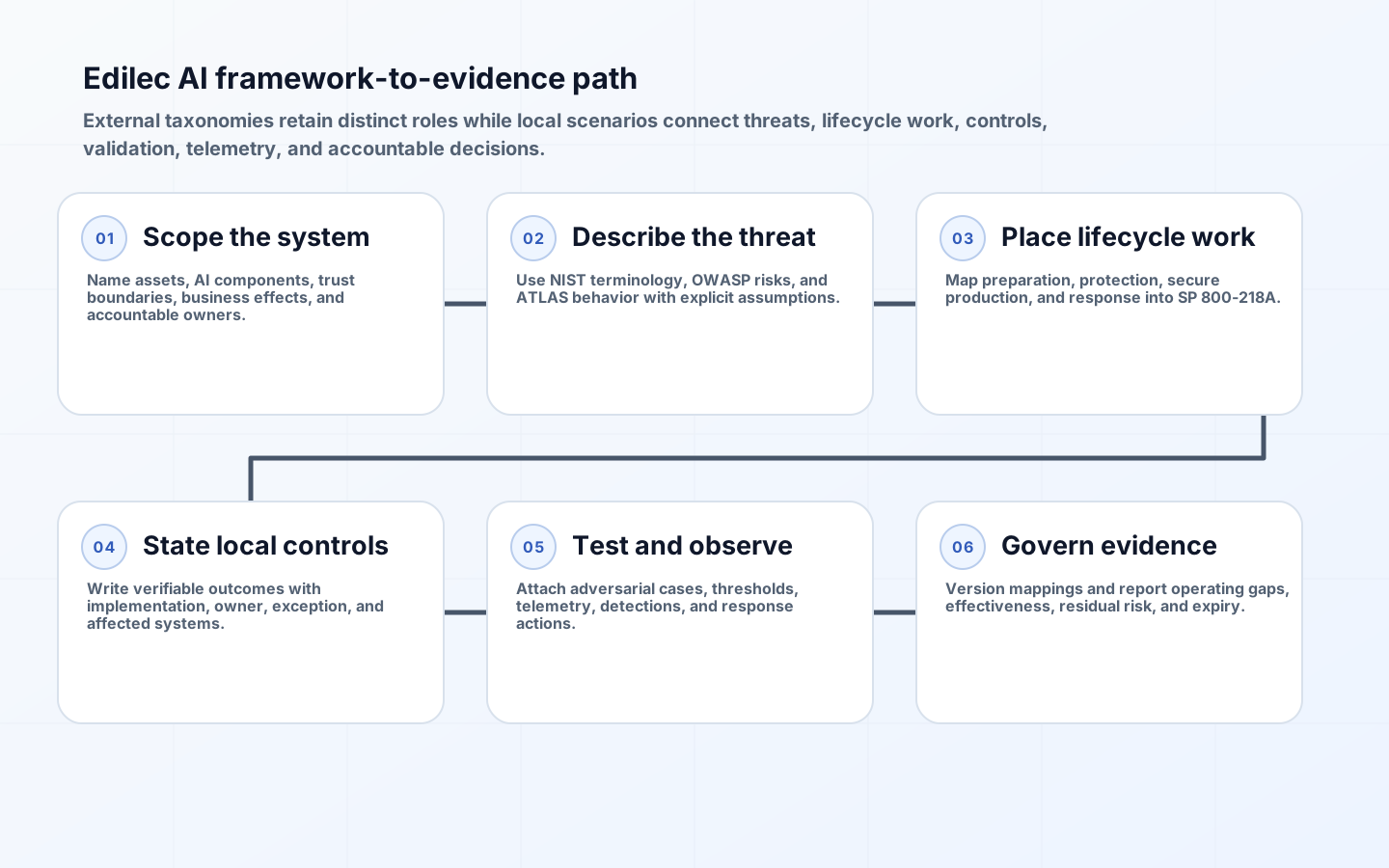
AI security framework mapping is useful only when each source keeps the job it was designed to do. NIST AI 100-2 supplies adversarial machine learning taxonomy and terminology. NIST SP 800-218A organizes secure development practices for AI models and systems. OWASP translates prominent generative-AI application risks into accessible engineering concerns. MITRE ATLAS describes adversary tactics, techniques and case-informed behavior. Treating their headings as interchangeable controls creates a large spreadsheet and very little assurance.
A practical crosswalk starts with a system and a risk scenario, then moves through threat description, lifecycle practice, preventive or detective control, test, telemetry and accountable evidence. It is a navigation layer, not a new framework. Edilec's AI guardrails review helps place runtime controls; this guide connects those controls to development and adversary knowledge without claiming one-to-one equivalence.
Give each AI security source a distinct job
Use NIST AI 100-2 when teams need precise language for attack stage, attacker goals, objectives, capabilities, knowledge and mitigations across predictive and generative AI. It helps a threat model distinguish poisoning, evasion, privacy and abuse. It is not a complete enterprise control catalog or product checklist. Its taxonomy makes scenarios comparable and exposes assumptions that a short risk label can hide.
Use NIST SP 800-218A to integrate AI-specific work into the Secure Software Development Framework. It is aimed at producers of models, producers of systems using models, and acquirers. It adds practices and tasks across preparing the organization, protecting software and model components, producing well-secured releases and responding to vulnerabilities. It gives process ownership and evidence a home, but it does not enumerate every attacker path.
| Source | Primary question | Best enterprise use | Misuse to avoid |
|---|---|---|---|
| NIST AI 100-2 | What adversarial ML attack are we discussing? | Threat language, assumptions, test design and mitigation research | Calling taxonomy entries implemented controls |
| NIST SP 800-218A | Which secure-development practice should own the work? | Lifecycle tasks, responsibilities, artifacts and acquisition expectations | Using practice completion as proof of runtime effectiveness |
| OWASP GenAI | Which application risks need engineering attention? | Backlog discovery, design review, developer education and abuse cases | Treating a Top 10 as exhaustive or certifying |
| MITRE ATLAS | How might an adversary pursue objectives? | Threat modeling, red-team scenarios, detections and incident analysis | Assuming every technique applies to every system |
| Local control catalog | What must our system enforce? | Owner, policy, implementation, evidence and exceptions | Copying external labels without system context |
| Evaluation register | Did the control work for this release? | Cases, thresholds, results, limitations and approval | Confusing test presence with adequate coverage |
Use OWASP for risk discovery and ATLAS for adversary paths
The OWASP GenAI Security Project publishes resources on LLM and generative-AI application risks, agentic security, AI data security, AIBOM, governance and red teaming. Its concise risk framing is useful for workshops and engineering backlogs. For each applicable risk, write the local asset, entry point, trust boundary, business effect and owner. A risk title alone cannot tell whether the application uses retrieval, tools, fine-tuning or shared tenant infrastructure.
MITRE ATLAS can then expand a scenario into adversary behavior across tactics and techniques. Use it to ask what access and knowledge an attacker needs, what preceding activity is observable, and which data sources could detect progression. ATLAS complements, rather than replaces, ATT&CK and conventional application threat models; a model artifact still lives in cloud storage, a stolen token still uses identity infrastructure, and a malicious upload still traverses an application endpoint.
Build a crosswalk around local control objects
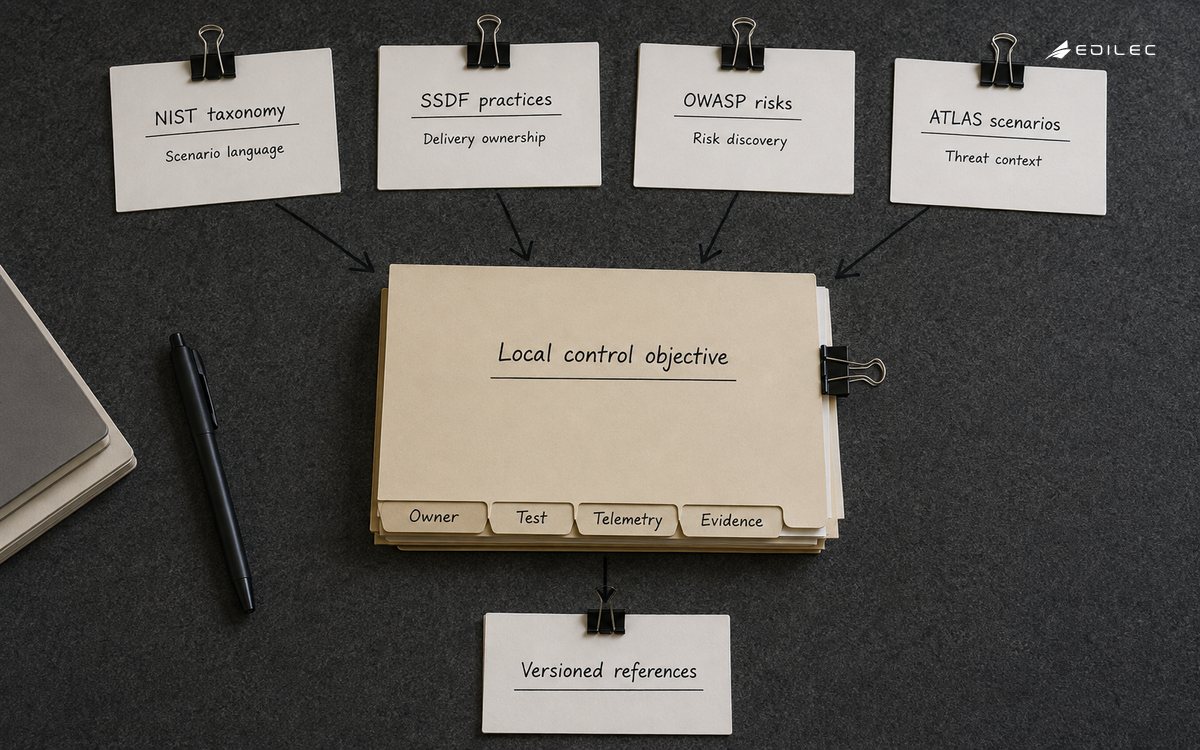
Create local objects for system, asset, scenario, external reference, control objective, implementation, test, telemetry, evidence, owner, exception and status. Map many external references to one local scenario when they describe different aspects, and one reference to many controls when defense is layered. Preserve source version and exact identifier. Do not overwrite an old mapping when a source changes; keep effective dates so audits and incidents can reconstruct what guided a release.
Phrase local controls as verifiable outcomes: 'The retrieval service authorizes every candidate against server-derived tenant and user context' is stronger than 'implement access control.' Link that outcome to code or policy, owner, affected systems, test cases, telemetry and evidence. The authority model in Edilec's agent permissions guide shows the level of resource and operation specificity a control needs.
Map one risk scenario through all four sources
Consider a malicious document that causes an enterprise RAG agent to send data externally. NIST AI 100-2 helps classify poisoning or abuse assumptions. OWASP resources flag data poisoning, prompt injection, sensitive information disclosure and excessive agency concerns. ATLAS helps model how an adversary obtains source access, plants content and achieves collection or impact. SP 800-218A places source governance, protected repositories, secure release, testing and response into lifecycle practices.
The local controls might include approved source onboarding, immutable ingestion lineage, untrusted-content delimiting, server-side authorization, destination allowlists, scoped credentials, user approval for disclosure, output scanning, retrieval and tool telemetry, and index rollback. Each control receives a test and evidence source. The crosswalk adds traceability: it does not imply that checking one OWASP row or one SSDF task proves the scenario is controlled.
| Local layer | Poisoned RAG exfiltration example | Evidence | Review owner |
|---|---|---|---|
| Threat | Attacker edits a synced source and embeds instructions to export retrieved records | System diagram, source roles and mapped external techniques | AI security architect |
| Prevent | Source approval, untrusted context, resource authorization and egress allowlist | Policy, configuration, manifests and denied abuse case | Knowledge and platform owners |
| Detect | Edit burst, instruction-like content, unusual retrieval and denied destination | Correlated source, trace, policy and network events | Security operations |
| Validate | Controlled poison variants cannot influence unauthorized tool effects | Versioned evaluation cases, results and side-effect reconciliation | Product security |
| Respond | Quarantine source, switch index, revoke token and preserve evidence | Exercise record, recovery timing and verified cleanup | Incident response |
| Govern | Residual cases, exceptions and supplier dependencies are accepted explicitly | Risk decision, expiry and funded remediation | Accountable business owner |
Convert mappings into tests and detections
For every high-priority scenario, define a prevention assertion, adversarial case, expected telemetry and response action. Test at the lowest deterministic layer first: authorization, schema, network or artifact policy. Then test system behavior under probabilistic model variation. Preserve model, prompt, data, tool and policy versions. Edilec's model evaluation engineering notes provide the release structure for cases, thresholds, slices and accountable decisions.
Detections should correspond to observable steps, not framework labels. A 'prompt injection alert' may be too vague to act on. A source-integrity alert, retrieval of quarantined content, denied tool scope escalation, new outbound destination or anomalous model-artifact download names the evidence and containment path. Map telemetry gaps honestly. If an ATLAS-inspired behavior cannot be observed, choose prevention, add a signal, or document the residual risk rather than coloring the crosswalk green.
Assign ownership without duplicating frameworks
Maintain one local control record and attach multiple external references. The data platform may own provenance, identity owns authorization services, AI engineering owns evaluation, security operations owns detection, incident response owns containment, and product risk owns acceptance. Mapping should reveal those handoffs, not create four parallel workstreams. A source custodian updates external versions; control owners assess whether a change alters obligations, threats, tests or evidence.
Evidence should be generated through ordinary work: signed manifests, protected repository logs, policy decisions, evaluation results, deployment records, alerts, exercises and risk approvals. Avoid screenshots where machine-readable records exist. Label design evidence, operating evidence and effectiveness evidence separately. A documented egress policy proves design; a deployed configuration proves implementation; an adversarial test and denied event support effectiveness. None alone is sufficient for a high-impact claim.
Govern versions, gaps, and reporting
Record source title, publisher, version or date, identifier, link, mapping rationale, reviewer and review date. Monitor publisher updates and prioritize impact by affected systems rather than remapping every row immediately. New techniques may create a scenario; revised OWASP risks may improve communication; an SP 800-218A interpretation may alter lifecycle evidence. Keep historical mappings for releases already approved. Never silently map a retired identifier to a different meaning.
Report coverage by risk scenario and evidence quality, not the percentage of external rows assigned. Useful measures include material systems with current threat models, high-risk scenarios with owners and tests, controls with operating evidence, detections exercised, expired exceptions and unresolved telemetry gaps. Edilec's AI governance guide provides the decision forum in which those gaps can be prioritized and funded.
Key takeaways
- Use NIST AI 100-2 for adversarial terminology, SP 800-218A for lifecycle practices, OWASP for risk discovery and ATLAS for adversary paths.
- Map external references to local scenarios, control outcomes, tests, telemetry, evidence and owners.
- Preserve many-to-many relationships and source versions rather than forcing false equivalence.
- Distinguish design, implementation, operating and effectiveness evidence.
- Measure scenario coverage and unresolved gaps, not the percentage of taxonomy rows colored green.
Frequently asked questions
Which AI security framework should an enterprise adopt?
Usually no single source covers governance, development, application risk, adversary behavior, testing and operations. Choose a governing risk and control model, then use these sources for their distinct specialist roles and connect them through local evidence.
Is the OWASP GenAI list a compliance standard?
No. It is a valuable community resource for awareness and engineering risk discovery, not a certification. Organizations must determine applicability, implement controls and verify effectiveness in their own system and obligations.
Can MITRE ATLAS techniques be mapped directly to controls?
They can inform controls, tests and detections, but one technique often needs multiple layered mitigations and one control can address multiple techniques. Preserve the scenario, assumptions and observable behavior instead of claiming one-to-one coverage.
Conclusion
A strong AI security crosswalk is a translation service between risk, engineering and operations. It lets each authoritative source contribute its intended perspective while local control records remain specific, owned and testable. That approach produces fewer duplicate controls and more useful evidence than merging every heading into a master checklist.
Pilot the method on one consequential scenario. Map attacker assumptions, lifecycle practices, preventive controls, tests, detections, response and evidence. The missing links will show whether the next investment belongs in architecture, development, observability, operations or governance, which is the decision the mapping should make easier.