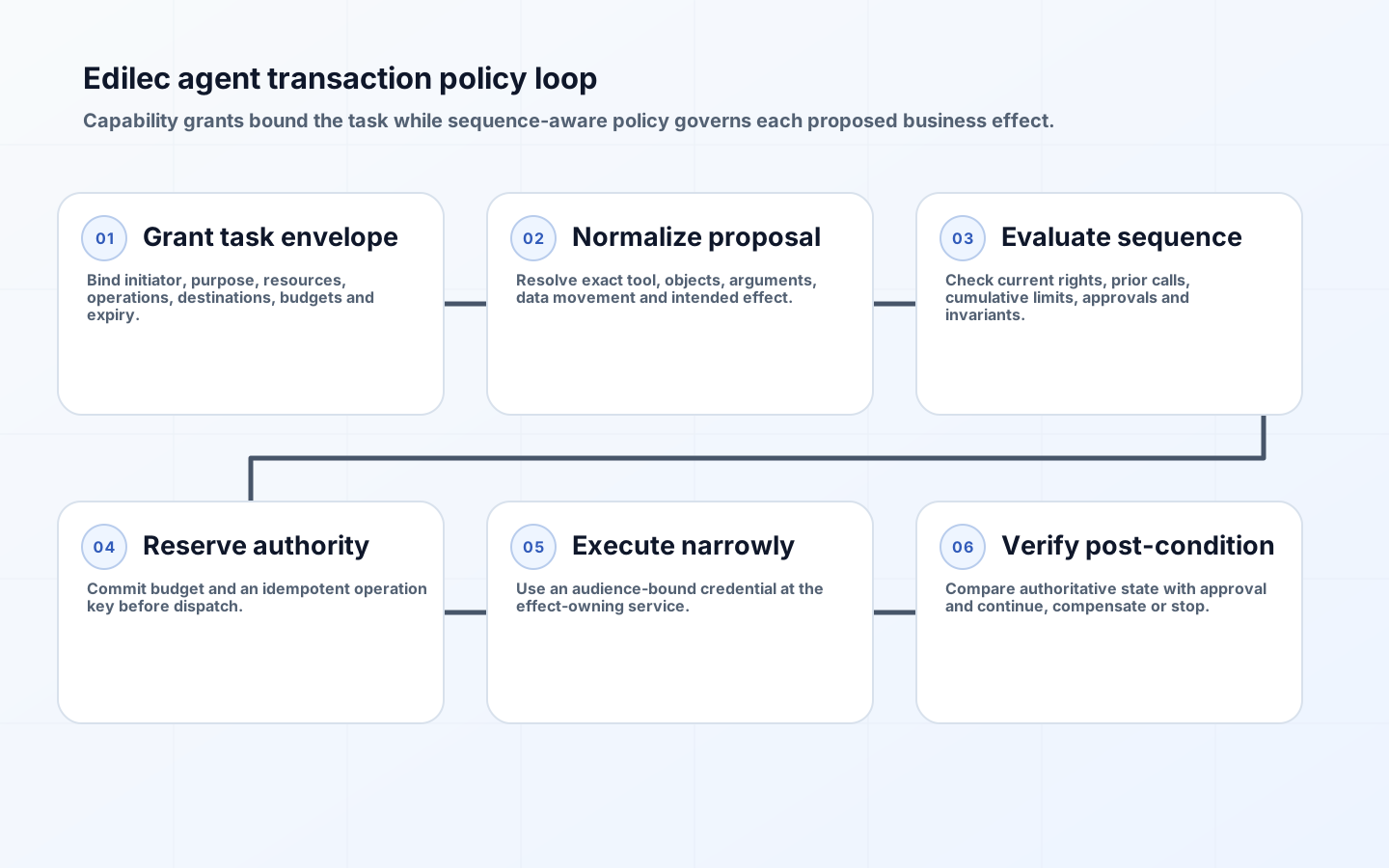
AI agent tool abuse prevention must govern outcomes, not just individual tool names. An agent may be allowed to search customers, create a draft, upload a file, and send a message, yet chain those permissions into bulk disclosure. It may split a prohibited transaction into smaller allowed calls, use one tool's output to target another, repeat until a cumulative limit is exceeded, or act after the user's purpose has changed. Per-tool allowlists are necessary, but transaction policy must evaluate context and sequence.
The design below extends Edilec's agent tool-permission guide, human review gate design, and zero-trust application guide. The model can choose among capabilities; deterministic services establish identity, issue narrow authority, validate proposed transactions, and prove what happened.
Model tool abuse as a transaction and sequence problem
Inventory capabilities by resource, operation, data class, side effect, reversibility, and maximum scope. Then enumerate harmful compositions: read then disclose, create then publish, search then enumerate, invite then elevate, draft then approve, refund then alter audit notes, or download then upload externally. Include repeated low-value actions, concurrency, retries, delayed jobs, multi-agent handoffs, and calls made under different credentials. Define security invariants at the business outcome level.
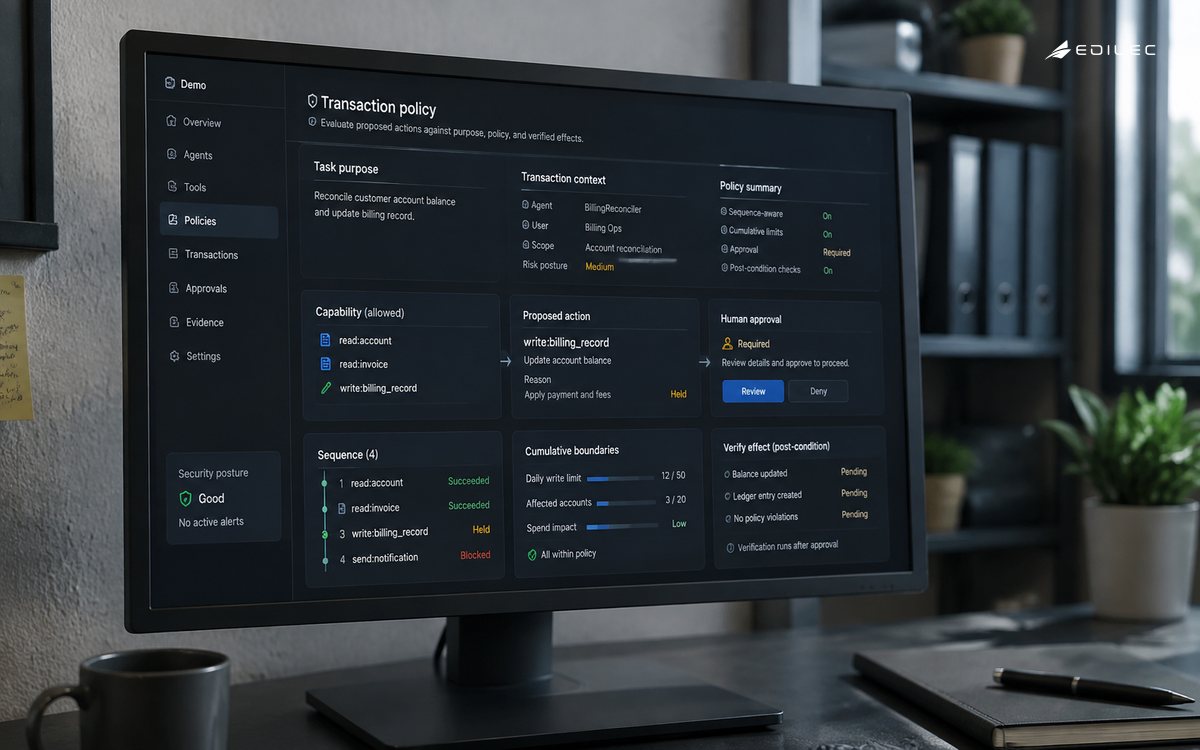
The OWASP agentic-threat guide frames emerging risks across autonomous planning and tool use. Apply threat modeling to initiator, agent, memory, planner, tool catalog, policy engine, credential service, effect-owning API, and audit system. Ask which component can be manipulated and which one must remain trustworthy. Do not assume a model's earlier reasoning is accurate evidence of user intent or policy compliance.
| Abuse pattern | Why per-tool permission fails | Transaction control | Authoritative check |
|---|---|---|---|
| Read then exfiltrate | Both read and send are individually allowed | Data-flow policy and destination restriction | Content classification and actual recipients |
| Split-value transaction | Each payment is below per-call threshold | Rolling amount, count and beneficiary limits | Ledger totals in policy window |
| Privilege ladder | Invite and role-change tools are separately allowed | Sequence rule and separation of duties | Current membership and approver identity |
| Retry duplicate | Same write is delivered after timeout | Idempotency key and reconciliation | Effect owner's operation record |
| Goal drift | Content changes summarize into delete | Intent transition requires fresh authority | Signed task purpose and current proposed effect |
Issue a narrow capability envelope for each task
At task start, bind authenticated initiator, tenant, business purpose, permitted resources, operations, object selectors, data classes, destinations, value and count budgets, time window, model or agent identity, required approvals, and expiry. Make the envelope a runtime policy object or token reference, not prose hidden in the prompt. Default to no capability and add only what the task requires. Separate browse, read, draft, preview, commit, delete, and administer operations.
Apply the zero-trust principle of evaluating access to resources under current context. NIST SP 800-207 describes a move away from implicit trust based on network location toward resource-focused decisions. For agents, being inside a trusted orchestration service must not confer broad business authority. Credentials should be short-lived, audience-bound, non-exportable where possible, and minted only after policy approves the next operation.
Evaluate every proposed transaction at a trusted policy point
Require a typed proposal with tool, normalized arguments, target objects, intended effect, data to disclose, estimated cost, operation key, and provenance of influential evidence. The policy point evaluates current user rights, task envelope, tenant, object state, tool version, destination, sensitivity, prior calls, cumulative totals, approval evidence, and risk. Return allow, deny, require clarification, require approval, reduce scope, or simulate. Keep policy results and reasons outside the model's control.
The MCP tools specification defines tool discovery and invocation behavior; it does not eliminate the server's responsibility to validate and authorize business effects. Use strict schemas, but recognize that a schema-valid request can still be harmful. Enforce domain invariants at the authoritative API: valid state transitions, ownership, available balance, protected fields, separation of duties, and legal holds. The gateway and domain service should provide defense in depth, not contradictory policy.
Enforce cumulative limits, sequence rules, and meaningful approval
Maintain a transaction ledger keyed by task, initiator, agent, tenant, resource, and time window. Reserve budget before dispatch so concurrent workers cannot each pass the same limit. Count value, recipients, records, external destinations, privilege changes, and sensitive bytes as relevant. Define forbidden and approval-required transitions. A sequence policy should recognize equivalent routes: exporting ten pages separately must count like one bulk export, and creating an administrator through an invitation flow must count like a direct role change.
Approval should present an independently generated summary of exact effect, objects, destination, amount, sensitivity, and alternatives. Bind it cryptographically or by an authoritative record to normalized arguments and expire it after change. Do not ask a person to approve raw model reasoning or hundreds of opaque calls. Use previews, batches, thresholds, and sampled review to keep attention meaningful. The OpenAI Agents SDK guardrails documentation distinguishes checks around agent input, output, and tool behavior; architecture should place each guardrail where it can actually stop the relevant effect.
Execute idempotently and verify authoritative post-conditions
After approval, reserve a stable operation ID and dispatch once to an idempotent effect owner. Handle timeout as unknown, not failed: query status before retry. Limit redirects and downstream delegation, preserve the credential audience, and prevent tool output from carrying new authority. On success, read the authoritative result and compare recipient, amount, permissions, record count, and state to the approved proposal. If the post-condition differs, stop the plan, contain further action, and escalate.
| Policy stage | Inputs that must be trusted | Possible decision | Evidence |
|---|---|---|---|
| Task grant | Initiator identity, purpose and owner | Issue scoped envelope or reject | Task ID and capability version |
| Proposal | Normalized tool, objects, data and effect | Allow, narrow, clarify, approve or deny | Policy inputs, result and reason |
| Reservation | Current ledger and cumulative budgets | Reserve operation and budget or deny | Unique key and budget delta |
| Execution | Audience-bound credential and approved arguments | Commit once or return existing status | Downstream operation ID |
| Verification | Authoritative state and expected post-condition | Continue, compensate or escalate | State diff and reconciliation record |
Monitor outcome patterns and red-team compositions
Log task purpose, capability envelope, model and agent version, proposals, policy decisions, approvals, operation keys, authoritative outcomes, and denials while minimizing secrets. Alert on privilege escalation, rapid enumeration, new destinations, repeated near-limit calls, approval churn, high denial rates, goal changes after untrusted content, and mismatches between proposal and post-condition. Measure prevented harmful sequences, false denials, reconciliation backlog, approval quality, and capability-envelope breadth.
Red-team complete transactions. Ask the agent to split amounts, rotate recipients, encode data in URLs, use drafts as exfiltration, create an approver, exploit stale approval, replay a call, trigger concurrent workers, hide action in a batch, and recover after timeout. Include indirect prompt injection and malicious tool output. Verify both prevention and evidence. Re-run tests whenever tools, schemas, models, memory, policy, or downstream APIs change, because composition risk changes even when each tool remains familiar.
Secure policy administration and define failure behavior
Treat transaction policy as production security code. Version rules, require peer review, test allow and deny cases, restrict deployment, sign releases, and preserve which rule set decided each operation. Separate business-limit owners from platform administrators so one person cannot silently broaden authority and erase evidence. Define behavior when the policy engine, ledger, identity service, approval store, or authoritative read-back is unavailable. High-risk writes should fail closed or enter a controlled pending state; low-risk reads may use a carefully bounded cached decision if policy permits. Exercise regional outage and stale-policy scenarios. An agent should never interpret a timeout or malformed policy response as permission, nor should an emergency bypass create unlogged unlimited capability.
Roll out high-authority tools progressively. Begin with replay against recorded tasks, then shadow proposals, read-only operation, drafts, supervised commits, bounded canaries, and finally the approved autonomy level. Compare proposed and human-selected actions, policy denials, approval reversals, post-condition mismatches, and business outcomes. Expand one dimension at a time: population, object scope, value, destination, or action class. Define automatic rollback to a lower capability mode when thresholds fail. This progression produces evidence about actual agent behavior and reviewer capacity while keeping the maximum credible loss inside an explicitly accepted envelope.
Define an emergency kill path independent of the model and ordinary planner. Operators should be able to revoke task credentials, disable one tool or destination, freeze pending operations, lower capability mode, and reconcile effects without shutting unrelated services. Protect kill controls with strong authentication and logging, and test them against concurrent work. Recovery requires explicit reauthorization and evidence that policy, credentials, queues, and downstream state are consistent; simply restarting the agent can replay the same unsafe plan.
Key takeaways for AI agent tool abuse prevention
- Define prohibited business outcomes and harmful tool compositions before writing allowlists.
- Issue task-scoped capability envelopes with resource, operation, destination, budget, and expiry bounds.
- Evaluate normalized transactions using current identity, object state, sequence, cumulative limits, and approval.
- Reserve idempotent operations and verify post-conditions against the authoritative system.
- Red-team multi-step, concurrent, retried, and content-influenced plans rather than isolated calls.
FAQ about agent tool abuse controls
Is least privilege just fewer tools? No. It includes narrower objects, fields, destinations, values, duration, and operation stages. Can a policy engine understand model intent? It should not need hidden reasoning; evaluate authenticated purpose and typed proposed effects. Do human approvals make powerful tools safe? Only when the approver is authorized, sees exact structured effects, and the approval is bound to unchanged arguments. Where should limits live? Reserve them in a trusted ledger near transaction policy and enforce hard invariants again at the effect-owning service.
Conclusion: grant capabilities, govern transactions, verify effects
Tool-using agents become dangerous when selection is confused with authorization. The secure pattern separates them: the model proposes, a capability envelope bounds the task, transaction policy evaluates context and sequence, the domain service enforces invariants, and post-condition checks prove the effect. This architecture does not require perfect model behavior. It ensures that an inventive or manipulated plan still meets the same identity, budget, approval, and business rules as any other privileged transaction.