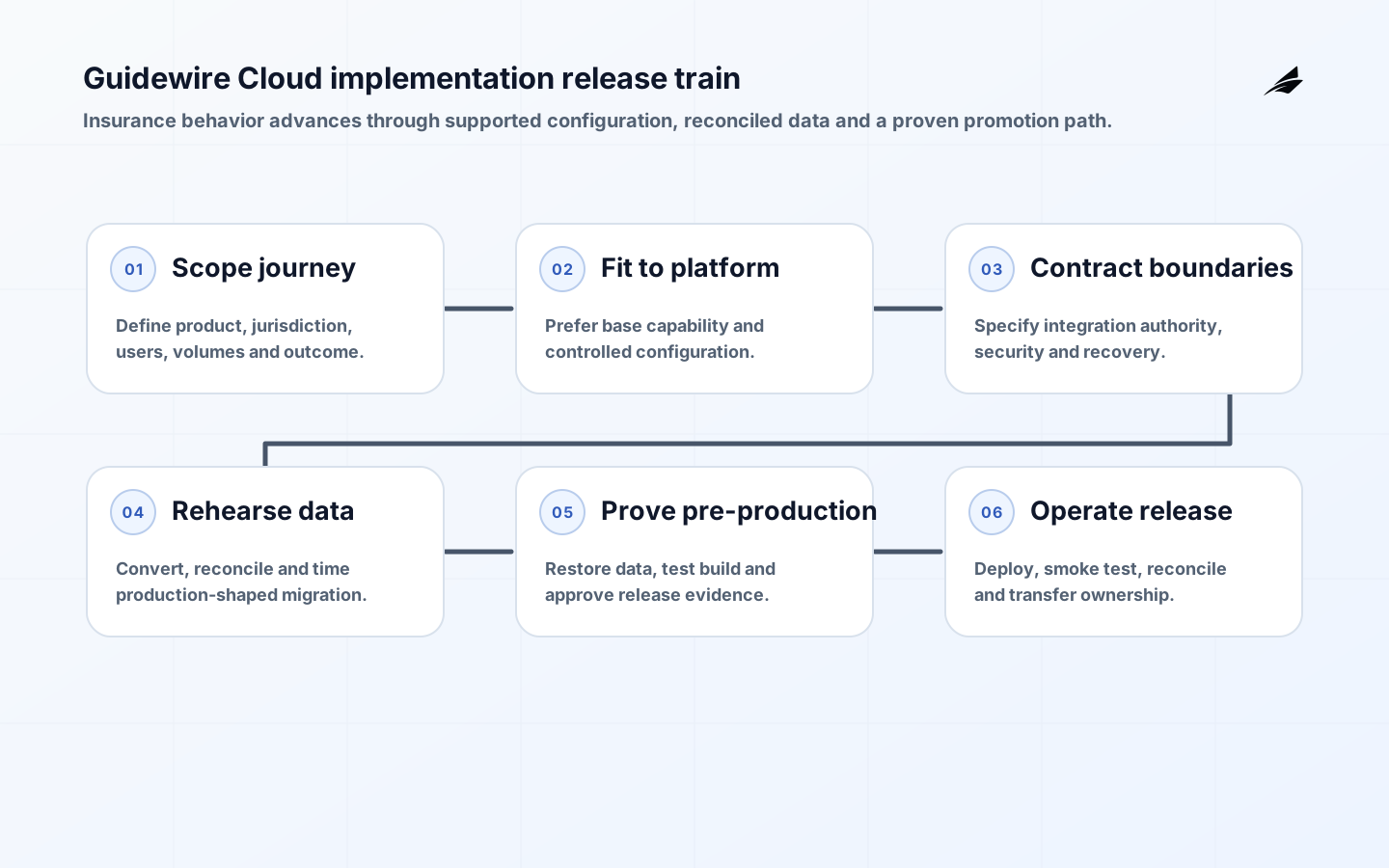
A Guidewire Cloud solution implementation is an insurance operating-model change expressed through product configuration, integrations, data and releases. The implementation must preserve policy, billing and claims outcomes while adopting the platform’s supported development and deployment path. Success is not simply moving InsuranceSuite to hosted infrastructure; it is reducing avoidable customization, proving business behavior and building an insurer team that can absorb continuing cloud releases.
This checklist should be tailored to the contracted Guidewire products, cloud region, release and insurer obligations. Use it with the Guidewire scope, cost and risk plan, the Guidewire Cloud FAQ and the cloud solution Guidewire checklist. Confirm current behavior in official documentation and Guidewire Community before execution.
Define insurance outcomes and product scope
Select bounded journeys such as quote-to-bind, policy change, billing exception or first notice of loss through assignment. Define target products, jurisdictions, channels, users, volumes, service objectives and measurable outcomes. Inventory current rules, forms, integrations, reports, data, manual work and regulatory evidence. Separate capabilities required for day-one continuity from changes intended to improve the process.
Establish design authority across product, underwriting, claims, billing, architecture, data, security and operations. Decide how the program evaluates base capability, configuration, extension, marketplace solution and process change. Guidewire describes Cloud Standards as principles and practices for quality, predictability and security in its developer migration guidance. Record every departure with value, upgrade impact, owner and retirement trigger.
| Design choice | Preferred question | Evidence before approval |
|---|---|---|
| Use base capability | Can the operating process adopt the supported behavior? | Fit demonstration and policy-owner acceptance |
| Configure | Is the variation supported without custom code? | Configuration design, tests and ownership |
| Extend | Does differentiated value justify lifecycle burden? | Architecture decision, assurance impact and upgrade test |
| Integrate | Which system owns the record and failure recovery? | Contract, security, idempotency and reconciliation |
| Migrate | Which history must be operationally active? | Retention, archive access and conversion rules |
| Retire legacy | What dependency or evidence remains? | Decommission checklist, archive proof and access removal |
Understand the Guidewire Cloud delivery model
Guidewire Cloud Platform provides development, build, deployment and observability capabilities. Its platform documentation describes star systems, planets, databases, authentication, build and promotion. Map those concepts to insurer environment policy, release authority and segregation of duties. Document which responsibilities belong to Guidewire, the implementation partner and the insurer for code, configuration, identity, data and external services.
Provision access through individual identities and least privilege. Separate development work from promotion to pre-production and production. Inventory repositories, binary storage, CI/CD, certificates, secrets, variables and runtime properties. Define evidence retention for builds and deployments. Establish a current-release watch and a process for testing platform changes, deprecations and InsuranceSuite updates against the insurer’s configurations and integrations.
Control configuration and integration boundaries
Organize configuration around owned insurance capabilities and trace business rules to tests. Avoid copying legacy behavior without confirming current need. Keep rules, product model, forms and user experience coherent across policy, billing and claims. Review batch schedules and high-volume operations. Every custom component should have a named owner, supported interface, logging, performance expectation and upgrade compatibility strategy.
For integrations, specify direction, authoritative system, protocol, authentication, payload, privacy class, throughput, timeout, retry, idempotency, ordering and reconciliation. Guidewire’s network connectivity guidance documents connectivity options including public TLS and supported PrivateLink scenarios. Test DNS, certificates, proxies, firewall paths, private endpoints and provider rate limits under production-shaped conditions.
| Integration class | Control focus | Failure exercise |
|---|---|---|
| Synchronous rating or identity | Latency, timeout, authentication and safe fallback | Dependency slow, unavailable or returns invalid schema |
| Asynchronous document or finance | Durability, ordering, duplicate handling and reconciliation | Consumer outage followed by controlled replay |
| Inbound API or portal | Authorization, tenant or account scope and abuse limits | Valid user attempts unauthorized object access |
| Outbound notification | Consent, template, provider response and idempotency | Provider timeout after accepting message |
| Data and analytics feed | Purpose, minimization, freshness and correction | Late or corrected source record |
| Batch or file exchange | Encryption, completeness, cutoff and quarantine | Partial, duplicate or malformed file |
Rehearse insurance data migration and reconciliation
Classify policy, account, billing, claims, party, document, note, code and audit history by operational need, legal retention and archive access. Profile completeness, duplicates, invalid references, unsupported codes and date or currency semantics. Define transformation rules with business owners. Decide what migrates actively, what is summarized and what remains in a governed archive; preserve links users need to service customers and explain prior decisions.
Run repeatable conversion cycles with record counts, financial control totals, referential integrity, rejected-record queues and business sampling. Reconcile open policies, receivables, payments, reserves, recoveries and claim financials according to scope. Time extraction, load, validation and rollback. The final rehearsal should use production-shaped volume and the exact code and procedure intended for cutover. Retain signed discrepancy treatment and evidence.
Embed security, testing and deployment checks
Guidewire’s application and development security guidance states that the insurer’s responsibility spans its code and configurations even though Guidewire manages the underlying platform. Threat-model custom code, integrations, document processing, administrative tools and secrets. Test role and object authorization, protect components and follow Guidewire’s customer security-testing policy.
Build a layered suite: rules and utilities, integration contracts, product-model and configuration tests, data-conversion tests, and end-to-end insurance journeys. Add accessibility, performance, batch, resilience and security evidence. Guidewire deployment checks can block promotion when required verification is not successful. Define insurer gates beyond platform checks, including business acceptance, reconciliation and support readiness.
Follow a rehearsed promotion and production release path
Guidewire’s current production deployment procedure describes preparation, dry run and production stages. It recommends promoting builds to pre-production, backing up production, restoring that data in pre-production, testing, then promoting the verified builds and running production smoke tests. Plan around maintenance windows and confirm current prerequisites for the exact platform release.
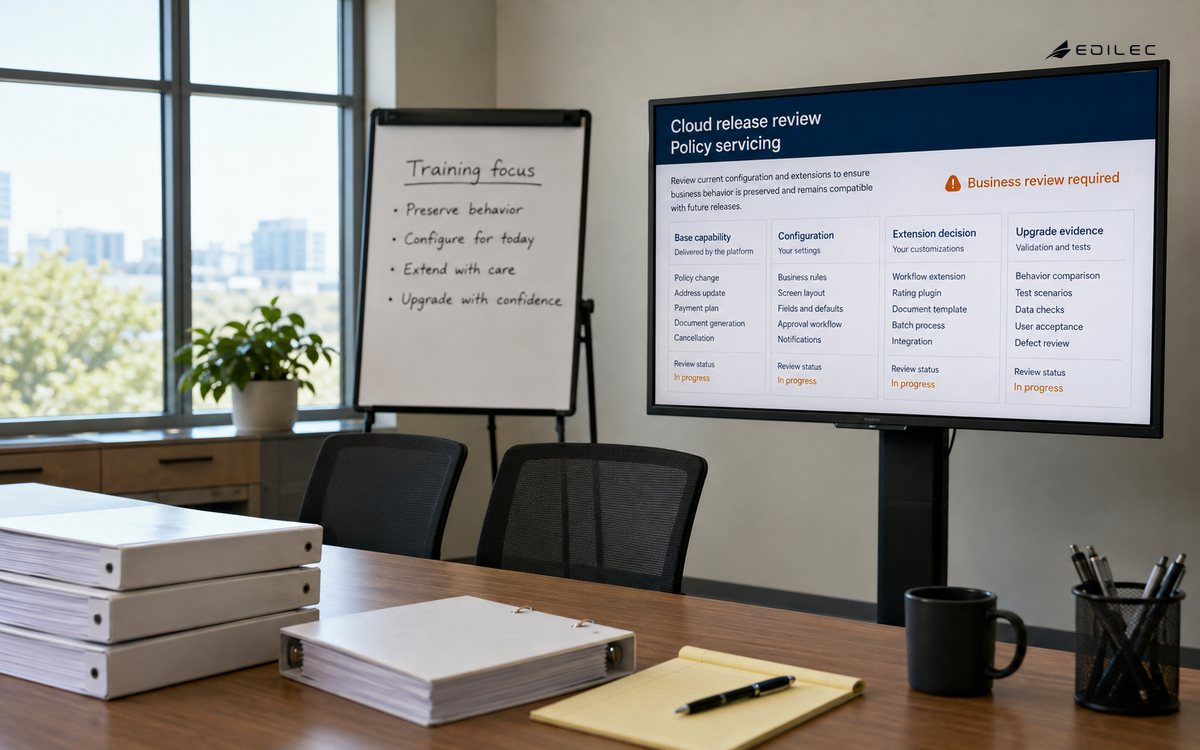
- Freeze the release candidate and trace configuration, code, integration and migration versions.
- Promote to pre-production and restore an approved production backup under protected access.
- Run conversion, regression, performance, security, batch and end-to-end insurance tests.
- Review discrepancies, schema changes, deployment checks, settings, certificates and open risks.
- Approve business cutover, communication, support bridge, control totals and reversal criteria.
- Promote the verified build and deploy using the supported production procedure.
- Verify application and node status, execute business smoke tests and reconcile critical records.
- Stabilize under enhanced monitoring and close the release only after business acceptance.
Prepare insurer ownership and continuous cloud operation
Name owners for product configuration, integrations, data, security, release, incident response and Guidewire relationship. Instrument critical insurance journeys and external dependencies, not just node health. Maintain runbooks for failed batch, interface backlog, document outage, identity failure and data correction. Review platform status, release notes, vulnerabilities, capacity, cloud usage and assurance findings on an agreed cadence.
Transfer knowledge through insurer participation in design, code review, release and incident exercises. Keep decisions and tests current, and maintain a backlog for reducing extensions that obstruct updates. Measure quote or claim outcomes, transaction correctness, release reliability, interface exceptions, support demand and update readiness. The implementation should leave the insurer able to accept platform evolution without reopening the original transformation program.
Example: implement first notice of loss as a bounded journey
For first notice of loss, define required claim facts, policy lookup, coverage snapshot, party matching, document intake, fraud signal and assignment. Demonstrate the base Guidewire behavior before adding extensions. Specify which system owns identity, geocoding, documents and outbound communications. Make duplicate notice handling, unavailable policy service and suspicious upload explicit rather than leaving them for end-to-end testing.
Create contract tests for integrations, role tests for claim access and conversion tests for open claims if migration is involved. In pre-production, use restored production-shaped data to run notification, assignment, reserve and document scenarios, then reconcile created records. Production smoke tests should verify a controlled claim path without exposing real customer information. Measure intake completion, assignment delay, duplicate rate and support exceptions after launch.
Key takeaways
- Frame Guidewire Cloud around bounded insurance journeys and measurable outcomes.
- Prefer supported base capability and configuration; justify every extension by lifecycle value.
- Specify integration authority, failure behavior and reconciliation before development.
- Rehearse migration and the documented pre-production-to-production release path with real evidence.
- Build insurer ownership for continuing updates, operations and reduction of avoidable customization.
Frequently asked questions
Can insurers customize Guidewire Cloud?
The platform supports configuration and defined extension approaches, but every departure from base capability can add assurance and update work. Use current Cloud Standards and product documentation, prefer supported interfaces, test upgrade compatibility and retain a decision explaining why the extension’s value exceeds its lifecycle cost.
Should all legacy policy and claims history migrate?
Not automatically. Migrate what active servicing, analytics and obligations require; place other history in a governed, searchable archive when appropriate. Define user access, legal retention, evidence integrity and cross-links. Test that staff can answer real historical questions before retiring the old system.
What should an implementation partner hand over?
At minimum: source and history, configuration, integration contracts, conversion rules, tests, build and promotion knowledge, architecture decisions, security evidence, runbooks, licenses, known risks and training. Verify by having the insurer team deploy, diagnose and change a representative capability using its own access.
Conclusion
After each cloud update, record compatibility findings for configurations and integrations, remediation effort and escaped issues. Trend that evidence to identify extensions that deserve redesign or retirement.
A Guidewire Cloud implementation is dependable when insurance outcomes, supported platform practices and insurer ownership reinforce each other. Keep configuration close to the product, make integrations and migration reconcilable, follow the current promotion procedure and test operational recovery. That foundation turns cloud delivery into a sustainable release train rather than a one-time migration event.