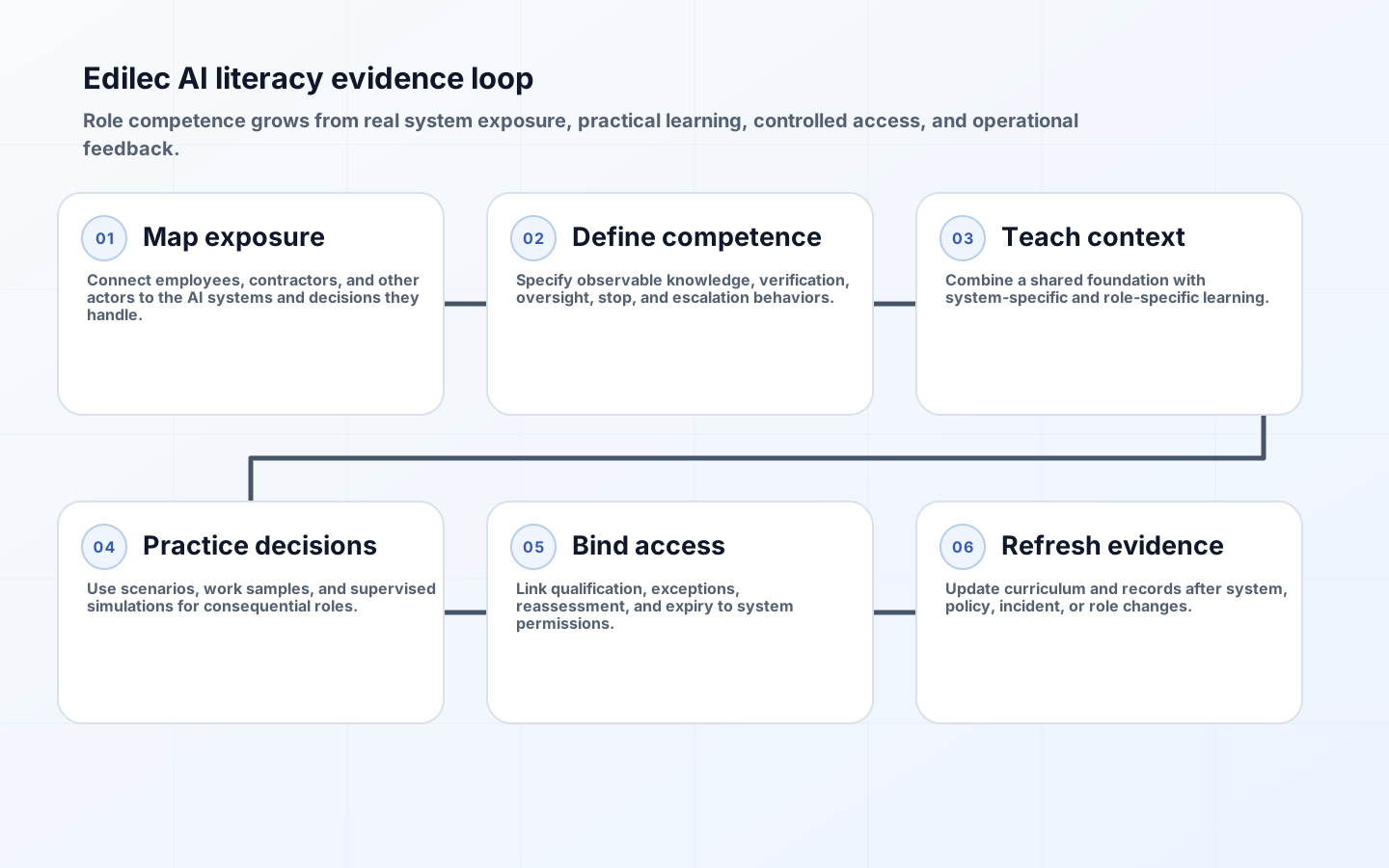
EU AI Act AI literacy should change how people select, configure, supervise, challenge, and stop AI systems. A generic annual video can establish common vocabulary, but it cannot make a recruiter competent to review candidate-ranking output, an engineer competent to evaluate retrieval risks, or a procurement lead competent to challenge a model-change clause. Build a role-based program from the systems people actually operate and the decisions they are authorized to make.
Article 4 of Regulation (EU) 2024/1689 requires providers and deployers to take measures to ensure sufficient AI literacy for staff and other people dealing with AI systems on their behalf, considering technical knowledge, experience, education, training, use context, and people on whom systems are used. The Commission's current materials also describe a proposed Digital Omnibus change. Track that legislative process, but retain role competence because safe operation, human oversight, contracts, and other duties still depend on it.
Define literacy as observable role competence
Write outcomes as actions: identify which approved systems may be used; recognize personal or confidential data; explain material limitations; verify outputs against authoritative sources; apply human-oversight instructions; record overrides; route complaints; stop use after a control failure; and escalate an unapproved use. Knowledge of definitions matters only when it supports these behaviors. Include opportunities and benefits so staff can choose appropriate uses rather than treating literacy as fear training.
The Commission's AI literacy Q&A suggests a minimum analysis of general AI understanding, provider or deployer role, system risk, people's existing knowledge, context, and affected persons. It says no certificate or mandated governance structure is required and internal records of training or guidance can be kept. That flexibility places responsibility on the organization to show why its program is sufficient.
Build a role-based AI literacy architecture
Create a common foundation and role modules. The foundation covers approved use, AI-system basics, limitations, privacy, security, intellectual property, bias, hallucination, transparency, incident reporting, and affected-person awareness. Role modules cover the exact systems, decisions, controls, and escalation routes for builders, evaluators, human reviewers, frontline users, procurement, legal, HR, support, executives, and contractors. High-impact roles require supervised practice, not only content completion.

| Audience | Required competence | Practice evidence | Refresh trigger |
|---|---|---|---|
| All users | Approved uses, data boundaries, verification, reporting | Scenario quiz and policy attestation | Policy or tool change |
| Builders | Intended purpose, evaluation, logging, secure design | Design review and test artifact | Model or architecture change |
| Human overseers | Limits, signals, override, recourse, stop authority | Observed case simulation | Drift, incident, changed workflow |
| Procurement and legal | Role, documentation, terms, vendor change | Evidence-package review | Renewal or new regulation |
| Executives and risk owners | Risk tolerance, residual risk, accountability | Gate decision exercise | Material portfolio change |
Teach the system and workflow, not AI in the abstract
For each production system, provide a concise operating brief: intended purpose, prohibited and out-of-scope uses, users and affected groups, input rules, known limitations, confidence or uncertainty signals, required verification, human authority, monitoring, incident route, and change date. Use examples from the actual interface and business process. A user should be able to distinguish an output that can be accepted, one that requires corroboration, and one that requires immediate stop and escalation.
The Commission confirms on its skills and literacy page that Article 4 entered into application on February 2, 2025 and emphasizes technical knowledge, experience, education, training, and use context. It also warns that examples in the literacy practices repository do not automatically create a presumption of compliance. Borrow instructional ideas, but justify your own coverage.
Include contractors and people acting on your behalf
Map roles by activity, not payroll status. Managed-service staff, temporary reviewers, consultants, outsourced support, implementation partners, and in some circumstances clients may deal with systems on the provider's or deployer's behalf. Put literacy prerequisites, system-specific guidance, evidence exchange, refresh duties, and access suspension in contracts. Verify completion before credentials are issued and withdraw access when the engagement or qualification expires.
Do not accept a vendor's generic AI certificate as proof of competence for your workflow. Assess relevant knowledge and provide local operating rules. The DevOps onboarding guide offers a useful pattern: tie learning to access, supervised work, and real escalation paths rather than a document dump.
Produce evidence without turning learning into surveillance
Maintain a role-to-system matrix, curriculum version, learning assignments, completion, assessment or observed-practice result, exceptions, instructor or approver, and refresh date. Preserve aggregate program metrics and targeted remediation. Minimize personal data, restrict access, set retention, and explain how records are used. The objective is to demonstrate program design and competence support, not to create a permanent behavioral dossier.
| Evidence | What it proves | What it does not prove | Owner |
|---|---|---|---|
| Curriculum map | Topics connect to roles and systems | Individuals can apply them | Program owner |
| Completion record | Material was completed | Competence under pressure | Learning operations |
| Scenario assessment | Person recognized defined cases | Every future case is covered | Role owner |
| Observed simulation | Controls and escalation were practiced | Production will never fail | Operational supervisor |
| Incident learning record | Program adapted to experience | Root cause is fully corrected | Governance and incident owners |
Assess proportionately and remediate gaps
Use short scenario assessments for ordinary users, practical review exercises for operators, artifact review for builders, and decision simulations for accountable executives. Set pass criteria before testing. A failure should lead to targeted coaching and retest, not automatic punishment. Analyze questions with widespread errors as curriculum defects. Test the ability to find current instructions because memorizing every policy detail is unrealistic.
NIST's AI RMF Core includes clear roles, training, and human-AI responsibility among governance outcomes. Use those outcomes to connect literacy to delivery, oversight, and risk management. The AI governance guide can place ownership across HR, learning, product, compliance, security, and department leaders.
Refresh on change, not only on the calendar
Trigger targeted updates after a new system, model or policy version; changed intended purpose; material incident; new affected population; altered human-oversight procedure; regulatory change; or evidence of recurring misuse. Keep an annual foundation refresh only where useful. Send concise change briefs to affected roles and require renewed practice for consequential controls. Archive previous operating instructions so incident investigators know what staff were taught at the time.
Measure operational outcomes: unapproved-use reports, preventable data disclosures, verification quality, overrides, escalation speed, near misses, policy questions, and control adherence. Avoid claiming causation from training alone. Use findings to improve interface design, access controls, automation, and procedures. The compliance-ready delivery guide helps convert recurring learning needs into product and process controls.
Roll out literacy as a managed change program
Start with the system inventory and identify the few roles that can create the largest consequences: builders, release approvers, administrators, human overseers, and teams using sensitive data. Interview them about actual decisions and failure modes. Pilot short modules and simulations, observe confusion, then revise before enterprise launch. Translate core guidance into the languages and accessible formats required by the workforce.
Give managers a roster showing required qualification by role, not private assessment detail they do not need. Integrate assignment with onboarding, role changes, access requests, procurement onboarding, and offboarding. When people temporarily cover a role, require the corresponding preparation. Allow an exception route for urgent incidents, with supervised access, limited duration, and retrospective review.
Create office hours and a searchable question channel so uncertainty surfaces before misuse. Classify questions into curriculum gaps, unclear policy, poor product design, and one-off support. Publish clarifications through controlled updates. A healthy program should make it easier to ask 'is this approved?' and 'how do I verify this?' than to conceal experimentation until an incident.
Evaluate the program after three and six months through work samples and operational signals. Interview staff about situations where guidance was unclear, compare trained and observed procedures, and review whether supervisors reinforce or undermine controls. Correct incentives that reward speed while punishing escalation. Competence decays when workplace norms contradict the course, so department leaders should be accountable for safe practice and adequate time for verification, not merely completion percentages.
Budget learning time as part of system adoption. A department that licenses a tool but allocates no time for practice, verification, or escalation has not created sufficient operating capacity. Include literacy work in launch plans and vendor onboarding, and require product owners to provide current instructions before users are assigned. For high-impact review roles, staffing plans should account for fatigue, case complexity, and access to a second opinion.
Key takeaways
- Define AI literacy as role-specific behavior around real systems, decisions, risks, and stop authority.
- Combine a common foundation with modules for builders, reviewers, users, procurement, leaders, and contractors.
- Link qualification to access and use practical scenarios for consequential roles.
- Keep proportionate records of curriculum, assignment, assessment, remediation, and refresh.
- Update learning when systems and workflows change, and use incidents to improve controls as well as training.
Frequently asked questions
Does Article 4 require an AI literacy certificate?
The Commission Q&A says no specific certificate is required. Organizations can keep internal records of training and other guidance, but should still justify sufficiency for roles and context.
Is one course enough for everyone?
Usually not. The Article 4 factors support differentiated learning based on knowledge, experience, role, system risk, use context, and affected people. Low-exposure roles may need only the foundation.
Are experienced AI engineers automatically AI literate?
Technical experience helps but may not cover organizational systems, legal duties, affected-person impacts, incident routes, or approved operating limits. Assess the competence needed for the assigned role.
Conclusion
A useful EU AI Act AI literacy program is a competence system, not a content library. Map roles to actual systems, teach decisions and controls, include non-employees acting on the organization’s behalf, practice consequential scenarios, and preserve proportionate evidence. Keep the program responsive to legal change, but do not let pending amendments become an excuse to leave people unprepared for systems they operate today.