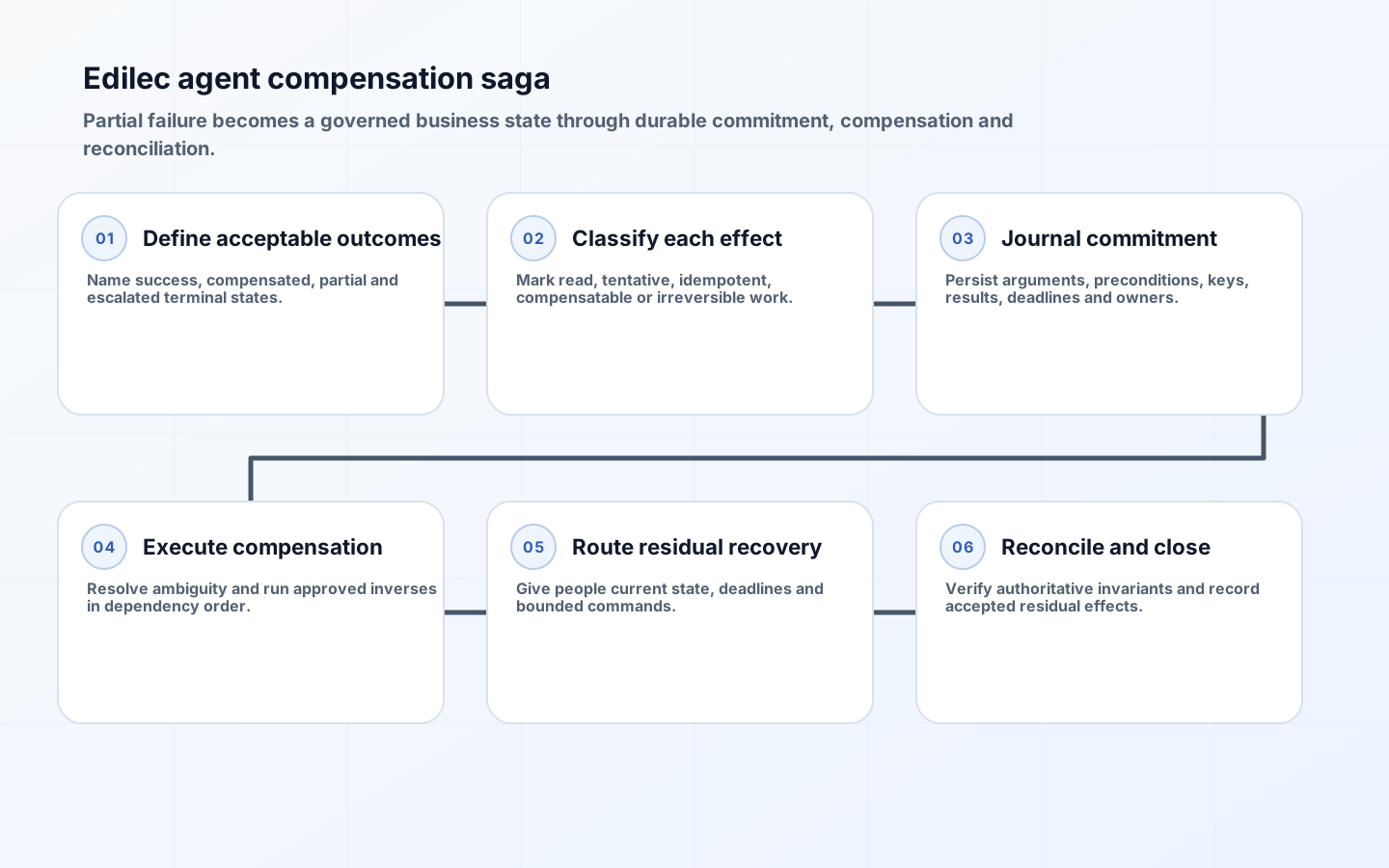
Agent workflow compensation is the planned business action that addresses a previously completed step when a multi-agent workflow cannot finish as intended. It is not a database rollback and rarely restores the world exactly. Canceling a shipment may not retract a customer notification; issuing a credit does not erase the original charge. Reliable automation therefore records each committed effect, defines an authorized compensation, and reconciles the final business state rather than instructing an agent to 'undo everything.'
Multi-agent designs make partial completion more likely because work crosses services, identities, queues and human decisions. A planner may reserve inventory, another agent may create an order and a third may fail to arrange delivery. The runtime needs a durable saga state independent of any model's conversation. Agents can propose and execute bounded steps, but deterministic orchestration owns commitment, idempotency, compensation order and closure.
Define acceptable business outcomes first
For each workflow, list successful, compensated, partially resolved and escalated terminal states. Define invariants: no customer charged without an order record, no revoked employee retaining active credentials, and no shipment left unowned after cancellation. Identify affected parties and required notifications. Compensation design starts from these outcomes, not from technical exceptions. A timeout is ambiguous; the remote action may have succeeded, so the first response is status resolution rather than a duplicate forward call or immediate inverse action.
Name the business owner who can accept residual effects. Technical teams can implement a credit operation, but finance decides whether credit is sufficient compensation for a settled payment. Operations decides how to handle a shipped parcel that cannot be recalled. Some failures require a human case from the beginning. The business process exception handling guide offers a broader queue and ownership model that compensation records can feed.
Classify every step before orchestration
| Step class | Example | Failure treatment | Required record |
|---|---|---|---|
| Read-only | Fetch current entitlement | Retry or refresh with version | Source and observed version |
| Tentative | Hold inventory with expiry | Let expire or explicitly release | Hold ID and deadline |
| Idempotent write | Upsert draft case | Retry with same idempotency key | Key and resulting version |
| Compensatable write | Create reservation | Invoke defined cancellation after status check | Forward and compensation IDs |
| Irreversible effect | Send disclosure or settle external transfer | Escalate and mitigate residual harm | Evidence, affected party and owner |
| Human commitment | Approve contractual exception | Follow governed revocation or amendment process | Decision version and authority |
Classification is specific to the provider and business state. A 'delete' API may only mark a record inactive and be reversible, while an email-send API creates an irreversible disclosure. A refund may be compensatable before settlement and manual afterward. Record preconditions and validity windows. Where possible, redesign forward steps as reservations or drafts that become final late in the saga. Reducing irreversible work before uncertainty is more reliable than adding clever compensations later.
Keep a durable saga and action journal
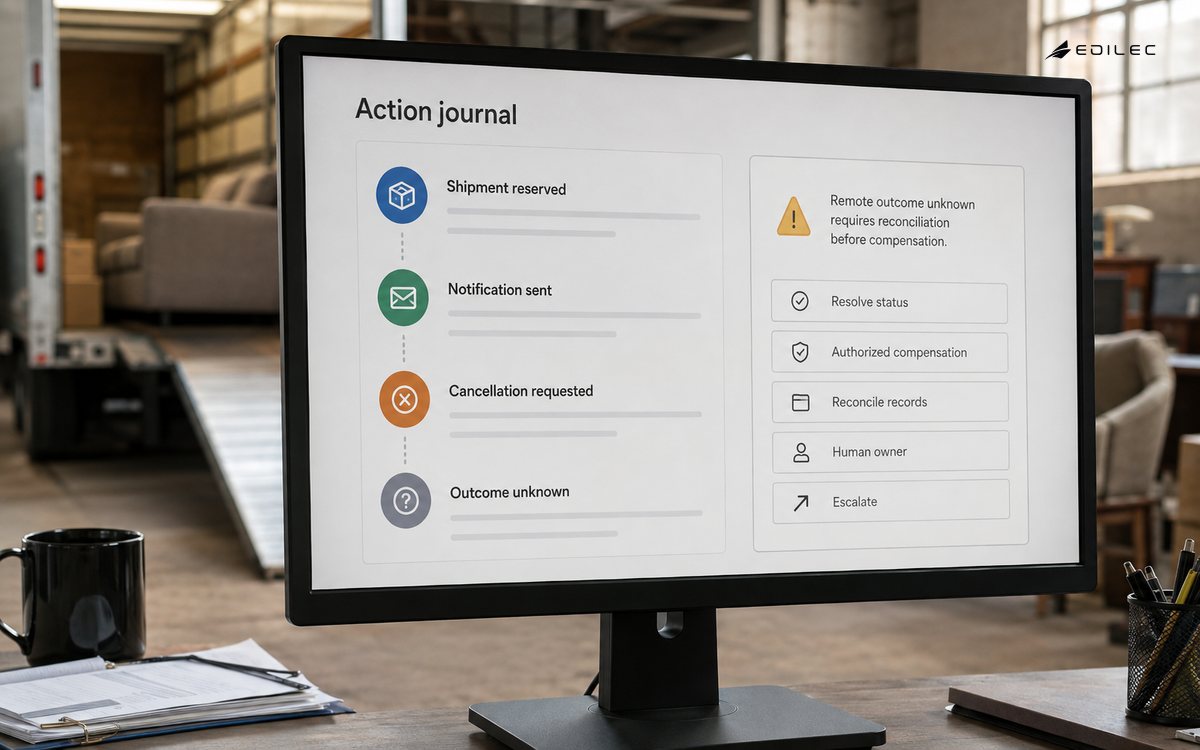
Create the saga before the first side effect. Store workflow type and version, business key, initiator, risk tier, current state, deadlines and owner. Each action journal entry records step, agent or service, normalized arguments, target, idempotency key, precondition, attempt, result, remote identifier, committed time and eligible compensation. Append new status events instead of rewriting history. The journal is the source for recovery after process restart, not reconstructed model memory.
The OpenAI Agents SDK results guide exposes final output, new items and serializable run state for interruption and continuation. Store agent state as supporting execution context, while the saga journal remains authoritative for business effects. A resumed model should receive a concise, provenance-linked view of committed steps and remaining options. It should never infer commitment from a natural-language transcript such as 'reservation probably completed.'
Define forward and compensation contracts together
| Field | Forward action | Compensation requirement | Why it matters |
|---|---|---|---|
| Business key | Stable operation identity | References same business effect | Prevents compensating the wrong action |
| Precondition | Expected target version or state | Allowed states for inverse | Detects intervening changes |
| Idempotency | Same key returns same effect | Separate stable compensation key | Supports safe retries |
| Result reference | Authoritative remote ID | Required input to compensation | Avoids search by generated text |
| Deadline | Forward validity | Latest useful compensation time | Triggers escalation before expiry |
| Evidence | Request, authority and result | Outcome and residual effects | Supports reconciliation and audit |
| Owner | Service accountable for completion | Team accountable for failed inverse | Prevents orphaned recovery |
The MCP tools specification defines tool schemas and invocation semantics at the protocol boundary. A compensatable tool needs application-level metadata beyond its input schema: idempotency support, commitment signal, status lookup, inverse operation, timing and side effects. Keep that metadata in a reviewed capability catalog. A model-visible tool description may explain when to propose cancellation, but the orchestrator validates whether cancellation is authorized and still valid.
Choose compensation order from dependencies
Reverse order is a useful default, not a universal law. Compensate according to business dependencies. If a shipment depends on an order and a payment, stop shipment before canceling the order; refund timing may follow financial rules. Build a dependency graph and identify compensations that can run in parallel safely. Do not continue compensating after an inverse failure without policy. The failed compensation may change which later actions remain safe.
Use an orchestrated saga for consequential workflows because one durable component can apply ordering, deadlines and policy. Choreography through events can reduce coupling but makes global state and ownership harder to see; if used, maintain a saga projection and explicit terminal-state rules. The multi-agent services implementation checklist covers roles and protocol controls. Compensation adds the shared recovery contract across those roles.
The A2A specification represents agent work through tasks, messages, artifacts and lifecycle states. When a saga crosses an A2A boundary, map the remote task identifier and state into the local journal without treating protocol completion as proof of business commitment. Preserve the remote agent identity, artifact references and cancellation result, then reconcile the external effect under local business invariants.
Resolve ambiguity before retrying or compensating
Network failure after a request leaves three possibilities: not received, received but not committed, or committed with response lost. Query status by idempotency key or business key. If the provider cannot answer reliably, mark the step unknown and route according to impact. Repeating a non-idempotent forward action can duplicate harm; issuing an inverse against a nonexistent action can also create error. Timeouts should never map directly to 'failed' in the journal without a commitment model.
Set retry budgets and backoff outside the model. Record every attempt under one logical action. Circuit breakers can stop repeated dependency failure, but they do not resolve existing unknowns. Reconciliation workers should revisit ambiguous entries and compare local journal with remote systems. If facts remain unavailable past a deadline, create a human task with the exact unknown, attempted checks, financial or customer exposure and safe available actions.
Design human-owned recovery for residual effects
A recovery screen should show forward actions that committed, compensations attempted, current authoritative state, unresolved differences, deadlines, affected parties and permitted commands. Reviewers may retry, choose an alternative compensation, accept a residual state or escalate. They should not edit hidden journal records. Any manual action receives its own identity, authority and evidence. Notify customers or operators based on the business incident, not generic agent error text.
The AI agent control plan provides permissions, approval and audit foundations. Apply them to compensation as strongly as forward action. A refund or access revocation is still consequential even when labeled recovery. Separation of duties may require a different reviewer from the original approval. Emergency recovery authority should expire and be reviewed after use.
Reconcile to prove closure
A successful compensation API response does not prove an acceptable final state. Re-read authoritative systems and evaluate invariants. Confirm balances, inventory, access, notifications and external references as applicable. Mark the saga compensated only when reconciliation passes or an authorized owner accepts documented residual effects. Keep original and compensation records linked; do not delete the forward event to make dashboards look clean.
Track sagas by terminal state, age, unknown actions, compensation success, manual intervention, residual loss and repeat cause. Alert on deadlines and orphaned ownership. Trace forward and inverse calls, but use the journal for durable reconciliation. The tool-calling practical guide explains bounded actions; here, the key measure is not tool-call success but whether the workflow returns to an approved business state.
Test failure at every transition
Inject failure before request, after remote commit, during response, between journal writes, during compensation and during reconciliation. Restart orchestrators at each point. Test duplicate events, out-of-order messages, expired reservations, changed target state and unavailable status APIs. Assert final invariants, journal completeness and idempotency. Use sandbox providers and deterministic fault controls; do not rehearse compensation by creating uncontrolled real effects.
The NIST Secure Software Development Framework emphasizes secure practices throughout development. Include saga definitions, capability metadata, journal migrations and recovery interfaces in threat modeling, review and release evidence. A schema migration that loses an idempotency key can be as damaging as a model regression. Version workflows so in-flight sagas continue under known compensation rules while new runs adopt the release.
Key takeaways
- Define compensated and escalated business outcomes rather than promising perfect rollback.
- Classify each step as read-only, tentative, idempotent, compensatable, irreversible or human commitment.
- Create a durable saga journal before side effects and keep it authoritative over conversation memory.
- Specify forward and inverse actions together with idempotency, deadlines, evidence and ownership.
- Resolve unknown commitment before retrying or compensating.
- Reconcile authoritative state and require an owner to accept any residual effect before closure.
Frequently asked questions
Is compensation the same as rollback? No. Rollback suggests restoring prior state atomically. Compensation is a later business action that may leave visible or financial residual effects.
Can an agent decide compensation order? It may propose a plan, but a versioned dependency and policy model should determine allowed order for consequential workflows.
What if an external tool has no status or idempotency support? Treat it as higher risk, serialize calls where possible, require stronger human control and design reconciliation around its authoritative records.
Conclusion
Agent workflow compensation turns partial failure into a designed operating state. Define acceptable outcomes, classify effects, journal commitments, pair forward and inverse contracts, order recovery by dependency and resolve ambiguous results before acting again. Give people a clear residual-risk queue and reconcile against authoritative systems. Multi-agent workflows then gain a recovery model grounded in business state and deterministic controls, rather than hoping another model call can narrate the world back to how it was.