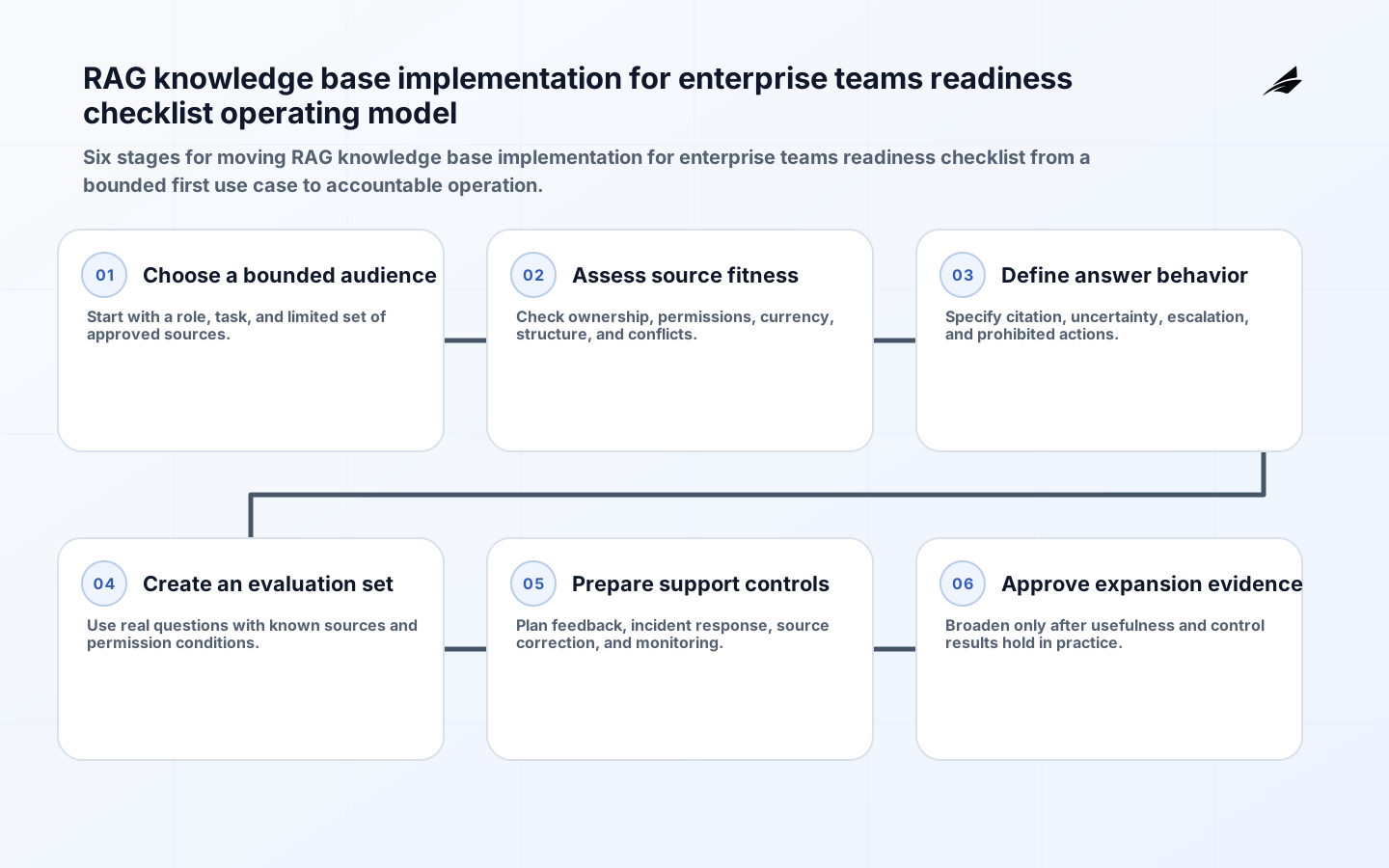
RAG Knowledge Base Implementation for Enterprise Teams Readiness Checklist is useful when a team needs to turn a broad ambition into a small, governed use case with evidence that users can trust and challenge. The real work is not selecting a fashionable product category; it is deciding what a enterprise RAG knowledge base may do, what evidence it must retain, and who can correct it when conditions change. This readiness checklist addresses an enterprise team preparing to make internal knowledge discoverable through retrieval and generated answers. It treats RAG knowledge base implementation for enterprise teams readiness checklist as an operating capability with an owner, a bounded first use case, and a visible recovery path. That framing protects the team from a common failure: launching a polished demonstration that cannot explain a surprising outcome or support a colleague under pressure.
Define the outcome before selecting tooling
Begin with one decision or task that a real person already performs. Describe the starting signal, the information that is allowed to influence the result, the accountable role, the action or response, and the evidence that proves completion. For RAG knowledge base implementation for enterprise teams readiness checklist, this gives every technical choice a business test: does it make a small, governed use case with evidence that users can trust and challenge more reliable, faster, or easier to review? The NIST AI Risk Management Framework is a useful discipline here because it frames risk management as an ongoing activity, not a one-time compliance review. Write down unacceptable outcomes as clearly as desired outcomes, including an incorrect result, an unavailable service, an unauthorized disclosure, and an unresolvable dispute.

| Question | Working answer | Evidence to request |
|---|---|---|
| What is in scope? | One enterprise RAG knowledge base path with a named user, decision, and owner. | A current journey map and a plain-language success condition. |
| What may change? | Only the records, routes, or release decision explicitly approved for the first use case. | A boundary statement and a list of excluded actions. |
| Who can intervene? | A business owner, a technical owner, and a support route with escalation authority. | Named roles, response expectations, and access review. |
| How is value judged? | By the quality and timeliness of the resulting work, not by activity volume. | A baseline and a scheduled review of outcome measures. |
Map the operating model and its boundaries
A sound design starts with the information lifecycle. Identify the source of each important field, the person or system allowed to change it, the rule for freshness, and the conditions under which it should not be used. Keep the presentation layer separate from the authoritative record; otherwise a convenient display can quietly become a decision source. For source quality, permissions, evaluation, and service readiness, this distinction is practical. It lets a reviewer trace a result back to a record, an event, or a test run instead of relying on a summary that may already be stale. It also surfaces the unglamorous requirements that determine whether a pilot can become a service: identity, permissions, environment ownership, retention, and incident handling.
RAG readiness depends on the state of the knowledge estate, not merely on a model connection. Sample proposed source collections for named ownership, current revision dates, structure, access labels, duplicate material, and an agreed retirement path. Select real questions from the intended users and verify that a reviewer can identify the source passages that should support a responsible answer. The NIST Secure Software Development Framework is pertinent because the ingestion, indexing, and access layers also need defined verification and response procedures. If the source owner cannot correct a misleading document or confirm its intended audience, it should not be treated as a dependable foundation for the pilot.
Design controls that help people make decisions
For an enterprise RAG readiness review, controls should be observable before users depend on the service. Enforce source-level permissions during retrieval, preserve the document identity and revision used for an answer, and require the interface to show when no approved evidence was found. Keep ingestion credentials separate from reader access, and test revocation with a real protected source rather than a mock label. A readiness owner should be able to answer three questions from a support case: what material was eligible, what was retrieved, and why was the response shown to this role. Those records make it possible to correct an access or freshness failure without treating every disappointing answer as a model problem.
| Risk or failure | Control to include | Signal to review |
|---|---|---|
| Input is incomplete, stale, or contradictory | Validate essential fields, preserve source time, and send unresolved cases to an exception queue. | Exception reason, age, and resolution outcome. |
| A permission or policy changes | Evaluate access at the action boundary and version the governing rule. | Denied action, policy version, and override history. |
| A dependency becomes unreliable | Use timeouts, bounded retries, and a manual continuation path. | Failure rate, retry age, and user impact. |
| A result is challenged | Keep a traceable record of inputs, result, reviewer action, and correction. | Challenge volume, reversal cause, and recurrence. |
Pilot a real path and rehearse the difficult cases
Choose a pilot that is narrow enough to understand end to end but meaningful enough that a user will notice the difference. The first release should exercise the same identities, data handling, integrations, and approval or release practices expected in production. Avoid treating a sandbox success as proof of service readiness. Before widening access, run deliberate scenarios: a bad input, a changed rule, a revoked account, a delayed dependency, and a disagreement about the result. Capture the evidence a support colleague would actually need. In RAG knowledge base implementation for enterprise teams readiness checklist, the rehearsal is where the team discovers whether the operating model can survive an ordinary inconvenient Tuesday.
- State the pilot population, enterprise RAG knowledge base boundary, and exit criteria in language a business owner can challenge.
- Run an expected path, a rejected path, a delayed dependency path, and a recovery path with the production-like controls enabled.
- Give every finding an owner, a due date, and a decision: correct now, accept temporarily, or exclude from the first release.
- Use the related planning guide and the companion checklist to keep planning, readiness, and delivery decisions aligned.
Measure the result, not just the system
Treat the readiness checklist as evidence for a controlled launch. Measure evaluation-set coverage, retrieval of approved source passages, correct permission behavior, citation completeness, escalation of uncertain questions, and the time from feedback to a source or configuration correction. Review results by user role and source collection; a service can appear useful overall while exposing one group to stale or inaccessible material. The NIST AI RMF Playbook offers a practical cycle for this work. Expansion should require that the pilot has a maintained evaluation set, a source-change workflow, and a support owner who can investigate a disputed answer without guessing.
Key takeaways
- RAG knowledge base implementation for enterprise teams readiness checklist earns trust through a bounded decision and named ownership, not through a broad technology promise.
- Make source quality, permissions, evaluation, and service readiness visible in the working flow so people can intervene before a small defect becomes a business problem.
- Use rehearsal evidence to decide whether to expand; counts of completed tasks or test runs are not enough by themselves.
- Connect this work with a connected implementation article so the broader operating model remains consistent.
Frequently asked questions
- What should a first enterprise RAG knowledge base release include? Include one valuable path, explicit boundaries, a named owner, reliable evidence, and a recovery route. Broader scope can wait until this path has survived change and exception handling.
- How should a team estimate effort? Estimate discovery, access and data preparation, design, build, verification, rehearsal, documentation, and handover separately. The unknowns are usually in dependencies and operating ownership, not in the first screen or rule.
- When is human review required? Use it where consequence, uncertainty, policy sensitivity, or incomplete evidence makes an unattended result unsafe. Define who reviews, what they see, and what they may override.
- Can automation or retrieval replace accountability? No. It can organize evidence and accelerate a bounded task, but an accountable business role still owns policy, exceptions, and the decision to expand or stop the service.
Conclusion
The practical question behind rag knowledge base implementation for enterprise teams readiness checklist is whether the team can operate the capability with clarity when the usual path fails. Start with a decision that matters, protect its boundaries, make evidence inspectable, and rehearse recovery with the people who will support it. That creates a credible base for improvement instead of an expensive promise. For implementation detail, Playwright assertions documentation is a helpful reference when automated user-interface evidence is part of the delivery, while the related planning guide provides a useful next step for the surrounding operating plan.